
At the end of each section you'll find options for examining the topics in more depth, by using links for my LONGER FAQ (containing some ideas omitted in this FAQ) and LINK-PAGES (that summarize ideas, compare views, and link to pages by other authors), and Other Pages I've written.
In this page, italicized links go to another part of the page; non-italicized links take you to another page.
disclaimer: This FAQ is written by Craig Rusbult, who is editor for one website (about Whole-Person Education) within ASA's overall website, but it expresses his own views, not the views of ASA. It's written for ASA, but not by ASA, so it isn't the ASA-FAQ. Hopefully, in the future there will be links to FAQ-summaries written by other members of ASA, as explained in the FAQ Homepage.
1A. Christian views of creation — who, when, and how?
I think three main views of creation, plus variations, are compatible with Bible-based Christianity:
In young-earth creation, everything was miraculously created in 144 hours, about 6,000 years ago. Later, most of the earth's geology & fossils were formed in a global flood.
In old-earth progressive creation, during a long history of nature (billions of years) God created using natural process plus miracles, with independent creations of new species and/or creations by modification of existing genetic material.
In old-earth evolutionary creation (aka theistic evolution), God designed the universe so everything in nature would evolve by natural process that could be guided by God.
What about the origin of life? With young-earth creation every species (from bacteria to dogs and humans) was instantly created. Most progressive creationists think God miraculously created the first one-celled living organism. But many evolutionary creationists — or all, if they are defined as above, claiming "everything... evolved by natural process" — think the first life was formed by natural process.
When we ask "who?" all views agree that God created everything. Theologically, all three views are equally creationist, even though many people think creationism refers to only young-earth views, due to an unfortunate abuse of the word by young-earth proponents & opponents. By contrast, these 3 monotheistic views are challenged by those (including polytheists, pantheists, deists, and atheists) who propose other views, and by agnostics who admit “I don't know” or claim “we cannot know.”
The when-and-how of these views, regarding the formative history of nature, are young-earth with God using miracles, old-earth with God using miracles (of various types) plus natural process, and old-earth with God using only natural process, without miracles.
1B. What are the relationships between science and worldviews?
As individuals and in groups, we have worldviews — views of the world, used for living in the world — that include our views of nature and science. We want all of our ideas to be consistent, and this leads to mutual influences between worldviews & science, and adjustments of ideas:
• Science is influenced by worldviews and related factors (personal desires, group pressures, cultural thinking habits, ideologies,...) that operate in a complex social context within individuals and in groups. { I think we should recognize these influences, and try to minimize their effects on the process and conclusions of science; we should challenge the extreme skepticism of postmodern relativists when they claim that these influences diminish the overall credibility of science and the reliability of scientific conclusions, as in young-earth criticisms of historical science; but we should carefully consider the potential influence of naturalistic assumptions. }
• When we think about “the way the world is, and why” — as when we ask, “is God actively involved in the world by guiding natural process and in other ways?” — our views are influenced by science, which is a cultural authority because we recognize its usefulness for understanding nature and developing technology.
When we study origins history,
An atheist or deist or rigid agnostic has no scientific freedom, since only one conclusion — a natural Total Evolution of Everything, without God — is acceptable.
A Judeo-Christian theist has a wide range of options that allow “following the evidence” to any conclusion about the when-and-how of creation. But theology, interacting with other factors, leads some theists to demand a particular conclusion about age or evolution.
1C. Understanding and Respect? or Distortion and Conflict?
When thinking about (and discussing) questions about origins, we should aim for an appropriate humility – not too little, and not too much – ... [[ iou – this sentence will be revised-and-completed soon, January 25-31, 2025. ]]
Why are so many so confident? Because eventually — due to adjustments among our ideas, along with some rationalizing — most of us become satisfied with the quality and consistency of our own ideas. Thus, vigorous advocates for every view of origins confidently believe they have The Answer, and (as Del Ratzsch says) "each side can see the case as so utterly closed that the very existence of opponents generates near bafflement." This widespread confidence, by advocates for all views, often indicates some "quantitative error" in situations where an appropriate humility would be more humility with less over-confidence.
In high school, our civics teacher often held debates in class about a wide range of controversial questions. Monday he convinced us that “his side” was correct, but Tuesday he made the other side look just as good. We soon learned that, to get accurate understanding, we should get the best information and arguments for all sides of an issue. After we did this and we understood more accurately, we recognized that people with other views may also have good reasons (intellectual and/or ethical) for their views, so we learned respectful attitudes.
But respect does not require agreement. We can respect someone and their views, yet criticize their views. Our teacher was not a postmodern relativist, and his goal was teaching us to rationally evaluate ideas.
In this educational website — which has been developed with the goal of promoting Accurate Understanding and Respectful Attitudes — you'll find coherent overviews (for a wide range of views) and links (so you can explore in more depth). Our goal is to help you rationally search for truth. We want to help you avoid unintentional distortions, because you'll accurately understand your opponents' views. And a respectful attitude — for other people and for our own intellectual honesty — should provide sufficient motivation so each of us will want to avoid building weak “strawmen” that are intentional distortions of opposing views.
But even with understanding and respect, the mere fact of disagreement can lead to conflict. This sometimes occurs, for example, in relationships between proponents of Evolutionary Creation and conventional Intelligent Design. The intensity of conflict (and associated emotion) is often increased by the importance of the issues being debated, as in applications for education, both religious and secular, formal and informal.
In most situations, respectful interactions (and rational evaluations) seem worthwhile, despite our disagreements. When we are motivated to do it, we can disagree with respect, in a way that is more enjoyable and is more likely to be productive. And sometimes a better outcome can be achieved through a willingness to look for common ground, to cooperate in a search for mutually beneficial win-win solutions.
confusion and clarity: When “evolution” is discussed, confusion is possible because evolution is a term with many meanings and different views may disagree when we ask “did this particular kind of evolution [with one specific meaning] occur during formative history?” Similarly, intelligent design is a term with many meanings, and different views may disagree when we ask “did this particular kind of intelligent design occur during formative history?” Unfortunately, confusion occurs when proponents of one view use one meaning for evolution {or intelligent design} but proponents of another view are using a different meaning for evolution {or intelligent design}, and the proponents don't define the meaning of evolution {or intelligent design} they are using. Therefore, to minimize confusions and misunderstandings, all proponents should always clearly define their definitions for each term they're using. When this is done there will be less confusion in the communication, and more clarity.
and... with: Why does the ending of my page-title — "...creation and/or evolution, with intelligent design" — include "and/or" plus "with", and underline the two words? It's because...
• I want you to think about the questions raised by and/or. Here are two facts: 1) all views agree that some evolution – when this term is defined in some ways – has occurred during formative history, and 2) all views agree that God created everything. Therefore, all views agree that evolution has occurred and God created everything, so each view can claim evolution and creation. / But sometimes the views (and their proponents) disagree when we ask “did this particular evolution occur during formative history?”
• I want you to think about the questions raised by with. Here is a fact: all views agree that intelligent design – when this word is defined in some ways – was involved in the creation by God. Therefore, all views can agree about "creation... with intelligent design." / But sometimes the views (and their proponents) disagree when we ask “was this particular kind of intelligent design involved in creation?”
1D. What are ASA's views about creation, evolution, and design?
Are we creationists? yes and no, because it depends on how creationism is defined.
YES. All members of the American Scientific Affiliation are Christians, so we all believe that God created everything, using natural process — which He designed, created, and sustains, and can guide — and/or miracles. How did God create? We agree about the essential doctrines of creation, but we "hold a diversity of views [about the details of creation] with varying degrees of intensity. (Jack Haas, former journal editor, and a website editor)"
NO. Most of us are not "creationists" if this means believing the earth is young, because — based on our studies of theology and science — most members of ASA think the earth & universe are billions of years old.
"As an organization, the ASA does not take a position when there is honest disagreement between Christians on an issue. We are committed to providing an open forum where controversies can be discussed without fear of unjust condemnation. Legitimate differences of opinion among Christians who have studied both the Bible and science are freely expressed within the Affiliation in a context of Christian love and concern for truth." (preface to ASA's Statement of Faith)
ASA does not advocate a conclusion about the "when and how" of creation, but we endorse a process of respectful discussion, so we can learn from each other, so we can better understand the similarities & differences in our views of theology and science. Since 1949, ASA — in its journal, websites, conferences, and in other ways — has provided an open forum for a variety of views about origins. As explained in a disclaimer for my website, "you'll find links to resource-pages expressing a wide range of views, which don't necessarily represent the views of the American Scientific Affiliation."
Our journal and websites are educational resources, not declarations of policy. We in ASA won't tell you what to conclude, but we will provide information that can help you make a knowledge-informed evaluation and intelligently reach your own conclusions.
2A. Are science and religion in conflict?
A common view of the relationship between science and Christian religion — inherent antagonism and warfare, in a conflict between the rationality of science (searching for truth) opposed by the ignorance of religion (trying to block progress) — is entertaining and dramatic, with heroes and villains clearly defined. It is useful for anti-Christian rhetoric, and has exerted a powerful influence on popular views about science and religion. But it's oversimplistic and inaccurate, and is rejected by modern historians. For example, David Lindberg & Ron Numbers see "a complex and diverse interaction that defies reduction to simple ‘conflict’ or ‘harmony’... and varied with time, place, and person." {examples: Stories of Science include Flat Earth & Galileo}
Here are five reasons to see conflict:
wanting to believe in “science-versus-religion conflict” for the purpose of rationalizing a personal rejection of Christian faith;
a failure to distinguish between scientism (by extending science into areas where it isn't logically justifiable) and science;
a perception that “natural” means “without God” – even though this is wrong in a Judeo-Christian worldview;
an assumption that biblical miracles and the methods of science cannot coexist – even though reliable science doesn't require always natural, just usually natural;
a belief that conclusions in science cannot be reconciled with statements in the Bible – even though this belief is due to overly rigid interpretations of the Bible, as discussed in 2B.
2B. Can we compare scripture (as in The Bible) with science?
No. In the diagram below — showing relationships between objects (SCRIPTURE & NATURE) and their interpretations (in theology & science) — only one comparison is logically possible. Every other comparison is logically impossible, and should not be attempted. We cannot compare scripture with science, but... we can compare our interpretations of scripture (in theology) with our interpretations of nature (in science). We cannot compare the “uninterpreted realities” of scripture (inspired by God) and nature (created by God). When we compare theology with science,* we should humbly recognize that both are based on human interpretations. But "no", we cannot directly compare scripture with science. {* A very important application of this logical humility is when we evaluate a young-earth claim that “if the Bible is true [AND if a young-earth interpretation of scripture is correct], then the earth is young.” }
Our science and theology are based
mainly (but not totally) on interpretations of nature and scripture, respectively; this is shown in the diagram, which is borrowed (with minor modifications) from Deborah Haarsma. 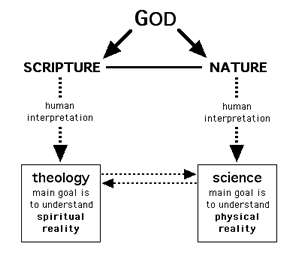 In
science the main goal is to understand physical reality. In theology the main goal is to understand spiritual reality. But the main goals
aren't the only goals, or the only results, and our theories about spiritual & physical realities
are mutually interactive; theology can affect science and our views of physical
reality, while science can affect theology and our views of spiritual reality. { Some
influences — in scientism and natural theology, in scientific & theological
views of nature, natural process, and miracles — are examined in the
full-length FAQ. } { note: It can be useful to view science as a process-of-interpreting and also a result-of-interpreting, with the process and result having a cause-effect relationship, with the human process producing the human result. }
In
science the main goal is to understand physical reality. In theology the main goal is to understand spiritual reality. But the main goals
aren't the only goals, or the only results, and our theories about spiritual & physical realities
are mutually interactive; theology can affect science and our views of physical
reality, while science can affect theology and our views of spiritual reality. { Some
influences — in scientism and natural theology, in scientific & theological
views of nature, natural process, and miracles — are examined in the
full-length FAQ. } { note: It can be useful to view science as a process-of-interpreting and also a result-of-interpreting, with the process and result having a cause-effect relationship, with the human process producing the human result. }
In 1500, science and theology were in harmony, but were incorrect, when both agreed that planets orbited a stationary earth. Later, for awhile, as in the time of Galileo, some interpretations of nature (in their 1600s-science) were in conflict with some interpretations of scripture (in their 1600s-theology). In 1700, science and theology were again in harmony, but now both interpretations were correct, they were true because they corresponded to the realities in nature and scripture.
Can we learn a lesson from history? In the 1600s, erroneous interpretations of the Bible were used to support earth-centered science that was wrong. Currently, I think erroneous interpretations of the Bible are being used to support young-earth science that is wrong.
In 1700 we did not compare the Bible (which says "the sun rises") with science (which claims “the earth rotates”) and decide science was more important. In fact, this comparison is impossible because the Bible and science cannot be logically compared. Instead, we compared different interpretations (of the Bible, and of nature) and wisely used all available information in our search for truth.
When we ask, “Is this Bible passage intended to teach us specific facts about nature?”, information from nature can be useful. This principle of theological interpretation was recommended by the International Council on Biblical Inerrancy (1982) when they affirmed that "in some cases extrabiblical data have value for clarifying what Scripture teaches, and for prompting correction of faulty interpretations." A prominent young-earth creationist, Ken Ham, adopts this principle when he uses evidence from nature (logically interpreted in science) as a motivation to reconsider his interpretation of scripture, so he can rationally conclude (in agreement with modern science) that the earth rotates and orbits.
2C. How can we wisely combine information from scripture and nature?
God has graciously provided us with two valuable sources of information. Of course, for the most important things in life — for learning about God and how He wants us to live & love — the Bible is more important. But for other questions we don't have to make an either-or choice, and by using both sources of information our understanding of total reality (spiritual plus physical) can be more complete and accurate.
We see a good way to think in Psalm 19, where an appreciation of God's dual revelations in nature ("the heavens declare the glory of God") and scripture ("the law of the Lord is perfect, reviving the soul,... rejoicing the heart") inspires a personal dedication: "let the words of my mouth and the meditation of my heart be acceptable in your sight, O Lord, my rock and my redeemer."
The full-length page summarizes useful principles for comparing different views in science (with each view formed by evaluating nature-evidence, using logic) and theology (formed by evaluating scripture-evidence, using logic), and explains why "credentials & character" are not useful for distinguishing between two views when "proponents of both views include intelligent scholars with scientific expertise who are devout Christians with high moral character, who sincerely want to find the truth."
The next two sets of FAQ-sections, 3A-3D and 4A-4C, look at what we can learn from theology and science when we ask “How old is the earth?”
While you're reading 3A-3D (about age-theology) and 4A-4C (about age-science), I urge you to please think carefully about this undeniable fact of logic: When a young-earth believer claims that “IF the Bible is true, the earth is young” they are claiming “IF the earth is not young, the Bible is not true.” Do you see the danger?
3A. Genesis 1 – Can an old-earth interpretation be satisfactory?
We want to avoid comparisons that are logically impossible, so we should ask an important question: “Can we compare Scripture (in The Bible) with science?” No. Section 2B describes two objects (SCRIPTURE & NATURE) that can be interpreted (in theology & science). And 2B explains why we can compare theology (our interpretations of SCRIPTURE) with science (our interpretations
of NATURE), but we cannot directly compare the “uninterpreted realities” of the raw objects, of SCRIPTURE and NATURE. We can compare theology with science (while humbly recognizing
that both are based on human interpretations) but we cannot directly
compare
SCRIPTURE (an object being interpreted) with science (a result of interpreting NATURE).
Let's compare some theological interpretations of the scripture in Genesis 1.
In a young-earth 144-hour interpretation, each "yom" is a 24-hour day.
In an old-earth day-age view, "yom" has one of its other meanings: a period of time with unspecified length. Or maybe old-earth creation occurred in six nonconsecutive days with long periods between the days; or in six days of proclamation, God described what would occur during creation. An old-earth gap view proposes an initial creation (in Genesis 1:1), catastrophe (in 1:2), and re-creation on the earth (beginning in 1:3).
In a framework view, the six days describe actual historical events, arranged topically instead of chronologically. The logical framework is based on two problems in Genesis 1:2, with the earth being "formless and empty." The two solutions are to produce form (by separations in Days 1-3) and fill these forms (in Days 4-6) to connect related aspects of creation history in Days 1-and-4, 2-and-5, 3-and-6. { If you study the text and think about it carefully, you'll see the logical patterns. When you compare two frameworks — the one you discover, and my verbal-and-visual summary (below in the gray box) — maybe you'll agree with me that this is the best interpretation. }
Or maybe the only purpose of Genesis 1 was teaching theology to its original readers, using current theories about physical reality (the ancient near-east cosmology) to more effectively challenge spiritual reality (in the polytheistic “nature religions” of surrounding cultures).
All interpretations should emphasize the essential creation-theology in Genesis 1: everything was created by God, and is subordinate to God; nature is not divine, and there are no polytheistic “nature gods” so we should worship only the one true God. Humans are special because God created us in His image, and our problem is not being physical (since God said his physical creation was "very good" for achieving His purposes), our problem is sin.
the framework of Genesis 1: Do the six days in Genesis form a logical framework? Yes. Genesis 1:2 describes the earth as "formless and empty," so there are two problems. God's two problem-solutions for the initial problems – "formless and empty" – are to produce form, and fill. The first 3 days produce form (by separations, in time or space, that produce day and night, sky and sea, land with plants), and the second 3 days fill these forms (with sun for day and moon for night, birds (sky animals) for sky and fish (sea animals) for sea, and land animals that eat plants):
The "form and fill" structure describes two related aspects of creation in Days 1 and 4 (for light), 2 and 5 (for sea and sky), 3 and 6 (for land). Together, the patterns we see in vertical columns (producing form in 1-2-3, filling in 4-5-6) and horizontal rows (with a matching of the forms & their fillings, in 1-and-4, 2-and-5, 3-and-6) show a beautifully logical framework for the history of creation. I think this logical framework is clearly intended in the text, and this framework interpretation – that is neutral regarding age of the earth – correctly defines the intended meaning of the six days. Clearly the days are logical, but are they also chronological? This is a possibility, because if we look at only the biblical text, the days could be either logical-and-chronological, or logical-and-nonchronological. But if the days are nonchronological (and are not 24-hour solar days), there is a MUCH better match between the information that God has provided for us in the Bible and in nature. Also, we don't have to propose the textually-unsupported speculations that (with a 144-Hour Creation) are needed to “explain away” the previous existence of light/day & darkness/night (in Days 1-2-3) before the sun exists (in Day 4). {why do young-earth creationists think our earth is round, and it rotates & orbits?} |
The two main arguments for young-earth theology are the claims (above) that Genesis 1 teaches a 144-hour creation, and (below) that “animal death before human sin” is theologically unacceptable. Sections 3A and 3B explain why these claims are not biblically warranted.
3B. Does the gospel (and salvation) require “no death before sin”?
John Morris said, "In this [old-earth] view, death is not the penalty for sin, for it preceded man and his sin. ... If the earth is old, if fossils date from before man's sin, then Christianity is wrong! These ideas destroy the foundation for the Gospel and negate the work of Christ on the cross. (source)" Ken Ham agrees that "as soon as Christians allow for death, suffering, and disease before sin,... the whole message of the Gospel falls apart. ... If there were death, disease, and suffering before Adam rebelled – then what did sin do to the world? (source)"
These claims appeal to our emotions — because we want a world where only good things happen, with no suffering or death — and offer a simple answer for a difficult theological question: if God is all-good and all-powerful, then why does God let bad things happen? When you first see it, a young-earth theology of “no animal death before human sin” may seem strong, but this claim becomes much weaker when it's examined more carefully. Morris and Ham ask a question — if the earth is old and "death is not the penalty for sin, for it preceded man and his sin... then what did sin do to the world?" — that is clearly answered in Genesis 3:22 when God establishes a death penalty for humans; because Adam has sinned, "he must not be allowed... to live forever" so God prevents this by temporarily removing "the tree of life" that would have sustained Adam (and Eve, and us) with eternal life.
A Brief History of Sin and Salvation
The Bible says very little about animal death. Instead the focus is on our problem (human sin leading to human death) and God's solution for converting sin & death into salvation & life. This divine plan is graciously wonderful, and it works whether the earth is young or old. my best p
God offered the gift of total life (with full relationship, high quality, and immortality) to Adam, but he rejected God's gift by his sinful disobedience when he chose to make moral decisions independent from God (eating from "the tree of the knowledge of good and evil") instead of trusting-and-obeying God. This fall into sin broke Adam's part of a conditional if-then covenant with God, and in Genesis 3:7-24 we see spiritual death (the intrinsic penalty in 3:7-13) plus physical death (a judicial penalty in 3:22,24). The three results of sin were a decrease in relationship with God, decrease in quality of life, and loss of everlasting life: "The man has now become like one of us, knowing good and evil. He must not be allowed to reach out his hand and take also from the tree of life and eat, and live forever." When the full supernatural protection provided by God (symbolized by the "tree of life") was removed by God, Adam and Eve began to perish, with natural processes temporarily allowing life while gradually (during the "yom" of Genesis 2:17 that, as in Genesis 1, can indicate an indefinite period of time instead of a 24-hour day) leading to their death.
Humans had sinned, and thus earned death. We needed a savior, and God is merciful, so His gift of life (with relationship, quality, and immortality) was won back for us by our Savior. How? God did this with a pair of death-related events that are the focus of biblical history: God (as the humanly fragile death-receiving Jesus) first pays the sinner's penalty of death with His crucifixion, and then God (as the victorious death-defeating Jesus) rises to life in His resurrection, showing us that He has conquered death. Jesus Christ accepted the penalty of death that each of us earns (by our sinful disobedience) and He (by living as a vulnerable human, yet living in sinless obedience to the Father) earned the right to make His own Eternal Life available, as a gift of grace, to all humans who will believe Him and accept His gift: "The wages of sin is death, but the gift of God is eternal life in Christ Jesus our Lord. (Romans 6:23)" The gift of full life – both spiritual and physical – that in Genesis was temporarily taken from us (because of our sin, thereby losing God's preventing-of-death with His "tree of life") will be permanently given back to us (because of Jesus) in Revelation. (Rev 2:7 & 22:1-2,14) Eventually there will be no sin & no death, and God's goals for us will be permanently actualized. Amen.
3C. Is young-earth belief necessary for a Christian?
Some Christians claim that belief in young-earth creation is necessary for correct Christian doctrine. {even though for salvation it isn't necessary}
How can we decide if a theological doctrine is essential? We can look at its certainty and importance by asking, “Is it taught with certainty (i.e. beyond a reasonable doubt) in the Bible, and is it theologically important?” I think we should say “no and no” for age of the earth, but “yes and yes” for some other claims. {also: for some claims it's “no and yes” or “yes and no”}
For example, consider the claim that after Jesus died he was brought back to life.
Yes, this is taught with certainty (i.e. beyond any reasonable doubt) as in the first Christian sermon by Peter in Acts 2:14-36.
Yes, this is important for Christian theology. Paul says, in 1 Corinthians 15:14, that "if Christ has not been raised, our preaching is useless and so is your faith."
This claim is certain and important, so it is an essential doctrine, a core-belief of Christianity.
Is a young earth essential?
Is it certain? After carefully studying Genesis 1 and the whole Bible, most evangelical Christian scholars have decided that an old-earth view is justifiable, maybe preferable, or that neither view is clearly taught, so believing the Bible is true does not require believing a young earth, and humility is appropriate. For example, in 1982 the International Council on Biblical Inerrancy decided (by agreement of all members except Henry Morris) to not include 144-hour creation as an essential part of a belief in Bible-inerrancy.
Is it important? Section 3B examines a central young-earth claim — that if the earth is old, with animal death before human sin, this will "negate the work of Christ on the cross" — and explains God's plan for salvation that works whether the earth is young or old. Other essential Christian doctrines are also age-independent, so the full gospel of Jesus — including His deity, virgin birth, teaching & miracles, sinless obedience to the Father in life, substitutionary atonement in death, victorious resurrection, ascension into heaven, and second coming — is fully compatible with a young earth or old earth.
Let's look at three young-earth claims by Ken Ham:
• He thinks it is wrong to "start outside the Bible to (re)interpret the Words of Scripture." But he does "start outside the Bible" when he rejects a claim that the Bible teaches a flat earth or a stationary earth. He accepts evidence from nature (logically interpreted in science) and uses this as a motivation to reconsider scripture, and when he looks carefully he finds valid reasons to accept a moving-earth interpretation of scripture. In a similar way, many Christians find valid reasons to accept an old-earth interpretation of scripture.
• He criticizes "man's fallible dating methods" and asks, "Can fallible, sinful man be in authority over the Word of God?" Is Ham claiming that an old-earth interpretation of nature is hindered by sin, but his young-earth interpretation of scripture is not hindered by sin, so his interpretation of the Bible (not just the Bible itself) is infallible? And his claim about "authority" ignores the fact that we cannot compare the Bible with science, we can only compare interpretations of the Bible (in theology) with interpretations of nature (in science) while trying to search for truth.
• He thinks rejecting a young earth will lead to rejecting essential doctrines, "even to Christ's Resurrection," in a "slippery slope to unbelief." But do all claims that “the Bible teaches this” have equal support? No. We can rationally decide that a 144-hour creation is not true, but The Resurrection is true and is an essential doctrine because (compared with a young earth) it is much more certainly taught and is much more important.
These three claims (•••) also are made by geocentrists in the Association for Biblical Astronomy who think the earth is stationary and the sun (along with everything else in the universe) revolves around the earth. Why do they believe this is true? Because they "assume that whenever the two [Bible and conventional astronomy] are at variance, it is always astronomy – that is, our 'reading' of the ‘Book of Nature,’ not our reading of the Holy Bible – that is wrong." Does this sound familiar? This flat-earth claim is very similar to the claim made by Ken Ham.
So why does Ham think that he, as a fallible sinful man, can avoid a "slippery slope" by rationally deciding to interpret the Bible in a non-literal way for a moving earth but not a young earth? Why does Ken Ham reject geocentrism, and propose instead that the earth moves and rotates?
Actually, I'm confident that Ken can avoid a slippery slope slide. And so can other intelligent people. Consider a physiological analogy: there is no distinct dividing line between bath water that is “cold” and “hot” because temperature varies continuously, so this is a "slippery slope" situation; but we can make a rational decision that a bathtub full of ice water is too cold for a bath, and boiling water is too hot. Similarly, instead of abusing "slippery slope" logic, Christians can rationally decide that The Resurrection is essential (because it is very certainly taught, and is very important) but a young earth is not essential.
3D. Is it wise to link The Gospel with a young earth?
Most evangelical Bible-believing scholars think a young earth is not an essential doctrine. And almost all scientists think a young earth is almost certainly false, based on their logical evaluations of evidence from nature.
Despite these reasons for caution, John Morris boldly declares that "if the earth is old... then Christianity is wrong!" and Ken Ham agrees that "the whole message of the Gospel falls apart." Is this wise? What are some results of young-earth claims?
They are claiming that “if the Bible is true, the earth is young”, which is logically equivalent to saying “if the earth is not young, the Bible is not true.” What happens when a person who thinks “the Bible requires a young earth” examines the scientific evidence and concludes “the earth is not young”? Another conclusion may be that “if the Bible is wrong about the earth's age, maybe it's also wrong about the rest,” so the Bible's authority is weakened, and faith can be weakened or abandoned.
This logical conclusion is a personal dilemma for many of our brothers and sisters in Christ. We should help them cope with their problem by helping them understand why a young-earth claim that “if true Bible, then young earth” is not theologically justifiable. And we should pray that they emerge from the experience with renewed faith in the Bible and faith in God. {my Open Letter for young-earth Christians}
A closely related problem is that non-Christians who are earnest seekers of spiritual truth — and who think a young earth and Jesus are a “package deal” that includes both or neither — may reject the whole package because, based on their knowledge of science, they are extremely confident that the earth is not young. If we want to “draw a line and take a stand” on a “package deal” we should do this for a doctrine that is essential (like The Resurrection of Jesus) and has strong evidence showing us it's probably true, not for a doctrine that is non-essential (like A Young Earth) and has strong evidence showing us it's probably false.
Therefore, it seems wise for Christians to not encourage (and not accept) any implication — whether it comes from fellow Christians who want to strengthen the Gospel, or non-Christians who want to discredit the Gospel — that “if the earth is not young, the Bible is not true.”
Appropriate Humility
Proponents of a young earth should be admired for their desire to determine what The Word of God teaches, and believe it. But I wish they would humbly consider the possibility that their interpretation of the Bible is wrong,* and they would adopt a more loving attitude toward their brothers and sisters in Christ who have other views of when-and-how God created so they don't include young-earth belief as part of their Christian faith. {* This humility requires recognizing that they logically are claiming “if the Bible is true, AND if our interpretation of the Bible [in our young-earth theology] is correct, then the earth is young,” and admitting that their interpretation might not be correct. }
Instead, there is a “not in our church” attitude, as when John Morris says: "Old-earth thinking is incompatible with the work of Christ. ... [young-earth] creationism should be a requirement for Christian leadership! No church should sanction a pastor, Sunday school teacher, deacon, elder, or Bible-study leader who knowledgeably and purposefully errs on this crucial doctrine. (source)"
I agree with Morris that, for essential doctrines, we should not be “tolerant” as defined in postmodern relativism. We should say “this is what the Bible clearly teaches, and it is important.” But for nonessential doctrines, we should be more appropriately humble. It seems wise, for personal faith and interpersonal evangelism, to focus on doctrines that are most clearly taught and most important, and when all things are considered (including information from nature) seem most likely to be true.
Here are some traditional words of wisdom, useful in all areas of life: "In essentials, unity. In nonessentials, diversity. And in all things, charity." To follow this advice, we must wisely distinguish between what is essential and nonessential, and behave with charity, with respectful humility and a love that transcends our differences, so "everyone will recognize that we are His disciples, when they see the love we have for each other. (John 13:35, paraphrased)"
4A. Do we have evidence for an old earth-and-universe?
The explanations proposed in young-earth flood geology seem incorrect (because they don't match what we observe) for geology and for the spatial arrangement of fossils within this geology. By contrast, old-earth theories of modern geology — which propose a combination of slow-acting uniformitarian processes and fast-acting catastrophic events (such as volcanoes and floods) — produce explanations that do match observations.
Evidence from a wide range of fields — including the study of sedimentary rocks, coral reefs, the fossil record in geological context, biogeographical patterns in fossils, seafloor spreading and continental drift, magnetic reversals, genetic molecular clocks, radioactive dating, the development of stars, starlight from faraway galaxies, and more — indicates that the earth & universe are billions of years old. If the universe is young, all of these fields are wrong, and we must discard much of modern science. This isn't likely to happen, nor does it seem desirable.
The reasoning is not circular, because “a long time” is a necessary component of many theories that in most other ways (such as the domains-of-nature they explain, and the theory-components they include) are independent. This logical principle of multiple independent confirmations has convinced almost all scientists that the earth & universe are very old (billions of years), and that evidence from nature provides extremely strong logical support for this conclusion.
Proponents of young-earth views can respond in four ways. They can... A1) claim their own logical analysis of the evidence is better than the conventional analysis, so the logic of science should lead to young-universe conclusions; but this claim is not supported by the evidence-and-logic, as you can see in pages written by me {it's one of my best pages, is a personal favorite} and by other scientists; A2) acknowledge the weakness of current young-universe science, but claim it will improve in the future; B) challenge the credibility of historical sciences; C) claim the universe is young even though it looks old. The last two responses, B and C, are examined in the next two sections, 4B and 4C.
4B. Can historical science be “scientific” and reliable?
We cannot observe events in ancient history. But can we — by a logical analysis of historical evidence, in sciences like archaeology, geology, radiometric dating, and astronomy — reach reliable conclusions about what happened in the past?
Proponents of a young earth are skeptical. They ask “Were you there? Did you see it?”, and imply that “no” means “then you can't know much about it.” They are trying to “discredit the old-earth witness” that (as summarized above in 4A) is testifying against their views. So... is the witness discredited, or reliable?
Because theory-based deductions are usually called predictions, the non-scientific meaning of "prediction" (focusing on the "pre") can lead to the mistaken impression that in science a logical inference must be made before an event occurs. But in historical science the timing of prediction is not a cause for concern. Why not? Because when we examine the logical foundation of science – using hypothetico-deductive logic in Reality Checks – we find that this logic is essentially equivalent whether it's done with Predictions (i.e., theory-based deductions that are made before Observations are known) or with Retroductions (i.e., theory-based deductions that are made after Observations are known).
The logical methods are similar in two “modes of science,” in operation science (to study the current operation of nature, what is happening now) and historical science (to study the history of nature, what happened in the past). Usually, theories in historical science are based on — and thus are consistent with — theories in operations science.
The solid foundation of each mode is a logical evaluation of observable evidence. And in either mode, scientists can logically infer an unobservable cause that produces observable effects. For example, scientists propose electrons (in chemistry) & ideas (in psychology) because what we can observe is best explained by theories proposing the existence of electrons & ideas we cannot observe. Similarly, we can infer the reality of historical events if these unobserved events produced observable evidence that we do observe now.
The main difference between these modes is that historical sciences use data from uncontrolled field experiments, not controlled lab experiments. Sometimes the limitations of historical data provide a reason for caution about conclusions. But scientists have developed strategies to reduce the practical impact of data limitations. For example, repeated observations of many Cepheid-stars from many parts of the universe have shown that all Cepheids have similar properties, which — by using the mathematical relationship describing how observed brightness decreases as the distance (from Cepheid to observer) increases — lets us measure the distance to faraway Cepheids, and calculate that it takes billions of years for their light to reach us.
Extreme relativists — including postmodern skeptics who challenge all science, and young-earth creationists when they challenge historical science — claim that in science the evidence is inadequate, so conclusions are determined by nonscientific beliefs. But most scholars, including myself, think extreme relativists are exaggerating the logical difficulties, and high-quality science (whether it's operation science or historical science) provides a reliable way to learn about the fascinating world created by God.
4C. Did God create a young universe that looks old?
The evidence for an old universe is impressive, but can we believe what we see?
It takes billions of years for light to travel from distant stars to the earth. How can we see this light, if the universe is less than 10,000 years old?
Most proponents of a young universe claim that God created the universe with appearance of age as a mature creation that would be immediately functional, with mature humans (not helpless infants), balanced ecosystems, our energy-giving sun, and starlight created “in transit to us” instead of coming from a shining star. This beginning of history is analogous to a movie that begins in the middle of an action scene, without showing everything leading up to the action. The universe appears to be older than it actually is, so it has a false apparent age (AA).
Yes, if the earth is young, some AA would be essential for Adam and Eve in Eden. But some AA doesn't seem necessary, so we can ask: If (as declared in the Bible) God is honest, would He create a universe with detailed nonessential evidence for events that never occurred? For example, in 1987 scientists observed starlight from 170,000 light-years away, with characteristics changing in a way that corresponds to the sequence of events during a supernova explosion. Should scientists conclude that this supernova-event really did occur, or that it's part of an apparent history (created by God) about events that “would have happened in an old universe” but never really happened?
Young-universe creationists can propose apparent histories that are minimal (with only essential-AA), or total (with all details about an old universe), or partial. With minimal-AA, most evidence was produced by actual history, so most old-universe conclusions of science must be challenged. By contrast, with total-AA and perfect “antiquing” it would be impossible to scientifically distinguish between a universe that actually is billions of years old and a universe created 6000 years ago (or 5 minutes ago) that just appears to be old. But usually AA (proposing some false observed age) is combined with flood geology (proposing a true observed age for all features produced in a global flood); a hybrid theory of “AA plus flood geology” can be tested, and (as discussed in 4A) it fails our scientific Reality Checks.
In my opinion, theories proposing apparent age are worthy of careful, respectful consideration, but there are theological reasons to prefer a theory of actual age (proposing that the world actually is the age it appears to be) with God creating a universe that “began from the beginning" so what we see is the actual history of what really happened. {a wide range of views, by me and others, are in APPEARANCE OF AGE: THEOLOGICAL QUESTIONS}
5A. Does “natural” mean “it happened without God”?
Do natural events occur without God? It's easy for Christians to assume this because natural process (normal-appearing process) is what we expect, so we tend to think it's just “the way things happen” and they happen without God. But this is a wrong way to think, because the Bible teaches us that God designed and created natural process, and continually sustains its operation; and natural does not mean “without control” because God can guide natural process to produce a desired natural-appearing result instead of another natural-appearing result.*
This theistic view of natural process helps us appreciate how God continually creates by using nature.* More important, it's a better perspective for everyday life, in our view of the world that we use for living in the world. Christians believe that God knows us, cares for us, and is lovingly involved in our lives, that He can change our situations, guide our thoughts & actions, and He responds to prayer. Usually all of this happens in ways that appear natural, yet God is actively involved. We should pray for these natural-appearing divine actions and praise God for them, as we “live by faith” when we trust God in daily living.
* In education for Christians, one useful activity is asking “Did God do this?” Mark Witwer explains why: "This question is rhetorical, reminding students to give God frequent credit for the science content being studied. ... The notion that a natural process happens ‘on its own’ – meaning it is not done by God – confuses God's use of secondary causes [i.e. natural-appearing causes] with His absence. As students build a Christian view of science, they stop asking whether God did something in nature, and begin asking how God did it." (quoted from Teaching Students to Think Christianly)
* Theists believe that a miraculous process (i.e. miraculous-appearing process) involves a supernatural God, and natural process (i.e. natural-appearing process) ALSO involves a supernatural God. Both types of process involve a supernatural God, so it's misleading to label only one of them supernatural, by calling them supernatural (when we mean miraculous-appearing) and natural (when we mean natural-appearing) because this implies that natural process does not involve a supernatural God, and cannot be guided by a supernatural God.
Therefore, I will call these two types of events [natural-appearing & miraculous-appearing] or simply [natural & miraculous]; but I won't contrast them as [natural versus supernatural] because this would imply that ONLY miraculous-appearing events involve the supernatural.
The word appearing is important because it humbly acknowledges that when we classify an event as being natural or miraculous, this inference is based on how the event appears to us (i.e. the event is natural-appearing or miraculous-appearing); our labeling of the event depends on what we observe-and-infer.
Of course, the way you think about events will be influenced by your worldview. For example, an atheist (who claims “there is no supernatural God” so “there are no supernatural miracles”) also can use these labels about how events appear, although they might choose to substitute mysterious-appearing for miraculous-appearing. Or they might agree about the appearance, but say “yes, it was miraculous-appearing, but it actually was not a supernatural miracle that was done by a supernatural God, it was just mysterious.”
For more about types of divine actions, see Sections 5E (foundational & active) and 6A (undetectable guiding & detectable directing).
5B. Was our “just right” universe designed by God?
An important part of divine design is creating a world that is “just right for life.” Consistent with the main theme of Sections 5A-5G, I think we should be appropriately humble (not too much, not too little) whether we're asking “did God create a universe or multiverse?” in 5B, or “did God create by using natural process and/or miracles?” in 5D, 5E, and 5F.
Because 5B is different than the other parts of 5A-5G, and is longer, 5B has two parts: this introduction, and later (after 5C-5G) the full Section 5B, with strange ideas that you may find fascinating. You have two options:
• You can read the full-5B later, because the way it ends — by concluding that "three explanations (designed universe, designed multiverse, non-designed multiverse) are plausible; each seems impossible to prove or disprove... so our views about a multiverse can be strongly influenced by our personal preference for a particular worldview... and its associated way of life" — makes a smooth transition into 5C, so you can continue onward to 5C (re: proof & faith) that's related to 5G (re: humility that is logically appropriate, is not too little and not too much) and/or to 5D,5E,5F (re: the usual questions about evolution). Or...
• if you're curious, and you want to immediately begin reading the rest of Section 5B, click this link.
5C. Can we prove the existence and activity of God?
Sometimes debaters try to logically prove or disprove the existence of God. But either proof seems impossible, and this is frustrating for those who seek certainty.
The Bible claims that God can do miracles. So why doesn't God do persuasive miracles more often? Why, after The BIG Miracle, didn't the risen Jesus go to downtown Jerusalem and show everyone that He was alive? And why doesn't God give everyone a compelling “Damascus Road Experience” as He did with Paul in Acts 9?
And if God wants us to recognize Him as Creator, why is there evidence — like a gradual increase of biocomplexity and biodiversity, the appearance of long-term biological evolution with full common descent, and long delays between biological innovations — that leads many rational people to propose “atheistic evolution” as an explanation? And why, as described above in 5B, is the explanation for a “designing of natural law” also ambiguous?
Maybe the universe was cleverly designed so all creation would occur by natural process, as proposed in evolutionary creation.
Or maybe our universe was not 100% self-assembling by natural-appearing process so some miraculous-appearing process was necessary.
Why is the evidence ambiguous? Maybe it's due to human bias (in our interpretations of evidence from nature), and miracles in formative history would be more widely accepted if scientists were freed from the philosophical restriction of methodological naturalism. Or maybe it's due to divine intention, with God producing intentional ambiguity, either by creating a universe in which miracles were not needed in formative history, or miracles did occur but they were “veiled” so they're not easily detected by scientists. Why might God do this? Maybe... it's because, in this way and in other ways, God wants to preserve a state of uncertainty (about His existence & activities) with enough logical reasons to either believe or disbelieve. Why? Maybe so each of us will be free to make an internal heart-and-mind –about whether we will say YES to God, or will say NO – without being overwhelmed by external evidence.
Absolute truth does exist, even though we cannot know with absolute certainty what this truth is. Each person can estimate the plausibility of various worldviews by using evidence that is historical (as in the Bible), personal (with God giving us individually customized experiences, and drawing us to himself through the Holy Spirit), interpersonal (by talking with others, or reading what they write, to share in their experiences and thinking), scriptural (by studying the Bible), and scientific (by studying nature). But there is no compelling logical proof for any worldview.
We thus have freedom to choose what we want to believe, which is influenced by how we want to live, and the lack of certainty forces each of us — no matter what we believe in our unique personal worldview — to live by faith in what we believe. Those placing their faith in Christ have an opportunity to develop the "living by faith" character that is highly valued by God, with a trust in God serving as the foundation for all thoughts and actions in daily living.
Two Histories and Freedom: When we're thinking about divine miracles in the formative history of nature, Christians have more worldview-freedom than atheists. Why? Because even though a Christian should believe that at least one miracle (the resurrection of Jesus) happened in salvation history, when we're thinking about formative history we are free to claim that “no miracles happened” or “miracles might have happened” or “a miracle did happen.” A conclusion that “no divine miracles happened in formative history” is compatible with a Christian worldview. By contrast, concluding “a divine miracle did happen” – during either formative history or salvation history – would not be compatible with the worldview-faith of an atheist or deist, or an agnostic who rigidly wants to remain agnostic.
Questions about “evidence and uncertainty” are examined more thoroughly, along with ideas from C.S. Lewis and speculations about Life as Educational Drama, in a page asking Why isn't God more obvious?
5D. Did God design nature to be 100% naturally-assembling?
Science tells us that many properties of nature are “just right” to let nature be at least partially natural-assembling. But when we ask whether nature was totally natural-assembling (including a natural origin of life), the most logically justifiable answer from current science is that “we're not sure.” Thus, for an important question — During the formative history of nature, was the degree of natural assembly 100%, or was it 99.99...% or less, with God “doing what was necessary” when natural process wasn't sufficient? — we don't have a certain answer.
Is 100%-natural assembly possible? Maybe not. Maybe there is a tension between operation and assembly, so if God wants a universe with optimal operation it cannot also be totally assembling. To illustrate, Walter Bradley asks if a car designed to change its own spark plugs would be a good design, or if this unnecessary feature would hinder the car in other ways that are more important. Maybe it's possible for nature to have total natural assembly — although this isn't required because God could “fill gaps in self-assembly” by doing miracles — and also have optimal operation. But maybe this isn't possible. Since we don't know with certainty, this is a reason for humble caution. { In another aspect of theistic optimizing, we also should consider theological sufficiency by asking “would unguided natural process produce the results that were wanted by God?” }
When we consider the current state of science and a possible tension between operation and assembly, it seems wise for evolutionary creationists to be humble. They should not demand an unquestionable conclusion – by Christians who think science should be seriously considered when forming their worldview – that the history of nature was totally natural. But this un-humble demand occurs when they scornfully say “that's just a God of the gaps claim” in response to any questioning of 100% natural assembly.
If the universe was cleverly designed so it could totally assemble by natural process, this would be impressive. But miracles also are impressive, and they eliminate the need for total natural assembly. Either way, God can enjoy interacting with His creation — by only guiding natural process (if natural assembly is 100%) or (if natural assembly is less than 100%) by natural guiding plus miracles — like a gardener caring for his fruitful garden. Either method of creation, with or without miracles, is worthy of God. Therefore every Christian who is appropriately humble (who would not confront God and say “you did it wrong”) should acknowledge this.
In our search for truth, we are influenced by a variety of internal & external factors that produce a wide range of personal preferences. Some people prefer a total natural assembly, while others want miracles during the creation process, and — even when the most scientifically justifiable conclusion is that “we're not sure” — these two personal preferences can lead to strong opinions about the methods of creation used by God. Neither preference is clearly taught in the Bible, and both seem compatible with what is clearly taught.
5E. Is “theistic evolution” an impossible combination?
Can evolution be theistic? Yes. Even though it's my view only partially (not totally), I think theistic evolution (that with more theological accuracy is aka evolutionary creation) should be defended by everyone — including its opponents, not just its proponents — against unjustifiable illogical criticisms. What is the view, and what are the criticisms?
What is the view?
When we compare two views — theistic evolution and atheistic evolution — we see similarity (both are evolution) and difference (only one is theistic).
similarity: Both views agree that a totally-natural process of biological evolution produced earth's current biocomplexity and biodiversity. Most proponents of theistic evolution make a stronger claim, proposing that a 100%-natural process of total evolution (astronomical, geological, and chemical, in addition to biological) produced everything — produced all non-living physical structures (galaxies, stars, planets, atoms, molecules,...) and living biological organisms (bacteria, fish, dinosaurs,... humans) — that happened during the formative history of our universe. {what are the many meanings of evolution?}
difference: A theistic interpretation of “what happens, and how” during natural-appearing biological evolution rejects the atheistic claim that “natural” means “it happened without God” and instead claims the evolutionary process was designed by God, using matter designed-and-created by God, with some events (some mutations, selections,...) perhaps guided by God.* By contrast, an atheistic interpretation claims that matter was not designed & was not created, and the process of natural evolution “happened without God” so it wasn't guided by God, and wasn't designed by God. { * When we're thinking about theistic guidance of evolution, we should consider theological sufficiency by asking whether unguided evolution would be sufficient to produce all of the results that were wanted by God. }
What are the illogical criticisms?
1a) One criticism, made by fellow Christians and by atheists, is that “theistic evolutionists are just accepting an atheistic theory of evolution, and adding a label of ‘theistic’ in an effort to make it appear to be more satisfactory for the Christian community.” 1b) A simple guilt by association implies that “all atheists are evolution-accepters, so all evolution-accepters are atheists,” even though this claim-reversal isn't logically justified. 1c) Christian critics often imply (or state) that “if it isn't a miracle, then God didn't do it,” but in doing this they seem to be accepting the atheistic claim that “natural” means “it happened without God.” / note: I've labeled all of these criticisms “1” — they're 1a-1b-1c, not 1, 2, 3 — to show their close relationship. [[also: in mid-2024, I'll explain WHY a label of evolutionary creation – not theistic evolution – is more logically accurate, and is more respectful. ]]
Let's evaluate these closely related criticisms.
1a: In most areas of science — ranging from the physics of rain to the biochemistry of embryology & physiology — there are no theological criticisms of scientists who accept naturalistic scientific theories that include only natural process, and claim “natural process is sufficient to explain what we observe.” A proposal for theistic evolution just extends this general acceptance into other areas of science.
1b: This implication is logically false, for the same reason that “all dogs are animals, so all animals are dogs” is logically false, even though its premise (all dogs are animals) is true. Or, using the logic of Venn Diagrams, a Venn Circle for animals includes dog animals and also non-dog animals; and a Venn Circle for evolution-accepters includes atheists and also non-atheists (theists, deists, pantheists, agnostics,...).
1c: Christians should not accept an atheistic claim — which is a major difference between atheistic evolution and theistic evolution — that “if it isn't a miracle, then God didn't do it” so “natural means it happened without God” because — in a theistic worldview — this claim isn't true. In making this claim, Christians are trying to promote a creation-by-miracles that they think is more worthy of God, is more obviously non-atheistic. But... [[ this paragraph will have an ending/transition to * for "more about 1c" ]]
1d. [[ iou – In late-2025, here I will briefly describe why criticisms-by-YEC are relevant, and will summarize 3A-3D/4A-4C, re: theology & science of YEC. ]] [[ And I'll add other ideas to this section, to make it more complete. ]]
5F. Should we eliminate “God of the gaps” criticism?
a summary: Basically, this section is a plea for appropriate humility. I think it would be better to just “let God be God” by avoiding two kinds of deity-limiting criticisms; we should refuse to make declarations about “what God MUST HAVE DONE” or “what God MUST NOT HAVE DONE,” because each kind of formative history – with or without miraculous-appearing theistic action – is biblically possible, is compatible with a Bible-based worldview. And with current science.
the question: For some part of formative history, if current scientific theories seem implausible, is this science gap caused by only the inadequacy of current scientific knowledge, or does it indicate a nature gap (a break in the chain of natural-appearing cause & effect) that was bridged by miraculous-appearing divine action?
color coding in this section: The purple colors are claims that sometimes are made by Old-Earth Creationists (and therefore by proponents of Intelligent Design?), while green colors are claims that sometimes are made by Evolutionary Creationists. I think each view is theologically acceptable (because each seems theologically compatible with what the Bible clearly teaches), but each view sometimes makes unjustifiable criticisms of the other view. To show my estimations-of-justifiability, the darker colors are claims that I think are not justified so they should be avoided, but the bright colors are claims that might be justifiable.
A claim about “what God must not have done” occurs when a claim for a nature gap is ridiculed by calling it a “God of the gaps” theory. This is confusing because God of the gaps can have many meanings. It might be:
• criticizing a claim that “God acts only in gaps” because this claim would require that “natural” means “without God” which is bad theology so it should be harshly criticized and rejected. But almost always “only in the gaps” is NOT being claimed when a nature gap is proposed.
• criticizing a theologically valid claim that “a nature-gap is possible so we should humbly consider this possibility.” But the criticism is making a bold counter-claim that “a nature-gap is impossible”; this claim seems to be based on a belief that certainly, without any doubt, the universe is 100% self-assembling (thus ignoring the reasons for humble caution outlined in Section 5D) so gap-actions were never needed in formative history. It also makes an assumption, which seems reasonable, that God would not use gap-action during formative history unless this action was necessary, unless 100% natural self-assembly would not produce a result that God wanted to happen.
• criticizing a specific claim that “in this situation [during the history of nature] a gap probably did occur” by instead claiming that “in this situation a gap probably did not occur” and we can have a respectful discussion about the scientific & theological merits of these two claims. This discussion should include a process of logical evaluation (using scientific methods in an attempt to detect design-action) in which theists should avoid the two extremes of concluding automatically – independent of evidence, and ignoring some of the possibilities – that either “a science-gap must always be a nature-gap” or “a science-gap could never be a nature-gap.”
• criticizing a claim that the Bible says “nature-gaps are necessary” by asking “is this claim an essential doctrine that is theologically important and is taught with certainty?” and — if personal faith depends on the existence of nature gaps — “is this claim spiritually wise?” { These two questions are analogous to those, for young-earth claims, in Sections 3C and 3D. }
• claiming that “proposing a nature-gap is unscientific,” which probably is claiming that all scientists should always use methodological naturalism; I think this claim is reasonable (both scientifically & theologically) but is questionable, as discussed in Sections 7C and 7D.
Many meanings are possible when someone says “God of the gaps” so we should ask “What do you mean?” But to improve the precision in our thinking and communicating, I think we should eliminate this term (which has many meanings) and replace it with a series of terms where each term has a precise-and-clear meaning.
Appropriate Humility:
Overall, when all things are considered (re: theology & science), each view has some strengths and some weaknesses. Each person has reasons for appropriate humility — for appropriate confidence (about their view) that is not too little, and not too much — when they are evaluating all views, and defending their own view, and criticizing other views.
Here are some common arguments against a gap-claim:
Critics often express a “boy who cried wolf” concern: if a claim for God's action turns out to be wrong, this could make Christians look foolish and damage our credibility. But even if some previous claims have been wrong, each current claim for a nature gap — like for the origin of life where most scientists think “the jury is still out” — should be evaluated based on its own merit. Also, see the “heads and tails” arguments below.
Sometimes a claim that "miraculous-appearing action bridged a nature-gap" is criticized as an argument from ignorance. But if this principle is generalized to all of life, it would be impossible to recognize a miracle in any situation, which is unbiblical because people in the Bible did recognize a miracle when they observed an exception to the way God usually works in nature. { And scientists do make restrictive statements about events that will not happen, as when they declare the practical impossibility of a perpetual motion machine, based on probabilistic principles. }
And a claim for a nature-gap is not a science stopper.
Christians should not demand an either-or choice between natural and miraculous, because God is able to work both ways. In the Bible, during salvation history the actions of God are usually natural but occasionally miraculous. Affirming either mode of divine action — in salvation history (where the Bible very clearly states that God uses both modes) or in formative history (where the Bible isn't clear) — does not require rejecting the other mode:
• God works in natural-appearing ways, so... Christians who propose nature-gaps should not imply, or allow an implication, that “if it isn't a miracle, then God didn't do it.” Why? Because we should not imply that “it happened naturally” means “it happened without God,” because this would imply that anything God accomplishes by using natural process should be counted against God in our worldview-thinking about divine action. This implication is not theologically acceptable. Instead, we should ask “Did God do this?” and answer YES.
• God works in miraculous-appearing ways, so... Christians who reject nature-gaps should not imply, or allow an implication, that if someone claims God can (or did, or does) work through miraculous-appearing actions, in formative history or salvation history, they are denying God's activities in natural-appearing events. This implication is incorrect and unproductive, because we should affirm the Bible-based principle that God can (and does) work in both ways, with actions that are natural-appearing or miraculous-appearing.
Both of these either-or dichotomies are useful for atheists in their clever “heads we win, tails you lose” arguments: if there are no nature gaps, then it all happens without God; but it's wrong to claim a nature gap. Ironically, their arguments use the either-or claims made by some theistic opponents and proponents, respectively, of a totally-natural evolutionary creation. Christians should respond by rejecting both of these atheistic arguments. Don't let them claim a “win” with either heads (natural process is atheistic) or tails (only natural process has occurred).
Instead of an either-or choice, Christians believe that God is able to work in more than one way in formative history and salvation history, so we have our own pro-theistic “heads and tails” arguments: when something happens by natural process, it happens due to God's clever design of nature, and the natural process might be divinely guided; but IF occasionally there is a divine bridging of a nature-gap in formative history, this happens because God is is able to do miracles, and is willing to use His power when this is necessary. Both methods of creation give us reasons to praise God.
5G. What is an appropriate humility about creation?
In science & theology, our humility should be appropriate – not too little, and not too much. As individuals and in groups, we should try to avoid "the quantitative error of believing more or less strongly than is warranted," said Bertrand Russell.
One way to develop appropriate confidence (not too much, not too little, not more or less than is warranted) is to understand the strong & weak aspects of your own view, and of other views. In Sections 5A-5G (and elsewhere in the page) I'm trying to promote this kind of understanding. For example, in Section 5F I use color coding to describe (in darker colors) "claims [re: God of the gaps] that I think are not justified" and (with bright colors) "claims that might be justifiable." I'm trying to show the weak & strong aspects of each view, so everyone can have "appropriate confidence... when they are evaluating all views, defending their own view, and criticizing other views."
During our discussions about creation, understanding the strong & weak aspects of all views can help us apply the Golden Rule: if we want others to carefully consider the logic of our arguments — instead of ignoring our view-defenses, or converting our view into a distorted strawman — we should carefully consider the logic of their arguments.
Accurate Understanding and Respectful Attitudes: These are worthy goals for all people (especially Christians) in their interactions with all other people. We should aim for understanding with respect by "getting the best information & arguments for all sides of an issue" and then, after we understand more accurately and thoroughly, we may find reasons for respect when we "recognize that people with other views also have good reasons for their views." But even if we don't "find reasons" we can still try to treat other people with respect, just because they are fellow humans.
But respect does not require agreement. We can respect someone and their views, yet criticize their views. With appropriate humility we can make some claims, but not others, with confidence.
In my opinion:
When we ask questions about age, theological arguments — claiming biblical support for either an old earth or young earth — are weak, but scientific evidence for an old earth (and old universe) is extremely strong. Therefore, a confident old-earth conclusion seems justified.
But when we ask “Can natural process lead to a total assembly of the universe?” {I think "maybe"} and “Can theistic evolution be theologically acceptable?” {"yes"} in Sections 5D-5E the scientific & theological arguments — claiming support either for or against 100% natural evolution — are not decisive, especially when we think carefully about divine design and evolution, as in 6A-6B and 7A-7D. Scientifically, we should distinguish between pre-biological chemical evolution (of the first living organism) and the later biological evolution (of living organisms) that has much stronger scientific support. Theologically, the Bible clearly states that God used miracles in salvation history, but is not clear (in fact it may say nothing) about miracles in formative history, so each view — proposing a formative history either with or without miracles, with two modes of divine action (usually natural-appearing plus occasionally miraculous-appearing) or only one (natural-appearing) — is compatible with what the Bible clearly teaches. Therefore, instead of criticizing either possibility as being a less worthy way for God to create, it seems wise to be humble by deciding that, either way, God's plan for design-and-creation was wonderful and is worthy of our praise.
To be theologically satisfactory, a process of evolutionary creation would have to be functionally sufficient (to produce complex physical & biological structures) and also theologically sufficient (to achieve the goals of God). Theists should ask “How precisely defined were the divine goals for creation? did God want to create exactly what occurred in the history of nature? or would a result that was slightly different, or very different, have been theologically satisfactory?” { The question of theological sufficiency is a major factor in persuading me to accept the overall plausibility – including theology & sceince – of creations by modification of existing genetic material. In addition to its theological benefits, it's a theory with scientific benefits compared with other theories. }
You and I should say in public – and believe in our hearts & minds – that “IF God created using another method (differing from the way I think He created, regarding age or evolution), then God is worthy of our praise.” But this humility (if... then...) is compatible with logically explaining, using arguments from theology & science, why we think a particular view is most likely to be true.
An appropriate humility – not too little, not too much – also is useful for evangelism. We should avoid telling a scientifically literate non-Christian “you must abandon your belief in if you want to follow Jesus,” whether the blank is filled with young-earth flood geology, or another scientific view that isn't an essential part of The Gospel. But if a person thinks a restriction – like rejecting an old earth and accepting a young earth – is included in a “package deal of necessary beliefs for a Bible-believing Christian,” we should feel free to explain why this change-of-view is NOT necessary, why (for reasons that are biblical) young-earth beliefs are not necessary for a Christian, and why (for reasons that are biblical & scientific) we think the earth is old.
the bottom line: Even when Christians disagree about the when-and-how details of creation, we are brothers & sisters in Christ, and we can join together in our praise of the creator (and His intelligence, power, wisdom) by joyously proclaiming that "you are worthy, our Lord and God, to receive glory and honor and power, for you created all things, and by your will they were created and have their being. (Revelation 4:11)"
5B – If you don't already know why Section 5B follows 5G, earlier there was an introduction to 5B with these ideas:
An important part of divine design is creating a world that is “just right for life.” Consistent with the main theme of Sections 5A-5G, I think we should be appropriately humble whether we're asking “did God create by using natural process and/or miracles?” (in 5D, 5E, and 5F) or “did God create a universe or multiverse?” (in 5B). .....
The full-length 5B [it's below] ends by concluding that "three explanations (designed universe, designed multiverse, non-designed multiverse) are plausible; each seems impossible to prove or disprove... so our views about a multiverse can be strongly influenced by our personal preference for a particular worldview... and its associated way of life." This uncertainty – with each "impossible to prove or disprove" – is consistent with what I say in 5C (re: proof & faith) and 5G (re: humility that is logically appropriate, is not too little and not too much). Why is there uncertainty? The reasons are examined here:
5B. Was our “just right” universe intelligently designed by God?
Sunshine warms our bodies and grows our food. But why do we have sunshine?
An amazing discovery of scientists, in recent decades, is that many properties of our universe are “just right” for life. For example, we have sunshine due to a tug-of-war lasting billions of years, with some forces pulling the sun's fiery atmosphere inward, while other forces push it outward, but neither can “win” due to a fine-tuned balance of forces. To understand the fine tuning that allows sunshine and many other wonderful features of our world, imagine that you are sitting in front of a control panel with dozens of dials. To allow life, each dial – which controls one property of nature – must be tuned to a specific setting within a narrow range. You are alive because all dials are properly tuned, and this leads to a wide variety of life-permitting natural phenomena that include stars (which produce the energy & atoms needed for life) and the biochemistry of DNA, water, and proteins.
Yes, nature seems to be designed — with an integrated system of elegant relationships, of the kind that scientists typically call “beautiful” — so we can live. But... is it actually designed?
Most scientists are convinced that fine tuning is necessary for a life-allowing universe. But when we think about why our universe is what it is, why it has the fine tuning we observe, there is a non-explanation and 3 plausible explanations that propose either “yes, our world was designed” or “no, it was not designed.”
A NON-EXPLANATION — The Anthropic Principle
When we observe that many properties of the universe are “just right” for life, maybe we should just say “so what?” Why? Because humans do exist, so the universe we observe must be consistent with our existence. This statement is the basic anthropic principle(s) that is a logically valid tautology (it's obviously true, but doesn't tell us anything important)* that is compatible with either design or non-design, with the presence or absence of a designer. / * So... could we call it a Kangaroo Principle? 🙂 / Lawrence Krauss describes the tautology: "it is not too surprising to find that we live in a universe in which we can live."
The Anthropic-Selection Principle does describe — with three selection effects — WHAT can be observed (only properties of nature that are fine tuned to allow life),* plus WHERE and WHEN fine tuning would be observed (only where-and-when intelligent observers actually do exist, as in the here-and-now of humans); i.e. we must observe a universe that is consistent with our existence, so the observations we can make (re: what we observe, including the location & timing of our observations) are selected-for by the fact of our existence. / * This logic assumes that no miracles are being used to “overcome” unfavorable properties of nature that, without the miracles, would not allow life. {in our universe this kind of miracle isn't necessary, because when carbon-based life does exist on Earth, its continuing existence is allowed by the nature-properties we observe.}
Although our anthropic principle does explain why we should not be “surprised” by the highly improbable fine tuning we observe, it does not explain WHY our universe is fine tuned for life. { To understand how it's a non-explanation for fine tuning, consider the surprised survivor of a firing squad. Should he just say “so what” because he would not currently be surprised if he hadn't survived? No, he should ask “why?” and propose explanations for his survival, perhaps by wondering if the rifles were filled with blanks, or all shooters intentionally missed, or... }
POSSIBILITIES and EXPLANATIONS
Let's consider the four combinations of these two mutually exclusive pairs:
• Universe or Multiverse? In our physical reality, maybe only one universe exists; or maybe a multiverse exists, containing many universes, and we live in one of these universes. / speculations: There is no direct evidence for a multiverse. But there is indirect evidence, as in observations that indicate rapid inflation during the early Big Bang, along with proposals for how inflation might be associated with the production of multiple universes. So the scientific support is somewhere in the broad range between zero and strong. Therefore, when you hear someone talking about a multiverse, you should use if-then critical thinking – “IF we live in a multiverse (but we may not), then...” – instead of concluding “we DO live in a multiverse, therefore...”
• Design or Non-Design? Maybe our universe – whether it's the only one, or is one of many – was intelligently designed, or maybe it was non-designed.
These two pairs of possibilities – universe or multiverse, and design or non-design – can be combined to produce 4 explanations (in the green and gray table-cells) for the fine tuning we observe:
Maybe... |
it was designed. |
it was not designed. |
we live in a universe. |
designed universe |
universe |
we live in a multiverse. |
designed multiverse |
non-designed multiverse |
A non-designed universe can be eliminated from serious consideration due to its extreme improbability, but the other 3 explanation-options seem to be reasonably plausible, so...
our choice is not design or multiverse, it's
designed universe or designed multiverse or non-designed multiverse.
A logical theist has two choices (in the "designed" column), but a logical atheist has only one choice (in "not designed" column). { Here I'm ignoring the possibility of a nontheistic designer-and-creator of a universe or multiverse, because this seems so implausible. }
Let's look at each of the four proposed explanations.
Designed Universe: Maybe our universe is the only universe, and it was designed-and-created by an extremely intelligent & powerful designer/creator who wanted to make a world with sunshine, proteins, and people. In Judeo-Christian theology, God is the designer/creator.
Non-Designed Universe: If there was no intelligent design, a single fine-tuned universe (with properties allowing life) seems extremely improbable. A proposal for a non-designed universe can claim only that “we were extremely lucky” because a response of "so what" is not an explanation for fine tuning, and a grand unified theory would also require extreme luck. Therefore, this attempt-to-explain seems highly implausible.
Non-Designed Multiverse: Maybe a multiverse — containing an immense number of universes with an immense number of universe-types (because their properties-of-nature vary throughout an extremely wide range) — could “beat the odds” and make it highly probable that the multiverse would include at least one universe with intelligent life.
Designed Multiverse: According to Robin Collins, "even if a ‘many-universes generator’ exists it seems to need to be well designed" in order to produce a multitude of universes with widely varying properties, especially if the universes include at least one with life. / For example, some scientists are hoping a non-design explanation will arise from M-theory (which unifies 5 earlier versions of string theory) with strings producing a String Theory Landscape of many different “ways for nature to be” in different universes, combined with a physical mechanism for generating the many universes within a multiverse. But intelligent design seems necessary to get a mechanism that is “just right” for producing a multiverse with a wide diversity of strings-based universes.
During the past half-century we've seen fascinating changes in the scientific plausibility for each of these four explanations. We have continued learning more about the fine-tuned properties of nature, so the possibility of a non-designed universe has plummeted to almost zero. But the plausibility of a multiverse has increased, thus providing evidence for a designed multiverse or non-designed multiverse. Our estimate for the plausibility of a designed universe has been increased by one of these changes, but decreased by the other. Very interesting. { This is one more example of why – when asking “can we prove the existence and activity of God?” – we cannot answer “yes” or “no” with logically justifiable certainty. It seems that God has created a “faith required” world for us, so we can live by faith and grow in spiritual maturity. }
BEATING THE ODDS with a Multiverse
The most popular current multiverse theories propose an immense number of different universe-types (having different properties of nature) with each universe-type occurring in an immense number of actualized-universes (all having the same properties of nature, but with different initial conditions and different histories of nature that would diverge due to their differing initial conditions plus differing quantum fluctuations (especially in their very-early histories) with causal indeterminisms.
There might be three types of divine design and two of these could, in principle, be detectable using scientific evidence. For both types of potentially-detectable design, a multiverse provides a way to “beat the odds” against improbability. How? This is illustrated with a poker analogy. If we deal only one 5-card hand [n = 1] a royal flush – with XJQKA of same suit – is highly improbable (1 in 649,740). But with more deals [n = 450,365] the probability rises to 50% “even money” 1-to-1 odds; and with even more deals [9 million] seeing a royal flush becomes highly probable, being favored by million-to-one odds. Similarly, we can imagine a mega-multiverse that increases the available probabilistic resources by “dealing an immense number of multiverse-hands” with a wide diversity of universe-types. In this immense-and-diverse multiverse the fine-tuned properties that now seem highly improbable (assuming we live in a single-universe) might become highly probable when we consider the entire multiverse and ask “will life-allowing fine tuning occur in one or more of its many multiverse-universes?” A multiverse can provide ways to “beat the odds” in two ways:
an immense-and-diverse multiverse – containing many universes with many universe-types – would weaken a claim for a design of nature by providing a plausible non-design alternative explanation for why we observe fine tuning in our universe. But this possibility would not disprove a design of nature, because the multiverse might be designed. In another kind of speculative scenario,...
An immense-but-nondiverse multiverse – containing many universes with one universe-type (all exactly like our universe) – would not explain the fine tuning of our natural process. But it would provide another way to “beat the odds” by weakening claims for design-directed action during the history of nature, as explained in a 5B Appendix.
Also, a non-diverse multiverse (with many universes of our exact universe-type) would raise theological questions about possible “duplicates of ourselves,” as discussed below.
THEOLOGICAL QUESTIONS about a Multiverse
When someone claims that in an infinite multiverse “everything would happen” and that would be strange, you should say “wait a minute” by challenging the claim for "everything" and by putting the strangeness into the context of actual human experience in our here-and-now. First, remember that a multiverse where duplications might possibly occur (because our exact universe-type occurs in many universe-actualizations) is speculative, so maybe this never occurs. Second, duplicating our "exact universe-type" might be difficult, maybe pragmatically impossible (in a physical multiverse that is not infinite, is only extremely immense) due to quantum-uncertainty fluctuations during the early history of our universe. Therefore you should think “IF this kind of multiverse does exist – but maybe it doesn't exist (that's how I would bet) so this IF could be wrong – THEN .”
And we should use these rational principles:
Physically,
1a. Immensity ≠ Infinity, and Many Things ≠ Everything: The mathematical results of infinity are very strange, so the results can seem very strange when people make scientifically-unsupported speculations by illogically extrapolating from a large number of universes to an infinite number of universes. But an infinite multiverse is physically impossible, and an immense multiverse (where many things happen) is not an infinite multiverse (where everything happens) so it's a mistake to make infinity-assuming speculations. { OTOH, a multiverse could be infinite IF it's backwards-eternal, as proposed by atheistic scientists who want to avoid a Beginning in order to avoid questions about what existed before the Beginning. And even with a Beginning and finite time, the number of universes would be extremely immense if an inflationary multiverse produces universes at an extremely high birth rate; in fact, the rate-of-production would increase exponentially with time. But... extremely immense is not infinite. }
1b. NORMAL OBSERVATIONS, thus Normal Science: In an immense multiverse you would observe things the same way you do now, as one creature living in one universe, not as an omnipresent super-observer who sees all of the many things that are happening in all universes. You would oberve only in your own here-and-now location within space-and-time. And these Normal Observations would produce Normal Science. In any universe like ours, here-and-now observers would rarely (or never) see strange events, like perpetual motion machines,* because in each universe, whatever is most likely to happen is what is most likely to be observed.* Therefore although we can imagine the multiverse-strangeness that might occur, we would never observe it. {unless we traveled to other universes within the multiverse, and scientists think that is impossible} In reality, your here-and-now actual experiences would be the same in a single-universe or multiverse-universe. Nothing would seem different. {* In every universe of our type, scientists will develop a Second Law of Thermo stating that a perpetual motion machine is highly improbable, is pragmatically impossible. } {* But our evaluations of proposals for some design-directed actions could be affected, for anthro-necessary aspects of formative history.}
Theologically,
2a. NORMAL OBSERVATIONS, thus NORMAL ACCOUNTABILITY: Using simple logic, we can move from 1b to 2a. Even if there were approximate “duplicates of you” in a multiverse (and this claim is just speculation, probably wouldn't occur), you would have Normal Observations {1b} in your personal Here-and-Now, in the Here (where you are) and Now (when you are) that is your location in Space-and-Time, and you would make Normal Responses; therefore you would have Normal Accountability {2a} in being responsible for the ways you respond (with your thinking & actions) to your own here-and-now situations. And so would every other person. God could use the same kinds of evaluation criteria — re: the thinking-quality & actions-quality of what we think & do, re: our faith & actions during our lives — in either a single-universe or multiverse-universe, whether we live in the only universe, or it's one of many. Nothing important would change, due to the Here-and-Now Principle.
2b. NO IDENTITY, thus NO ACCOUNTABILITY: But one theory might be incompatible with Judeo-Christian theology. A strange theoretical speculation – a materialistic Many Worlds Interpretation (MWI) of Quantum Mechanics – proposes that each of us would “do every possible response” in every Here-and-Now Situation. At every instant you would simultaneously be doing good but also doing evil, having strong faith but also no faith, thus producing an immense number of different personal histories, spanning the entire range from being totally good to being totally evil, so... (for Personal Identity) what kind of person would you be, and (for Personal Accountability) which of your many personal histories would be evaluated by God? There are Bible-based logical reasons to claim that a materialistic (atheistic or deistic) MWI would not be theologically satisfactory, because it seems that each person would not have a satisfactory Personal Identity-and-Accountability. But there are two reasons to make this claim with humility. First, humans have limited knowledge about the what-how-why of God's actions (in the past, present, future) so we cannot know how might God evaluate a person IF there is MWI (as described in another page) so we should be appropriately humble. Second, my claim is about materialistic MWI, and a Judeo-Christian theist should have...
2c. Theistic Interpretations of Scientific Theories: All materialistic views of reality – including materialistic interpretations of scientific theories – are in tension with a theistic worldview. Theists should not adopt atheistic interpretations of nature, proposing that natural process occurs without God so God has no ability to control (e.g. by a divine guiding of natural-appearing events), or that divine miracles are impossible. If we have a theistic worldview and want to be logically consistent, we should reject materialistic evolutionary theories (i.e. theories that are not evolutionary creation), and materialistic multiverse theories, and materialistic MWI theories. Instead we should formulate our own theistic interpretations of each theory, including a multiverse creation theory that is analogous to our theistic interpretations of evolution. {more}
2d. Appropriate Humility in Creation Theology: If we (Judeo-Christian theists) believe in the sovereignty of God, we believe that in any multiverse the many things happening would include only what God allows to happen. Life would occur only where God miraculously creates it or (if life naturally evolves) permits its survival, whether this occurs only on earth, or also in other locations within our universe, or in other universes. Because of this sovereignty, in every location with life the quality of living (re: history, cultures, conditions, ethics, etc) would include only what is allowed by God. We should humbly acknowledge that because God is omniscient & sovereign, He would understand-and-approve whatever happens in a multiverse (IF it exists, and it may not), and that recognition should be sufficient for Christians who are living by faith, even though we don't understand everything. Unnecessary restrictions on creation theology — as in earlier battles against a sun-centered solar system, and (see 3C-3D) current battles against an old universe & old earth — should be avoided. Instead we should make only claims that are necessary, that are theologically justifiable based on what the Bible clearly teaches. I don't think the Bible has any clear teaching, one way or the other, about the possibility of a multiverse. And I don't think there is any theological conflict between the Bible and the possibility of a multiverse.
2e. Appropriate Humility in Personal Beliefs — Living by Faith, not Proof
How did our universe begin, and why does it have properties that allow life? I think three explanations (designed universe, designed multiverse, non-designed multiverse) are plausible. Each seems impossible to prove or disprove, partly because our knowledge is hindered by an absence of evidence about what existed, and what then happened, before our Big Bang Beginning. An atheist assumes the initial existence of a materialistic capability for creating our universe. A theist assumes the existence of God, who has this capability. Each asks the other, “Can you explain what caused the existence of what you assume as the starting point?” Neither offers an answer that satisfies the other, and neither assumption can be proved. Therefore an appropriate humility is justified. Each of us should acknowledge that – due to the absence of conclusive evidence – our views about a multiverse can be strongly influenced by worldviews (shaped by a wide variety of factors) that include religious views plus philosophies of science and life.
Should this lack of proof bother Christians? No, because God wants us to live by trusting faith, without certainty. We believe that God designed and created our world, even though we cannot prove it. We praise God for the sunshine that warms our bodies, grows our food, and lets us see. And when scientists learn how sunshine is produced by natural process, we should praise God for His wonderful design of nature, whether He designed nature by using a universe or multiverse.
|
APPENDIX for Section 5B: Could a Grand Unified Theory produce a Non-Designed Universe? could it explain The Fine Tuning? Some scientists hope that, in the future, a grandly unified Theory of Everything will show why it is necessary for the properties of nature (its qualitative characteristics, numerical constants, and initial conditions) to be what they are. So far, scientists have not constructed this theory, and it's possible that they never will. But if they do, would their Grand Unified Theory show that design is not required? NO, because it would seem highly improbable — IF there is only one way to combine all properties of nature into one set — that this one unique set would produce a universe that allows life. When we ask “why is there fine tuning?” the only response (as with any non-designed universe) would be that “we're extremely lucky.” But instead of “extreme luck” I think the best explanation for this wonderful one-of-a-kind universe (with properties that are elegantly unified, and fine-tuned for life) would be intelligent design. Design-Action during History: As explained earlier, "an immense-but-nondiverse multiverse – containing many universes with one universe-type (all exactly like our universe) – would not explain the fine tuning of our natural process." It would, however, produce many different histories of nature, because each universe would have its own unique initial conditions, including fluctuations (due to quantum uncertainties) in its history, with fluctuations in very-early history exerting heavier influence on its overall developmental history. This diversity-in-histories (despite the non-diversity in properties of nature) would provide another way to “beat the odds” by weakening claims for design-directed action during the history of nature. This influence-on-evaluations would occur if a principle of anthropic selection (for the kind of universe we're able to observe) is combined with assuming (as with methodological naturalism)* a totally-natural formative history of nature. But this influence depends on anthropic selection so it's logically valid only for evaluating theories about a historical outcome that is anthro-necessary, that is necessary for human existence.* It wouldn't affect other theories, so this kind of influence would be compatible with overall scientific rationality. / * If a multiverse-universe (instead of a single-universe) is being assumed, the effects of methodological naturalism will remain the same, but the probabilistic resources will increase, thus decreasing the logical plausibility of a claim for detectable design-directed action, making it weaker but not disproving it. {* e.g. a key anthro-necessary outcome is an initial origin of simple life that then could complexity & diversify, thru biological evolution, to produce humans.} |
6A. What are the four types of intelligent design?
Maybe a feature (a star, bacteria, whale, biochemical system, radio signal, house, car,...) was produced by intelligent design,
1) by natural process because nature was designed (presumably by a supernatural agent) so this would happen, or
2) by natural process that was undetectably guided in a natural-appearing way by a supernatural agent, for the purpose of creating a particular natural-appearing result that was wanted, or
3) with detectable design-directed action by a natural agent (3a) or by a supernatural agent (3b), which was necessary because undirected natural process would not produce the result that was wanted.*
Or maybe there was no design, and the feature was produced by natural process that was not designed, not undetectably-guided, and not detectably-directed.
* An undirected natural process is natural-appearing (i.e. it's not detectably directed by a natural agent or supernatural agent), but it might be undetectably guided by a supernatural agent.
When we're thinking about design and evolution, we should distinguish between these 4 types of intelligent design, and between 7 types of evolution — astronomical, geological, chemical, and biological (4 types), plus combinations and a philosophical meaning — described in Section 7A. To avoid confusion, to improve our thinking & communicating, we should try to specify the precise type of design and/or evolution that is being examined and evaluated.
evaluations: Can we detect design by using the observation-based methods of science, with our current scientific knowledge? This question requires a different answer for each kind of design. I think our science-based conclusions should be MAYBE for 1 (because although we definitely observe a “fine tuning of nature” this might be happening in an undesigned multiverse, as explained in Section 5B); and NO for 2 (by definition, natural-appearing guidance is undetectable, so if a Christian says YES it's due to Bible-based theology, not science); definitely YES for 3a (e.g. we confidently infer, based on observations of a car, that it was designed-and-produced by natural agents) and (as explained in Section 7B) for 3b it's PROBABLY in principle, and MAYBE in practice.
controversies: All theists should say YES for a divine design of nature (1), but atheists say NO. Everyone agrees about 2 (NO, by just using the definition of undetectable) and 3a (YES, every day we infer design-action by natural agents). 3b is controversial, with atheists & evolutionary creationists saying NO, while miracle-proposing creationists (old-earth & young-earth) say yes.
worldview-effects: An atheist rejects divine design (as in 1, 2, or 3b) so they affirm only design-directed action by a natural agent (3a). All theists should accept the possibility of all four types of design, but there is disagreement about the reality of design-directed action by a supernatural agent (3b), with evolutionary creationists thinking this was not necessary in the formative history of nature.
emphasis: In the mainstream community of Intelligent Design (ID) proponents, intelligent design usually means detectable design-directed action, presumably by a supernatural agent (so it's 3b); ID-ists also propose, but with less emphasis, a design of nature (1), and there is even less emphasis on supernatural undetectable guiding of natural process (2). Similarly, when ID is criticized by its opponents – by evolutionary creationists & others – the ID they oppose is usually supernatural detectable design-directed action (3b). / In Sections 7A-7D my focus is 3B, because it's interesting and is controversial. 3b is also the usual focus for most other authors (and speakers), but it's not the only kind of design, so you should try to understand each author's intended meaning(s) by looking at the context.
6B. Intelligent Design and Creationism:
Who is in “the big tent of ID” and why?
[[ iou - an introduction is needed here ]]
Two Types of Design Theories — Basic and Supplemented
In everyday life we often see the results of human design. Everyone accepts design-action by a natural agent (to explain faces on Mt Rushmore, or a house, car,...) when there is evidence, and design theories are common in science. But it's more logically difficult to convincingly show design-action in biology, as discussed in Section 7B. And concerns arise when the design-action might be supernatural, leading to a common claim that a design theory is a creation theory. Is this justified?
A basic design theory only claims that design-directed action did occur (this is the first stage in any design investigation, for archaeology, homicide, origins,...) but it does not propose a mechanism for design-action, it does not try to explain the process of how (and by whom, why,...) the design-idea was actualized into a designed feature. Although a basic design theory can be supplemented with details to form a variety of theories about supernatural creation (by God or...) or natural non-creation (e.g. with evolution of life on earth directed by space aliens who evolved before us, or...), basic “mere design” does not propose divine action, but does acknowledge this as a possibility; it does not try to distinguish between creation and non-creation, it just claims “design did occur” and (as an implicit logical corollary) that the designer had the abilities necessary to conceptualize the feature and produce it, to get the idea and actualize it.
We also can think about a supplemented design theory. Michael Behe acknowledges that "most people (including myself) will attribute the design [that he claims was necessary for a particular biological system that he thinks is irreducibly complex] to God, based in part on other, non-scientific judgments they have made," to form a supplemented design theory. But as a scientist, in a basic design theory he thinks "the biochemical evidence strongly indicates design, but does not show who the designer was." / This pair of theories (basic & supplemented) is analogous to a theistic evolutionary creationist who says “although my personal view (in a supplemented evolution theory) is that God designed-and-supervised the process of evolution, my basic evolution theory (based on scientific evidence) claims only ‘evolution’ but not ‘theistic evolution’ so science does not provide support for (or against) my non-scientific claim that God was involved in the evolution.”
Intelligent Design and Young-Earth Creationism
What are the similarities and differences between design and creation?
Logically, a design theory is not a creation theory (as explained above) but there are similarities.
Sociologically, there are connections between design and creation. What are the connections?
Most advocates of Intelligent Design (ID) are monotheists — mainly Christians, but also Jews & Moslems — who think the designer is God. The “big tent of ID” includes mainly old-earth progressive creationists (OECs) and young-earth creationists (YECs), with evolutionary creationists excluded by their own choice, and also by the ID community.
Most leaders of ID are OECs who think the earth & universe are billions of years old (*), but they welcome YECs into the “big tent” community of ID. Why? OECs & YECs both criticize neo-Darwinism and agree that “design-action did occur,” and both (along with evolutionary creationists) oppose an atheistic worldview. The leaders of YEC have formed an uneasy limited alliance with ID, despite ID's toleration of old-earth views and its lack of emphasis on Genesis, which is strongly emphasized by YECs.
What are the mutual benefits? The anti-evolution aspect of YEC gets a “free ride" from design theories that (since they're not burdened by connections with weak young-earth science) are more scientifically credible, and are less constitutionally questionable in American public education. And ID can use YEC support, sociologically (in the Christian community), financially (in contributions & book sales), and politically (in education & other areas).
What are the disadvantages for ID? In the classroom & courtroom (as in the Dover Trial) the potential acceptability of ID is decreased by its connections with YEC. And among scholars, ID's strategic alliance with YEC (whose opposition to old-earth science is considered scientifically foolish) is a disadvantage when the scientific credibility of ID is being evaluated, even though ID's sociological connections with YEC do not affect the logical content of ID, and therefore should not be considered in a logical evaluation.
* Although OEC accepts one current scientific consensus (re: age) but rejects another (re: design), old-earth creation is logically coherent because its acceptance-and-rejection are due to differences in scientific evidence (the support for an old earth is very strong, but questions about design seem justified) and theory structure (YEC proposes miracles to overcome weakness in its own young-earth theories, but OEC proposes miracles due to weakness in the non-design theories it rejects).
In my opinion, we should try to evaluate claims for ID logically with a minimum of emotion, by considering these factors:
• every scientific theory should be logically evaluated based on scientific merit, not motives; evolution should not be rejected because some of its advocates are atheists, and design should not be rejected because most of its advocates are theists. { In the conventional methods of science, motivations can influence the proposing of a theory, but should not affect its evaluation. In philosophy of science, this is the distinction between a theory's context of discovery (in this case, ID is motivated by theism) and its context of justification (where the motivations are not logically relevant). }
• sociological connections between ID and YEC should be mostly irrelevant in scientific debates, because ID arguments assume a conventional old-earth history of nature; but there are many similarities in the theories proposed by ID & OEC, and in the evidence-and-logic that each claims as support. / Ironically, in scientific evaluations when YECs “draw a line” at evolution of fossils so they claim this did not occur, the perceived plausibility of “evolution” (with “ ” because often evolution is vaguely defined by everyone involved, unfortunately) increases because all of the strong evidence for an old earth — including the fossil progressions in its old-earth geology — becomes evidence for “evolution”. { This increase of perceived plausibility is not logically warranted, and it doesn't happen when people understand the many meanings of evolution and they use this knowledge during their evaluations of evolutions. }
• sociological connections between ID & YEC are very relevant in educational debates, because much of the political support for ID in public schools (for teaching about ID, or allowing criticism of neo-Darwinism) comes from YECs, and also because teaching about ID will stimulate questions (both friendly & hostile) about religion and creation (YEC and OEC), which might promote a climate of controversy that most teachers want to avoid. What should public schools teach about origins?
7A. evolution has many meanings, so... How should we evaluate evolution?
When we're evaluating evolutions, we should...
Consider Similarities & Differences, and Use Crucial Experiments: How? Is a theory proposing that “John is an Olympic Weightlifter” supported if we observe that John can lift a hat and place it on his head? No. But it would be supported — compared with a theory claiming “John has Average Strength” — by seeing John lift a heavy weight that's close to the world record.
Similarities & Differences: To distinguish between these competitive theories — Olympic Weightlifter versus Average Strength — we must focus on their differences (they disagree about John's ability to lift a near-record weight), not their similarities (they both agree that John can lift the hat).
Use Crucial Experiments: When we see John lift his hat, we logically respond with “so what?” By contrast, asking John to lift the heavy weight is scientifically useful for our evaluation; it's a crucial experiment because it can produce crucial evidence (in crucial observations that helps us distinguish between the two competing theories.
When we ask “What is the scientific support for evolution?”, we can evaluate four (or more) types of evolutionary change: astronomical, geological, chemical, and biological.
Most scientists think the support is very strong for astronomical evolution (in an old universe) and geological evolution (on an old earth), but is not strong for chemical evolution (of the first life). The support varies when we look at four related aspects of biological evolution (for the development of life): • micro-E (within a species) and minor macro-E (to produce a new-yet-similar species), • fossil-E progressions (in the geological record), • common descent (with all species related by shared ancestors), and • Total Macro-E with all biocomplexity and biodiversity produced by cumulative effects of macro-E.
In biology, a basic definition of evolution is "change in the genetic composition of a population during successive generations," so any micro-E change is “evolution” that is obvious and should be affirmed by everyone, but this micro-E is not crucial evidence that supports other kinds of evolution.
combining evolutions: A change often occurs due to combining several kinds of evolution, especially in biology, as when micro-E and minor macro-E's combine to produce a family-of-species with common descent that can be observed in a fossil-E progression.
conflating evolutions: In a non-technical definition, non-scientists criticizing “evolution” sometimes define it as “everything required to form complex life” which includes both chemical E and biological E, even though scientists consider these to be two separate processes. And young-earth creationists often define evolution even more broadly as “old universe” in a confusing conflation of all evolutions; when they use this broad definition, evolution ≡ astronomical E + geological E + chemical E + biological E.
religious philosophy: In a non-scientific definition that I think should be avoided (or at least should be acknowledged as being non-scientific), some people — including some scientists & nonscientists, theists & atheists, young-earth creationists & others — think evolution = philosophical materialism so this religious philosophy (declaring "only matter exists") is being claimed whenever evolution is claimed. In this non-scientific philosophical interpretation, evolution is defined to be inherently atheistic by claiming we should conclude that if natural evolution is sufficient, then God isn't necessary, so God doesn't exist and only matter exists. Does God want to prove that He exists and is active in our world?
This table shows whether five aspects of evolution (four scientific and one non-scientific) are accepted in four views of creation:
theories of creation: For each E, does a creation theory say Yes or No ? |
creation by natural evolution |
progressive creations by modification |
progressive independent creations |
young-earth independent creation |
• micro-E and minor macro-E |
YES |
YES |
YES |
YES |
• old earth with fossil-E |
YES |
YES |
YES |
no |
• full common descent |
YES |
YES |
no |
no |
• natural Total Macro-E |
YES |
no |
no |
no |
• “only nature exists” atheism |
no |
no |
no |
no |
Splitting "evolution" into components allows logical comparisons:
In the row for "micro-E and minor macro-E" all theories agree (YES YES YES YES) so these "evolutions" are irrelevant for comparing neo-Darwinian evolution with the other three creation theories.
Evidence for an old earth (with evolutionary fossil progressions) is not evidence against the two old-earth progressive creations, which say "YES YES".
Similarly, evidence for common descent — such as homologous adaptations, "molecular clock" analyses, and a sharing of genetic code, Hox genes, and pseudogenes — counts against one old-earth theory (with occasional independent creations) but not another (with occasional genetic modifications) because it says YES.
To distinguish between any two theories — whether the question is weightlifting or evolution — we should compare the competing theories and focus on evidence about disputed components (where they disagree, where one theory says YES and the other says NO), not agreements. For example, most of the common "evidence for evolution" does not support creation by natural evolution over progressive creations by genetic modification, because they disagree only about the question of 100%-natural Total Macro-E. / And we should ask separate questions about descent and design. For example, Michael Behe accepts common descent but he challenges Total Macro-E, and proposes Intelligent Design, with his claims about irreducible complexity. }
And a common argument against the intelligence of design — as when Stephen Jay Gould claimed that "God surely would not have used a collection of parts generally fashioned for other purposes; ... odd arrangements and funny solutions [as in the “panda's thumb”] are the proof of evolution" — assumes the necessity of independent creations, thus ignoring the possibility of creations by modification, which is a major part of my own view about the “how” of creation. Gould boldly asserts that God "surely would not..." as if he knew that God would want his creative actions to be obvious. (Why isn't God more obvious?)
When using a word with many meanings, we should not mix the meanings. We should not shift evidence for a strongly supported aspect of E (micro-E,...) onto a less strongly supported aspect (Total Macro-E) without carefully analyzing the relationships between different aspects. And we should not imply that evidence against young-earth creation is evidence against old-earth progressive creation or Intelligent Design.
Unfortunately, loose logic allows claims that are bold yet vague, as in declaring that "evolution is a fact" without defining the meaning of evolution, thus implying that all four types of E are a "fact" with the same high level of certainty. But this is not true.
As explained in the FAQ-Homepage, "within ASA there is a wide range of strong opinions" about some questions, including those in 7B-7C (and 5D-5F) so this is "one ASA-FAQ rather than the ASA-FAQ." { In ASA, all of us propose some types of divine design but some of us don't propose all types of divine design. }
7B. Can we use scientific methods to detect design?
In everyday life, when we wake up in a house, listen to a radio, read a newspaper, or drive a car, we conclude that “the origin of this feature required design.” Why? Because we observe “signs of design” that we think could not be produced by the undirected natural process of non-design, that in all of our previous experience have been produced by design-directed action, which seems required to produce the signs-of-design characteristics. These inductive inferences to design — using valid inductive logic based on past experiences & present observations — are common in everyday life and in science.
William Dembski, a prominent design theorist, describes signs of design in a more technically sophisticated way, in terms of complex specified information. A radio signal with a short string of prime numbers (like “2 3”) is not complex, and it could easily occur by chance. A long string of random numbers is complex, but is not specified because it has no pattern or function. But a long string of prime numbers (2 3 5 7 11 13 17,...) is complex and (due to its conceptual functionality) is specified.
Other types of specification due to functionality occur when you read a “paragraph” and understand the meaning, see a “painting” on the wall of a cave, or when a combination of parts is a “bicycle” you can ride to the store.
These common examples are uncontroversial, and we can logically infer “design” even if we didn't observe the designer or design-action. But questions arise when the design-action seems unfamiliar (so it might be supernatural?) and we're looking at design in biology (where the capabilities & limitations of natural evolution are not fully known). In these situations the main concerns are religious — Is a design theory a creation theory? — but critics also have methodological questions:
Is an argument by analogy justifiable, in a claim that because scientists confidently infer design in a common context (for a house, radio signal, cave painting,...) they should accept the possibility of infering design in a biological context (when we ask if design-action was required to produce biological functionality in the first living cell, or in the DNA specifying a functional protein, biochemical system, or whole organism)?
Those who think detectable Intelligent Design might have occurred in formative history usually ask questions about chemical evolution and biological evolution:
• For each step in an extrapolation from small-scale evolution to a large-scale natural production of all biological complexity — and for this macro-evolutionary scenario as a whole, not just in steps — how many mutations and how much selection would be required to produce the changes in DNA that we observe, how long would this take, and how probable is it? {disclaimer: I haven't studied this much, don't know whether the answer(s) would provide support for design, or against it.}
• Are some systems irreducibly complex (because all parts are required for the system's function), and could such a system be produced by a process of step-by-step evolution if there would be no function to “select for” until all parts are present?
• Could a nonliving system naturally achieve the minimal complexity (with hundreds of biomolecular parts) required to replicate itself and thus become capable of changing, in successive generations, through natural selection in neo-Darwinian evolution? Based on current science, I think the answer should be “probably not” because scientists are learning that what is required for life seems to be much greater than what is possible by natural process. Then how did life begin? {some possibilities}
Most scientists think neo-Darwinian evolution could produce all existing biological complexity.
Loren Haarsma & Terry Gray explain why: "We know several evolutionary mechanisms that increase the size of a cell's genome (e.g., gene duplication, horizontal transfer, polyploidy, endosymbiont capture). Combined with natural selection, this allows information transfer from the environment to the cell's genome. In addition, the genomes of living organisms display redundancy and multitasking, allowing for the evolution of novelty and interlocking complexity. (source)"
They also recognize the limits of current knowledge: "In order to know whether or not some complex piece of biological machinery could have evolved, we must know each species' genetic sequences [by genomic sequencing that has only begun recently], but also understand in great detail how gene products interact with each other in living cells." They think that currently "the jury is still out" on design questions for biological evolution, but "it seems most promising — both scientifically and theologically — to study biological complexity expecting to find more evidence that God designed into it the ability to self-organize."
Can scientists correctly evaluate and distinguish between similar theories such as natural evolution and creation by genetic modification? Yes, if they had enough detailed historical data — such as lab reports for structure, physiology, and (especially) genome-DNA, for all organisms during a period of change — it would be possible, maybe even easy. But with the data we actually have it's much more difficult, maybe is impossible.
Testing for Design by using The Logic of Mutual Exclusion
A particular feature was produced either by detectable design-directed action (design) or by what appears to be undirected natural process (non-design). These two possibilities seem to be mutually exclusive, so if non-design is highly improbable, design is highly probable; e.g. if we estimate non-design to be 10%, design is 90%. The evaluative status of non-design (and thus design) can be decreased or increased by empirical observations, so a theory of design is empirically responsive and is testable. In terms of probable truth, which is the usual goal in science, design is scientifically falsifiable because we can conclude that a design theory is probably true (if all non-design theories seem highly implausible) or is probably false (if any non-design theory seems highly plausible) by using the logic of mutual exclusion.
Can design be proved? No. A design theory does not claim that non-design is impossible so design is certain, it only claims that design seems more probable so it's the best explanation. But proof is always impossible in science. Instead, scientists try to develop a high level of logically justified confidence in the truth or falsity of a theory. Therefore it seems unreasonable for critics of design to demand, by using the logic of postmodern skepticism, that if design proponents cannot claim the certainty of proof, they can claim nothing.
Evaluation of scientific theories is based mainly on scientific evidence-and-logic, but this evaluation can be affected by philosophical perspectives that influence decisions about what to conclude when the evidence is not conclusive. Should we give non-design “the benefit of doubt” and put “the burden of proof” on design? Or vice versa? Or instead of declaring a winner, can we just say “ [with blank filled by design or non-design] seems most probable, but at this time we cannot be certain” and continue searching with a humble open-minded attitude, in our efforts to learn more?
We can logically infer design in two ways: when with positive design-logic we recognize “signs of design” as in a house, radio signal, newspaper, or cave painting; if with negative design-logic we ask whether a feature could be produced by non-design, and if we answer “probably not” then we conclude, by using the logic of mutual exclusion, that it probably was produced by design. These two ways of thinking are related, and a “sign of design” is usually an intuitive recognition/conclusion, based on experience and logic, that production by non-design (by undirected natural process) is highly improbable.
Scholars sometimes analyze the process of science in terms of invention and justification, with each having different “scientific method” expectations. The initial invention of an idea can occur in any way (as when Kekule visualized the cyclic structure of benzene in a dream), but the process of justifying this idea requires scientific evidence-and-logic. It may be useful to think of positive design-logic as a way to invent a claim for design, and negative design-logic as an attempt to justify this claim by using scientific evidence and logic.
seven possibilities: Perhaps a feature, such as the first life (more specifically, the first carbon-based life), was produced by undirected natural process (*) that seems very improbable but it 1v) did occur anyway, or 1w) is actually very probable because we live in a huge multiverse*; or maybe it was reasonably probable and it can be (or could be) described in a naturalistic theory that 1x) is currently known, or 1y) will be known in the future, or 1z) will never be known; or maybe the feature was produced by design-directed action, by 2a) natural design and construction (by a previously existing form of life that was not carbon-based), or 2b) supernatural design and creation. / * The intitial origin of earth's carbon-based life could have been on earth, or elsewhere (maybe in a location that had conditions more favorable for biogenesis?) with life then coming to earth by panspermia.
All current theories for a natural evolution of chemicals from nonlife to life seem highly implausible, because what is necessary (for life) seems much greater than what is possible (by natural process). Due to possibilities for a future theory (1y) or no theory (1v, 1w, or 1z), the implausibility of current non-design theories doesn't prove the truth of design. But should scientists consider the possibility that design-action produced the first life? Even though proof is impossible because we can never propose and test all possible mechanisms for non-design, could we develop a logically justified confidence that our search has been thorough yet futile, and no promising mechanisms remain unexplored? And in current science, is the origin of life a test-case for scientific humility? {more about the origin of life from the author of this FAQ and OTHER AUTHORS}
And what about Darwin? It also seems justifiable for scientists to consider the possibility of design-action during the process of biological evolution, when we ask questions about evolution rates and irreducible complexity. I say (in Definitions of Irreducible Complexity) that "in 2009 [and now in 2010] I think 'the jury is still out' when we look for 'proof beyond a reasonable doubt' on a verdict either for or against claims that irreducibly complex biological systems provide evidence for intelligent design."
* Intelligent Design in a Multiverse is discussed below in the appendix for Section 7B.
One challenge in evaluating design is uncertainty about the adequacy of current science. If our science becomes more adequate in the future, will non-design seem more plausible because we have discovered how natural process could produce a feature? Or will non-design seem less plausible — as with chemical evolution in the 56 years since the Miller-Urey experiments inspired naturalistic optimism — because we have learned more about the limits of natural process?
What will happen? We can try to predict improvements in current theories and inventions of new theories, by using current knowledge (*) plus creative thinking (to imagine what could be) and critical thinking (to predict what is probable in reality, not just possible in our imaginations) so we can avoid the extremes of insisting that "nothing new will happen" or "anything could happen." / * For example, we can "critically imagine" how future knowledge might change our views about each obstacle to a natural origin of life: the unfavorable reactions for chemical synthesis, the biocomplexity required for life,...
Imagine a "super science" developed by trillions of super-intelligent space aliens who have studied biochemistry for billions of years, have explored the universe searching for life and environments for producing it, but have not yet constructed a plausible theory for a natural origin of life, and instead have concluded that it seems impossible. Even with this knowledge a denial of design would be possible, but would it be rational?
Compared with this imaginary super-science, in the near future the actual state of human knowledge will remain much less advanced. For awhile, scientists will continue to disagree about the plausibility of design, but this is healthy for science when it stimulates thinking and discussions between advocates for different points of view. Proof is impossible in science, and it can be difficult to confidently answer the question, "Was design involved in producing this feature?" Although it should be easier to decide, "Should we ask the question?", there are also vigorous debates about this, as you'll see in Sections 7C and 7D, which ask "Should we include design in science?" and "Can a Christian use methodological naturalism?"
comments about completeness: In this condensed Overview-FAQ, Section 7B has omitted many details (in what you've read above) and some important questions — about intelligence (how much is necessary for design? is Hoover Dam designed? what about a beaver dam? or an ant hill?) and intention (is industrial water pollution a result of design-action if it was unintended? if it was predictable and was thus intentional?), competence (as in “panda's thumb” questions about "improvised problem solving" during evolution) and compassion (why does nature include mosquitoes and deadly viruses?), goals and abilities of the designer (must we know these before concluding "this feature was the result of design"? I say "no" because if a designed feature exists we can infer the goals and abilities), what are the probabilities of false negatives (by concluding "no design" when there was design) and false positives (concluding "design" when there was no design) — and you can explore these extra ideas from 7B (plus additional ideas from 7A, 7C, and 7D) in the full-length FAQ about Evaluating Evolution and Design.
APPENDIX for Section 7B — Intelligent Design in a Multiverse
[[ Section 5B includes a summary of ideas about ID in a Multiverse. ]]
Even if a natural origin of life is highly improbable, a combination of selection effects (in the anthropic principle) plus a multiverse (with many actualized-universes of the same universe-type) can be used to "beat the odds" and thus decrease the scientific support for a claim that undirected natural process could not produce life, or do anything else in our history that is anthro-essential, that would be necessary for our existence as observers; but for everything else, whatever is most likely to happen is what is most likely to be observed.
How would a multiverse help to beat the odds? For a particular event during the history of nature, a multiverse would increase the available probabilistic resources and thus would increase the probability of this event. For example, even if a natural origin of life is improbable in one universe, it's much more likely to happen if it could occur in any of an immense number of universes. {examples from poker and evolution}
But even if we assume a multiverse (and there is no direct observational evidence either for or against this assumption) a claim for detectable design-directed action could still be scientifically supported. How? We could logically conclude that "design-action is probable" if, in the future, scientists conclude that a natural origin of life is so highly improbable that it is basically impossible — analogous to the extreme improbability, with only undirected natural process, of a Boeing 747 arising from a garbage dump in Seattle, filling with passengers, and flying to Miami — so this would NEVER happen even in an immense multiverse, and therefore design-directed action is necessary to form a living organism.
But it would be difficult, even if we had knowledge from a super-science, to prove this natural-impossibility in a way that would be accepted by dedicated skeptics — even in a universe (due to the seven possibilities and a worldview-based resistance to acknowledging design) but especially if an assumed multiverse with immense probabilistic resources (*) has increased the level of natural-improbability that skeptical scientists will accept as evidence for design — so there is a possibility of design-directed action that did occur but is not acknowledged by skeptics. {more about A Multiverse and/or Intelligent Design}
* Some proponents of a multiverse propose an infinitely large multiverse where "everything" happens due to infinite probabilistic resources. But infinity is physically impossible, so it's more scientifically justifiable to claim a large multiverse where many things happen. Therefore, if we assume a multiverse we should try to estimate its size and its increased probabilistic resources.
Is it scientific? My main page about the fine tuning of nature (is it due to intelligent design and/or a multiverse?) includes a section asking "Can a multiverse theory be scientific?", and my conclusion is that "we should be cautious about claiming ‘it isn't science’ if this claim is being used as a trump card to prematurely eliminate multiverse theories from serious consideration. Instead we should be patient while learning what we can, and trying to infer what we can based on evidence-and-logic, even if these inferences cannot be proved." Basically, this is what I also think about intelligent design (here in 7B-7C) and historical science (in 4B).
iou – The following two paragraphs originally were in the "intelligent design" part of Section 5B and eventually they will be integrated (with revisions to reduce duplications, etc) into this section:
Is nature just Life-Allowing, or also Life-Producing? A claim that the formative history of nature was all-natural (as proposed by theistic evolutionary creationists but also by deists, agnostics, atheists, and others) requires a universe that is naturally life-producing. Because we are here, being sustained by natural process, nature must allow intelligent life. If this anthropic principle is supplemented with a naturalistic assumption (proposing that only natural process occurred during the history of nature) the naturalistic conclusion must be that nature also produced intelligent life by 100%-natural evolution. But a naturalistic assumption is optional for theists because either possibility – a universe that is only life-allowing or is also life-producing – can be theologically acceptable for theists who believe God could create life miraculously if this was necessary, if the universe was not 100% self-assembling.
What about MWI and divine design? MWI is useless for trying to explain fine tuning, because “beating the odds” requires a multiverse with an immense number of universes that have widely varying nature-properties, as in an Inflationary Multiverse with String Theory Landscape (an Inflationary String Multiverse, is-M). By contrast, an MWI “multiverse” (mwi-M) is a very different situation (so maybe we shouldn't call it a multiverse?) because there is only one universe (with whatever single set of nature-properties it has)* that splits into an immense number of different realities. Either kind of multiverse (is-M or mwi-M) could increase the plausibility of a universe that naturally self-assembles (with no need for divine interventions) through natural astronomical evolution, and origin of life, and biological evolution that produces intelligent observers. / a summary: The plausibility of an undesigned fine-tuned universe would be increased by only is-M, not by mwi-M. But our estimates for the plausibility of a totally natural self-assembling formative history could be increased by either kind of multiverse, by is-M and also mwi-M. / * iou – Here is a possibility I'll investigate: I think (but am not yet sure, thus the iou) there is a special time period during the early Big Bang when quantum uncertainty-fluctuations affect the way(s) that the universe “freezes” into having particular properties of nature. With MWI this could produce many types of universes, each having different properties. If a large number of these fluctuations “become actualized with MWI” and if this leads to at least one universe with a life-producing evolutionary history (even though most other MWI-branches don't) then my statement that "MWI is useless for trying to explain fine tuning" is wrong. If this historical phenomenon does occur (if fluctuations can produce different universe-types), I'll revise my description to make it more modest and thus more accurate, maybe by saying an mwi-M “is typically less useful” although it could produce minor variations in properties-of-nature for a universe whose fine tuning is almost-ok, to convert it into being fully-ok. }
7C. Is methodological naturalism always useful in science?
Should theories of intelligent design be allowed in science?
Currently, most scientists use methodological naturalism (MN) by including only natural cause-and-effect in their scientific theories. Is it necessary for a scientist to always conclude, for everything in the history of nature, that “it happened by natural process”? This assumed conclusion produces an inflexible Closed Science that is constrained, in its search for truth, by rigid-MN. In a rational alternative, a flexible Open Science uses testable-MN in which a scientific investigation begins by assuming “it happened by natural process” but considers this a flexible assumption that can be tested, not a rigid conclusion that must be accepted.
If we define science as “whatever scientists do,” and most scientists currently use methodological naturalism (MN), does this make it scientific? If those with power to make decisions (about publishing, funding, hiring) decide that MN is a “rule of science” that is unwritten yet is enforced, does this settle the issue?
Is science a game with rules? This is an interesting sociological perspective, useful for thinking about interpersonal dynamics and institutional structures. But instead of viewing science as a game with rules, we should think of it as an activity with goals.*
For most scientists the main goal of science (although not the only goal) is finding truth about nature. But rigid-MN might lead to unavoidable false conclusions. When some scientists recognize this and question the usefulness of rigid-MN, is it cheating or wisdom?
* Let's compare “cheating” in two contexts: is it acceptable to move a refrigerator using a two-wheeler if the goal is competitive (during a Refrigerator Drag in a StrongMan Contest) or is pragmatic (in a business that delivers appliances). Which of these two contexts is more similar to the main goal of science? More generally, scientists and their problem-solving methods — including logical reality checks, and cultural-personal factors, and much more — are examined in a set of pages, condensed from my PhD dissertation, about scientific method.
If "the main goal of science... is finding truth about nature," perhaps with rigid-MN this search is occasionally futile, like trying to explain how the faces on Mount Rushmore were produced by natural processes of erosion. If scientists are restricted by an assumption that is wrong — that does not match the historical reality — their finest creativity and logic will fail to find the true origin of the faces. / In another analogy, we can think about a man who is looking for missing keys only in the kitchen, when the keys are on the front porch. When searching for keys, if we're not certain where the keys are, instead of demanding an either-or choice (by restricting the search to either kitchen or porch) it seems more rational to search everywhere, in both kitchen and porch. In this situation, restricting the search is not an effective key-finding strategy. Why? Because the keys are not in the kitchen.
In science, is rigid-MN a useful truth-finding strategy? Probably* rigid-MN will be useful IF its assumption (that history has included only natural events) matches reality, since rigid-MN will help scientists avoid being distracted by false theories about non-natural events. But IF non-natural events really have occurred in history, so the premise of MN is false, rigid-MN will force scientists to reach some false conclusions, and this doesn't seem useful.
We don't know whether MN matches the reality of history, so should we search with a humble attitude by refusing to assume that we already know — with certainty, beyond any doubt — what did and didn't happen ? Should we assume answers, or investigate questions?
Logical Criteria for a Scientific Theory:
Some logical characteristics that we find in most scientific theories — so these characteristics can be used as logical criteria for deciding whether a theory is authentically “scientific” — are...
Naturalistic: The main theme of Section 7C is methodological naturalism, and the question is whether all scientific theories (about everything in history) must always propose only natural cause-and-effect.
Falsifiable: Sometimes a theory of design is criticized by claiming it is not scientific because it is not falsifiable. But this claim seems wrong, for two reasons. First, most philosophers of science think it is impossible to define science, and to separate science from non-science, on the basis of a specific criterion such as falsifiability. Second, a design theory can be empirically responsive, testable, and scientifically falsifiable, by using the logic of mutual exclusion. In science we cannot prove or disprove any theory, and thus conclude that it is certainly true or is certainly false. But we might be able to develop a logically justified confidence that a specific theory (and it could be a design theory) is probably true or is probably false.
Predictive: Should a design theory be labeled “unscientific” because it does not make predictions? This demand seems unreasonable for many theories that make a claim about history. The goal of historical science is to describe what did happen in the past (not to predict what will happen in the future) and it can describe one-time events in history. To see how unreasonable a demand for “prediction” is, imagine claiming that a meteor-extinction theory (proposing that dinosaurs became extinct due to a giant meteor impact 65 million years ago) is unscientific because it cannot predict this event. / In the hypothetico-deductive logic used for historical science and operation science, retroductive logic — when observations are compared with theory-based deductions that are made after the observations are known — has the same logical validity as predictive logic — when observations are compared with theory-based deductions that were made before the observations are known — although with retroduction there is more concern about the possibility of using ad hoc theory adjustments to achieve a match between deductions and known observations. {retroductive logic: more & more}
Mechanistic: In most situations a mechanistic explanatory theory can provide an adequate description and explanation. But in some situations, “what happens” depends on the decisions and actions of an agent, so a historical theory that is accurate (because it correctly describes what actually happened) must be an agency explanatory theory — proposing that “agent action was involved” — instead of a mechanistic theory that ignores the agent.
Published: A logical/sociological criterion for scientific legitimacy is whether ideas have been published in a mainstream science journal. But getting papers published can be difficult for anyone who challenges current theories, since most journal editors (and those who advise them) are defenders of current theories. Another factor is the understandable desire for self-protection, because the career of an editor can be endangered if they authorize the publishing of papers that challenge some current views. {why doesn't intelligent design publish?}
Here is more about these criteria:
If miracles occur, as claimed in the Bible, is science still possible? Yes. Effective science requires a world that is usually natural (without frequent “Alice in Wonderland” surprises that affect science) but it doesn't have to be always natural.
Can non-natural events be studied using the methods of science? In most ways, no. But in some ways, yes. Scientists can infer an unobservable cause (such as electrons in chemistry, or ideas in psychology, or the actions of an unseen agent) if this unobservable cause produces observable effects. As explained in Section 4B (for historical science), "we can infer... historical events if these unobserved events produced evidence we can observe now."
Can we predict or mechanistically describe the actions of a supernatural agent? No. In this area of reality, we have limited understanding. But these limitations are not reasons to think a basic design theory (which claims only that “design-action did occur”) is unscientific, because in historical science it's unreasonable to demand that a theory must be predictive or mechanistic, as explained above.
Should we define science as a search for natural explanations, or a search for logical explanations? If there is a conflict between natural and logical — if Methodological Naturalism says “for this question we must accept a natural conclusion even though evidence-based logic doesn't support it” — which criterion should have higher priority?
But in natural science, don't we have to explain natural phenomena and natural history by natural causes? No, this claim is just circular logic that's camouflaged with verbal ambiguity by using natural to mean both “pertaining to nature” (three times) and “normal appearing” (once).
A principle of Methodological Naturalism cannot be derived from science (so it's non-scientific) but is compatible with science (so it's not un-scientific).
Should intelligent design be allowed in science?
This section builds on 7B which asks, "Can we use scientific methods to detect design?" and observes that "scientific theories are evaluated based on scientific evidence-and-logic combined with philosophical perspectives" that include the option of deciding that "instead of declaring a winner, we can just say ‘we're not sure at this time’ and continue searching, with a humble open-minded attitude, in our efforts to learn more."
If some scientists think "a designer did it," will this stop scientific progress because there is nothing left to study? No. Design is not a science-stopper, because when most scientists hear a claim that "maybe a non-design explanation doesn't exist" they will continue their non-design research, probably with renewed vigor due to the additional motivation of responding to a challenge.
Most biologists think non-design research, based on neo-Darwinian theories, is more productive for helping us understand the history of life. I agree. But design can also be scientifically useful when the perspectives of design and non-design are combined, with creative-and-critical thinking (about non-design) supplemented by additional critical thinking (about design); and design can promote creative thinking by its proponents & opponents.
We don't have to make an either-or choice between design and non-design. Because responsible proponents of design agree with their critics that the main motivation for science is to search for truth about nature and its history, they want non-design research to continue and prosper so we can learn more, so in future science we can better evaluate the merits of non-design and design. They want to supplement non-design research, not replace it. They want to stimulate productive thinking and action (this has occurred due to Michael Behe's claims for irreducible complexity) with invigorating debates between critics of a theory and its loyal defenders, so why is intelligent design not published in science journals?
Two goals of editors – their editorial responsibility, and promotion of intellectual freedom – can be in tension, and sometimes responsibility indicates that a particular idea should be excluded from their journal. In the history of science, many challenges to current theories have been wrong, and have been responsibly rejected because they were not based on solid science. But should we be concerned when the ideas of Michael Behe are rejected because an editor decides (in one of Mike Behe's Adventures in non-Publishing) that publishing his ideas "cannot be appropriate" because "our journal... believes that evolutionary explanations... are possible and inevitable"? Even IF all of Behe's claims are found to be wrong after these claims have been thoroughly investigated in future science, journal editors can ask, "Could his current questions help to stimulate productive thinking and research?" if other scientists are motivated to find evidence against his claims. And maybe it's possible that some of his claims might not be wrong.
Design will have little overall impact on science, because most areas are not affected by claims for design. But for a few questions — about the fine-tuning and origin of our universe, and the origins of first life and complex life — maybe design deserves to be viewed as a potentially useful idea, worthy of serious consideration and further development.
A basic design theory (which claims only that "design did occur") does not explicitly propose supernatural action, but — since design-action can be either natural (as in genetic engineering) or supernatural (as in miraculous biblical healings) — it implicitly acknowledges the possibility of divine action, so design isn't limited by the restriction of rigid methodological naturalism.
Due to circular logic, The Assumption of MN — that no matter what the evidence indicates, "it happened by natural process" — automatically becomes The Conclusion of MN. Of course, the irrelevance of evidence does not mean there is no evidence, or that MN is leading to the wrong conclusion. But it does illustrate a logical weakness of MN, which bypasses the process of science and then (by ignoring MN-Humility) claims the authority of science for its naturalistic conclusions.
Are scientists "unscientific" if they strongly criticize chemical evolution by describing the inadequacy of all current theories? or if they claim that future theories will also be inadequate? or propose a design theory that implies a non-natural cause? or explicitly propose a non-natural cause? But if a critic proposes a new naturalistic theory, does this make the criticism scientific?
Can scientists admit that "we are far from finding the answer" but not that "maybe there is no natural answer"? Should we use rigid-MN to restrict the freedom to propose that "maybe..."? Or should we let scientists use the entire process of science, including a logical evaluation of all competitive theories, when they are determining the conclusions of science?
7D. Should a Christian accept methodological naturalism?
The Bible claims that God does miracles. Can a Bible-believing Christian use methodological naturalism (MN) and assume "no miracles in the history of nature" while doing science? Is methodological naturalism theologically satisfactory? Yes, I think devout Christians can use MN in two ways:
• Proponents of an open search accept rigid-MN in science, but view the resulting closed MN-science as one aspect of a broader "open search for truth" that considers all possibilities, including miracles. MN-science is respected as an expert witness, but is not allowed to be the judge and jury when we're defining rationality and searching for truth.
• Proponents of open science claim that historical science would be more effective, in a search for truth, if we replace rigid-MN with testable-MN in which a scientific investigation begins by assuming "it happened by natural process" but considers this an assumption that can be tested, not a conclusion that must be accepted.
In both approaches, natural does not mean without God.
Confusion is caused by the common use of "naturalism" with two meanings: In a narrow meaning, naturalism is a specific claim — which is compatible with Christianity — of “only natural process” for a particular event, series of events, or period of history; this type of narrow claim can be affirmed by a wide range of people, including Christians and non-Christians. In a broad meaning, NATURALISM is a general claim — not compatible with Christianity — that “only nature exists” or “only matter/energy (and related forces) exists” with no God and thus no divine action; this broad claim is affirmed by a narrow range of people that does not include Christians.
When one word has two meanings, this often leads to sloppy thinking and communicating, so I think we should avoid using naturalism with the broad meaning, NATURALISM. Instead, the atheistic claim that "only matter exists" or "only nature exists" should be called materialism or matterism or naturism. {the frustration of multiple meanings & stolen words - sigh}
Do you see the two differences between methodological naturalism and philosophical materialism? {methodological is not philosophical, and naturalism is not materialism}
Is the result of MN different when it's applied to questions about... a design of nature (that occurred before its formative history began), or.. design-action (that occurred during the formative history of nature)? [[== edit]]
An open science is not theistic science.
A theistic science is based on the principle that theists should use all they have reasons to believe (including their theology) when doing science, when constructing and evaluating theories. But theistic science is not a single way of thinking, because our differences — when interpreting the Bible (in theology) and nature (in science) and combining these interpretations — can lead to different ideas about God, scripture, divine actions, nature, and science, which can produce dogmatic rigidity (ranging from extremes of young-earth geocentrism to evolutionary deism) or open-minded flexibility.
But everyone, whether they are a theist or nontheist, has a worldview that influences their science and their willingness to "follow the evidence" to a logical conclusion. For example, an atheist can accept only one conclusion – a totally natural evolution without God – so their scientific freedom is limited.
An open science welcomes all perspectives — including atheism, agnosticism, pantheism, and theistic sciences with differing views about MN and about questions of age and evolution — but is not restricted by the dogmatism of any perspective, so it can maintain an open mind about a wider range of scientific conclusions.
With methodological naturalism the inevitable scientific conclusion for every question — no matter what is being studied, or what is the evidence — must be that “it happened by natural process.”
Scientists who use MN, which places a limit on what can claim to be science, automatically place a limit on what science can claim to explain. Why? Because MN logically requires MN-Humility that acknowledges the possibility of unavoidable error: If the origin of a feature involved a non-natural cause, then any explanation by MN-Science (in terms of only natural causes) will be incomplete or incorrect.
In principle, an open search that combines MN-Science with MN-Humility is logically and theologically acceptable. In practice, a weakness of this combination is the rarity and futility of humility.
MN-Humility is rare. Christian scholars who advocate an open search rarely ask their colleagues to consider the possibility that MN-Science can err (in general) or might have erred (in a specific situation) by reaching a wrong conclusion. And non-Christian scholars are even less likely to be humble about MN-Science. / Consider this example: Theories about a natural origin of life (NOOL) are an especially interesting "test case" when we ask questions about MN-Humility, because scientific support for NOOL-producing chemical evolution is much weaker than for biological evolution, and (unlike biological evolution) NOOL is not important for biological science; but NOOL is necessary for a formative history of nature without miracles (which is assumed in MN-Science, and is proposed by evolutionary creationists) and, in a more extreme claim, for a world without God (as proposed in the philosophical naturism of atheists). NOOL is an opportunity for MN-Humility. But instead of a humble acknowledgment that maybe life did not begin by a natural process that is part of MN-Science, there are confident statements — by individuals and organizations, in textbooks, educational films, and websites — implying that chemical evolution did produce life, even though we don't yet know the details of how this happened.
MN-Humility is futile in producing a "level playing field" for evaluations, even when it is acknowledged. Why? Think about what happens when a "scientific" theory and a "nonscientific" theory both claim to describe some feature in the history of nature. Even if scientific evidence does not support the scientific theory (as with a natural origin of life) it is considered more plausible due to the cultural authority of science. The nonscientific theory is not respected because in modern society most people assume that, for a theory about nature, "not scientific" means "not true."
Usually, thinking that "scientific" means "probably true" is a good way to bet. Our confidence in science is generally justifiable, because science based on evidence-and-logic has been very useful for understanding nature and developing technology. But MN-Science is not constrained by evidence and logic, since the unavoidable conclusion (independent of evidence) is that "it happened by natural process." Thus, MN-Science can bypass the process of science and then claim the authority of science for its naturalistic assumptions that, due to the rarity and futility of MN-Humility, appear to be scientific conclusions.
Does methodological naturalism influence the way we think? In principle, scientific methodology and philosophical worldviews can be independent. But in practice they are mutually interactive and each tends to influence the other. Methodological naturalism can influence our thinking because its naturalistic assumptions automatically become naturalistic conclusions about "the way the world is (regarding what can and cannot happen) according to science," and many people are influenced by science.
8. Wise Education about Creation and Origins
This is the only page in my set of 8 Full-Length FAQs that isn't yet written. Maybe something more will be available by the end of 2019. Until then, in my Introductory FAQ you can see some questions it will address. And many of the ideas that will be in it are already in the homepage for ORIGINS EDUCATION. Eventually these questions will be examined in this FAQ, which (since it isn't yet written) currently just links to pages that are now available:
8A. What should Christians teach about creation?
When this section is written, it will use my earlier FAQ-pages (1-7) as a foundation for understanding creation — who, why, what, when, how — and what to teach about creation. It will include many ideas that now are in CHRISTIAN EDUCATION.
8B. What should public schools teach about origins?
Until this section is written, you can read my links-page for ORIGINS EDUCATION IN PUBLIC SCHOOLS (written by me as editor, trying to be fair & relatively neutral) and my personal page (written as author, not editor, freely expressing my own views) for Critical Thinking – about Creation, Evolution, and Intelligent Design – in Public Schools.
My 8 Full-Length FAQ's have detailed responses for 8 Frequently Asked Questions: |
||
1 – Views of Creation and "When
we disagree..."
|
 |
5. What can a Christian believe
about evolution?
|
|
other related pages:
This page, written by Craig Rusbult (editor of "Whole-Person Education" website), is an "editorial" that doesn't claim to speak for ASA, as explained above; it's https://asa3.org/ASA/education/origins/overview-faq.htm Copyright © 2006-2025 by Craig Rusbult, all rights reserved The top-of-page images are from NASA/NSSDC, U.S. National Park Service, ASA's Teaching Science in a Climate of Controversy, The Nature Conservancy, and NOAA. This website for Whole-Person Education has TWO KINDS OF LINKS: an ITALICIZED LINK keeps you inside a page, moving you to another part of it, and a NON-ITALICIZED LINK opens another page. Both keep everything inside this window, so your browser's BACK-button will always take you back to where you were. SEARCH THE WEBSITE |
|||||||||||||||||||