my academic history:
Intellectually, I've been productive due to inherited intelligence, developing this potential through education (formal & informal), and hard work.*
Professionally, I've followed a “road less traveled” instead of the typical academic
path, and I have mixed feelings about the results of my road less traveled. What was the road, and how did I begin traveling it? As a chemistry major, I enjoyed learning and did well, getting two American Chemical Society “best student” awards
(for all high schools of Orange County CA, then for UC Irvine) and received a fellowship for graduate study from the National
Science Foundation. But during graduate school in Seattle at my first UW, for various reasons — partly due to academic immaturity
(playing too much in my fascinating new city, and not studying enough) and an
incomplete mental awakening (I discovered creativity but not discipline
& commitment), but mainly an intellectual preference for generalization (instead
of the specialization expected in grad school) — I decided
to not
pursue
a career in research chemistry.
* This combination has allowed academic awards
& fellowships,
800s
(highest possible) in GRE Exams (for college graduates applying to grad school) for Math & Verbal, and high intellectual productivity by writing about a wide range of topics in many web-pages; a few of them are linked to at the end of this page, and many more are in my personal home-page. { * some reasons for why the awards & scores are less impressive than they might seem to be. }
After leaving graduate school, I traveled
and worked and played, along with lots of reading & thinking, and developed
a passion for communicating ideas through writing.* Later, I enrolled in the History of Science program at the University of Wisconsin, but even though I liked-and-respected the historians at UW, and enjoy history, I never
felt like a historian. During our first semester a fellow grad
student began a sentence, "We historians think...", and my
internal response was that “it's an interesting concept – WE historians – but it doesn't feel like me.” But
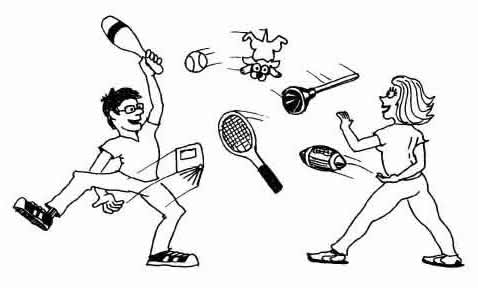
since high school I had occasionally taught (mostly chemistry, physics, math, but also tennis, juggling, music) and often thought about the process
of thinking, so when I entered the program for Science Education at UW the concept
of “we educators” struck a resonant chord in me. It feels natural, is intellectually stimulating, and has provided the freedom & flexibility
to pursue my continuing generalist interests. I enjoy education — it's how we teach and learn, so we can improve our thinking & doing — and I think it's an essential aspect of life, is one of the most important things we do. It's also fun. I enjoy exchanging ideas with other educators, and cooperating with them in our efforts to improve our education.
* The “passion for writing” has been a major influence in my life — and I've invested LOTS of time in writing — from 1975 until now.
some motivations and goals: I'm an enthusiastic educator who enjoys discussing ideas with other educators. Improving our education — by designing better ways to teach & learn, so we can improve our thinking and doing — is one of the most important things we can do. And it's fun! I'm especially interested in designing education that will help more students improve their ability to solve problems (to make things better) in all areas of life. In fact, one of my main motivations for moving from Madison to Columbus, in May 2022, was to network with other educators and begin cooperative collaborations to pursue our shared goal of making things better by improving our Education for Problem Solving and also for Music Improvising and in other areas of life.
teaching experience: mostly chemistry & physics, but also math, problem-solving strategies, ESL, tennis, juggling, music improvising
& theory, ballroom dancing; mostly in classes but also in other ways, including summertime “chemistry camps” and by tutoring (in physics, chemistry, calculus);
special interests in education: helping students improve their thinking skills (creatively generating
& critically evaluating ideas,...) and the process we use for solving problems in science & design; visual representations of ideas, and teaching scientific
concepts;
living locations: small towns in Iowa until 1962 when I was 14, Anaheim until 1970 (with Newport Beach & UC Irvine during 3 school-years of college), Seattle most of 1970-89 (except for 4 years, scattered thru time, at home in Anaheim, plus Eugene and Corvallis, with shorter times in Santa Cruz, Madison & Milwaukee), then Madison 1989-2013, Anaheim 2013-2020 to be a caregiver for Mom & Dad, then back in Madison for awhile, before moving to Columbus in May 2022. { yes, I like college towns }
favorite movie: It's
a Wonderful
Life, partly for its artistic value (plot, dialogue, acting,...) but mainly
for
the message: Each of us affects
other
people,
and
life
is
better
if
we
affect
others
in ways that are beneficial
for them, that help them become better people who are developing their full potential, living in ways that are beneficial for others, and enjoying life. {more}
spiritual foundation: I'm a Christian,
and my overall goal is to love and trust God more fully so I can live by faith in
ways that are beneficial for others, and also for me because I'm moving closer to being-and-doing what God wants.
I have mixed feelings about the results of my road less traveled.
Intellectually, I've been highly productive.
Professionally, I haven't followed the standard path. The result of this combination is that, despite
developing many great ideas in a wide range of areas, so far these ideas aren't widely known or used, and my life doesn't summarize well on a curriculum vitae.* This is
partly because instead
of
writing for
scholarly journals or in books, since 1997 I've focused on writing for the
web, which I think can be (when all things are considered) a superior way to communicate ideas, but
unfortunately web-writing doesn't get much credit among scholars. A more general explanation is that I haven't been a skilled “salesman” for my ideas.
Although the product is strong, the marketing has been weak. My actual intellectual productivity has been high, but the perception of productivity (by others) has been lower. This contrast between reality and perception is frustrating, but I think it's temporary, and in the future my work will be more widely known & used.
* For example, while living in Madison (a university city) people sometimes asked “are you a professor?” and I explained that “if I had made different decisions earlier in life, I would be, but I didn't so I'm not.” Being a professor would have been a good match for my abilities, work ethic, and interests (because I'm intelligent, hard working, and enjoy learning, thinking & writing, teaching) but – because of my decisions and the resulting life path – this didn't happen. / an update: After thinking about this more deeply, I'm wondering if my claim is justified. I'm imagining that it would have been a challenge for me to make it successfully thru the first 5 years, to get university tenure. Why? Because I like to write about a wide variety of topics. Although most of this has been different aspects of thinking-learning-teaching, so it's all related to education, it hasn't been the kind of “focused creativity” that is wanted by academic journals and tenure-granting departments, in their standards for scholarly research & writing. Probably I would have been able to adjust to their standards, in my choice of topics and style of writing, but I'm not certain. And this would have greatly decreased the variety in my writing. It would have been better in some ways, worse in others. As with many things in life. / Also, to work as a professor in an education department, typically they require 3 years of K-12 teaching experience; I'm not sure if I would have enjoyed this, or would have been willing to do it. I thought about this, and decided it would be much better if instead I did “research studies” by visiting many classrooms, and talking with teachers & students & parents & others, asking them to share their experiences so I could learn from them. I think this would have been fun, and very educational, for me and for them. Maybe a department of education would have let me do this instead of the typical “3 years of K-12” but I never applied for this kind of job, never asked anyone about it, and have never done this kind of researching. So I'll never know what might have happened. / And considering all aspects of life, would I have enjoyed being a professor? I'm sure that my early years of teaching — the first 3 years of K-12 (if I did this) and the first 5 years in a university (maybe longer) — would have been filled with 80-hour weeks. Even though I would have been busy doing things I enjoyed, the stress of “too much work and not enough play, plus not enough sleep” would not have been fun. Well, that's enough of speculative “what if” imaginings. In reality,...
On most days, when I wake in the morning I'm free to think about (and write about) ideas that are
wonderfully exciting. I'm thankful that, for more than a decade, God was using me to do full-time volunteer work on a productive ministry
project – a website for Whole-Person Education – that was very satisfying. To
make money for food and rent, in Madison my paying job was teaching chemistry. I've enjoyed teaching, but it has taken valuable time from
working on education, and I consider education (not teaching) to be my main vocation. During the spring & summer of 2011 and 2012, and in all seasons since January 2013, I've been able to do full-time writing, mainly to develop my website about Education for Problem Solving. This has been a satisfying experience — because I can wake in the morning and continue working on ideas from the previous day (and week, month,...) which allows “mental momentum” that is useful in many ways — and these have been times of high productivity. In the near future I hope to work cooperatively with other educators in creative collaborations, to actualize our ideas (mine and theirs) by converting these ideas into action, with the goal of improving education so it's more effective in helping students learn valuable ideas-and-skills.
reasons for humility: Despite... [[ iou – I'll finish writing this in early-February 2026, to explain why "the awards (best Chemistry Student) & scores (two 800's) are less impressive than they might seem to be," due to... statistical odds (we took an ACS Chemistry Exam, and if all of us did 10 exams, I may have gotten the top score only once), and the exam's unusual ending (as explained later, I "coped with the surprise" but this may have dropped another student out of the top position); changes in population (increased from 1.2 million in 1965 to 3.2 million now) and demographics (with Asians, highly skilled & competitive, increasing to 22% now) for Orange County CA. And for GRE my Verbal Scores steadily increased (from 640 in 1966, to 760 in 1988, then 800 in 1990) due to getting more experience (in reading & writing) and for the final two times (1988, 1990) I prepared by practicing (with 3 previous Exams provided by GRE) and memorized a list of "GRE words" (photocopied from a "how to prepare" book in the library) that often were used for two parts of the exam (A & B), and designing a time-strategy for effectively using the limited exam time by changing my order-of-doing from A-B-C-A-B-C to A-A-B-B-C-C (where A was Sentence Completion, B was Word-Analogies, C was Reading & Answering) so I could "do all A's while in that mode of thinking, then all B's, and all C's) and doing "mass production" filling of the multiple-choice bubbles (filling all A-bubbles after finishing both A's, then all B-bubbles after finishing both B's, then filling all C's in each reading selection, after finishing it, for "safety" to avoid a disaster) and using a watch to time myself for each set of sections (I was very fast for A & B, slower for C) during the exams (to estimate "when I should finish A, and B" based on practice exams, and to stay "on schedule" during the real exam, to ensure finishing in the time allowed); also, getting 800 didn't require perfection, and I missed 2 answers for Math (the limit for an 800) and 3 answers for Verbal (the limit for 800) so I was "at the limit" for each score. ]]
reasons for humility and gratitude: Although... [[ iou – I'll write this in early-February, to describe the "good luck" of having genes allowing intelligence, and a good family situation, and opportunities; for all of these, I'm grateful for Mom & Dad, and God. one idea is that being "proud" of inherited intelligence is not warranted, similar to an NBA player not being proud of being 6'10" tall. ]]
functional intelligence and wisdom: [[ iou – Here I'll comment on the "mixed results" of my "road less traveled" and my wisdom in traveling it; and I'll compare my using-of-opportunities with those of my sister who chose a "road well traveled" and did it extremely well, achieving much more professional success (as an elite social scientist, one of the best in the world) compared with me, her older brother... to be continued. ]]
My twitter-profile for
@DTprocess — "educator (PhD in C&I)
using model of creative/critical Design-Thinking Process [= DT Process] for Education + bike,
juggle, dance, improv, sport-science, ESL" (links for
these are
below)
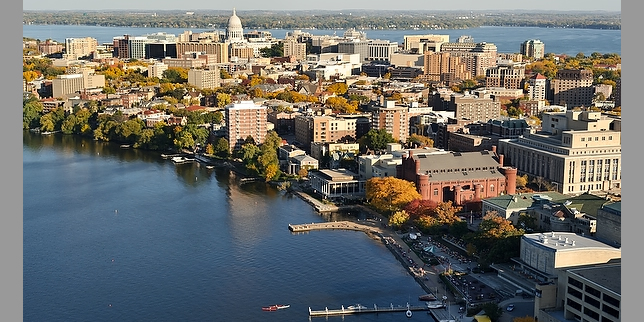
* — includes an
aerial view of Madison.
I attended 15 Annual Meetings of ASA (of the 22 possible) from 1990 to 2011, but only one (2016) since then. And between 2013 & 2019 — when I was serving as caregiver for Dad & Mom in Anaheim CA, before they died at 91 & 95 after lives that were long and good — 3 meetings of the ASA SoCal Chapter. For most meetings I did something, usually a talk (but once a poster session), and for a few years I chaired a session for ASA's Science Education Commission.
Recently I've submitted abstracts (in 2022-23-24) but have decided that instead of investing time in this (by preparing for the talk & trip, then doing the trip-and-meeting) a wiser use of time would be staying in my new home city (Columbus OH), doing projects (especially education for problem solving & music improvising) and connecting with more people, more deeply. The proposed topics were... Scientific Research about The Benefits of Music (2024), Schrodinger's Cat in a Multiverse: What is scientifically plausible? and theologically satisfactory? (2023) that is related to Education for Critical Thinking - Schrodinger's Cat in a Multiverse? (2016), plus Improving Our Problem Solving with Education, Process, and Prayer (2022).