|
Home
Topics
About
Science & Faith
Apologetics
Archaeology &
Anthropology
Astronomy &
Cosmology
Bible
& Science
Creation & Evolution
Education
Environment
Ethics
Historical
Studies
Mathematics
Origin
of Life
Philosophy
Physical
Science
Psychology
&
Neuroscience
Science
&
Technology
Ministry
Teaching
& Research
Worldview
Whole-Person
Education
Youth
Page
Publications
JASA/PSCF
Articles
Book
Reviews
__________________
"Todayís public
talk about moral values is usually framed in terms of a search for a
moral consensus that is no longer self-evident ndeed that to many
people is not evident at all.
The search for a
moral consensus based on a common human nature has, for some time now,
replaced the social function of religious belief, which was long thought
to be the indispensable foundation of social peace.
For most of
history, unity of religion was deemed essential to the unity of society
and culture.
That assumption
was shattered in the religious wars in Europe of the sixteenth and
seventeenth centuries.
As a consequence
of the wars of religion, precisely the opposite conclusion was drawn:
Social peace requires that religious beliefs, and disagreements over
religious beliefs, be determinedly disregarded.
Although
established religion continued for some time in most of Europe, religion
no longer served its earlier function." --
W. Pannenberg
"...Christian
morality is based on the idea that human beings are made in the image of
God and are therefore are of infrinite value, and this informs all
Christian ethical thinking." -
Rodney Holder
2011
|
| Bioethics
News | Books |Current Issues
| Home
| Stem Cells | Web Sites
|
Current
Ethical Issues in Science
 The last
several decades have seen a rapid increase of scientific knowledge in areas
which have wide-ranging ethical implications - most prominently in the biosciences,
the environment and
medicine. There is intense discussion both within and without the
Christian community on points of contention - in many cases the question now
turns more on should we rather than the traditional
can
we. The last
several decades have seen a rapid increase of scientific knowledge in areas
which have wide-ranging ethical implications - most prominently in the biosciences,
the environment and
medicine. There is intense discussion both within and without the
Christian community on points of contention - in many cases the question now
turns more on should we rather than the traditional
can
we.
At the same time one's personal ethics are being
challenged in increasing measure. This topic often receives front page
coverage as yet again another scientist is charged with fraud.
Walter Hearn has ably dealt with day-to-day questions
in his Being a Christian in Science (InterVarsity, 1997) . For
Walt:
Christian behavior is rooted in biblical
precepts and in loyalty to Jesus Christ. We need not apologize for bringing
those precepts with us into scientific work . (p. 40)
Try this short video:
Atheism and morality
which answers the
question: Can atheism provide grounds for morality?  (8 min.)
An Essay from God and Nature:
BY EMILYRUPPEL, ON JULY 6TH, 2011
Hundreds of years ago, under cover of darkness. Shrouded in secrecy.
Breaking the law.
This is what human biological science used to look like. Once upon a
time, seekers of knowledge in the natural world (Leonardo Da Vinci
among them) risked their careers and lives digging up cadavers to peek
inside them and try to discern how the human body functions. At the
time, this act was seen as a violation of human dignity, immoral, and,
of course, illegal.
That was then. This is now: biologists are once again caught in a
moral dilemma that threatens their science 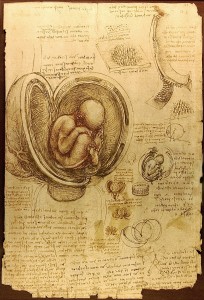 and
puts them under constant legal crossfire. While the dissection of a
dead, thus de-souled, human body is no longer viewed as a scientific
travesty, the disassembly of human embryos has for years been
generating enormous controversy for researchers, politicians, and the
public. and
puts them under constant legal crossfire. While the dissection of a
dead, thus de-souled, human body is no longer viewed as a scientific
travesty, the disassembly of human embryos has for years been
generating enormous controversy for researchers, politicians, and the
public.
In 2001, President Bush signed a law restricting the use of federal
funding for embryonic stem cell (ESC) research to cell lines that had already been
extracted from unwanted IVF (in vitro fertilization) embryos in
fertility clinics. In March 2009, President Obama issued an order
destrictifying Bush’s policy so that new embryo lines could be opened
up to researchers. But in August 2010, a federal judge made a
preliminary ruling against the more lenient policy in court, citing a
1996 ban on federal funding for any project that destroys human
embryos. And this May, a federal appeals panel overturned the judge’s
temporary injunction restricting federal funds from being used while
the judge makes a final ruling....
more
Roman J. Miller, "When
Fraud Knocks on the Door" PSCF 58 (March 2006): 1.
Thoughts of a Teacher/editor.
Wolfhart Pannenberg's "When
Everything is Permitted" Argues the need for "Christian
ethics."
Ethical
Method in Christian Bioethics: Mapping the Terrain
Offers an "analysis
of patterns of ethical methodology among Christians weighing in on contemporary debates."
Bioethical and especially
biotechnologica developments are both so urgent and have come so quickly
upon us that there has been little time for Christian bioethicists to reflect
upon or develop a coherent methodological approach. However, our answers to
particular questions e.g., what should we think and say about nanotechnology
or germ-line genetic intervention or cryopreservation or any other
issueódemand reflection on a prior methodological question: How should a
Christian go about discerning a reliable answer to such ethical questions? I
would here like to offer a very preliminary analysis of patterns of ethical
methodology among Christians weighing in on contemporary biotechnology
debates.
Note: The views
represented on this page do not represent the official position of the
American Scientific Affiliation.
Current Issues
Chemicals
Claus Jacob & Adam Walters*,
"Risk and Responsibility in Chemical Research The Case of Agent Orange,"
HYLE--International Journal for Philosophy of Chemistry, Vol. 11,
No.2 (2005)
Computer Science
J. Barry DeRoos, Ethics in Computer Science
Excessive Consumption
Swearengen, Jack & Woodhouse, Edward, "Overconsumption:
An Ethical Dilemma for Christian Engineers," PSCF 54 (June2002):
80
Fraud:
Kurt M. Pickett, John W. Wenzel, Stephen W.
Rissing, "Iconoclasts
of Evolution: Haekel, Behe, Wells & the Ontogeny of a Fraud,",
The American Biology Teacher 67 (May 2005): 275-282.
Rodney L. Bassett, David Basinger, and
Paul Livermore, "Lying
in the Laboratory: Deception in Human Research from Psychological,
Philosophical, and Theological Perspectives," JASA, 33 (December 1982): 201-212.
Brian E. Porter and Steve VanderVeen, "Does
Being Honest Pay? An Empirical Study," Christian Scholars Review
XXVIII (Number 3 1999): 452-465.
Thomas D. Pearson,"Ethics
in the Workplace: What Should the Christian Do?"
PSCF 50 (June 1998): 85.
Stephen K. Moroney, "How
Sin Affects Scholarship," Christian Scholars Review XXVIII (Number
3 1999): 432-451.
Genetic Engineering
"Promise of
genomics research needs a realistic view" by a UNC Panel
CHAPEL
HILL, N.C. the ten years since the human genetic code was mapped,
expectations among scientists, health care industry, policy makers, and
the public have remained high concerning the promise of genomics research
for improving health. But a
new commentary by four internationally prominent genetic medicine and
bioethics experts cautions against the dangers of inflated expectations –
an unsustainable genomic bubble – and it offers ways to avoid it while
still realizing “the true – and considerable – promise of the genomic
revolution.”
Prof. John Bryant . "Ethical Issues in Genetic Modification,"
Faraday Paper #7 (PDF)
This paper surveys the origins and present applications
of the Genetic Modification of plants,animals and humans. The ethical
concerns raised from both secular and religious sources areconsidered. It
is concluded that humankind has been delegated responsible stewardship for
all the earth’s resources, including DNA, and that there are strong
theological motivations for using Genetic Modification wisely and for the
benefit of others.--A Faraday Institute Paper
J. Bruce McCallum, "Evolving
Concepts of Nature and Human Genetic Engineering," PSCF 58 (September
2006): 171-178.
D. Gareth Jones, "Genetic
Prospects: Finding a Balance Between Choice and Acceptance." PSCF 57 (September
2005): 202-211.
D. Gareth Jones, "Biomedical
Manipulation: Arguing the Case for a Cautiously Optimistic Stance," PSCF
54 (June 2002).
Leon R. Kass, "The Age of Genetic
Technology Arrives," Leon R. Kass, M.D. is professor in social thought
at the University of Chicago, Hertog fellow at the American Enterprise
Institute, and chairman of the President's Council on Bioethics. Excerpted from Life,
Liberty and the Defense of Dignity. Published by Encounter Books, San
Francisco, October 2002. Reprinted with permission by The American Spectator,
November/December 2002.
Medical Practice
Dr. Everett Koop:
"Christian
Ethics in the Workplace" youtube
6 min
James J. Rusthoven,
"Understanding Medical
Relationships through a Covenantal Ethical Perspective," PSCF
62 (March 2010): 3-15. PDF
Relationships between different parties form the
core of medical practice. Increasing attention has focused on the possible
merits of understanding such relationships as covenantal in nature. Some
advocates of a covenant ethic have focused on promise and fidelity as the
defining features of this relationship. However, historical and/or
metaphysical justification for prescribing a covenantal model varies, with
some appealing to the ancient Greek medical tradition while others claim
authority in the biblical revelation of covenant initially established by
God with humankind. In contemporary medicine, reliance on rational
identification of a common morality without appeal to transcendent
authority has become a dominant paradigm of medical ethics. The basis for
envisioning a biblical covenant ethic for clinical relationships has a
firm foundation in Reformed theology, which has developed the concept of
covenant as a central theme. Such an ethic provides a transcendent
grounding that is absent from a common morality based on reason alone that
dominates much of bioethical thought. The patient-supporter relationship
is presented as an integral part of medical practice that can be
understood through a biblical covenant ethic as fidelity between a person
or community and the vulnerable patient, grounded in the agape love of God
for humankind.
A TANGLED
WEB: Medicine and Theology in Dialogue by R. John Elford and D. Gareth
Jones, eds. Oxford: Peter Lang, 2008. 279 pages
ASA Review
SPIRITUAL
DIMENSIONS OF NURSING PRACTICE by Verna Benner Carson and Harold G.
Koenig, eds. 2d ed. West Conshohocken, PA: Templeton Foundation Press,
2008. 403 pages.
ASA Review
The
Christian Medical and Dental Society provides position papers on many
issues in medical and dental practice.
New Study by Harvard Medical School
Researchers at Cambridge Health Alliance finds US Medical Students
Receive Negligible Instruction about Military Medical Ethics.(November
2007) A new study by Harvard
Medical School researchers who are also clinicians at Cambridge Health
Alliance (CHA) found that medical students receive very little teaching
about military medical ethics and are ignorant about a physician's
ethical duties according to the Geneva Conventions. The study, entitled
"Medical Student Knowledge Regarding the Military Draft, the Geneva
Conventions, and Military Medical Ethics," appears in the current
issue of the International Journal of Health Services... Cambridge Health Alliance Full
Story
Dennis M. Sullivan, "The
Oral Conceptive as Abortifacient: An Analysis of the Evidence," PSCF
58 (September 2006): 189-195.
Hessel Bouma III, "Challenges
and Lessons from The Teri Schiavo Case
," PSCF
57 (September 2005): 212-220.
John H. Woodburn, "Life,
the Ultimate Challenge," PSCF
57 (June 2005): 126-127.
Lawrence R. Huntoon, "Editorial: Modern
Bioethics," Journal of the American Physicians and Surgeons
- Vol. 10 No. 4
Dec. 2005.
James J. Rusthoven, "Current
Concepts of Capacity and Autonimy in Medical Decision-Making: A Critique from a
Christian Perspective," PSCF 57 (December 2005): 311-317.
Robert Trundle and Robert Vossmeyer, "Sex
Revolution and Psychosexual Disorder: A Historical Perspective on the Delusion
of Medical Neutrality," Aquinas 47, No. 1 (2004) Used
by permission
Jay L. Holman, "The
Future of Medical Science: Ethical and Theological Implications, Part I,"
PSCF 46
(December 1994): 220-229.
Jay L. Holman, "The
Future of Medical Science: Ethical and Theological Implications, Part II,"
PSCF 47 (March
1995): 23-31.
D. Gareth Jones, "The Human
Cadaver: An Assessment of the Value We Place on the Human Body," PSCF
47 (March
1995): 43-51.
D. Gareth Jones, "Contemporary
Medical Scandals: A Challenge to Ethical Codes and Ethical
Principles," PSCF 42 (March 1990): 2-14.
C. Gordon Winter,
What is Life
? (1996)
Neuroethics
Prof.
Gareth Jones: 'Genetics,
plasticity and personhood: the brain in the 21st century' MP3. AUDIO
William Polk Cheshire, With All Your Mind: Implications of Functional
Neuro-imaging for Ethics |
Audio| A talk from the ASA/CIS Edinburgh Meeting 2007
Stem Cell Research
 A
trachea-shaped polymer has been coated with a patient's stem cells
then successfully transplanted, opening the way to many other
"synthetic" organs... A
trachea-shaped polymer has been coated with a patient's stem cells
then successfully transplanted, opening the way to many other
"synthetic" organs...
New Scientist
Full Story
The Biology of Stem Cells (Proquest) An overview.
Nature 450,
457-458 (22 November 2007) | doi:10.1038/450457b;
Published online 21 November 2007
Replicator
review:
Nature has
implemented a peer-review policy for strong claims.
The transfer of a nucleus from a somatic cell of one organism into
an enucleated germ cell of another for therapeutic or reproductive
cloning is now well-established in many species, but has proved
notoriously difficult to do in primates. Indeed some experts have
concluded that it simply couldn't be done. Woo Suk Hwang's
high-profile paper reporting that it had worked in human cells
turned out to be fraudulent, making the goal seem even more
elusive...more
Hope or hype? Can stem cells live up to being
the panacea for disease?
Injections
of these cells, which have the special ability to transform into any other
cells, have been paraded as the panacea for diseases, from Parkinson's to
diabetes. And recent advances, such as clinical trials where heart attack
patients are to be injected with stem cells or research showing their possible
ability to restore the sight of blind mice, suggest this hope could be becoming
a reality. But is this really the case? We are at the stage where
some stem cell research is moving from animal models towards the clinic, says
Professor Anne McLaren, a developmental biologist from Cambridge University. But
while there has been much progress, there has also been a lot of hype, she
adds... Full Story
BBCNews
Celia Dean-Drummond,
"A Recovery of Wisdom As Virtue for an Ethics of Genetics,"
PSCF 59 (March 2007): 19.
William R. Hurlbutt, "
Framing
the Future: Embryonic Stem Cells, Ethics and the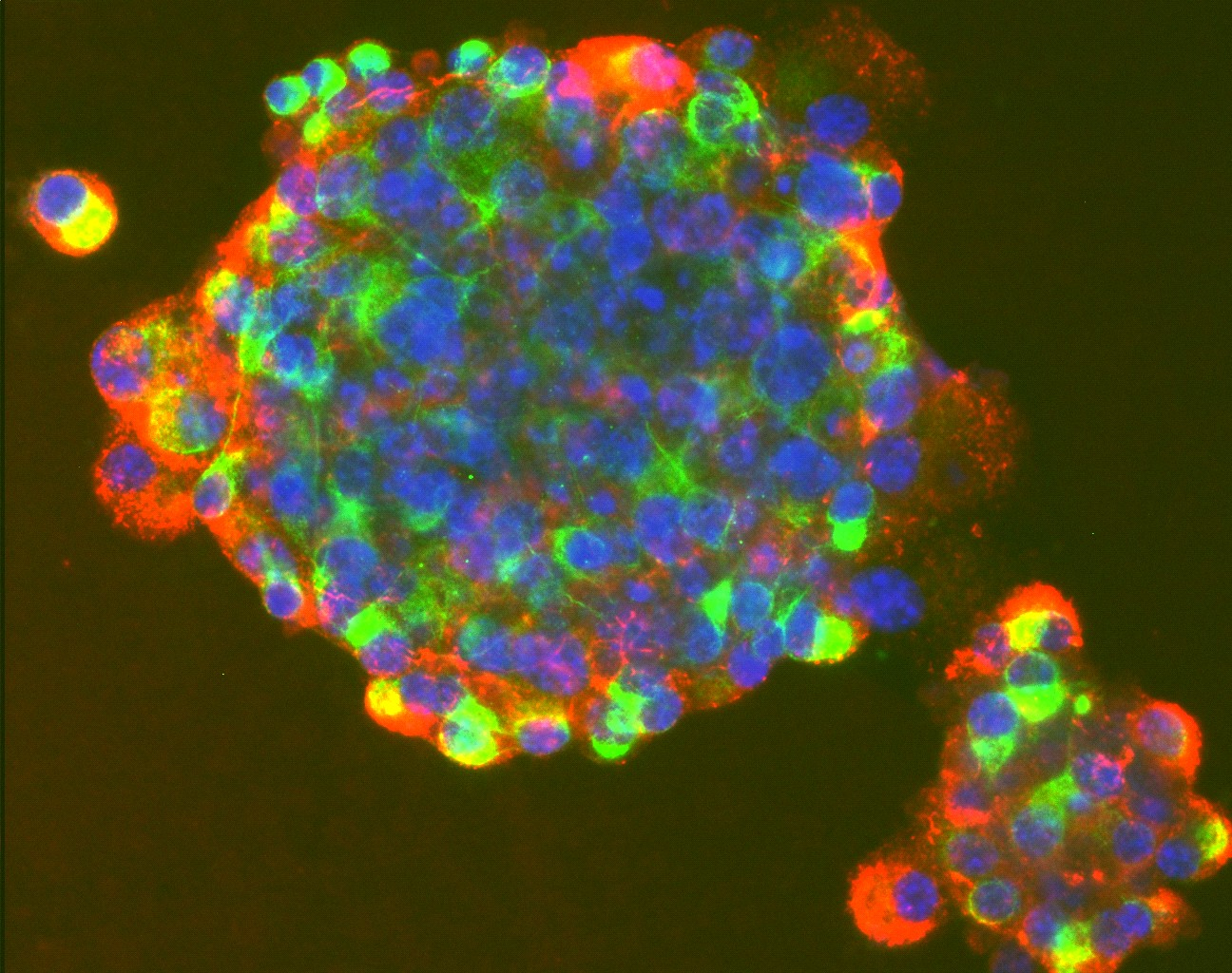 Emerging Era of Developmental Biology," 59: 4, Pt. 2, 2006
Used by permission Emerging Era of Developmental Biology," 59: 4, Pt. 2, 2006
Used by permission
Skin derived precursor cells. (photo courtesy Freda Miller)
----------
Robert A. Boomsma, "Embryonic
Stem Cells and a Reformed Christian World View," PSCF 56.1:38-48
(3/2004).
Adrian Teo and Donald Calbreath,
"Embryonic
Stem Cells and a Reformed Christian World View: A response to Robert Boomsma","
PSCF 58 (September 2006):179-188.
----------
Cathleen and Paul Shrier,
"Human
Embronic Stem Cell Research and Christian Community Ethics: An Old Testament
Investigation,"
PSCF 58 (March 2006): 37-47.
Krystin A. Mannoia, "An
Evaluation of Three Religious Approaches to Stem Cell Research," PSCF
56.1:216-225 (9/2004)
Karen Lebacqz,
"Pandemic
Justice," PSCF 59 (March 2007): 10.
David P. Gushee,
"Ethical Method in Christian Bioethics: Mapping the Terrain",,
The Center for Bioethics and Human Dignity (2003)
Carson, Joseph P., "
"Should ASA Defend and Advance Professional Ethics in Science and Technology Professions?," PSCF 54 (June 2002): 124.
Catherine H. Crouch, " Scientific Ethics: A Realm for Partnership," PSCF 52 (September 2000): 156-58.
Malcolm Jeeves, Psychologising about God and ReligionLecture delivered in
the Winstanley Lecture Theatre, Trinity College, Cambridge on Tuesday, 28th
November 2000.
Martin LeBar, "A
World is Not Made to Last Forever: The Bioethics of C. S. Lewis,"
JASA 35 (June 1983): 104-107.
George Murphy, "Chiasmic
Cosmology as the Context for Bioethics, PSCF
42 (June 1990): 94-99.
George Murphy, "Science
and Martyrdom," PSCF
41
(March 1989): 33-35.
Books
On Being a Scientist: A
Guide to Responsible Conduct in Research: Third Edition
The scientific enterprise is built on a foundation of
trust. Society
trusts that scientific research results are an honest
and accurate reflection of a researcher’s work. Researchers equally trust
that their colleagues have gathered data carefully, have used appropriate
analytic and statistical techniques, have reported their results
accurately, and have treated the work of other researchers with respect.
When this trust is misplaced and the professional standards of science are
violated, researchers are not just personally affronted—they feel that the
base of their profession has been undermined.
ebook:
Living Under God's Law -
Christian Ethics
(PDF Download)
ebook:The Government of the Tongue -
Ethics, Richard Allestree
(PDF Download)
SACRED
CELLS? Why Christians Should Support Stem Cell Research
by Ted
Peters, Karen Lebacqz, and Gaymon Bennett. Lanham, MD:
Rowman and Littlefield Publishers, 2008. 272 pages.
ASA Review
H. Tristram Engelhardt Jr., Foundations of Christian Bioethics, Exton,
PA, Swets & Zeitlinger, 2000
John
Frederic Kilner (Editor), et al Cutting-Edge
Bioethics: A Christian Exploration of Technologies and Trends (Horizon in
Bioethics Series Book) (Paperback - March 2002)
Edwin C. Hui, At the Beginning of Life: Dilemmas in Theological Bioethics (Christian Classics Bible Studies) InterVarsity Press (October 2002).
D.
P. Gushee and G. H. Stassen, Kingdom Ethics: Following Jesus in
Contemporary Context (Downers Grove, IL: Intervarsity Press, 2003).
James Peterson, Genetic Turning Points: The
Ethics of Human Genetic Intervention, Eerdmans, 2001
Web
Sites
Religion
and Ethics Newsletter (PBS)
Bioethics Centres
Loma Linda University Center for Christian Bioethicsics Issues of
Life: Bioethics and medical links
Christian Medical and Dental Society US
CMF Ethics
CMF produces literature addressing a wide range of ethical issues from a
Christian perspective.
Return to Top  Home
Home
Last Entry:
5/15/2015/2011
|

 Friday,
08 July 2011 14:35 |
Friday,
08 July 2011 14:35 |