| |
About Faith &
Science
An
entry-level approach to Science &Christianity Studies
| Biographies | Biblical
Hermeneutics | Biblical
Interpretation | Conclusion
| Creation
and Providence |
| Doctrine
of Scripture| Introduction | Nature
and Practice of Science |
"The fear of the Lord is the beginning of Wisdom." Psalm 111:10,
Proverbs 1:7
"In the beginning God created the heaven and the earth." Gen. 1:1
"Upholding the Universe by His Word of Power" Hebrews 1:3
Introduction
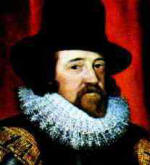 "Let no man think upon a weak
conceit of sobriety or an ill-applied moderation think or maintain,
that a man can search too far, or be too
well studied in the book of God's word, or the book of God's works,
divinity or philosophy: but rather let men endeavor an endless
progress or proficience in both; only let men beware ... that they
do not unwisely mingle or confound these learning together."
(Sir Francis Bacon, 1605) "Let no man think upon a weak
conceit of sobriety or an ill-applied moderation think or maintain,
that a man can search too far, or be too
well studied in the book of God's word, or the book of God's works,
divinity or philosophy: but rather let men endeavor an endless
progress or proficience in both; only let men beware ... that they
do not unwisely mingle or confound these learning together."
(Sir Francis Bacon, 1605)
Christians believe that their
faith touches all of life – including the study of nature and the
stewardship and use of the natural world for human welfare.
Discussions about God and nature have taken place with varying degrees
of intensity since the time of the early church. For the most part,
Christians have felt that faith and science should live in harmony when
each is properly understood. However, as science gained a deeper
understanding of the natural world, and became more important in daily
life, it opened many new possibilities for interaction and potential
conflict with Christian beliefs.
Our history
page provides
more detail on
these developments.
The American Scientific Affiliation (ASA)
was established in 1941 to support Christian students who found that
they were unable to effectively respond to challenging questions posed
by college and university faculty with little sympathy for the Christian
faith. Over the years the ASA's purpose has broadened to include all
Christians and anyone interested in the issues that are addressed. We
seek to make the resources of this web site useful for those who are
looking for help with specific concerns or who may be turning to the
field for the first time. If you want to dig deeper, there is plenty of
material to further your understanding.
The rise of
 science
in the seventeenth and eighteenth centuries was accompanied by a
diminishing influence of the Church and the Bible, and the turn to a
secular society where government, education and medicine became, for the
most part, independent of church structures and beliefs. Scholars
continue to debate the fine points of how this has played out in Europe
and the Americas. science
in the seventeenth and eighteenth centuries was accompanied by a
diminishing influence of the Church and the Bible, and the turn to a
secular society where government, education and medicine became, for the
most part, independent of church structures and beliefs. Scholars
continue to debate the fine points of how this has played out in Europe
and the Americas.
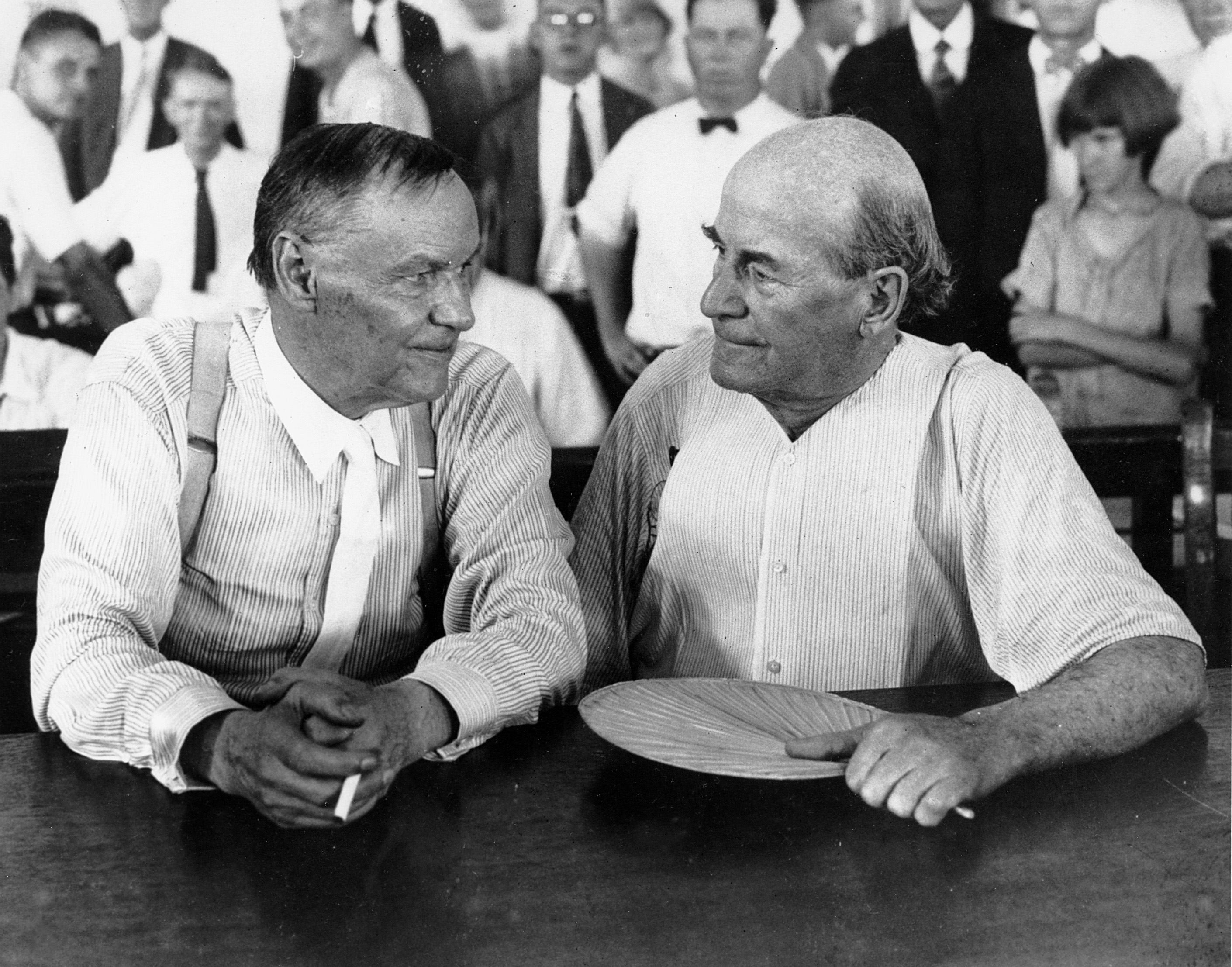
Clarence Darrow and William
Jennings Bryant take a break at the Scoes,Triai (AP)
As time passed, Americans saw science-religion questions
become fodder for the media in such widely separated events as the Tennessee Scopes
trial (1925), the
more recent Dover
PA School Board legal
episode (2005), and the
Freshwater
hearing ( 2011).
The US 2008 and 2012 presidential elections saw science and religion
became part of the debates. The nomination of Francis Collins for
the post of Director of the NIH (2009) raised a storm of
protest from those opposed to his public Christian witness. Ironically, the US Senate unanimously confirmed him to the post.
Candidates in the US 2012 and 2014 elections have included various faith-science
issues in their rhetoric. Clearly, a combative mix of science, Christianity, and
politics does not offer the space for serious study.
As the second decade of the 21st Century began, there was
an increasingly virulent sometimes science based opposition to
Christianity in the print media and on the web by the "new atheists."
Interest in faith-science questions has expanded from the apologetics of
conservative Christianity to include liberal and conservative
Protestants, Catholics, Muslims, Hindus, and beyond.
Today,
some American Christians feel endangered by the results of scientific
study and the philosophical conclusions that some non-Christians have
drawn. They include negativism toward parts of science as part of a political
package in the culture
wars.
However, many Christians regard science as a gift
from God that
can be of enormous value to the human condition and are working to use
science in a God-honoring way in medicine, agriculture and innumerable
other areas. They view being made
in the image of God as a
mandate for these activities.
We
will first offer some basic ideas important when considering particular
issues. Since most questions have roots in the past, it is important to
take into account these earlier responses before we jump into the
present discussion.
*******************************************
When examining
science-faith issues, we must appreciate the fact that (1) different
people may come to different conclusions when
faced with the same evidence and that ( 2) the
evidence (or the way that we assess the evidence) may change over time.
As one digs (ponders), what may appear clear on the surface becomes more
complex and sometimes unsolvable based on the information at hand. Our
religious and educational backgrounds
weigh heavily on how we think. This becomes very clear when one leaves
home for college.
Humility and reserving judgment are valuable virtues when examining
science-faith questions or anything new in our experience!
Christians believe that God has revealed himself in nature as well as in
the written word (sometimes called the "Two
Books" concept). The ASA seeks to do justice to both sources of
revelation. However, tensions arise when the 'two books ' are brought to
bear on a particular question; What role does each book take? What
happens when the books disagree? Are there areas of priority?
While it is important to carefully evaluate these faith-science issues, we
should also recognize that our redemption
is not affected by our views in this arena. Also, the fact that
Christians disagree should not destroy the fellowship that we have in
Christ. Too often scientists, feel isolated in their church or
academic community because of their beliefs.
Perhaps, it would be easier to function as though modern science and the
Bible had nothing to do with each other except in matters involving
morals and ethics, but that would ignore what historian Colin Russell
described as
"...the battery of historical data which point to a
massive mutual debt between science and Christianity."--Colin
Russell, Cross-currents:
Interactions Between Science & Faith (1985),
p. 20.
________________________________________
...the fact that Christians disagree should not destroy the
fellowship
that we have in Christ
_____________________________
This
material is offered to students of all
ages and backgrounds to help you to
become informed, perhaps make decisions, and strengthen your faith.
Whether you are new to the subject or an "old hand" finding this page
for the first time, it is important that you develop a grasp of the
nature and use of both Scripture and science before
plunging into the issues that capture our mind today.
BY THOMAS BURNETT, ON DECEMBER 21ST, 2010 GOD AND NATURE SERIES

painting by Cristiano Banti (1857)
Do you believe that the sun is the center of our solar
system? Why? Very few people have ever carried out the
measurements necessary to determine that earth moves around the sun.
Most of us simply accept it by faith, backed by scientific
authority. But what would we believe if authorities told
us that earth didn’t move? That is the situation that Galileo
found himself in 400 years ago. Though Copernicus had already
published his theory of a sun-centered universe, he only had some
elegant mathematics but .
. . → Read More: How
was Galileo converted?
Check out a surprising response to the question: " Does
Science Lead to Atheism?"
Try one (or more) of these Short Videos
 Creator or the Multiverse? Does
the fine tuning of the universe point to God or an infinite collection
of universes? Creator or the Multiverse? Does
the fine tuning of the universe point to God or an infinite collection
of universes? Video, 8
Min. Faraday
Institute
Why
is Richard Dawkins so angry? Video, 5
Min. Faraday
Institute
Where are we today?
Essay Review: " Evangelical
and Catholic Interactions with Science," PSCF 60 (2008):
251. CATHOLICISM AND
SCIENCE by
Peter M. J. Hess and Paul L. Allen. Westport, CT: Greenwood Publishing
Group, 2008. EVANGELICALS
AND SCIENCE by
Michael Roberts. Westport, CT: Greenwood Publishing Group, 2008. A
broad comparative picture of a varied landscape
Larsen,
Timothy, “‘War
Is Over, If You Want It’: Beyond the Conflict between Faith and Science,” PSCF 60 (2008):
147. "The
purpose of this article is to help emerging scholars, especially in the
sciences, to reframe the issue of the relationship between faith and
learning in a productive way. While critiques of the warfare model exist
in the specialized literature of the history of science, the presumption
of conflict continues to dominate in the media and in popular
conversations in both secular and religious contexts. As a result, young
scholars have often imbibed this model themselves as an accurate
portrait of the way things are, and they usually do not have a clear,
up-to-date reflection on the relationship of faith and learning to put
in its place."
Jesus Creed Collection of
Discussions of recent science-Christianity books and blogs This
frequently updated collection offers summaries and comments on works
related to current evangelical discussions by the (bashful) RJS and
occasionally by Scott McKnight. The strings of reader comments are
often equally valuable. Take a look at the list, prepare your coffee,
then plunge in.
The Doctrine of
Scripture
Our understanding of scripture is key to building a Christian
world view that includes revelation
in nature. Yet we must recognize the struggle that this has been for
Christians since the time of the early church fathers and before. Shades
of difference in interpretive views and the cultural surroundings of
local churches may set the stage for confrontation that builds walls of
misunderstanding. We ask that you consider what may be new,
and perhaps, conflicting ideas,
before drawing your own conclusions.
You may remember the song,
The
B-I-B-L-E, from the Church nursery class or in your home.
The words
go...
The
B-I-B-L-E
Yes, that's
the book for me
I stand slone
on the Word of God
The B-I-B-L-E
The doctrine of Scripture is vitally important; for it is through the
instrumentality of the Word (preached and read) that God saves us and
causes us to grow in the grace that is in Christ Jesus. Only through the
Scriptures do we have the knowledge of God in Jesus Christ. While we
claim that scripture is the final authority on faith and practice, the
problem remains in making that affirmation a living reality through sound
interpretation and consistent
application to life's
situations – which include the challenge of science.
How we
value the Bible and questions of biblical interpretation have continued
to cause divisions among the people of God who seek to relate scientific
advances and the Bible. On one hand, some thinkers feel that the Bible
has no relation
at all to the day-to-day work of the scientist. Others believe that
scripture has much to say about particular details of interest to
scientists but insist that the biblical picture holds priority when the
two sources of information appear to conflict. Others
feel that the picture is more complex and emphasize the need to
carefully examine the points of disagreement and withhold  judgment until
better information is available. judgment until
better information is available.
The Gutenberg Bible at the Ransom Center
While we claim that scripture is the final authority in faith and
practice, the problem remains of making
that affirmation a
living reality through sound interpretation and consistent application
to life's situations – which include the challenges of science.
We will start with the assumption
that the Bible and science have some overlapping interests. The Bible
speaks of beginnings, scientists are interested in how the universe and
it's contents came to be; the Bible speaks of right behavior, scientists
need principles to guide their practices, and so on.
As part of the evangelical wing of the Protestant church, the ASA has
been part of the discussions that produced the
Chicago
Statement on Inerrancy (1978) and the
Chicago
Statement on Biblical Hermeneutics (1982). These statements were
written at a time when Evangelical leaders felt that the doctrine of
inerrancy was being eroded from within and without the Evangelical
community.
Three decades later, dramatic discoveries in science suggested that
these documents were impeding the
science/faith discussion for the Christian community.
The result has been opening up of the discussion especially as it
relates to the events of early Genesis that relate to the current state
of scientific knowledge.
One effect has been to cast doubt on some of the hallowed concordistic
schemes of the early 20th century and open room for other scenarios.
Inerrancy
Five Views on Biblical Inerrancy (Counterpoints: Bible and
Theology)
Paperback –
December 10, 2013 by J. Merrick, Ed., S. Gundry, Ed., A. Mohler,
P. Enns, M. Bird,
K. Vanhooze,
J. Franke (Kindle, $7.99) This
work effectively frames the topic in the second decade of the
21st Century.
Biblical Interpretation
Today
one may find many different attitudes toward scripture. For some the
Bible is the actual Word
of God; others, claim the Bible contains the
word of God; while others see the Bible as a wide-ranging human
document that is one
among many similar ancient documents.
The "(strict) literalist" view maintains that the meaning
of Scripture is obvious and needs no interpretation. On the other hand,
the "critical"
(sometimes called "historical") view maintains that a scientific study
of languages, culture, history, archaeology, etc. is necessary to
overcome the vast distance in time and culture between the present and
the actual Bible events. While the latter approach may seem reasonable,
evangelicals have often been wary or negative toward critical methods of
reading the Bible because of the role they have played in fostering
unbelief - the modernism of
the early 20th Century.
It is noteworthy that the "literalists" of the
reformation period recognized the use of literary devices such as poetry, parables, similesand metaphors by
the biblical writers as well the need for literary
methods as tools for
understanding the deeper meanings of scripture.
Some have charged that biblical criticism originated with
anti-Christian writers who valued reason and logic over faith and
revelation, whose goal was to discredit and ridicule the Bible and
Christianity. Their analysis techniques were picked up by some liberal
theologians and used to explain away and discount biblical accounts of
prophecy, miracles, personal demons, etc. However, current evangelical
theologians effectively use literary
methods of analysis to
understand scripture in it's purpose, historical context, and content
related to the natural world.
Biblical Hermeneutics relates
to the subject of how one is to understand Holy Scripture. By
definition, this is a theological
act, i.e. part of the discussion of a faith-community.
This does not mean that it is of no relevance to those who do not
consider themselves to be part of that community, but rather that it is
an issue that arises out of the particular
views of that community.
Therefore one must differentiate between Christian and Jewish biblical
hermeneutics etc., even though there is an overlap between the two,
since they share part of their scriptures.
Our views arise out of different
faith traditions which
developed their own notions
of hermeneutics. It must also be stressed that theological differences
between these faith communities "preclude any 'definitive'
statement' on biblical hermeneutics - in spite of the erudition and
passion of particular advocates." ASA members and those who write
for PSCF
predominately come
from the broad evangelical tradition - their work reflects the issues of
the day and their struggles to live and think as Christians in a complex
arena. Our purpose is to discuss a range of science related topics but
we often seem stuck on origins (evolution) related questions - as
is the case for evangelicals in general.
Evangelical theologians are actively engaged in studying the influence
of Ancient Near Eastern (ANE) documents on the early Old Testament, as
well as the literary forms in which Genesis was written. Time will tell
whether these conclusions will join earlier interpretations that have
challenged Christians seeking to link scientific accounts of the past
with the biblical record.
John Walton's The
Lost World of Genesis One (2009)
offers a fresh approach; "...I propose that the people in the ancient
world would believe that something existed not by virtue of its material
properties, but by virtue of its having a function in
an ordered system (p. 26)."
Yet the September
2010 Issue of PSCF illustrates
anew the difficulty in achieving agreement on Genesis
Nothing
is more highly debated in evangelical circles than the way
that the early chapters
of Genesis relate to the history and character of the world as we know
it.
_____________________
Ways of Relating Scripture and Science
Concordism is the
hermeneutical belief that scripture
and true science are in agreement.
It takes the Bible in a more or less literal - chronological fashion and
seeks to adapt science to fit that reading of the Bible which written in
a pre-scientific ancient near east culture. Many evangelicals hold a
concordist position. This approach is found today in scientific
creationism and
various apologetic ministries. One
value seen in this strategy is that proving that modern science aligns
with the Bible provides powerful evidence for the inspiration of
scripture and support for Christian apologetics and evangelism. Science
is seen as providing a corrective for earlier "naïve" descriptions of
creation and providence and the role of humans in nature. Inevitably,
questions of biblical and scientific authority emerges. In some eyes
this amounts to tinkering with scientific data and/or the biblical text
to achieve agreement - always hoping for a new scientific discovery or
fresh biblical interpretation that would close the gap.
A second
tradition views the Bible
and science as providing two kinds of information; the
Bible provides a picture of the Creator, His purpose and plan for
creation and redemption of a fallen humanity while science offers
details and concepts of the World that are refined and transformed as
more information is received. 2 This
approach seems to avoid conflict but fails to engage a biblical response
to the nature of humanity and
the role of humans in this world.
A third
view is found in the
reformation belief that "scripture
alone interprets scripture" (sola scriptura). Here one
begins with not with hermeneutics but with the more fundamental level of
religious presuppositions - a biblical world view.3 Christians
from congregations and organizations which encourage this "third view"
have developed numerous ways to interpret the early chapters of Genesis
- a confusing start for those new to this field.
A fourth view seems
to be gathering strength in the early 21st Century as the challenges of
genetics and paleontology build new tensions between evolution and
Christianity and our desire to keep the Bible and natural science in
"conversation." Evolution is seen as a "game changer" - a
literal/historical reading of Genesis will not do - unless we want to
reject the scientific evidence. Carolyn
Arends' recent Christianity
Today essay
illustrates a better path. A 2015
CT interview of John Walton is instructive.
*******************************
The pages of PSCF reflect
the diversity of strategies for relating scripture and nature. We often hear the cry that the Word of God always gives
in to the word of
science. Yet we forget that there have often been good reasons for this.
Christians of an earlier time and some today have been all too willing
to espouse fanciful unfounded descriptions of nature in an attempt to
save favored models of
biblical interpretation. At this stage of our understanding
it may be appropriate to recognize that there are numerous ways
of approaching faith-science questions that appears faithful to the
Bible rather than insisting that a particular choice trumps all others.
Paul Marsten , Understanding
the Biblical Creation Passages, 2007
Lifesway 60pp., ebook, pdf .
This very readable e-book offers insight into the ways that current
scholars approach the interpretation of the Genesis passages.
References
1 One
may hold a concordist position
on historical narratives as found in Gen. 1-3 even though the chronology
of the story is figurative. It is the actual characters and the events
which are historical in a concordistic sense. See Kline
2 The
letters of Seeley and Godfrey, Blodgett, Hill, Mcintyre, Godfrey,
and earlier Kline, are
just the tip of the iceberg of debate.
3 Noel
Weeks, Robert
Godfrey, Vern
Polytherysis, and John
Collins represent
this position.
________________________________
At this stage of our collective understanding of it may be
appropriate to recognize that there are numerous ways of approaching
faith-science questions that are faithful to the Bible rather
than insisting that a particular choice trumps all others.
_________________________________
Two Biblical
Hermeneutics Studies
1. The
Baylor 2009 ASA Annual Meeting Papers : PSCF, 62 September 2010
| Adam and Eve as Historical
People, and Why It Matters |
|
[PDF] |
147 |
Collins, C. John |
|
|
Genesis and the Genome: Genomics Evidence for Human-Ape Common
Ancestry and Ancestral Hominid Population Sizes |
|
[PDF] |
166 |
Venema, Dennis R. |
|
| After
Adam: Reading Genesis in an Age of Evolutionary Science |
|
[PDF] |
179 |
Harlow, Daniel C. |
|
| Recent
Genetic Science and Christian Theology on Human Origins: An
"Aesthetic Supralapsarianism" |
|
[PDF] |
196 |
Schneider, John R. |
2. Concordism
and a Biblical Alternative: An Examination of Hugh Ross’s Perspective
(2007)
Paul Seely, Concordism
and a Biblical Alternative: An Examination of Hugh Ross’s Perspective PSCF 59 (March
2007): 37.
Hugh Ross, Additional
Explanations on Concordism: A Response to Paul Seely’s Critique
PSCF 59 (March
2007):46.
Paul Seely, Reading
Modern Science into Scripture PSCF 59 (March
2007):51
Carol A. Hill, A
Third Alternative to Concordism and Divine Accommodation: The Worldview
Approach PSCF 59 (June
2007): 129.
Paul H. Seely, The
First Four Days of Genesis in Concordist Theory and in Biblical
Context, PSCF 49 (June
1997): 85-95. Moderate
concordism's interpretation of the days of Genesis is derived from
modern science. The correlation of Gen. 1:1 with the "Big Bang" has a
certain legitimacy; but, concordism's interpretation of the days
themselves takes Genesis 1 out of its historical and biblical context.
Concordism achieves a concord between modern science and the Bible only
because it has rewritten the Bible to agree with modern science. From a
biblical standpoint there is no need to take the Bible out of context in
such a radical way as concordism does. Biblical inspiration, according
to the teaching of Jesus, sometimes encompasses concession to human
weakness even in the area of morals (Mark 10:5), how much more then in
the area of science, the discovery of which God has delegated to man
(Genesis 1:28). Scripture and science complement each other.__________________________________________________________________________
General
 Peter
Rüst, Early
Humans, Adam, and Inspiration PSCF 59 (2007):
182. Peter
Rüst, Early
Humans, Adam, and Inspiration PSCF 59 (2007):
182.
David F. Siemens, Jr., Extended
Humpty Dumpty Semantics and Genesis 1 PSCF 59 (2007):
194.
James Barr, Biblical
Chronology: Legend Or Science? (The
Ethel M. Wood Lecture 1987. Delivered at the Senate House, University of
London on 4 March 1987. London: University of London, 1987).
Books
Peter Enns, “The
Evolution of Adam: What the Bible Does and Dosen’t Say About Human
Origins,” Brazos Press, paper (2012).
C. John Collins, "Did Adam and Eve
Really Exist?: Who They Were and Why You Should Care," Crossway
Books, paper (2011).
Gregory K. Beale, "The
Erosion of Inerrancy in Evangelicalism: Responding to New Challenges to
Biblical Authority," Crossway
Books. paper (2008).
C. John
Collins, Genesis
1-4: A Linguistic, Literary, And Theological Commentary 318
pp., ISBN: 0875526195, (2005) P & R Publishing, Paperback.
W. Robert Godfrey, God's
Pattern for Creation: A Covenantal Reading of Genesis 1.
144 pages. ISBN: 087552799X,
2003, P & R Publishing, Paperback.
Lee Irons & Meredith Kline, in "The Genesis Debate," ed. David
Hagopian, 2001, Crux Press, Paperback.
James McKeown, Genesis
The Two Horizons Old Testament Commentary pp.,  ISBN-10: 0802827055,
2008, Wm. B. Eerdmans Publishing Company. ISBN-10: 0802827055,
2008, Wm. B. Eerdmans Publishing Company.
John Walton, Genesis, NIV
Application Commentary, 2001.
Articles
Richard H. Bube, "Towards
A Christian View Of Science," JASA 23:(March
1971): 1-4. An
ASA Classic
Peter Enns, Preliminary
Observations on an Incarnational Model of Scripture, Calvin
Theological Journal 42
(2007), pp. 219-236.
Meredith Kline, Space
and Time in the Genesis Cosmogony PSCF 48:
(March 1996): 2-15.
Clark H.
Pinnock, "The
Ongoing Struggle Over Biblical Inerrancy," JASA 31
(June 1979): 69-74.
Walter R. Thorson, "Hermeneutics
for Reading the Book of Nature 55 PSCF (June
2003): 99-101.
Biblical Doctrines
of Creation and Providence
Two
fundamental planks in a Christian world view are the Doctrines of
Creation and Providence.
While these doctrines are widely held beliefs, the details continue to
vex theologians and scientists alike as each seeks to make sense of the
world around us
Creation
 A report
from the ASA Commission on Creation (2000) offers a General
Statement on Creation which
it was felt to reflect the general thinking of the ASA community and several more statements representing narrower
views on the details of creation. One might think
that biblical and scientific scholars could have
otten together and forged a definitive statement
on origins rather than a grocery list but the issues
are too complex to achieve accord. at this time. A report
from the ASA Commission on Creation (2000) offers a General
Statement on Creation which
it was felt to reflect the general thinking of the ASA community and several more statements representing narrower
views on the details of creation. One might think
that biblical and scientific scholars could have
otten together and forged a definitive statement
on origins rather than a grocery list but the issues
are too complex to achieve accord. at this time.
We can agree on the who and
perhaps the when but the how is
speculative. We see patterns in
nature and marvel at its detailed interworkings,
harmony, and beauty as those created in the image
of God but the details elude us.
The Nature
and Practice of Science
"As the pinnacle of God's
creative activity, humans stand responsible for their stewardship of
fellow creatures and the earth. Indeed, a helpful corrective which
has emerged in contemporary theology is the recognition that the
cosmos is neither "mere nature" nor "our world," but is most
properly "God's creation." Humans are granted a high degree of
delegated agency within God's creation, but it remains fundamentally
God's alone. This affirmation underlines the tremendous charge of
stewardship to humankind by the Creator."
"Creation is not a brute fact without meaning. It derives its
meaning from the divine character and will. As the theater of God's
redemptive activity, creation is not static, but is moving toward
the goal established by the Creator before the foundation of the
universe. Creation, like the humans within it, has a future." (R.
Albert Mohler, Jr.,)
Ask a
scientist friend to define science and you will be surprised by the
 response.
What seems easy to explain and obvious to anyone takes many twists and
turns when one is active in scientific research or engages
in "philosophical analysis" about how science works. response.
What seems easy to explain and obvious to anyone takes many twists and
turns when one is active in scientific research or engages
in "philosophical analysis" about how science works.
Here is a carefully written discussion of the nature of
science by Dr.
Helen Quinn, a theoretical physicist at SLAC in Physics
Today, July 2009.
....thoughts from
other authors:
Science is
an intellectual activity carried on by humans that is designed to
discover information about the natural world in which humans live and to
discover the ways in which this information can be organized into
meaningful patterns. A primary aim of science is to collect facts
(data). An ultimate purpose of science is to discern the order that
exists between and amongst the various facts.
Science involves
more than the gaining of knowledge. It is the systematic and organized
inquiry into the natural world and its phenomena.
Science is
about gaining a deeper and often useful understanding of the world.
Science alone
of all the subjects contains within itself the
lesson of the danger of belief in the infallibility of the
greatest teachers in the preceding generation . ..As a
matter of fact, I can also define science another way:
Science is the belief in the ignorance of experts.
To do science is
to search for repeated patterns, not
simply to accumulate facts.
Religion is a culture
of faith; science is
a culture of doubt.
The fuel on which science runs
is ignorance. Science is like a hungry furnace that must be fed logs
from the forests of ignorance that surround us. In the process, the
clearing that we call knowledge expands, but the more it expands, the
longer its perimeter and the more ignorance comes into view. . . . A
true scientist is bored by knowledge; it is the assault on ignorance
that motivates him - the mysteries that previous discoveries have
revealed. The forest is more interesting than the clearing.;
There is no
philosophical high-road in science,
with epistemological signposts.
No, we are in a jungle and find our way by trial and error, building our
roads behind us as we proceed. We do not find sign-posts at cross-roads,
but our own scouts erect them, to help the rest.
The
stumbling way in which even the ablest of the scientists in every
generation have had to fight through thickets of erroneous observations,
misleading generalizations, inadequate formulations, and
unconscious prejudice is rarely appreciated by those who obtain their
scientific knowledge from textbooks.
Regardless of the diverse ways that scientists describe their task
and the ways this plays out in their own experience, it is clear that
science is both understanding and doing - making sense of nature and
making "better things for better living" as the earlier du Pont slogan
proclaimed. The interweaving of medical research to discover the
mechanism of a disease and the search for a cure illustrate the
complexity of the scientific enterprise.
Many of us
take our ideas about the nature of science from Francis
Bacon- who lived four centuries ago. For Bacon, science is the
objective pursuit of reliable knowledge. Although one might "know"
something through authority, faith, or intuition, scientific
method is distinct in
that it must be possible for other investigators to ascertain the truth
of scientific theories. It is founded on objective
observation, the formulation of hypotheses that fit the data and
predict other possibilities, repeatable experiments that can fail as
well as succeed, and analysis and review by the scientific community.
Baconian science rests ultimately on pure, objective dispassionately
collected observational data followed by the application of special
logical procedures to those data in order to produce scientific
theories. This set of stringent procedures constituted the 'scientific
method.' - something you learned by 8th grade.
However:
This view of
science achieved dominance, becoming practically the official conception
by the early 20th century, and still underlies many popular ideas about
science. But however attractive its promises, Baconian inductivism is in
fact irreparably defective,
disintegrating at nearly every point when examined by philosophers.
Among its many problems are these: (a) There simply is no form of logic
by which theories, laws, and the like can be inferred from empirical
data; and (b) empirical procedures cannot confer certainty upon any
scientific theory.
The
following summary of an article by Philosopher of Science, Del Ratzsch
sets forth the current situation:
The only
way to test proposed theories or hypotheses was to deduce
experimental or other observational predictions from the theory or
hypothesis (hence the term hypothetico-deductivism), then see
whether or not the predictions matched observed reality, thereby
confirming or contradicting the theory. Hypothetico-deductivists
believed that although theories could not be proved true, they could
at least be empirically
confirmed.
Not
everyone agreed, A number of people (claiming to follow Karl
Popper) concluded for technical, logical reasons that theories
could not even be confirmed, much less proved. But in their view,
science could at least prove
specific theories to be false by
uncovering empirical data contrary to predictions of those theories.
Unfortunately, even this modest claim turned out to be too strong.
Historically, it was almost universally believed that perception was
neutral, in the sense that genuinely honest and careful observation
was unaffected by beliefs, presupposition, philosophical
preferences, or similar factors. This neutrality guaranteed the
objectivity and utter trustworthiness of empirical data, which
constituted the secure foundation of science. But that perceived
neutrality came under
attack in the mid-20th century. Thomas
Khun, for example, argued that perception itself was an
active--not a passive--process, deeply colored by the broader
conceptual matrices, or paradigms, to which one had prior
allegiances - context
counts!
This
view not only destroyed the allegedly rigid, logical structure of
science, but also threatened
the pure objectivity of its foundation. Furthermore,
paradigms influenced not only perception, but also theory evaluation
and acceptance, conceptual resources, normative judgments within
science, and a host of other consequential matters. And, according
to Kuhn, paradigms were partially defined by, among other things, metaphysical
commitments and values. Thus, non-empirical, human-suffused
perspectives had seeped into the no-longer-inviolable scientific
method at all levels, from empirical bedrock to theoretical
pinnacle. One consequence of under-determination was
that no amount of (even pure) empirical data could point to just one
theory among competitors.
Thus, if
one adopted a realist stance toward theories, claiming that some
specific scientific theory was actually true, rather than merely a
useful model, the selection of that specific theory had to involve
(at least implicitly) factors beyond just the empirical. Kuhn's own
list of operative non-empirical principles was relatively
tame--simplicity, fruitfulness, measurability, accuracy, and the
like. But some postmodernists went much further, claimin
However: Rigor, objectivity, and warrant may be less
than absolute, even less than many fervently hope, but science can
still get at theoretical truth. A tempered realism still seems
defensible. Realist claims are plausible only if we have grounds for
confidence in the human perceptual and cognitive structures that,
inescapably, function within science,
for
instance, that the very heart of science contained political
agendas, social biases, dominance hierarchies, gender prejudices,
and so on. But what
can no longer be denied is that a science with utter objectivity,
absolute logical rigidity, and purely empirical foundations is not
an attainable ideal. Most
contemporary mainline commentators argue that despite the
unavoidable dependence of science upon resources other than just
empirical data and reason, scientific results can still claim
significant rational justification and epistemic legitimacy.
Further, the principle of underdetermination
of theory by data indicates
that science requires a conceptual
environment extended beyond the merely empirical. Historically,
that indispensable confidence and conceptual richness was drawn from religious
principals. Some current historians argue that without the broader
Christian conceptual matrix, modern science might never have arisen.
Ideally, a worldview should be a unified, integrated whole. But for much
of the 20th century, many people thought that religion and science were
simply irrelevant to each other. At worst, religion was seen as fighting
a rearguard action against the seemingly inexorable advance of a science
destined to conceptually engulf everything it touched.
Science is
now recognized as (1) at least partially embedded in a wider conceptual
context and (2) unavoidably drawing resources from that wider context. Science can
thus be locked into place within a number of different worldviews, with
advocates of each claiming that it confirms their particular view.
There are
many who insist on some version of methodological
naturalism--that whatever the ultimate metaphysical reality, genuine
science as science must (either definitional or practical) be completely
detached from everything other than the purely natural. But rigid cases
for such prohibitions are increasingly difficult to construct, and even
some secular thinkers now admit that there are no compelling reasons why
Christian thought cannot contribute to a legitimate conceptual context
for science.
Thus, it seems that empirical data and science is pretty
much an imaginary idea. What we are really dealing with is interpretations
of data and science within philosophical foundations. These can
include Ontological Naturalism, Methodological Naturalism, and even
Creationism (typically, Young Earth Creationism). Old Earth Creationism
apparently finds its foundation in Methodological Naturalism.
There are many who insist on some version of methodological
naturalism--that whatever the ultimate metaphysical reality, genuine
science as science must (either definitional or practical) be completely
detached from everything other than the purely natural.
___________________________________________________
Charles (Chuck) F. Austerberry, A
view from the ASA Listserve, (2008) The
thoughts of a practicing scientist.
A further
pair of blog comments
Science
Falsely So Called
by "Benjamin"
August 25, 2010
The Theories
of Natural Selection and Evolution are not science because they cannot
be tested. They fall into the philosophical realm of tautology. A
tautology is a formula whose negation is unsatisfiable. Karl Popper
(1902-1994) wrote extensively about this problem to the irritation of
evolutionists. Although they disagreed with him, they were never able to
negate his philosophically arguments. Karl Popper famously stated
"Darwinism is not a testable scientific theory, but a metaphysical
research program. One of his greatest critiques of evolutionists is that
they only looked for evidence to support their theory. True scientific
method searches for other evidence, forms other hypotheses and seeks to
disprove the favored hypothesis. None of this is allowed in the field of
evolutionary studies. Strangely, as critical as Popper was of
evolutionary science, he remained committed to
it.
Response It's
"Only a Theory"
by" javadave61," August 25,
2010
Benjamin...
The fact is, evolution
is a theory to explain numerous facts, not a single fact to be tested in
a laboratory. Christians often argue that "evolution is only a theory,
not a fact," as if it's some nebulous philosophy. When we say those
things, we completely embarrass ourselves. Evolution is indeed
"only a theory," BUT a theory is higher than a fact, for a theory
explains all the facts. We don't say that the theory of gravity is "only
a theory." The theory of gravity will never grow up into a fact. All the
creation scientists have to do is produce one fact that does not fit
within the theory of evolution, and the theory will be changed or
undone. In fact, science is a very competitive field, and you only
make a name for yourself by proving that something someone said before
you is wrong. Scientists would LOVE a verifiable test that can be
repeated in a laboratory that would fit outside the theory of evolution
so a newer, more comprehensive theory can take its place. In fact, I
believe someday that will come. Just as the theory of gravity was
subsumed into the far more encompassing theory of relativity, so the
theory of evolution will continue to be expanded to give us a clearer
picture of the workings of nature.
But to call
it a mere philosophy that isn't falsifiable is misguided. All a creation
scientist has to do is head into laboratory with a primitive form of
bacteria and let these bacteria reproduce for a period of ten years. An
entire generation of bacteria live and die within about a 24 hour
period. Over a period of years, thousands of generations pass, giving us
a chance to observe evolution in a fast forward mode. All creation
scientists have to do is conduct this experiment and demonstrate that no
evolution has occurred. But in fact, scientists have already done this
with upwards of 30,000 generations of bacteria reproduction and have
seen repeatable and predictable evolutionary changes in the bacteria. In
fact, this happens with viruses, which is why we have to have a
different flu shot each year. We kill the viruses, but the mutated
generations live to evolve into a new strain. If you believe evolution
is a false philosophy, don't get your flu shot!
But here's
where God screams out his name. Each time these bacteria tests have been
done, these bacteria evolve in nearly the same way each time. What this
demonstrates is that evolution is not "random," but directed. That shows
intelligence and purpose. Rewind the clock of time, refire the big bang,
and eventually, you'd have upright intelligent creatures that are fully
self-aware and capable of knowing and worshiping God. Evolution may
appear random on a micro scale, but the broader picture reveals purpose
and design. Unfortunately, we Christians have surrendered the territory
known as science and have left Dawkins and company to interpret the data
to a new generation of future atheists. We will answer for that someday.
Conclusion:
One of the
enjoyable aspects of relating science and Christianity is the
ever-changing challenge of new discoveries. Environmental questions,
medical advances, astronomy, neuroscience, and the social sciences offer
new challenges for reflection. None of us can be an expert on
everything, but we can cultivate ways of thinking and attitudes that
allow us to be a productive part of the discussions .
"There is a clear analogy
between the limitations on the scientist and those on the
theologian. The scientist must submit his]her mind to the data of
experiment, the theologian must submit his to the data of
revelation. The word “data” means “the things that are given.” Both
the religious person and the scientist accept givens. The givens may
perplex. They may seem difficult to bring into harmony with each
other or with what is known on other grounds. They may throw all our
theories into confusion. But accepting the data must come before
progress in understanding. That is why the words of St. Augustine
apply, in a way, to the scientist as much as to the theologian: credo
ut intelligam, “I believe in order that I may understand.”
"So we see in science
something akin to religious faith. The scientist has confidence in
the intelligibility of the world. He has questions about nature. And
he expects—no, more than expects, he is absolutely convinced—that
these questions have intelligible answers. The fact that he must
seek those answers proves that they are not in sight. The fact that
he continues to seek them in spite of all difficulties testifies to
his unconquerable conviction that those answers, although not
presently in sight, do in fact exist. Truly, the scientist too walks
by faith and not by sight."- Stephen
F. Barr
If this
discussion has caught your attention you may want to turn next to the
>Bible-Science
discussion.
We close
this page with several useful articles and materials on science and a
number of short autobiographies of ASA members.

Science
for All Americans: Book about Science Literacy By
Project 2061 - American Association for the Advancement of Science. A
Short volume covering the basics of science.
Issac Newton
Mark Strand, "Transcultural
Issues in Science," PSCF (March
2003) 41.
Biographies and
Autobiographies
Arie Leegwater, 'Giving and Receiving': Charles A.
Coulson's Witness as a Christian Scientist.
Audio (MP3) a
presentation at the ASA/CIS Edinburgh Meeting, 2007
Autobiographies A
personal view of the spiritual and scientific odysseys of ASA members
and friends. Please send us yours.
|
