Agnosticism:
The view that the truth of claims
like the existence of gods is unknown or unknowable. Word from Greek
a, meaning without, and gnosis, meaning knowledge. Noted
agnostics include Francis Crick, David Attenborough, Carl Sagan and
Warren Buffett.
Deism:
The belief, based solely on
reason, in a god who created the universe and then abandoned it, assuming no
control over life, exerting no influence on natural phenomena, and giving no
supernatural revelation. The belief that god has created the universe but
remains apart from it and permits his creation to administer itself through
natural laws. Deism thus rejects the supernatural aspects of
religion, such as belief in revelation in the
Bible, and stresses the importance of ethical conduct. In
the eighteenth century, numerous important thinkers held deist beliefs
(including many of America's founding fathers).
Theism:
1.
the belief in one god as the creator and ruler of the universe,
without rejection of revelation (distinguished from deism).
.
2.
belief in the existence of a god or gods ( opposed to
atheism).
Design:
"When we come to inspect the
watch, we perceive. . . that its several parts are framed and put together for a
purpose, e.g. that they are so formed and adjusted as to produce motion, and
that motion so regulated as to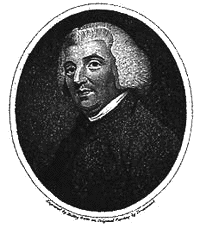 point out the hour of the day; that if the different parts had been differently
shaped from what they are, or placed
after any other manner or in any other order than that in which they are placed,
either no motion at all would have been carried on in the machine, or none which
would have answered the use that is now served by it. . . . the inference we
think is inevitable, that the watch must have had a maker - that there must have
existed, at some time and at some place or other, an artificer or artificers who
formed it for the purpose which we find it actually to answer, who comprehended
its construction and designed its use . . . living organisms are even more
complicated than watches, in a degree which exceeds all computation . . . how
else to account for the often amazing adaptations of animals and plants? . . .
only an intelligent Designer could have created them, just as only an
intelligent watchmaker can make a watch."
(William
Paley, 1802).
Portrait
of Wm. Paley
point out the hour of the day; that if the different parts had been differently
shaped from what they are, or placed
after any other manner or in any other order than that in which they are placed,
either no motion at all would have been carried on in the machine, or none which
would have answered the use that is now served by it. . . . the inference we
think is inevitable, that the watch must have had a maker - that there must have
existed, at some time and at some place or other, an artificer or artificers who
formed it for the purpose which we find it actually to answer, who comprehended
its construction and designed its use . . . living organisms are even more
complicated than watches, in a degree which exceeds all computation . . . how
else to account for the often amazing adaptations of animals and plants? . . .
only an intelligent Designer could have created them, just as only an
intelligent watchmaker can make a watch."
(William
Paley, 1802).
Portrait
of Wm. Paley
Naturalism: (1)
In general, the philosophical belief that what is studied by the
non-human and human sciences is all there is, and the
denial of the need for any explanation going beyond or outside the
Universe. All such naturalists since Darwin insist especially upon
the evolution, without supernatural intervention, of higher forms of
life from lower and of these in turn ultimately from non-living
matter. (2) (in philosophical ethics) Particularly since G. E.
Moore, the view held by those who, taking the naturalistic fallacy
to be not really a fallacy, insist that value words are definable in
terms of neutral statements of fact - not excluding even statements
of putative theological fact. Earlier, and surely better, usage
allowed any secular and this-worldly accounts of value to score as
naturalistic; including those - for instance in Hume - which expose
and eschew that fallacy (A.
Flew, 1979).
Natural Theology
(Physico-theology): Those beliefs that can be
established by reason without divine revelation; the attempt to demonstrate the
existence and activity of God from the phenomena of nature.
Teleology:
The study of design or purpose in natural phenomena; the
use of ultimate purpose or design as a means of explaining natural phenomena;
purposeful development, as in nature, toward a final end. A term applied to any
system attempting to explain a series of events in terms of ends, goals, or
purposes. It is opposed to mechanism, which holds that all events are explained
by mechanical principles of causation. The teleological proof of the existence
of God argues that since there is design (intelligent design) in the world,
there must be a designer - God.
Two forms: (1)
Natural (or internal) teleology - teleological features attributable to some
natural phenomenon, and (2) Artificial (or external) teleology - teleological
features attributable to purposeful action consciously carried out by an agent
(F.
Ayala, 1998).
Albert Einstein once asked, does the moon exist when no one is looking at it? Such
questions had been the preserve of philosophers, but with the discovery of
quantum mechanics in the 1920s they became legitimate queries for
physicists, as well.
Niels Bohr, one of the founders of quantum mechanics, did not believe
that science grants us access to an objective reality and insisted that the
task of physics was not to find out "how nature is" but only "what we can
say about nature". Einstein, on the other hand, maintained an unshakeable
belief in a reality that exists out there. Otherwise, he said, "I simply
cannot see what it is that physics is meant to describe". ....More
New Scientist
Some Relevant Scripture
Ps. 19:1
"The heavens declare the glory of God: the skies proclaim
the work of his hands." (NIV)
Ps. 97.6 "The
heavens proclaim his righteousness, and all peoples see his glory."
(NIV)
Rom. 1:20
"Ever since the creation of the world his eternal power
and divine nature, invisible though they are, have been understood and seen
through the things he has made." (NRSV)
Video Presentations
'God: new evidence,' these feature Revd. Dr. John
Polkinghorne, the former professor of Mathematical Physics at Cambridge
University, Revd Dr. David Wilkinson, the principal of St. John's College,
University of Durham (a former astrophysicist) and Revd Dr. Rodney Holder of the
Faraday Institute in Cambridge, also a former astrophysicist
(Focus UK, David A. Couchman)
General Papers
(Intelligent Design is discussed
here)
We first ask the Question "Who is apologetics for?
Ronald G. Larson, "Revisiting
the God of the Gaps," PSCF 61 (March
2009): 13
Although
design arguments for the existence of God are sometimes dismissed as
God of the Gaps apologetics, reasons for rejecting them based on the history
of science, philosophy, religion, and pragmatism are not as compelling as is
often implied. I argue that using multiple evidences of design in nature,
with regular updates to accommodate new findings, can be a sound and
convincing approach to apologetics.
John W. Hall. "
Chance
for a Purpose," PSCF 61 (March 2009): 3.
In our popular understanding, chance implies a lack of
purpose. Consequently, the presence of chance or stochasticity in some
physical and biological processes has led to the inference that the universe
has no purpose. But we ourselves construct systems with stochastic features
for our own uses. Several such systems were investigated to elucidate how
the set of possible outcomes of a stochastic process is related to the
global and local purposes of the system. One observation is that when every
possible outcome is compatible with a particular purpose, the outcomes may
be described as “purpose-equivalent.” This and other insights are used in
investigating the relationship of two created systems with what we know of
God’s purposes. These are the physical processes that produced the
distribution of matter in the universe and biological evolution. How
stochastic processes relate to other forms of divine action is also
discussed.
David Snoke,
"Defining
Undesign in a
Designed Universe," PSCF 60 (December
2008): 225.
The argument from design,
recast today in the Intelligent Design movement, relies critically on the
contrast of designed things with undesigned things. This poses a problem for
Christians, however, because they affirm that God designed the whole
universe. How then can we call anything undesigned? I argue that this
problem is equivalent to the problem of free will, or the problem of moral
evil, and as such can be addressed by the same philosophical frameworks
developed in the past for addressing those issues, in particular the notions
of different levels of description and Augustine’s different levels of
giftedness.
William Lane Craig,
"The Existence of God and the Beginning of the Universe."
Truth: A Journal of Modern Thought 3
(1991): 85-96.(web link)The
kalam
cosmological argument, by showing that the universe began to exist,
demonstrates that the world is not a necessary being and, therefore, not
self-explanatory with respect to its existence. Two philosophical arguments
and two scientific confirmations are presented in support of the beginning
of the universe. Since whatever begins to exist has a cause, there must
exist a transcendent cause of the universe..
William Lane Craig,
"Philosophical and Scientific Pointers to Creatio ex Nihilo"
JASA 32.1
(March 1980): 3-13. To answer
Leibniz's question of why something exists rather than nothing, we must posit
three alternatives: the universe either had a beginning or had no beginning; if
it had a beginning, this was either caused or uncaused; if caused, the cause was
either personal or not personal. Four lines of evidence, two philosophical and
two scientific, point to a beginning of the universe. If the universe had a
beginning, it is inconceivable that it could have sprung uncaused out of
absolute nothingness. Finally, the cause of the universe must be personal in
order to have a temporal effect produced by an eternal cause. This confirms the
biblical doctrine of
creatio ex nihilo.
Robert Trundle,
"A First
Cause and the Causal Principle: How the Principle Binds Theology to Science,"
Philosophy in Science
X (2003) pp. 107-135.
Randy Isaac,
"From Gaps to God,"
PSCF 57
(September 2005): 230-234
Arguments for the existence of God
that are based on design often specify an aspect of our natural world that
cannot be explained by our current understanding of the laws of nature. Such a
gap of knowledge is construed as evidence for the existence of a supernatural
being. Critics of this
approach label these arguments as “God-of-the-gaps” fallacies that diminish the
case for a Creator God as the gaps are filled in with increasing knowledge.2
Confident that all such gaps
will some day be filled via the scientific method, many people reject design
arguments for God. However, gaps of knowledge do exist in nature and the
scientific community acknowledges that many cannot be filled, even in principle.
This article surveys various types of gaps and considers their role in an
argument for God.
Dennis Jensen, "Pain,
Pleasure and Evolution: An Analysis of Paul Draper's Critique of Theism,"
PSCF 51.1
(March 1999): 40-46)
Murphy, George L.,
Cross-Based Apologetics for a Scientific Millennium
PSCF 52.3:190-193
(9/2000).
Padgett, Alan G.,
The Roots of the Western Concept of the 'Laws of Nature': From the
Greeks to Newton
PSCF 55 (December 2003):
212-221.
Harley B. Potter, "How
to End Science's Border War: A Conceptual Framework,"
PSCF 51 (June
1999): 98-101.
David Snoke, "The
Apologetic Argument," PSCF
50 (June 1998): 108.
Peter Zoeller-Green, "Genesis
Quantum Theory and Reality: How the Bible agrees with Quantum Physics - An
Anthropic Principle of Another Kind: The Divine Anthropic Principle,"
PSCF 52 (March 2000): 8.
Intelligent Design
In the mid 1980s the topic of
"intelligent design (ID)" emerged to capture the attention and
 support of many in the evangelical world and raise the ire of the scientific
community.
support of many in the evangelical world and raise the ire of the scientific
community.
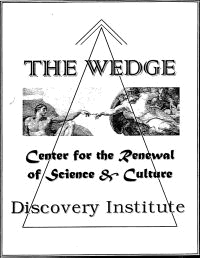
ID has stirred passions within and outside of the Christian world and a well
funded movement promotes a
Wedge Strategy
featuring a broad social, political, and academic agenda whose ultimate goal is
to "defeat [scientific] materialism" represented by evolution, "reverse a
stifling materialist world view and replace it with a science consonant with
Christian and theistic convictions" and to "affirm the reality of God." One part
of the program involves advocating discussion of ID in the public school.
In the second decade of the 2ist C. there is little consensus over the value of ID as an apologetic or as a
part of science. More than 25 years of endless discussion has seen
hardened attitudes, brought out bursts of angry rancor, and built walls of
mistrust among Christians who should know better.
A
Christianity Today Village Discussion on ID (2010)
A November 2011
Discovery Institute (DI) article "Phillip
Johnson on the Scientific Nature
of Opposition to Darwinian Theory" illustrates the rhetorical strategy and
logic that characterizes this anti-evolution
movement today.
Johnson was initially motivated by the way that a high school teacher force
fed evolution to his children. It is difficult not to conclude that his
basic objection to evolution was religious in the light of his evangelical faith
rather than a carefully worked out scientific study that not only demonstrated
the flaws in contemporary evolutionary studies but provided an alternative
scientific explanation for the diversity of life. Johnson's deeply held
views followed the line of many other Christians in the 1980s and today. He
lamented the fact that "naturalistic methods" reigned in the science of both
atheist and Christians in the field.
Rather than join the cause of the creation scientists who
followed main-stream science in all but questions of origins which fell in the
realm of God and miracles Johnson attacked the
philosophy that undergirded scientific method -
methodological
naturatism,
A historian comments:

"I don't think that God is obliged entirely to "hide" himself in the creation. At the same time,
I share Polkinghorne's view that "The world is not full of items stamped 'made by God' -- the
creator is more subtle than that -- but there are two locations where general hints of the divine
presence might be expected to be seen most clearly." One of those is cosmic history, the other
our own consciousness. As Polkinghorne likes to say, "when the astronomer peers into her
telescope, she needs to remember that the most complex object in the universe is six inches
behind the eyepiece."

The "biggest problem" with ID, as I see it, is "the inability to separate ID from the politics of the
"culture wars." It isn't hard to find leading ID advocates linking these inseparably. So, for
those who find the ideas themselves interesting and worth considering, but who reject the
cultural warfare that the ideas are explicitly said to be linked to, what are we to do?

Furthermore, what are we to make of ourselves, those of us who believe that an inference to
purpose/design in the universe is larger than science alone, that it depends also on
metaphysics/theology? I know quite a few Christians in the sciences who believe that one can
in fact make design inferences from nature, but not independently of theodicy and prior
conceptions of who the designer actually is. Are we ID advocates, or not? I find the general
thrust of ID persuasive myself--the universe and its parts really are too complex in specified ways
to have been the product of "blind chance," as Christians and others have called it for centuries.
But, I also hesitate to claim "proof" of this from the mere absence of presently known specific
mechanisms that could have produced such complex objects."

"So--does this make me an adherent of ID?  To the best of my knowledge, no, because of my
belief about the importance of metaphysics and theology in drawing design inferences. On the
other hand, what of my sympathies toward the larger picture and my support for a modest natural
theology?  Does this make me an ID or just the kind of TE that some IDs seem not to appreciate?"

"The bottom line, for me, is that I believe what I believe, without regard to the categories we
sometimes quite artificially impose on people and their ideas/beliefs. In my opinion, the culture
wars seem to require "proofs" to support a particular agenda and to oppose the equally shrill claims
of Richard Dawkins and company. In culture wars, those who sit in the middle of the road tend to
end up as road kill. I suggest that drivers are often responsible for what they hit, particularly if it
doesn't just jump in front of you around the next bend in the road.  A little more delicacy in
navigation might leave some more of the truth alive."--ASA Listserv
A scientist comments:
"In principle, ID as a scientific research program could be separated from ID as a "movement,"
and most of my  criticisms have been directed toward the latter.

However -

1)  "In principle" is one thing but the actual history is another.  I recall that Phillip Johnson was
cranking up his anti-naturalism rhetoric well before any of the claims of Michael Behe or Bill
Dembski became prominent, and that "movement" was ready to glom onto specific ID ideas pretty
much when they emerged from the womb. ID as a scientific research program alone has never
really existed.  It has always been marked by Johnson-like  cultural confrontation.

2)  The major things that I have always focused on in criticizing ID are:
a)  The failure of the movement's spokespersons to be straightforward about their theological
agenda. On one hand there's Dembski saying that ID is just the Logos doctrine of the Gospel
of John in the language of information theory, but when theological questions or challenges are
raised, the response is "There's no theology here. We're just scientists and philosophers." (I'm
speaking of ID leaders.)
b)  When one starts looking at the theology that is implicit in ID claims, it isn't very good.

3)  I don't want to give the impression that my criticisms of ID are only theological. I focus on that
1st because it doesn't get enough attention & 2d because molecular biology isn't my scientific
specialty. But I think there is plenty wrong with ID scientifically. For one thing, the jump from the
claim that at a particular time certain processes haven't been explained in terms of natural processes
to the claim that they can't be so explained is unjustified. Things like the bacterial flagellum should
have been described not as "irreducibly complex" but as "not-yet-reducibly complex." The fact that
Behe et al resist evidence that some steps of things like the blood-letting cascade, the flagellum or
the immune system can be explained in terms of natural processes is quite
significant."--ASA Listserve
Dialogue
from the pages of
PSCF
The 2008 Round
Groothuis, Douglas. “Intelligent
Design and the State University: Accepting the Challenge,” PSCF
60 (December 2008): 233.
The emerging discipline of Intelligent Design (ID)
is a legitimate scientific research program and, therefore, should be taught as
such at the state university. I argue that the design inference is a reliable
means of detecting design in nature which relies on no uniquely religious
assumptions. However, ID does grant some intellectual credibility to Christian
theism since it directly challenges the monopoly of naturalism in science and
thus opens the door to claims that the Christian God is the Designer of nature.
Thorson, Walter R. “A
Response to Douglas Groothuis,” 60: (December
2008): 240.
Douglas Groothuis’ proposal to make
“intelligent design” (ID) the focus of a Christian apologetic in the university
community is a bad idea. It would publicly associate Christianity with debatable
claims that design arguments are scientific, and also with hostile attitudes to
scientific tradition. Dismissing “naturalism” as a presupposition of science is
a particularly questionable move. In this response to Groothuis’ article, I
argue, first, that the continuing controversy over ID has some disturbing
parallels with earlier controversies over recent-earth creationism; second, that
while there are a few legitimate arguments for ID, most are superficial, both
scientifically and philosophically. The ambivalence or hostility of most ID
arguments toward any kind of biological evolution is also significant. I argue
that while ID is legitimate as natural theology, it is certainly not an agenda
for scientific enterprise; in a brief account of the ID movement, I survey
various arguments for ID. Finally, I discuss why attacking “naturalism” is
misguided; in the long run, it damages the credibility of those arguments (such
as Michael Behe’s) that have some scientific merit.
Howard Van Till, Mark Discher and
others on Intelligent Design
Van Till and Intelligent Design.
Mark Discher,
PSCF 54
(December 2002): 220.
Is the Creation a "Right Stuff" Universe?
Howard J. Van Till,
PSCF
54
(December 2002): 232.
Is Howard Van Till's Response to "Van Till and Intelligent
Design" a "Right Stuff Response?
Mark Discher, PSCF
54
(December 2002): 240.
David J. Krause, "Discher
Analysis Raises Concerns,"
PSCF 55 (March 2003: 68[PDF]
George H. Blont, "Intelligent Design and Right Stuff: Where is the
Truth?"
PSCF
55 (March 2003: 69
[PDF]
David F. Siemens, Jr., "On Dischers Reply to Van Till,"
PSCF 55
(March 2003: 69
[PDF]
Adrian Teo, "Thomas Aquinas and RFEP,"
PSCF
55 (June 2003): 136.
[PDF]
Ben M. Carter, "Response to Discher and Van Till Dialogue",
PSCF 55
(June 2003): 137.
[PDF]
Thaddeus Trenn, "On Super-Intelligent
Design"
PSCF
55 (June 2003): 137.
[PDF]
____________________________________________________________
...the
directly empirical level does not exhaust the substance of science, and design
theories
may bring to science deeper cognitive richness, broader conceptual resources,
and more substantive anchors than a purely (methodologically)
naturalistic science can achieve - Ratzsch
_____________________________________________________________
James Madden and Mark Discher, What
Intelligent Design Does and Does not Imply,
PSCF 56 (December 2004): 286
[PDF]
______ What Would Count as Defeating Naturalism? A
Reply to Van Till,
PSCF
56 (December 2004): 296
[PDF]
Howard J. Van Till, Is the ID Movement Capable of
Defeating Naturalism? A Response to Madden and Discher,
PSCF 56 (December 2004): 292.
[PDF]
Further Papers on ID
Del Ratzsch,
Design: What Scientific Difference Could It Make?
PSCF
56.1:14-25 (3/2004)
The claims that intelligent design theories are not legitimately scientific and
that such theories can carry no genuinely scientific content represent
conventional anti-design wisdom. However, actual supports for such claims come
to remarkably little and tend to implode under scrutiny. Furthermore, demands
confronting design theories are often arbitrarily restricted to the realm of
direct empirical consequences. The precise surface-level empirical upshot of
design theories is, I think, still relatively minimal. But the directly
empirical level does not exhaust the substance of science, and design theories
may bring to science deeper cognitive richness, broader conceptual resources,
and more substantive anchors than a purely (methodologically)
naturalistic science can achieve.
H. Allen Orr,
Annals of Science Devolution Why intelligent design isn't.
New Yorker, May 30, 2005.
(An outsider's view on ID)
William Dembski,
Allen Orr in the New Yorker — A Response
As articles against intelligent design go, this one
is not that bad. At least it gives some sense of the scientific issues that ID
raises. But it also misrepresents ID in some key respects. (28 May, 2005)
Thorson, Walter R.,
Naturalism and Design in Biology: Is 'Intelligent Dialogue' Possible?
PSCF 56.1:26-36
(3/2004)
Seen as natural theology rather than science,
“intelligent design” (ID) is not incompatible with a “naturalistic” approach to
biology proposed earlier (cf. notes 1, 2 below). This paper develops ideas based
on this understanding, emphasizing points of mutual agreement and
some unresolved differences between the two perspectives.
Gavin McGrath, "Intelligent
Design from an Old Earth Creationist Perspective,"
PSCF
58 (September 2006): 252.
Jeff Mino, "Science
or Sience: The Question of Intelligent Design Theory,"
PSCF
58 (September 2006): 226-234.
Michael A. Everest, "Why
Does ID Get (Nearly) All the Christian Press,"
PSCF 58
(September 2006):235-236.
David F. Siemens, Jr., "Mounting
Evidence for Theistic Evolution against Intelligent Design,"
PSCF 58
(September 2006): 239-240.
Dal Ratzsch,
Nature, Design and Science
(2003) Dal Ratzsch
answers questions about Intelligent Design
Wesley Elsberry and Jeffrey Shallit,
Information Theory, Evolutionary Computation, and Dembski's Complex Specified
Information," (Nov. 2003)
Arthur V. Chadwick, "The
Trilobite: Enigma of Complexity A Case for Intelligent Design,"
PSCF 52.4
(December 2000): 233-241.
David F. Siemens, "Two
Prediction Sets and Their Consequences for Applying Intelligent Design Theories,"
PSCF
51.6 (June 1999): 108-113.
Intelligent
design, stripped to essentials, covers a broad range of theistic views. It
includes Van Till's "functional integrity," which insists that God, in the
original creation, provided both the causal principles and physical basis for
the development both of the inanimate universe and terrestrial life.1
This view is not to be confused with deism or process theology, for it holds (1)
that the rational Creator originally established the universe so that, under his
continual providential care, it developed "naturally," and (2) that he is
omniscient, omnipotent, and sovereign.2 Though Van Till is Reformed,
his view is comparable to Luther's teaching that all natural principles are
larvae dei, the masks of God, behind which he is at work.3
Although it is always God at work, we see only the masks, whether we look at the
development of the inorganic, from the Big Bang on, or the total development of
the organic world. This is why we declare with the psalmist, "The heavens
declare the glory of God," while recognizing that "The fool hath said in his
heart, There is no God."4 We recognize God's hand behind natural
events while the fool does not. Indeed, the fool's attitude is the same as that
which brought forth Christ's rebuke: "Except ye see signs and wonders, ye will
not believe."5
Michael B. Roberts,"
Design Up to Scratch? A Comparison of Design in Buckland (1832) and Behe,"
Perspectives on Science and Christian Faith
51.4 (December 1999): 244-252.
Intelligent Design has attracted both its
supporters and denigrators. Behe’s Darwin’s Black Box has been a secular best
seller. This paper1compares
Intelligent Design with nineteenth century Paleyan design, by comparing the
philosophy and methods of Buckland’s lecture on "Megatherium" in 1832 with
Behe’s philosophy in Darwin’s Black Box. Buckland regarded every detail as
showing design and practiced reverse engineering, but Behe regards only the
unexplained to show design. To put it pithily; Buckland saw the demonstration of
design in explaining. Behe sees the demonstration of design in not explaining.
William A. Dembski,
"Intelligent
Design as a Theory of Information," PSCF
49 (September 1997): 180.
For the scientific community, intelligent design
represents creationism's latest grasp at scientific legitimacy. Accordingly,
intelligent design is viewed as yet another ill-conceived attempt by
creationists to straightjacket science within a religious ideology. But, in
fact, intelligent design can be formulated as a scientific theory having
empirical consequences and devoid of religious commitments. Intelligent design
can be unpacked as a theory of information. Within such a theory, information
becomes a reliable indicator of design as well as a proper object for scientific
investigation. In my paper, I shall (1) show how information can be reliably
detected and measured, and (2) formulate a conservation law that governs the
origin and flow of information. My broad conclusion is that information is not
reducible to natural causes, and that the origin of information is best sought
in intelligent causes. Intelligent design, thereby, becomes a theory for
detecting and measuring information, explaining its origin, and tracing its
flow.
Return


 n
this page we will consider arguments framed from the natural world and our
scientific understanding of natural phenomena. Scientific findings and
scientific theory are a two-edged sword - on one hand used to
support Christianity, on another to discredit
it.
n
this page we will consider arguments framed from the natural world and our
scientific understanding of natural phenomena. Scientific findings and
scientific theory are a two-edged sword - on one hand used to
support Christianity, on another to discredit
it.  The
rise of modern science in the 17th century was accompanied by serious concerns
about the effect that the new mechanisms of nature would have on Christianity.
As most of the participants were 'men' of faith (often clerics), there was
intense debate over God's role in nature and the kind of God that apologists
offered.
The
rise of modern science in the 17th century was accompanied by serious concerns
about the effect that the new mechanisms of nature would have on Christianity.
As most of the participants were 'men' of faith (often clerics), there was
intense debate over God's role in nature and the kind of God that apologists
offered.