|
Home
Topics
About Science & Faith
Apologetics
Archaeology &
Anthropology
Astronomy
&Cosmology
Bible & Science
Creation&
Evolution
Education
Environment
Ethics
Historical Studies
Mathematics
Origin of Life
Philosophy
Physical Science
Psychology &
Neuroscience
Science &
Technology Ministry
Teaching & Research
Worldview
Whole-Person Education
Youth Page
Publications
JASA/PSCF
Articles
Book Reviews
ASA/CSCA
Newsletter
Issues
_____________
"The Biblical doctrine of
creation is one of the richest doctrines revealed to us by God.
It reveals to us that the God who loves us is also the God who created us and
all things; at once it establishes the relationship between the God of religious
faith and the God of physical reality.
It is because of creation that
we trust in the reality of a physical and moral structure to the universe, which
we can explore as scientists and experience as persons.
It is because of creation that we know that the universe and everything
in it depends moment-by-moment upon the sustaining power and activity of
God.
It is because of creation that we know that we are not the end-products
of meaningless processes in an impersonal universe, but men and women
made in the image of a personal God. It is by the formulation of
"creation out of nothing" that we affirm that God created the universe
freely and separately, and reject the alternatives of dualism and
pantheism.
To worship God as Creator is to emphasize both His transcendence
over the natural order and His imminence in the natural order; it is to
recognize that His mode of existence as Creator is completely other than
our mode of existence as created.
To appreciate God as
Creator is to recognize that which He created as intrinsically good; the
rationale for scientific investigation, the assurance of ultimate
personal meaning in life, and the nature of evil as an aberration on a
good creation are all intrinsic to such an appreciation.
We believe in
creation. It is unthinkable for a Christian to do otherwise."
Richard Bube-1971
Darwin confided the
following to Harvard botanist Asa Gray in a letter of May 1860:
"I had no intention to write atheistically….I can see no reason, why a man, or other animal, may not have been aboriginally produced by other laws; & that all these laws may have been expressly designed by an omniscient Creator, who foresaw every future event & consequence. But the more I think the more bewildered I become."--
Charles Darwin to Asa Gray- 1860
I never knew the
newspapers were so profoundly interesting. North America does not do England
justice; I have not seen or heard of a soul who is not with the North.
Some few, and I am one of them, even wish to God, though at the loss of
millions of lives, that the North would proclaim a crusade against
slavery. In the long-run, a million horrid deaths would be amply repaid
in the cause of humanity. What wonderful times we live in! Massachusetts
seems to show noble enthusiasm. Great God! How I should like to see the
greatest curse on earth—slavery—abolished!
Charles Darwin to Asa Gray June 5, 1861.
The case for Cosmic
Ancestry is not yet proven, of course. At this point the best reason
to notice it is that the mainstream Darwinian paradigm does not
satisfactorily account for sustained evolutionary progress and the
origin of life on Earth. We will mention some of the flaws in the
Darwinian account, but our primary purpose is to present Cosmic
Ancestry as a viable, new scientific account of evolutionary
progress and the origin of life on Earth.
Brig Klyce
Bloggers Coment!
Science
False So Called
August
2010
The Theories of Natural Selection and Evolution are not science because
they cannot be tested. They fall into the philosophical realm of
tautology. A tautology is a formula whose negation is unsatisfiable.
Karl Popper (1902-1994) wrote extensively about this problem to the
irritation of evolutionists. Although they disagreed with him, they were
never able to negate his philosophically arguments. Karl Popper famously
stated "Darwinism is not a testable scientific theory, but a
metaphysical research program. One of his greatest critiques of
evolutionists is that they only looked for evidence to support their
theory. True scientific method searches for other evidence, forms other
hypotheses and seeks to disprove the favored hypothesis. None of this is
allowed in the field of evolutionary studies. Strangely, as critical as
Popper was of evolutionary science, he remained committed to it.
It's
"Only a Theory"
Benjamin...
The fact is, evolution is a theory to explain numerous facts, not a
single fact to be tested in a laboratory. Christians often argue that
"evolution is only a theory, not a fact," as if it's some nebulous
philosophy. When we say those things, we completely embarrass ourselves.
Evolution is indeed "only a theory," BUT a theory is higher than a fact,
for a theory explains all the facts. We don't say that the theory of
gravity is "only a theory." The theory of gravity will never grow up
into a fact. All the creation scientists have to do is produce one fact
that does not fit within the theory of evolution, and the theory will be
changed or undone. In fact, science is a very competitive field, and you
only make a name for yourself by proving that something someone said
before you is wrong. Scientists would LOVE a verifiable test that can be
repeated in a laboratory that would fit outside the theory of evolution
so a newer, more comprehensive theory can take its place. In fact, I
believe someday that will come. Just as the theory of gravity was
subsumed into the far more encompassing theory of relativity, so the
theory of evolution will continue to be expanded to give us a clearer
picture of the workings of nature.
But to call
it a mere philosophy that isn't falsifiable is misguided. All a creation
scientist has to do is head into laboratory with a primitive form of
bacteria and let these bacteria reproduce for a period of ten years. An
entire generation of bacteria live and die within about a 24 hour
period. Over a period of years, thousands of generations pass, giving us
a chance to observe evolution in a fast forward mode. All creation
scientists have to do is conduct this experiment and demonstrate that no
evolution has occurred. But in fact, scientists have already done this
with upwards of 30,000 generations of bacteria reproduction and have
seen repeatable and predictable evolutionary changes in the bacteria. In
fact, this happens with viruses, which is why we have to have a
different flu shot each year. We kill the viruses, but the mutated
generations live to evolve into a new strain. If you believe evolution
is a false philosophy, don't get your flu shot.
But here's
where God screams out his name. Each time these bacteria tests have been
done, these bacteria evolve in nearly the same way each time. What this
demonstrates is that evolution is not "random," but directed. That shows
intelligence and purpose. Rewind the clock of time, refire the big bang,
and eventually, you'd have upright intelligent creatures that are fully
self-aware and capable of knowing and worshiping God. Evolution may
appear random on a micro scale, but the broader picture reveals purpose
and design. Unfortunately, we Christians have surrendered the territory
known as science and have left Dawkins and company to interpret the data
to a new generation of future atheists. We will answer for that someday.
|
|
ASA Statements |
Biblical/Theological Papers
|
| Evolution Basics
|
Historical Papers | | News |
Polls |
Resources
| Scientific Papers |
| Spectrum of Views
| On-line Science Journals |
Youth Resources
|
No topic in the world of
'science and Christianity' has
fostered the intensity of discussion and
disharmony with
evangelicals as the source of biological diversity. The pages of Perspectives
on Science and Christian Faith (PSCF)
reflect the tensions for a community which claims to
value both the Bible and science yet finds it difficult to forge a
view on origins that takes in
to
account both areas of revelation. Various faith-science blogs
debate the details and new discoveries with great gusto.
St Augustine offers this advice:
"...In matters that are so obscure and far beyond
our vision, we find in Holy Scripture passages which can be
interpreted in very different ways without prejudice to the faith we
have received. In such cases, we should not rush in headlong and so
firmly take our stand on one side that, if further progress in the
search of truth justly undermines this position, we too fall with
it. That would be to battle not for the teaching of Holy Scripture
but for our own, wishing its teaching to conform to ours, whereas we
ought to wish ours to conform to that of Sacred Scripture."
A June 2011
Christianity Today
article "The Search for the Historical Adam" and
a later web site
editorial "No Adam, No Eve, No Gospel"
drew much interest from evangelical publications,
web pages, and
bloggers of many persuasions. It described recent advances in genetics that suggested
the need for reconsideration of the traditional Christian understanding of Adam and
Eve.
In short, well established genetic studies have concluded that humanity
could not have begun with an initial human pair uniquely given souls by
God; rather the complexity of the human genome required an original
population of ~1,000.
While anti-evolution advocates sought to pick holes in the scientific
picture, biblical scholars have
sought to develop interpretations that
join an evolutionary process with the biblical text. C.
John Collins
(Did Adam and Eve Really Exist?
Crossway 2011) finds a contemporary
population while Peter Enns, The Evolution of Adam,
What
the Bible Does and Doesn't Say about Human Origins,
Brazos Press (2012) sees Genesis as not directed to primarily provide objective
historical and scientific information but
to offer a statement of the story of nation of Israel within the context
of Near East history.
Others treat the
biblical text in a different way. However
most feel the Augustinian picture to be
persuasive.
There is
certainly
much more at stake here than with earlier science-faith impasses in
medicine or astronomy.
It is important that the reader review the basic themes of the
topics "About Science and Faith" and
"The Bible and Science." These sections will prepare you
for the challenges of Ancient Near East literature, the
enduring misunderstandings produced by erroneous readings of the Hebrew text,
claims that the Bible anticipates aspects of modern science,
translations biased by the influence of ancient philosophy, the
claims of modern statements on the inspiration and
inerrancy of the Bible, controversies over literal vs. symbolic readings
of early Genesis, and much more..
All of this is taking place in an active scientific environment
concerned with related topics.
_________________________________
A Recent News Item: "A
4.4 million-year-old skeleton nicknamed “Ardi” by scientists who
found
her remains in Ethiopia show this earliest known
ancestor of humans was a lot more like us
than
chimps or apes-"-
Bloomberg.
Our page points to PSCF and other sources that focus on the
religious significance of the
creation/evolution issue and concerns over the evidence that supports evolution.
The ASA has no
official position on evolution; its members hold a diversity of views with varying degrees of
intensity.
Advocates and foes of evolution alike
have often gone far beyond the science of the
subject to advance
various causes. Despite the cries of those who claim a corner on the Truth,
the importance of "beliefs"
and "feelings" on all sides reduces the chances for consensus. Too
often, would-be authors are not familiar
with current research. Scientists, philosophers and theologians are rightly concerned with those who would
speak learnedly about fields with which they have only
a surface knowledge.
Today's spirited discussion
often pits Christian vs. Christian and scientist vs. scientist when it
comes to points of interpretation. Public debates over education and the
"culture wars" keep the pot boiling. We offer creditable resources from
which the reader can draw his/her own position.
Try these two articles:
Harry L. Poe, "The English Bible and the Days of
Creation: When Tradition Conflicts with Text," PSCF
66, Sept. 2014: (130-139)
PDF
and
David L. Wilcox, "Genetic Insights for Human Origins in Africa and for
Later Neanderthal Contact." PSCS 66, Sept. 2014: (140-153).
PDF
Recent
polls that indicate the mood of the American public:
Public’s Views on Human Evolution
According
to a new Pew Research
Center analysis, six-in-ten Americans (60%) say that “humans and
other living things have evolved over time,” while a third (33%) reject
the idea of evolution, saying that “humans and other living things have
existed in their present form since the beginning of time.”
.
In U.S., 46% Hold Creationist View of Human Origins:
Highly religious Americans most likely to believe in
creationism
PRINCETON, NJ -- Forty-six percent of Americans believe in the
creationist view that God created humans in their present form at
one time within the last 10,000 years. The prevalence of this
creationist view of the origin of humans is essentially unchanged
from 30 years ago, when Gallup first asked the question. About a
third of Americans believe that humans evolved, but with God's
guidance; 15% say humans evolved, but that God had no part in the
process.
more
Joe E Martin, "
Compatibility of Major U.S. Christian Denominations with Evolution,
Evo Edu
Outreach (2010) 3:420–431 (on-line) ...."An informal survey of major
Christian organizations and
denominations in the United States, based
mostly
on publicly available statements, indicates that in fact most
Christians, as
represented by their governing
bodies, view evolution as being compatible
with their faith. Although
on a worldwide basis this is largely a result of
the high number (estimated at 1.2 billion) of adherents to Catholicism,
even
in the United States, where Protestants
outnumber Catholics and where
anti-evolution sentiment runs high there is more acceptance than non-acceptance
of evolution among Christians, based on statements from their
organizing bodies or spokespersons."
************************************
Sixty+ years of ASA publications reflect the paths that English speaking
evangelicals have
taken on biological origins. What was essentially a 1950s concordistic - literal approach between
the early chapters of Genesis and the science of the day has become a complex matrix of
literary and concordistic treatments that take into account ancient Near East (ANE) cultures
and
recent advances in the
scientific understanding of nature.
A Spectrum of Creation Views
held by Evangelicals
All Christians in the sciences affirm the central role of the Logos in creating
and maintaining the universe. In seeking to describe how the incredible universe
has come to be, a variety of views has emerged in the last two hundred yea rs
as
continuing biblical and scientific scholarship have enabled deeper
understanding
of God's word and world.
Challenges to the church via cultural issues have had
their effects on faith
science thinking. rs
as
continuing biblical and scientific scholarship have enabled deeper
understanding
of God's word and world.
Challenges to the church via cultural issues have had
their effects on faith
science thinking.
Today we see a range of views
on natural history that have
developed out of a 'Christian' worldview. They vary according to the
place of scripture and science
in the telling of the story. The place of direct actions of God and
'so-called' secondary causes are
key features of each story. How one reads the Bible, the
role of theology, scientific details and theory,
and the philosophy of science
each color our
thinking.
The Evangelical Spectrum:
Apparent Old Creation:
The universe is recent as recorded in the
Bible but created to look old as found by scientific studies. Al Mohler
Old-earth Creation - Ruin - Reconstruction:
Christian Geology Ministry,
Gaines R. Johnson
Old-earth
progressive creation:
God's direct role in creation as
consisting of separate
creative acts spread out over several billion years
of time. J. J.
Davis, G.
Mills,
Hugh Ross - Reasons to Believe
Evolving Creation (Theistic Evolution):
God's
activity is typically progressive in time, and
potentially understandable in terms of cause-and-effect sequences of
physical or historical
events.
K. Miller,
Robert, J. Schneider,
Denis R.
Venema
One Time
Creation:
God has created a universe which depends
continually upon God, but
which has been endowed with the ability to accomplish what God wants it to
accomplish
without
any "corrections" or "interventions." G.
Murphy,
H. VanTill
We provide a series of papers and books that emphasize various aspects
of biological origins. They
are
arranged
under the categories of Historical,
Scientific, and
Biblical/Theological papers.
Then follows
a friendly exchange in PSCF
on
evolutionary psychology. An earlier dialogue
Theistic Evolution offers
a shorter
introduction. Younger surfers should check-out
Fish Wars.
Many
anti-evolution ministries parade the alleged and real deficiencies
of evolutionary descriptions for the development of life - a half empty cup that
cannot be filled.
An alternative approach sees - a cup half filled that needs work
- which seems
more appropriate for an organization of scientist-Christians.
________________________________________________________
Evolution Basics
Non-coding half of human genome unlocked with novel sequencing
technique
Recent News:
Texas A&M University biology doctoral student John C. Aldrich (left),
working with associate professor of biology Dr. Keith A. Maggert
(right), has developed an inexpensive, fluorescent-dye-based sequencing
technique to monitor DNA-related dyanmics in heterochromatin -- a
game-changing discovery that lays the groundwork to study the non-coding
half of the human genome.
October 7, 2014
Filed under on
Thursday, February 7, 2013.
GAINESVILLE, Fla. — An international team of scientists including University
of Florida researchers
has generated the most comprehensive tree of life to date on placental
mammals, which are those bearing live young, including bats, rodents,
whales and humans. Appearing Thursday in the journal Science, the study
details how researchers used both genetic and physical traits to
reconstruct the common ancestor of placental mammals, the creature that
gave rise to many mammals alive today. The data show that contrary to a
commonly held theory, the group diversified after the extinction of
dinosaurs 65 million years ago. The research may help scientists better
understand how mammals survived past climate change and how they may be
impacted by future environmental conditions.
A
Biologos video which address the age question. 17
min. (2012)
What would have made them laugh? Or cry? Did
they love home more than we do? Meet the
real Neanderthals. A NEANDERTHAL
walks
into a bar and says... well, not a lot, probably.
Certainly he or she could never have delivered a full-blown joke of the
type modern humans
would recognize because a joke hinges on surprise juxtapositions of
unexpected or impossible
events. Cognitively, it requires quite an advanced
theory of mind to put
oneself in the position
of one or more of the actors in that joke - and enough working memory
(the ability to actively
hold information in your mind and use it in various ways).
more...
Introduction:
Evolution, the
overarching concept that unifies the biological sciences, in
fact embraces a plurality of theories and hypotheses. In
evolutionary debates one is apt to hear evolution roughly
parceled between the terms "microevolution" and
"macroevolution". Microevolution, or change beneath the species
level, may be thought of as relatively small scale change in the
functional and genetic constituencies of populations of
organisms. That this occurs and has been observed is generally
undisputed by critics of evolution. What is vigorously
challenged, however, is macroevolution.
Macroevolution is evolution on the "grand scale" resulting in
the origin of higher taxa. In evolutionary theory,
macroevolution involves common ancestry, descent with
modification, speciation, the genealogical relatedness of all
life, transformation of species, and large scale functional and
structural changes of populations through time, all at or above
the species level (Freeman
and Herron 2004; Futuyma
1998; Ridley
1993).from t.o archives.
JUNE 17TH, 2011
by Monica Slinkard
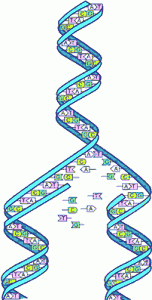 Since
the announced completion of the human genome project in April 2003,
the
scientific community has been working to decipher the meaning of the
approximately
24,000 genes in the human genome. In case you don’t remember from
high school biology
(or chemistry), genes are specific sets of DNA unique to every
single organism, and the
code contained in a person’s DNA is part of what makes them who they
are, for better or for worse.
But when it comes to understanding the exact ways in which DNA
differences define unique
characteristics of a person at the cellular level, in
the way cells function and malfunction, even the most learned academics agree that the science of genomics
has a very long wayto go.Dr. Liskin Swint-Kruse, an ASA member and a professor of
biochemistry at the University of
Kansas Medical Center, has high hopes. Really high.
high—Liskin compares the quest for mastering
genomics to the challenge of putting a man on the moon at the turn
of the century (the last century).
To an early 1900’s stargazer, the impossibility of walking on the
dark side of a glowing orb in space is a
fitting comparison to the distance scientists must travel before
they unlock the subtleties of how DNA Since
the announced completion of the human genome project in April 2003,
the
scientific community has been working to decipher the meaning of the
approximately
24,000 genes in the human genome. In case you don’t remember from
high school biology
(or chemistry), genes are specific sets of DNA unique to every
single organism, and the
code contained in a person’s DNA is part of what makes them who they
are, for better or for worse.
But when it comes to understanding the exact ways in which DNA
differences define unique
characteristics of a person at the cellular level, in
the way cells function and malfunction, even the most learned academics agree that the science of genomics
has a very long wayto go.Dr. Liskin Swint-Kruse, an ASA member and a professor of
biochemistry at the University of
Kansas Medical Center, has high hopes. Really high.
high—Liskin compares the quest for mastering
genomics to the challenge of putting a man on the moon at the turn
of the century (the last century).
To an early 1900’s stargazer, the impossibility of walking on the
dark side of a glowing orb in space is a
fitting comparison to the distance scientists must travel before
they unlock the subtleties of how DNA
works.
Full
Article
This
PBS
resource is a good startingpoint
See a detailed list of "Early Humans".
We thank Ashley, a student at the Kent School
for directing us to
this site.
In this Biologos series, Gordon J. Glover examines both sides
to the evolution controversy as it relates to the Bible.
He asserts that whether evolution is true or false, it creates
theological problems. Therefore, it is necessary for pastors,
seminary professors, and theologians to seriously consider the facts and
facilitate honest discussion about the issues
at hand.
Discovering the tree of
Life
Video (10 min.) Yale University Peabody Museum of Natural History
*************************************************
PSCF Special Issue SEPTEMBER 2010
"Adam and Eve as Historical People, and Why It Matters,"
C. John Collins
The best way to account for both the biblical presentation of
human life and our own
experience in the world is to suppose
that Adam and Eve were real
persons, and the
forebears of all other human beings. The biblical presentation
concerns not simply
the story in Genesis and the biblical passages that refer to it, but
also the larger
biblical storyline, which deals with God’s good
creation invaded by
sin, for which
God has a redemptive plan; Israel’s calling to be a light to the
nations; and the
church’s prospect
of successfully bringing God’s light to the whole
world. The biblical
presentation further concerns the unique role and dignity of the human race, which
is a matter of daily experience for everyone: all people yearn for
God and need him,
depend on him to deal with
their sinfulness, and crave a wholesome
community
for their lives to flourish.
"Genesis
and the Genome: Genomics
Evidence for Human-Ape Common Ancestry and Ancestral Hominid Population Sizes,"
Dennis R. Venema
The relatively new and
rapidly expanding field of comparative
genomics provides a wealth of data useful for testing the hypothesis
that humans and other forms of life share
common ancestry. Numerous independent lines of genomics evidence
strongly support the hypothesis that our
species shares a common ancestor with other primates. Additional lines
of evidence also indicate that our species
has maintained a population size of at least several thousand individuals
since our speciation from the ancestors
of other great apes. This article will provide an overview of genomics
evidence for common ancestry and hominid
population sizes, and briefly discuss the implications of these lines of
evidence for scientific concordist approaches to the
Genesis narratives.
Recent Genetic Science and Christian Theology on Human Origins: An
“Aesthetic Supralapsarianism” John R. Schneider
Recent genomic science strongly supports
the theory of common ancestry. To classical
Protestants,
particularly, this theory seems incompatible with Scripture, most
especially with the “historical Fall,” which Protestants
presume to be manifestly biblical and so have cemented it securely
into their confessions and theology as a whole. Nevertheless,
John Schneider proposes that it
is important for traditional Protestants to consider alternatives to
this essentially “Augustinian” view. He invites readers to examine Eastern thinking (mainly in
Irenaeus of Lyon) together with a minority of Protestants (such as
Karl Barth and
supralapsarian Calvinists), for whom the Incarnation and Atonement
are the purpose of creation from the
beginning.
Their understanding differs from the execution of divine
“Plan B,” as implied by the Augustinian western version of an unintended “fall”
from
utopian first conditions. Schneider appeals to a fresh reading of
the book of Job in support of an
“aesthetic supralapsarianism,”
which sustains Protestant virtues of
biblical authority, divine sovereignty, and grace, while
opening avenues to compatibility with
evolutionary science.
"After
Adam: Reading Genesis in an Age of Evolutionary Science,"
Daniel C. Harlow
Recent research in molecular biology, primatology, sociobiology, and
phylogenetics
indicates that the species Homo sapiens cannot be traced back to a
single pair of
individuals, and that the earliest human beings did not come on the
scene in anything
like paradisal physical or moral conditions. It is therefore difficult
to read Genesis 1–3
as a factual account of human origins. In current Christian thinking
about Adam and
Eve, several scenarios are on offer. The most compelling one regards
Adam and Eve
as strictly literary figures—characters in a divinely inspired story
about the imagined
past that intends to teach theological, not historical, truths about
God, creation,
and humanity. Taking a nonconcordist approach, this article examines
Adam and Eve
as symbolic literary figures from the perspective of mainstream biblical
scholarship,
with attention both to the text of Genesis and ancient Near Eastern
parallels. Along the
way, it explains why most interpreters do not find the doctrines of the
Fall and original sin
in the text of Genesis 2–3, but only in later Christian readings of it.
This article also
examines briefly Paul’s appeal to Adam as a type of Christ. Although a
historical Adam
and Eve have been very important in the Christian tradition, they are
not central to
biblical theology as such. The doctrines of the Fall and original sin
may be reaffirmed
without a historical Adam and Eve, but invite reformulation given the
overwhelming
evidence for an evolving creation.
Nick Spencer and Denis Alexander,
Rescuing Darwin:
God and Evolution in Britain Today 2009 (Theos)
e-book
Adrian
Desmond and James Moore,
Darwin's Sacred Cause: How a
Hatred of Slavery Shaped
Darwin's
Views on
Human Evolution, Hardcover,
Houghton,
Mifflin, Harcourt, 2009. "Arresting . . .
confront[s] the touchy subject of Darwin and race head on . . .
ADAM’S ANCESTORS: Race, Religion, and the Politics of Human Origins by
David N. Livingstone. Baltimore, MD: The Johns Hopkins University Press,
2008. 301 pages.
PSCF Review
ASA Statements
Richard H.
Bube, "We
Believe in Creation,"
Journal of the American Scientific Affiliation
(PSCF),
23 (June 1971):121-122.
ASA
Executive Council, "A
Voice For Evolution as Science," PSCF, 44 (December 1992): 252.
ASA
Creation Commission Statement (August 2000)
Historical Papers
Hiram
Caton,
Getting Our History Right: Six Errors about Darwin and His Influence
www.epijournal.net 5(1) 2007: 52-69.
James Moore ,
Evolution and Wonder : Understanding Charles Darwin (July
20,2006) on
Charles Darwin’s view of religion,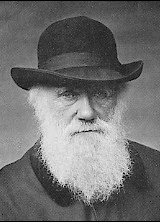 adaptation, and creation. Audio interview
Edward O. Dodson,
Toldot Adam: A Little-Known Chapter in
the History
of Darwinism,
PSCF
52.1:
47-54 (3/2000).
Sara Joan Miles,
Charles Darwin and Asa Gray Discuss Teleology
and Design PSCF 53.3:196-201, 2001.
Michael Roberts,
Was Darwin a Christian? PSCF
52.2:84-85 (6/2000).
Lectures
Dennis Lamoureux,
"Beyond
the Evolution - Creation Debate" (2003)
Scientific
Papers
David
Lathi,
"Looking
to the Birds: A Perspective on the Interpretation of Nature,"
PSCF 55 (March 2003): 14-21
John Bracht,
Natural Selection as an Algorithm: Why Darwinian Processes Lack the
Information Necessary to Evolve Complex Life PSCF
54.4:264-269 (12/2002)
Glenn R.
Morton,
"Transitional
Forms and the Evolution of Phyla," PSCF
53.1
(March 2001):
42-51.
Ronald G.
Larson,
"Viral Evolution:
Climbing Mount Molehill?" PSCF 52 (September
2000):
169.
Lahti,
David,
Evolutionary Theory Misunderstood PSCF 52.3:215-217 (9/2000).
Armin Held, & Peter Rust,"Genesis
Reconsidered" PSCF 51.4:231-243 (12/1999).
Gordon C.
Mills, "A
Design Theory of Progressive Creation." A series of five papers
from 1995 - 1999 describing Dr. Mills' views.
Peter Rust, "How
Has Life and Diversity Been Produced?" PSCF 44 (June 1992): 80.
Junghyung, Kim, "Naturalistic versus Eschatological Theologies of
Evolution," PSCF
63 (June 2011):95.
Snoke, David,
Why Were Dangerous Animals Created? PSCF
56.2:117-125 (6/2004)
Fischer,
Dick,
Young-Earth Creationism: A Literal Mistake PSCF
55.4:222-231 (12/2003)
Morton, Glenn
R. & Simons, Gordon,
Random Worms: Evidence of Random and
Nonrandom Processes in the Chromosomal Structure of Archaea, Bacteria and
Eukaryotes PSCF
55.3:175-184 (9/2003)
Richard
Thornhill,
"The Panda's
Thumb: Design and Optimality from Plato to Endo"
PSCF
55 (March3003): 32-35.
Newman,
Robert C.,
Some Problems for
Theistic Evolution PSCF
55.2:117-128
(6/2003).
Merideth G. Kline,
"Space and Time in the Genesis
Cosmogony," PSCF 48 (March 1996): 2
George L.
Murphy, "Chiasmic
Cosmology and Creation's Functional Integrity, "PSCF
53
(March 2001):7 - 13.
Howard J.
Van Till, . "Basil, Augustine, and the
Doctrine of Creation's Functional
Integrity." Science &
Christian Belief 8, No. 1 (1996): 21-38.
Davis Young,
"The Antiquity and the
Unity of the Human Race Revisted,"
Christian
Scholar's Review
XXIV:4,380-396 (May, 1995)
A Historical
Note
One of the first to carry out a controlled evolution experiment was
the Rev.
William H. Dallinger, a
minister in the English Wesleyan Methodist Church. A talented and
persistent amateur
scientist, he was the first to
study the complete life cycle of unicellular organisms under the
microscope and
the adaptation of such
organisms to changes in temperature. He cultivated small unicellular
organisms in a custom-built
incubator over a time period of seven years
(1880-1886). Dallinger slowly increased the temperature
of the incubator
from an initial 60 °F up to 158 °F. The early cultures had shown clear
signs of distress
at a temperature of 73 °F, and were certainly not
capable of surviving at 158 °F. The organisms
Dallinger had in his
incubator at the end of the experiment, on the other hand, were
viable at
158 °F. However, these organisms would not grow
anymore at the initial 60 °F. He concluded that
this was was clear evidence for Darwinian adaptation, and that the
organisms had adapted to live in a
high-temperature environment.
Unfortunately, Dallinger's incubator was accidentally destroyed in 1886,
and he was unable to continue this line of research. His approach was followed by numerous
workers in the early 20th Century.
--JWH
Youth Resources
http://www.pbs.org/wgbh/evolution/humans/index.html
http://www.peoplefinders.com/article-archaeological-finds-of-early-human
s.aspx >
http://anthro.palomar.edu/primate/prim_8.htmThe
http://www.actionbioscience.org/evolution/index.html
http://www.evotutor.org/
General Books
Bethany Sollereder, "God and Evolution:
A
Review of Four Contemporary
Books,"
PSCF
61 (March 2009): 40-48.
SAVING DARWIN: How to Be a
Christian and Believe in Evolution by Karl W. Giberson.
New
York: HarperOne, 2008. 248 pages, notes, index. Hardcover; $24.95. I
SBN: 0061228788.
ONLY A THEORY: Evolution and the
Battle for America’s Soul by Kenneth R. Miller.
New York: Viking Adult, 2008. 244 pages, notes, index. Hardcover;
$25.95. I
SBN: 067001883X.
THANK GOD FOR EVOLUTION: How the
Marriage of Science and Religion Will Transform
Your Life and Our World
by Michael Dowd. New York: Viking Adult, 2008.
413 pages,
EVOLUTIONARY CREATION: A
Christian Approach to Evolution by Denis O. Lamoureux.
Eugene, OR: Wipf and Stock, 2008. 493 pages, appendices, notes,
glossary, index.
Paperback; $55.00. ISBN: 1556355815.
 Keith
B. Miller, editor; Perspectives on an Evolving Creation 2003
Eerdmans. Keith
B. Miller, editor; Perspectives on an Evolving Creation 2003
Eerdmans.
A strong
Christian case for evolutionary theory According to the authors of this
book, who explore
evolutionary theory from a clear Christian
perspective, the common view of conflict between evolutionary
theory
and Christian faith is mistaken. Written by contributors representing
the natural sciences,
philosophy, theology, and the history of
science, this thought-provoking work is informed by both solid
scientific
knowledge and keen theological insight.
PSCF Review
ebooks:
(free)
Evangelicals, Evolution, and Academics (2008) A series of
short articles by Steve Martin, Keith Miller,
Dennis Verema, Steve Matheson,
Karl
Giberson, Gordon Glover, Douglas Hayworth, and Ted Davis; edited by
Steve Martin.
Ebook and Index for the Student Perspective Series
(2009)
Marlowe C. Embree,
The Social Psychology of the Origins
Debate (2008) An
examination of how
our
attitudes and beliefs are formed, how bias
and prejudice affect
our interaction
with others, and how our thinking
styles and
personality profiles are important factors, all within
the
context of
the
origins debate.
Charles Darwin (1838-41)
The Voyage of the Beagle
Charles Darwin (1859)
The Origin of Species
Charles Darwin (1871)
The Descent of Man
Reference Works
Frederick Gregory, Nature Lost?
Natural Science and the German Theological Traditions
of the
Nineteenth Century.
MA: Harvard University Press, 1992.
Ronald L. Numbers.
The Creationists.
New York: Alfred Knopf, 1992.
____. Darwinism Comes to America, 1998
____________________________________________________________________
Concluding reflections
A Physicist and a historian.
Americans remain "a
spectacularly religious" people..as long as this is the case...there
will be an intense
discussion about origins. Science permeates all of
American society from top to bottom.
The rub
comes where
the scientific elite wields its cultural dominance
irresponsibly and carelessly identifies "scientific knowledge of
origins" with an "exhaustive knowledge or understanding of origins" and
thereby dismisses religious views as
"primitive and therefore false." Religious groups have a responsibility to appreciate that this is
an advanced
scientific culture and deal with the tough issues that come
up. ...the origins debate in America will not go away.
--Giberson and Yerxa, Eastern Nazerene College in Species of Origins: America's Search
for a Creation Story.
A Philosopher
The present state of
the evolution versus religion controversy is that it is currently being
played out as a social, political, and broadly cultural contest roughly
equivalent to the "red-state" and "blue-state" political conflict. The
controversy begun in large volumes of theological and scientific
speculation in Victorian times has now descended to the level of a
bumper-sticker war, in the competing Jesus and Darwin fish symbols that
appear on the rear of automobiles. Evolutionary proponents
continue to publish popular books claiming that evolutionary concepts
can solve every mystery of human existence while religious critics
continue to promote biblical "science" and to exploit the explanatory
gaps in orthodox Darwinian theory. French culture and history moved on
from the political conflicts that resulted from the Dreyfus affair and
left them unresolved. Attempts to resolve the conflicts resulting from
the religion versus evolution controversy are not likely
to be successful because evolutionary materialism
and biblical literalism have become political.
Books on Genesis
--John Caiazza, Rivier College
John Walton
2009. The
Lost World of Genesis One: Ancient Cosmology and the Origins Debate. Non-literal
days. Genesis reflects ancient cosmology.
John Lennox, Seven Days That Divide the
World: The Beginning According to
Genesis and Science (2011)
C. John Collins,
Report of the Creation Study Committee
(Presbyterian Church in America, 2000) A balanced and thorough examination of Genesis 1-3 by a conservative
reformed denomination.
Genesis 1-15 by Gordon J. Wenham (Waco, TX : Word
Books, c1987.)
Other ANE Creation Texts
Dialogues
Evolutionary Psychology
News
and Discussion
Fossil Is Missing Link In Elephant Lineage
A pig-sized, tusked creature that roamed the
 earth some
27 million years ago represents a missing link between the
oldest known relatives of
elephants and the more recent group from
which modern elephants descended, an
international team that
includes University of Michigan paleontologist William
Durham...
Science Daily earth some
27 million years ago represents a missing link between the
oldest known relatives of
elephants and the more recent group from
which modern elephants descended, an
international team that
includes University of Michigan paleontologist William
Durham...
Science Daily
Earth's early battering revealed
Detailed analysis of the oldest rocks on
Earth
throws new light on one of our planet's most violent phases.
BBC News
Resources
AIBS
Evolution Page
The Complete Work of Charles Darwin This site currently contains more than 50,000 searchable
text pages and 40,000 images of both publications and handwritten
manuscripts. There is also the most comprehensive Darwin
bibliography ever published and the largest manuscript catalogue ever
assembled.
More than 150 ancillary texts are also included, ranging
from secondary reference works to contemporary reviews, obituaries,
published descriptions of Darwin's Beagle specimens and important
related works for understanding Darwin's context.
Robert Schneider
has written an up-to-date series of essays on the
theme of Creation.
Thanks to
P. Rust, P. Garrison, D. Fischer, G. Murphy, R. Miller, D.
Campbell,
T. Davis,
M. Roberts, G.
Glover, S.
Martin and T. Gray for their helpful advice .
Return

|


