Your worldview is "your view of the world, used
for living in the world" so in daily living it should be
the dominant influence shaping your decisions-and-actions.* Douglas
Wilson emphasizes the importance of developing a Christian worldview
that is truly in
the heart-and-mind (not just on the tongue) and is converted
into action: "A Christian worldview is not
the same thing as Christian worldview jargon. ... Having a Christian
worldview means living like an obedient Christian in all of life."
* Living a Theistic Worldview: A person who is a theist — who believes (unlike an atheist) that God exists, and (unlike a deist) that God actively “does things” in the world — has a theistic worldview. But if a theist, in their thinking-and-actions, lives as if God is not active, they are not living their worldview, they are not using "their view of the world" {or at least the view they claim to believe} for "living in the world." Instead they are using an atheistic/deistic worldview {so is this what they actually believe?} for their everyday living. / One part of living a theistic worldview is with prayer, by asking God to help you live more effectively.
In this column,
the main theme is converting worldview-IDEAS into worldview-ACTION
for living. It
begins by examining worldviews (shared and individual), followed
by General
Principles that are useful for everyone, and then moving into Ethical
Principles (with
a mixture of general and Christian ideas) and Christian
Living.
Worldview — Shared yet Unique, with Overlaps
The major parts of a Christian worldview
are shared by all Christians. These similarities occur because a conventional Christian worldview is based on principles that are clearly taught in the Bible.* But some sharing-of-parts is
specific to Catholics (or Baptists, Presbyterians,...) and to those
who are not Christian yet have experiences with it — some through
personal experience, and almost everyone through being influenced
by “what they hear” from media, friends, or their own religious leaders. {* And many parts are shared by followers of Judaism, due to major overlaps between Christian worldviews and Judeo-Christian worldviews and Jewish worldviews, which are similar in many ways but differ in some ways.}
A person's "Christian worldview" is
influenced by their beliefs and faith, and also by other factors — their
inherited characteristics and abilities, background experiences and
life context, the values, attitudes, and habits they have developed,
the ways they have been influenced by others (by family, friends, pastors, colleagues, plus a wide variety of media), and more — and these vary from one person to another.
Therefore,
it's not accurate to talk about THE Christian worldview — especially when we're thinking about the worldview(s) we actually use for everyday living, which is "the dominant influence shaping our decisions and actions" — because
each person has a unique personal worldview. But we can think of the beliefs
shared by all Christians as being "the Christian worldview-component"
if we: recognize that this component varies from one person to another
(and one church to another); and if we recognize that Christian
beliefs are only one part – although often
a very important
part – of a person's total worldview.
General
Principles for Living
Some principles for effective
living are general, spanning a wide range of worldviews. For example:
The Seven Habits of
Highly Effective People (by Stephen Covey) summarizes and illustrates
valuable principles for living. I recommend reading this book.
To convince you that it's worth reading, there are summaries (by Covey) of The 7 Habits and (by others) a brief
review, an introductory
summary and a detailed summary in a 10-page outline: inside-out and overview and the habits.
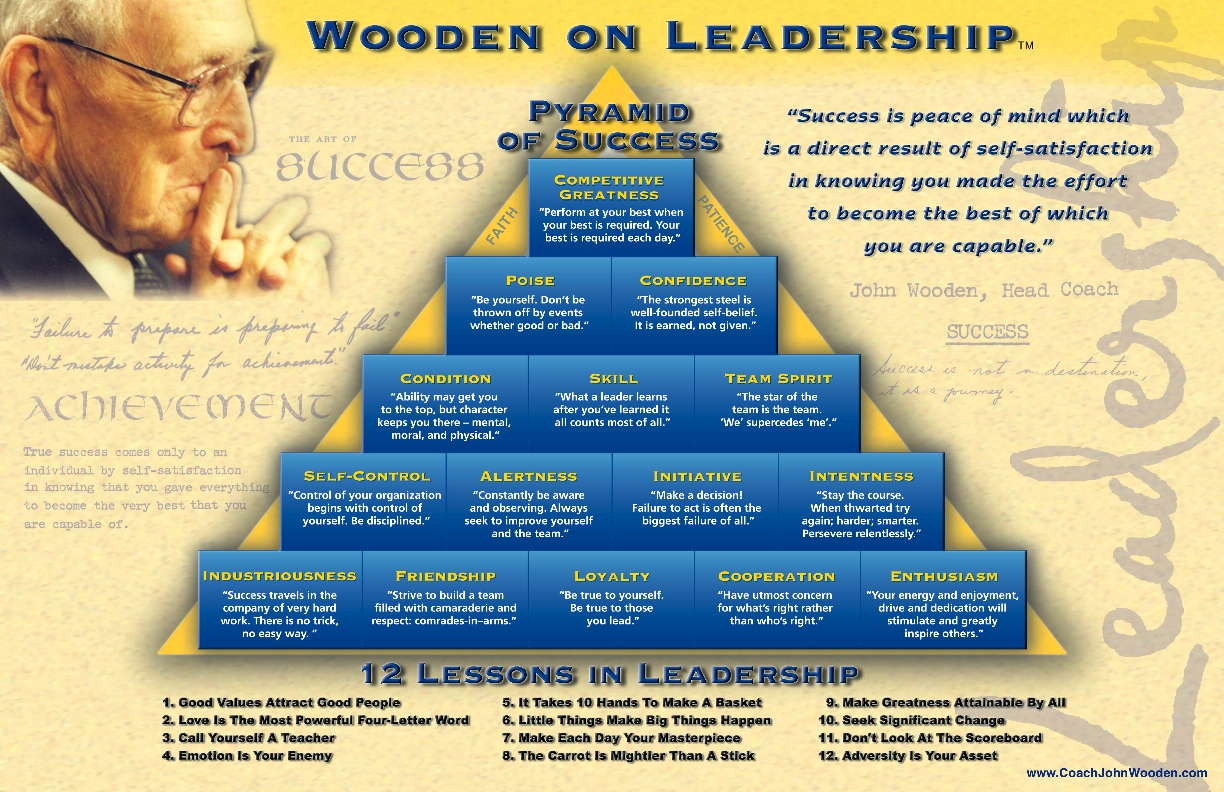
Pyramid of Success: A classic from John
Wooden,
whose UCLA teams won 10 basketball championships in 12 years (1964-1975),
is The Pyramid of Success for athletics and life. Wooden
began with his definition of success — "success is peace of mind,
which is a direct result of self-satisfaction in knowing you made
the effort to do your best to become the best that you are capable
of becoming" — and built a Pyramid
of Success that is useful
in all areas of life; you can learn
about each of the 15 blocks and print
the pyramid.
Conflict Resolution is sometimes necessary.
General Principles for doing it well come from U of Kansas (with a summary of What Why When How + checklist & tools) and Colman
McCarthy (in 9 Easy Steps by trying to build a non-competitive relationship, cooperating because "it's not you versus me, but you and me versus our problem," working together to get a win-win solution) and MindTools (using an Interest-Based Relational Approach to "resolve conflicts in a united, cooperative way... by separating people (and their emotions) from the problem,... building mutual respect and understanding") and A-Management-A ("learning how to handle conflict efficiently... in the workplace") and UC-Berkeley; Conflict Resolution Network uses 12 Skills (summaries with links to details about the skills [win-win approach, creative response, empathy, appropriate assertiveness, co-operative power, manage emotions, be willing to resolve, map the conflict, develop options, use negotiation, use mediation, broaden perspectives] & trainer's manual) and offers Resources. Individuals tend to have-and-use different conflict styles — avoiding (turtle), forcing (shark), accommodating (teddy bear), compromising (fox), cooperating (owl, wisely aiming for win-win) — that each offer benefits (basics & details), that can be chosen & adjusted. (an eclectic mix-page has McCarthy + Styles, with Educational Applications) I.O.U. - Later I'll search for useful videos, re: conflict resolution & christian conflict resolution & more. And soon, late-night Dec 22, I will continue revising this paragraph and the one below.
Christian Principles — similar to General Principles in most ways, but not all* — can be useful for everyone, and especially for Christians: basic Bible-based principles include using character virtues (compassion, kindness, humility, gentleness, and patience, as in Colossians 3:12 → What-and-How of Christian Virtues) and a process based on Philippians 4; also, relevant Bible verses ( 18 100 A B ) and a series from Focus on the Family.
* Here are three differences: • Christian Principles can include General Principles plus principles that are explicitly Bible-based; and in a theistic worldview we believe that... • “what happens” depends on what we do plus what God does, and • God will help us “do it better” when we ask for help with prayer. When I (editor of this page, Craig Rusbult) have said “oops” and asked “why didn't I do this better?” usually my answer-to-self has been “not enough attention to principles (general & Christian) and my process of thinking” and/or “not asking God for help.”
Ethical Principles
Christian Ethics
Byron Borger provides an excellent summary
of important ideas from a book — Choosing the Good: Christian Ethics in a Complex World, by Dennis Hollinger — that he says
is "the best I have yet seen" about Christian
ethics. This book "makes it clear that admitting
ethical complexity is not the same as moral relativism."
{ After his book review, the page continues with his insightful brief descriptions of nine books about
ethics-and-applications. } / I.O.U. - Later, I'll search for more about ethics, including web-pages about [complexity of christian ethics] & [worldviews christian ethics] & reviews of An Introduction to Biblical Ethics (+ other books), and more.
General Ethics
Are ethics and atheism compatible? Can an atheist be ethical? In his introduction to worldviews
and worldview-options, Jerry Solomon seems to question the possibility of non-Christian
ethics when his friend said, "Joe, you're
an excellent doctor. You care deeply about your patients.
Why do you care so much for people since you believe we have evolved
by chance? What gives us value?"
Solomon says, "Joe was stunned by the question
and couldn't answer it. His ‘world view’ had taken a blow."
Do you think Joe should be stunned? or can an atheist have good reasons
for being ethical?
Norman
Geisler, a Christian scholar, respectfully summarizes ideas from The
Ethics of Humanism by Paul Kurtz (author of Humanist Manifesto
II, who claims "there can be an objective
and positive humanist basis for ethical conduct") and then
Geisler critically analyzes the positive and negative aspects of
Kurtz's views.
Ethical principles similar
to Golden Rules — doing for others what you want done for yourself,
or (in a Golden Rule with Empathy) doing for others what they want done for themselves — occur in
a wide range of religions and philosophies, e.g. in Judaism and Christianity.
A basic principle of character
education is the existence of "widely shared...
core
ethical values... that transcend religious and cultural differences
and express our common humanity." (from 11
Principles of Effective Character Education)
Two meanings of tolerance
(old & new) – and intolerant demands based on new "tolerance" – are
examined in APOLOGETICS &
RELATIVISM.
Charles Kay summarizes ethical principles that are general – are not specific to any religion, are consistent with a wide range of worldviews – proposed in five
theories of ethics: Egoism (aiming for "the benefit, pleasure, or greatest good of the self alone") & Utilitarianism (wanting to "promote the greatest good for the greatest number") & Deontological Ethics (behaving in ways you would want everyone to behave, if the goal is producing a good society) & Virtue Ethics (when good actions arise from virtuous character), ...
and a Theory
of Justice by John
Rawls, described in an outline and in encyclopedias of philosophy (Internet & Stanford) and Wikipedia. Rawls asks you to imagine that a veil of ignorance prevents you from knowing your situation in life. You don't know the wealth of your parents or (later in life) of yourself, or your inherited abilities (physical, mental,...), whether you're black or white, or where you live, and so on. In this thought-experiment, you are part of a committee who will determine policies for your society. Richard Beck explains how Christians can use this perspective to develop more empathy and compassion — to understand the situations & perspectives, the thinking & feeling, of others, and want to improve their lives — as a way to think about how society could become more fair, with more justice for more people.
Christian
Living
Some general principles (for
effective living and ethical behavior) are useful for everyone. But a Christian believes
that to live a fully effective life, as defined by God, we need Jesus
Christ.
The essence of living a
Christian worldview is letting God transform your mind and thus
your attitudes, relationships, and actions. Paul
says, "Offer yourselves as a living sacrifice
to God, dedicated to his service and pleasing to him. This
is the true worship that you should offer. Do not conform
yourselves to the standards of this world, but let God transform
you inwardly
by a complete change
of your mind. Then you will be able to know the will of God – what
is good and is pleasing to him and is perfect." (Romans 12:1-2)
A modern summary of The Good News – in The Four Spiritual Laws – says "God loves you and offers a wonderful plan for your life" and ends by describing a Christ-Directed
Life when you ask God to "Take control of the throne of my life. Make me the kind of person You want me to be."
What and How? What: In the Two Great Commandments, Jesus tells you to love God fully (with all of your heart, soul, mind) and love people fully (to "love your neighbor as you love
yourself"). How: God will help you love. The first commandment, to fully love God, is the solid faith-foundation that lets God supply you with the abilities you need when you're doing the second commandment, so you can love other people more effectively. How? Jesus says, "I am the true vine, and My Father is the gardener. ... Abide in Me, and I will abide in you. The branch cannot itself produce fruit, unless it abides on the vine. Likewise, you cannot produce fruit unless you abide in Me." {edifying insights about John 15 are in excerpts from Andrew Murray's classic book, Abide in Christ.}
You can Use Prayer for Problem Solving — with a problem defined very broadly as "any opportunity, in any area of life, to make things better" so problem solving includes almost everything you do — and for learning more from your life-experiences. {a follow-up page, also by Craig Rusbult, is Building
a Vital Spiritual Life by Prayer}
God calls all Christians
to a life of service, and there are many ways to serve. No
matter what you're doing, whether it's helping the poor in Calcutta
or
serving people and God in some other way, here is wise advice
from Mother Teresa: "...it was
never between you and them anyway." But if it isn't
between you and them, what (and who) is it all about?
It's between you and God. Paul says, "Whatever you do, work at it with all your heart, as working for the Lord, not for men, since you know that you will receive an inheritance from the Lord as a reward. It is the Lord Christ you are serving." (Colossians
3:23-24)
It's
obvious that Teresa invested her life in humble service. But
can we also serve God by working, in our vocation, as a plumber,
teacher, secretary, or
scientist? Walter Hearn offers wise advice in his excellent
book about Being a Christian in Science: a
summary
and reviews. And a sub-area is devoted to exploring
opportunities for CHRISTIANS
IN SCIENCE.
We can learn from
our own experience and also the experiences of others, by talking
with them or by reading biographies of Christians. (Mark 10:42-45)
Christian
Perspectives on Critical Thinking criticizes an either-or view of
faith and reason, because although "our salvation
is in Jesus Christ, not human reason,... logical reasoning is useful and
it should be highly valued." Because "critical = evaluative", critical thinking isn't necessarily negative; it often produces positive conclusions and praise.
And it links to educational web-resources that will help you (and your
students) improve the quality of your thinking.
I.O.U. - Later there will be
more, selected from the thousands of websites with principles of Christian
faith
and living. I haven't yet invested the time needed to
make a short list, but here is a short classic — The
Four Spiritual Laws (available in HTML and many
languages & versions including a Good
News Children's Version and CCC's Flash) — plus
(from Billy
Graham) Steps
to Peace With God and (from Greg
Laurie) How
to Know God. And
you can explore Christian resources and Kids
Links. == we should “do the right thing” to convert our ethical ideas into ethical actions.
== [[maybe, or maybe not, I will include reviews
(1 2)
of The
Transforming Vision by Brian Walsh (articles
- academic & popular). More
ideas, and inspirations for living in a way that is consistent
with
these
ideas, are
in Foundations
for Developing a Christian Worldview, which gives brief summaries
of 14 inspiring books.
Can we live more Christianly by exerting more effort? Or does it require dependence on a spiritual source of support? / Yes,
God has a wonderful plan for our lives, but to live it we must
develop a Bible-based worldview, and live this worldview daily
by faith.
Christian Stewardship
Fully
living a Christian worldview involves a CHRISTIAN
STEWARDSHIP of
everything in life, including our opportunities (which depend on time,
abilities, knowledge, money, relationships,...) and our environment.