THINKING SKILLS:
CRITICAL THINKING
What is critical thinking?
Why teach critical thinking?
Critical Thinking in Schools
Effects of Motivated Reasoning
Ethics of Critical Thinking
CREATIVE THINKING
Be Creative-and-Critical
Creativity in Life (Part 1)
What, Why, and How
Principles & Strategies
Liberating Creativity
Creativity in Life (Part 2)
Education for Creativity
Research about Creativity
Problems and Problem Solving
Basic Problem-Solving Skills
Education for Problem Solving
Problems in Design & Science
Problem Solving in Schools
You can explore other parts of our
website for Whole-Person Education
(using links at bottom of page) and
our community of science-and-faith. |
Education for Practical
Critical Thinking Skills
to use in Everyday Life
In this page the sections are:
( How to teach Critical Thinking )
|
WHAT is Critical Thinking?
Critical = Evaluative
To avoid misunderstanding, in the context of "critical thinking" we need to understand what "critical" does mean, and doesn't mean. In this context, critical thinking is just logical thinking; critical thinking is not necessarily
being “negatively critical” as in a commonly used meaning of the word. In fact, a more accurate term
would be logical
thinking (re: its process) or evaluative thinking (re: its goal). The result
of evaluation can range from positive to negative, from acceptance to rejection
or anything in-between. Yes, critical evaluation can produce a glowing
recommendation. On this page, for example, the quotes and links — which
are recommended, but (as with all sources of information) should be used with
an attitude of "critical thinking" evaluation — are the result
of my own critical thinking.
Here are two brief
definitions of what it is: Critical
thinking is "reasonably and reflectively deciding what to believe
or do." ... Critical thinking means
making reasoned judgments. Basically, it is using criteria to judge
the quality of something, from cooking to a conclusion of a research paper. In
essence, critical thinking is a disciplined manner of thought that a person
uses to assess the validity of something: of a statement, news story, argument,
research, etc. {quoting Robert Ennis, and paraphrasing Barry Beyer}
A page that is brief yet is rich
in ideas, and is worth reading carefully, is Defining
Critical Thinking by Michael Scriven & Richard Paul. You
can read Our
Concept of Critical Thinking from The
Critical Thinking Community which offers a comprehensive Library
of Articles for you to explore.
Barbara Fowler has selected 19
brief definitions of critical thinking from a variety of sources, and Robert Ennis has a brief 11-point outline and a Long Definition.
Characteristics of Critical Thinkers
For a quick overview,
read Characteristics
of Critical Thinking which begins with "What is Critical Thinking?" and
continues with: Characteristics of Critical Thinking, Why teach
Critical Thinking?, and Teaching Strategies to help promote Critical Thinking
Skills.
Linda Elder and Richard Paul
describe Valuable
Intellectual Traits (Intellectual Humility, Courage, Empathy, Integrity,
Perseverance, Faith In Reason, and Fairmindedness) and Universal
Intellectual Standards (Clarity, Accuracy, Precision, Relevance,
Depth, Breadth, and Logic).
For a more comprehensive overview,
use their 35
Dimensions of Critical Thought as a launching pad to read 35 pages
with brief, clear descriptions of Affective Strategies, Cognitive Strategies
(Macro-Abilities), and Cognitive Strategies (Micro-Skills).
And you can find much more by exploring the sitemap for CriticalThinking.org
Willing and Able, with Disposition and Skill: An effective thinker must be willing to think and able to think. These requirements — for disposition (be willing) and skill (be able) — are described in the pages above, and with more detail in a series of papers by Peter Facione, Noreen Facione, Carol Giancarlo, and Joanne Gainen. I suggest The
Motivation to Think in Working and Learning and Professional
Judgment and the Disposition Toward Critical Thinking; or
you can read the abstracts to see what looks interesting. [[check: is there a url-link to the series?]]
Beneficial Uses of Critical Thinking
A person's critical thinking will be more generally-beneficial if they're able to think well and use their thinking well, in ways that will be more beneficial in more ways for more people. A person's beneficial use of critical thinking can decrease if they're not "able to think well" (e.g. if they can't recognize fallacious reasoning "that is logically incorrect" or they unintentionally use it with unconscious motivated reasoning) or if they don't "use their thinking well" (e.g. if they intentionally use fallacious reasoning in ways that might be considered unethical).
Critical Thinking for Problem Solving: A “big picture” perspective on critical thinking views it in the wider context of thinking that is productive for problem solving, where...
Knowledge + Creative Thinking + Critical Thinking → Productive Thinking .
My links-page for PRACTICAL CREATIVITY begins by describing the productive interactions between Creative Thinking and Critical Thinking: "Creative Thinking is extremely useful – and it's fun! – but it should be combined with Critical Thinking, during your process of Productive Thinking [that effectively combines Knowledge plus Creative Thinking and Critical Thinking]. Why? During productive PROBLEM SOLVING you ‘make things better’ by creatively
Generating Ideas and critically Evaluating Ideas. Usually, creative generation is the most exciting part of creative-and-critical Productive Thinking and it's very important. But critical evaluation (i.e. logical evaluation) is usually more important, in two ways: • if creative ideas are
immediately converted into action [due to uncontrolled enthusiasm] without being wisely evaluated, the result can be unwise action; • your critical evaluation of ideas can motivate-and-guide your creative generation of ideas" in a productive process of...
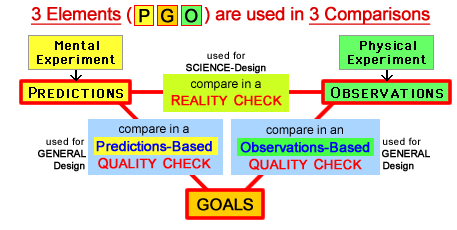 Guided Creativity with Creative Thinking being motivated-and-guided by Critical Thinking: When you are trying to Solve a Problem, you Evaluate Options (for a Problem-Solution) by using 3 Elements – Predictions and Observations plus Goals – in 3 kinds of Comparisons, in a Reality Check and two Quality Checks. Your critical Evaluation of an Option (it's a possible Problem-Solution) can motivate you to creatively Generate a New Option, with your critical Evaluation guiding your creative Generation in a critical-and-creative process of Guided Generation. {more: in my links-page for CREATIVE THINKING this process is examined in three sections, with Guided Creativity — explored & recognized by you in Part 1 and then described by me in Part 2 — could be used (as illustrated in Part 3) to improve “the party atmosphere” during a dinner you'll be hosting, by improving a relationship.
WHY should we teach Critical Thinking?
As explained in
the pages above, critical thinking is essential for effective functioning
in the modern world.
IOU – Soon, probably mid-October 2022, here I will describe (and quote from, and link to) web-pages that describe its importance, after evaluating some of the many pages about this.
In an essay that "takes
a Socratic approach to defining critical thinking and identifying its
value in one's personal, professional, educational, and civic life," Peter
Facione discusses “what and
why” in Critical
Thinking: What It Is and Why It Counts and concludes with a consensus
statement (of experts in the field) about critical thinking and the ideal
critical thinker:
We
understand critical thinking to be purposeful, self-regulatory judgment
which results in interpretation, analysis, evaluation, and inference,
as well as explanation of the evidential, conceptual, methodological,
criteriological, or contextual considerations upon which that judgment
is based. [Since this includes almost all types of logical
reasoning,] CT is essential as a tool of inquiry. As such,
CT is a liberating force in education and a powerful resource in
one's personal and civic life. While not synonymous with good
thinking, CT is a pervasive and self-rectifying human phenomenon. The
ideal critical thinker is habitually inquisitive, well-informed,
trustful of reason, open-minded, flexible, fair-minded in evaluation,
honest in facing personal biases, prudent in making judgments, willing
to reconsider, clear about issues, orderly in complex matters, diligent
in seeking relevant information, reasonable in the selection of
criteria, focused in inquiry, and persistent in seeking results
which are as precise as the subject and the circumstances of inquiry
permit. Thus, educating good critical thinkers means working
toward this ideal. It combines developing CT skills with nurturing
those dispositions which consistently yield useful insights and
which are the basis of a rational and democratic society." {the ending-quotation is from "Delphi
Report" consensus statement, The Executive
Summary for Critical Thinking: A Statement of Expert Consensus for
Purposes of Educational Assessment and Instruction, Executive Summary & Expert Consensus from InsightAssessment.com with links for MORE }
Education in critical
thinking offers an alternative to a drift toward postmodern relativism,
by emphasizing that we can "distinguish between
facts and opinions or personal feelings, judgments and inferences, inductive
and deductive arguments, and the objective and subjective. {MCC
General Education Initiatives}" Critical thinking encourages us to
recognize that our “rationally justifiable confidence” in a claim
can span a wide range, from feelings to fact and everything in between. Three
Categories of Questions explains why, because students don't recognize
questions involving "reasoned judgment" (which
are neither fact nor opinion), they "fail to
see the difference between offering legitimate reasons and evidence in
support of a view and simply asserting the view as true." You
can see samples from The
Art of Asking Essential Questions.
Critical Thinking in Schools
and then after we've decided “yes, let's do it,”
HOW should we teach critical thinking?
LEARNING
Critical Thinking (outside school) — Educating Yourself
You
can use online tutorials of Critical
Thinking Web (sitemap) about Logic, Fallacy, Argument
Analysis, Venn Diagrams, Scientific Reasoning, and much more. { This website was developed – by Joe
Lau & Jonathan
Chan – for college
students and teachers, but with suitable adjustments it's also useful
for
K-12 because logic
is logic, for the young and old. Basic Principles of Critical Thinking from Scheffer & Rubenfeld.
The essence
of critical thinking is logic. And logical evaluation — by
using reality checks and quality checks —
is the essence of Design-Thinking Process and Scientific Method. On the other end of the logic spectum,
we see a variety of logical
fallacies that include circular reasoning and strawman arguments.
TEACHING Critical Thinking (in school) — Strategies & Activities
Useful ideas about critical thinking
and education are in Critical
Thinking by Design (Joanne Kurfiss) and Critical
Thinking: Basic Questions and Answers (Richard Paul). For a broad
overview, A
Brief History of the Idea of Critical Thinking.
Critical Thinking in Life: Students get many educational benefits when we show them that they use their basic problem-solving skills (imaginative creative thinking & logical critical thinking) for almost everything they do in life. When a student understands the practical value of critical Evaluative Thinking in their everyday life they will be more motivated to improve this valuable skill.
Growth Mindset: One of the best things a teacher can do for students is helping
them develop-and-use a growth mindset. This is an extremely useful way to think because — when a student asks “how well am I doing in this area of life?” and honestly self-answer “not well enough” — instead of thinking “not ever” they will be thinking “not yet” because they are confident that in this area of life they can “grow” and improve, because when they invest intelligent effort in their self-improving, they will improve. A growth mindset will help them improve their skills in all areas of life, including their critical thinking.
Activities for Critical Thinking: Teachers can creatively generate a wide variety of goal-directed activities for doing-thinking-learning with inquiry activities (that can include logical argumentation) in design & science.
Thinking is encouraged by a creative
use of Thinking Activities, such as Aesop's Activities or Socratic
Teaching (Six
Types of Socratic Questions) and other teaching
tactics that encourage active learning. { I.O.U. - Later, maybe in mid-2021,
there will be more about "thinking activities" that can help you teach principles for critical thinking in ways that make learning simple and fun. Although most principles of critical thinking
are useful for students & teachers at all levels, instructional activities should
be customized for students with different ages, experiences, and abilities. }
Dany Adams explains how, "because
the scientific method is a formalization of critical thinking, it can be
used
as a simple
model
that removes critical thinking from the
realm of the intuitive and puts it at the center of a straightforward,
easily implemented, teaching strategy," in Critical
Thinking and Scientific Method.
Understanding Logical Fallacies: This worthy educational goal is the focus for a wide variety of activities that are educationally valuable and are interesting for students. Therefore, I've made a special page (with LINKS and QUOTES) about Logical Fallacies.
What is a fallacy? Wikipedia's List of Fallacies begins with a simple definition: "a fallacy is reasoning that is logically incorrect." Later it describes a challenge ("because of their variety, fallacies are challenging to classify") and some ways that reasoning can be logically incorrect: in a formal fallacy, there is "an error in the argument's form," and with an informal fallacy the logical error can be due to "improper presumption, faulty generalization, error in assigning causation, and relevance, among others." {italics added by me, here and below}
Their article on Fallacy says (re: effects) "a fallacious argument may be deceptive by appearing to be better than it really is" and (re: ethics) "some fallacies are committed intentionally to manipulate or persuade by deception, while others are committed unintentionally due to carelessness or ignorance." A fallacy can occur intentionally or unintentionally, consciously or unconsciously, due to a lack of skill in logical thinking or biased motivated reasoning. In some situations, in some ways, a use of fallacies can be considered unethical.
I.O.U. -- This paragraph will be revised soon, in mid-June 2021. * Or a teacher can try to be unfair, and achieve this goal by using biased reasoning. In fact, an effective type of fallacious argument is pseudo-Monday/Tuesday, e.g. by pretending to describe two views accurately even though they're describing a “stronger version” of one view, or (typically more effective) by describing both views accurately but providing stronger counter-arguments against one of the views. / Or a teacher could try to be fair but actually be favoring one view unintentionally, because "it is impossible" to be "totally neutral." But even though "totally neutral... is impossible," I think the overall result — especially for helping students learn “HOW to think” for themselves so they can self-defend against just being told “what to think” by others — will be beneficial when a teacher genuinely tries to "be fair" when they're doing Monday-and-Tuesday instruction.
Bayesian Logic: I.O.U. - This section will be developed later, but a central concept is logically illustrated in two videos by Julia Galef (11:25 showing it with "visual math") and xxxx (xxx showing it with a concrete math-example) showing how the uncertainties of a medical test (re: its false negatives and false positives) will mislead you into reaching an incorrect conclusion unless you use correct Bayesisan Logic, regarding prior probabilities.
Principles for Teaching: ERIC Digests offers excellent summary/overviews for teaching
critical thinking in schools at all levels, from K-12 through higher education — How
Can We Teach Critical Thinking? & Promoting
Critical Thinking in the Classroom & Strategies
for Teaching Critical Thinking & Reflective Thought and Critical Thinking — plus methods for teaching critical
thinking in the contexts of teacher education & community colleges & social studies & (college) english studies & literature & environmental
education & television & adult
ESL. {All except "adult ESL" were written between
1989 and 1994, so they're not up-to-date, but most principles for "teaching
critical thinking" were discovered/invented before 1989 and are still
relevant today.} And ERIC has
a wide range of resources, letting you search for research & other
information about thinking
skills (critical thinking, evaluative thinking, decision making, ...)
and much more.
Assessment: This is very difficult. Accurate evaluation of a thinking skill — or
even defining precisely what the "skill" is, and how we can observe
and measure it — is much more difficult than evaluating ideas-knowledge. Some
educators have accepted the challenge: for example, for Common Core and Next Generation Science Standards and by CriticalThinking.org and by InsightAssessment.com (FAQ & sitemap & resources for teaching, measuring, research) with ways to evaluate critical thinking for college students.
Critical Thinking on the Web offers
links to many interesting, useful resources about critical thinking in
a WIDE variety of areas, for teaching more.
The Center for Critical Thinking (sitemap) — led by Richard
Paul & Linda Elder & others — offers link-pages for critical
thinking education in K-12 and higher education. {research about critical thinking} Of
course, education also occurs outside schools, and most thinking
occurs outside the classroom in everyday
life and business and other areas of life: "Critical
thinking is the art of taking charge of your own mind. Its value is
simple: if we can take charge of our own minds, we can take charge of our
lives." They describe
the centrality of thinking, and a common educational problem:
Critical
thinking is not an isolated goal unrelated to other important goals in
education. Rather, it is a seminal goal which, done well, simultaneously
facilitates a rainbow of other ends. It is best conceived, therefore,
as the hub around which all other educational ends cluster. For
example, as students learn to think more critically, they become more
proficient at historical, scientific, and mathematical thinking. Finally,
they develop skills, abilities, and values crucial to success in everyday
life. ... Recent research suggests that
critical thinking is not typically an intrinsic part of instruction at
any level. Students come without training in it, while faculty tend
to take it for granted as an automatic by-product of their teaching. Yet
without critical thinking systematically designed into instruction, learning
is transitory and superficial.
Teaching Strategies to help students improve their
Accurate Understanding and Respectful Attitudes
Monday plus Tuesday: Students in my high school learned
valuable “lessons for life” from one of our favorite
teachers. In a society-and-government class, he explained ideas clearly in lectures, and we also debated the pros & cons for different positions on a wide range of issues. He participated, was a skilled debater, and Monday he would argue persuasively for one position. But the next day (or later in the class Monday) he
would criticize this position, and present strong arguments for the other position(s).
Understanding and Respect: After awhile, after hearing the strongly presented pros & cons for different positions on many issues in Monday-plus-Tuesday debates, we learned that
if we want accurate understanding we
should get the best information and arguments that all position-views
can claim as support. When we did this, so we understood more accurately
and thoroughly, we usually recognized that even when we have valid reasons
for preferring one view, people with other views also may
have good reasons, both logical and ethical, for their choices, and this helped us develop respectful attitudes. {but his goal wasn't a postmodern relativism}
Originally, all I the two paragraphs above was all I wrote about about Understanding and Respect. Then I wrote a brief explanation of why our teacher's goal wasn't a postmodern relativism. For decades I've been optimistic, thinking “it will be better when more people have this kind of experience.”
Optimism becoming Pessimism:
For decades, I've been optimistic. I was thinking “it will be better when (as I assumed would happen) more people have Monday-and-Tuesday experiences, and this produces more mutual understanding and respecting.” I was hopeful, even though I knew that this kind of education would face tough challenges, that it would be difficult to do effectively, maybe even difficult to do.
Then during 2020 I observed the continuing increase of hostile polarizations that often lead to inaccurate understandings and disrespectful attitudes. I began learning more about the causes and effects of motivated reasoning. Due to this learning-about-people, I've become more pessimistic – for reasons (including personal rationality) described in the rest of this page and in another page – about the prospects for education (inside & outside classrooms) that can help improve our understanding and respecting. Although I'm less optimistic than earlier, I still think we should continue pursuing this worthy goal.
Education to improve Critical Thinking
(and promote Understanding & Respect)
Teachers can help students improve their logical skills of critical thinking — while they're encouraging accurate understanding and respectful attitudes — by designing argumentation activities that help students accurately understand
the main views for an issue.
How? One teaching method is that of my teacher, with HIM doing the expert analysis-and-debating Monday, and also Tuesday, with an overall result (when all days were combined) of accurately describing different views and the best arguments for each view. This method was time-effective for improving our knowledge, for helping us quickly learn the pros & cons of differing views on a wide range of interesting life-relevant topics. But methods with STUDENTS becoming the active “experts” will more effectively help students improve their own thinking skills.* One kind of argumentation activity has analysis-and-debating by students — either individually or (more time-practical, and useful for developing collaborative skills) in cooperative teams — with students first arguing for one view, and then arguing for the other view(s). When this kind of activity is done well, students will improve their critical thinking skills, in their logical evaluating of arguments & counter-arguments, their planning of persuasion strategies, and communication skills.
* Most educators think the best way to improve thinking skills is with active practice, when students “actively think” during a challenging activity. / It also can be useful to explicitly define the educational goals by telling students, at appropriate times during activities, “you are improving your knowledge by learning the pros & cons of issue-positions, and improving your thinking skills, and how to understand others & respect them.”
How? In common language, an argument often involves hostile attitudes & words, and occasionally even hostile actions. But in the context of critical thinking, an argument is an attempt to persuade someone by a skillful use of evidence-and-logic. During an argumentation activity, students should reduce hostile attitudes that can lead to antagonistic words and angry confrontations. More generally, a teacher can encourage students to be “peacemakers” who try to reduce hostility (in attitudes, words, actions) by themselves and by others, both inside the classroom and (especially) outside it, to make our disagreements more enjoyable & productive for more of us, more often and more effectively. One way to pursue this goal is to help students improve their beneficial uses of empathy with kindness.
How? A simple informal activity — useful in all areas of everyday life, inside & outside the classroom — is to just listen to the other person during a conversation, because it's an opportunity to better understand what they are thinking and feeling. When we listen for the purpose of understanding, we "seek first to understand, then [with communication based on empathy & self-empathy] to be understood." {it's Habit 5 in The 7 Habits of Highly Effective People}
Reducing Controversy about Educational Methods
sources of controversy: When a teacher tries to accurately describe different views, and the best arguments for each view, some people will think the descriptions are non-accurate because the teacher is being non-neutral. This is due to both perception (because many people
think
a treatment-of-views is neutral only if it's biased in the way they want) and reality (because it's impossible for a teacher to describe views in a way
that
is totally
neutral). But teachers
can try to be fair* by aiming for accurate descriptions, treating different perspectives with respect, and providing access to high-quality resources where skillful advocates for each view explain the evidence-and-logic supporting their own view, and criticize other views. Despite a teacher's best efforts, however, some students (and parents & others who feel strongly about an issue) may want to make life unpleasant for the teacher. Because of this, teachers have a rational reason to avoid controversy, and therefore to avoid a Monday-plus-Tuesday activity.
* Or a teacher can try to be unfair, and achieve this goal by using biased reasoning. In fact, an effective type of fallacious argument is pseudo-Monday/Tuesday, e.g. by pretending to describe two views accurately even though they're describing a “stronger version” of one view, or (typically more effective) by describing both views accurately but providing stronger counter-arguments against one of the views. / Or a teacher could try to be fair but actually be favoring one view unintentionally, because "it is impossible" to be "totally neutral." But even though "totally neutral... is impossible," I think the overall result — especially for helping students learn “HOW to think” for themselves so they can self-defend against just being told “what to think” by others — will be beneficial when a teacher genuinely tries to "be fair" when they're doing Monday-and-Tuesday instruction.
strategies to reduce controversy: A simple strategy that is rational for a teacher because it can increase the quality of their personal life (even though it decreases the quality of their teaching) is to avoid instruction (like Monday-and-Tuesday activities) that might be considered controversial. {of course, this kind of self-protective strategy also can be used by administrators & school boards} / Or a teacher can depend on analysis-and-debating by students to get accurate descriptions of views, and of arguments for each view. If this is done well, a teacher is less likely to be justifiably criticized for being personally biased. But this might not be enough to avoid controversy, especially if some students sometimes don't use wise filtering when they are actively debating. / Or a teacher can courageously have discussions about the difficulties caused by increases in hostile polarization to show the benefits of disagreeing in ways that are enjoyable and productive. During a time (in the mid-1960's) when American society wasn't as polarized, our teacher confronted this problem directly (but without much detail) in his first class with his main rule, "don't be a nut" who will cause trouble.
[[ motives for complaints -- can come from parents or social-activists if issues considered important (ideas + practical) -- by parents to protect students (with the safety-ism criticized by Haidt, e.g. analogy with peanut allergies, cognitive therapy (to mimic bad-experience but in safe contexts); and I'll link to summaries (videos: short short long), and written reviews ]]
avoiding postmodern relativism: The intention of our teacher (who on Monday & Tuesday would argue for one view & another view), and the conclusions of his students, was
not a postmodern
relativism. The goal was an objectively-rational evaluation of ideas during our search for truth about reality, and for practical reality-based principles that can be used as a solid foundation (along with good values) for designing better life-strategies, for wise-and-effective thinking and actions, as individuals & societies. {more about avoiding postmodern relativism}
 disagreeing more enjoyably & productively: An understanding-based respect does not require agreement. You can respect someone and their views, yet criticize their views by using evidence-and-logic plus values. For important issues we should not be timid or mentally lazy by accepting a postmodernist assertion that “you should not claim your position is better, you should claim only that you prefer it.” Instead we should feel free to explain our views and defend our views. We should try to search for knowledge that is true & useful, and for principles & actions that will help make life better for more people. It should be socially acceptable to disagree with others, to explain – using evidence-and-logic plus values – why we think our views are better. But we can help make the process of disagreeing
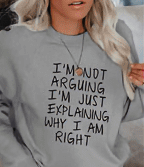
about some things (although agreeing about most things in life) more enjoyable and productive. {to see a contrast, compare empathy-with-kindness and public shaming} / Although this t-shirt is intended to be humorous, I agree with its message IF it's claiming "I'm just explaining why [I'm appropriately confident that] I am right." disagreeing more enjoyably & productively: An understanding-based respect does not require agreement. You can respect someone and their views, yet criticize their views by using evidence-and-logic plus values. For important issues we should not be timid or mentally lazy by accepting a postmodernist assertion that “you should not claim your position is better, you should claim only that you prefer it.” Instead we should feel free to explain our views and defend our views. We should try to search for knowledge that is true & useful, and for principles & actions that will help make life better for more people. It should be socially acceptable to disagree with others, to explain – using evidence-and-logic plus values – why we think our views are better. But we can help make the process of disagreeing
about some things (although agreeing about most things in life) more enjoyable and productive. {to see a contrast, compare empathy-with-kindness and public shaming} / Although this t-shirt is intended to be humorous, I agree with its message IF it's claiming "I'm just explaining why [I'm appropriately confident that] I am right."
|
Causes and Effects of
Motivated Reasoning
WHAT is motivated reasoning?
Basically, it's a tendency for people to believe what they want to believe, and find reasons for believing it.
iResearchNet.com says "Motivated reasoning is a form of reasoning in which people access, construct, and evaluate arguments in a biased fashion to arrive at or endorse a preferred conclusion. The term motivated in motivated reasoning refers to the fact that people use reasoning strategies that allow them to draw the conclusions they want to draw (i.e., are motivated to draw). ... motivated reasoning refers [only] to situations in which people want to confirm their preferred conclusion, rather than to [other] situations in which people's reasoning is driven by an accuracy motivation," by wanting to reach a conclusion that is strongly justified by a logical evaluation of all available evidence.
motivated reasoning occurs when people (quoting Wikipedia) "use emotionally-biased reasoning to produce justifications or make decisions that are most desired rather than those that accurately reflect the evidence, while still [even though their motivated justifications don't "accurately reflect the evidence"] reducing cognitive dissonance. In other words, motivated reasoning is the tendency to find arguments in favor of conclusions we want to believe to be stronger than arguments for conclusions we do not want to believe."
note: In the quotations above and below, italics and [comments in brackets] are added by me.
A person can use motivated reasoning in any area of life (when thinking about the nature of reality, and principles for living well, policies for governing effectively, evaluating the abilities of themself & others,...) and it's only one aspect of a person's general overconfidence about many kinds of personal abilities in many areas of life.
WHY do people use motivated reasoning? — CAUSES
We'll begin by looking at a common deviation from one goal of critical thinking, which ideally should produce...
appropriate confidence: An evidence-based logical evaluation should lead to improved understanding that promotes an appropriate humility about conclusions, with a logically-justifiable appropriate confidence that is not too little, not too much. {Bertrand Russell, re: three kind of error}
inappropriate over-confidence: We often see people being overconfident about the logical justification for their own personal views, and the views of their groups. Why? A major cause of overconfidence is the motivated reasoning that often is used by people, both individually and in groups. So... we then can ask “why do people use motivated reasoning?”
causes of motivated reasoning, by individuals and groups:
A major source of overconfidence is the motivated reasoning that occurs because people (individually and in groups) have mixed motivations, combining logic-and-emotion in our thinking-and-feeling; logically we want to have accurate understanding; and emotionally we want to have a positive self-image so we can feel good about ourselves (as individuals & as a group)* and (as individuals in groups) we want to get respect from others and have supportive allies, and (as individuals & as groups) we want to win arguments, to have a positive self-image and a positive group-image. Being in a group often leads to social pressures, with group dynamics that influence the reasoning of members, and reinforce our tendencies to be individually overconfident.
* The self-image of a person (or group) is improved when they can reduce the unpleasant cognitive dissonance (i.e. dissonance in thinking) that occurs when they recognize an inconsistency between their beliefs, or between their beliefs and actions. They want the personal confidence of believing that their system of beliefs-and-actions is internally consistent, and also has high quality because it's better than other beliefs-and-actions they could choose, AND often (in comparisons of self with others, producing effects that are both positive & negative) it's better than the beliefs-and-actions chosen by others. / Due to these comparisons, although the motive (of wanting personal confidence) and strategy (of becoming more confident by reducing cognitive dissonance) are basically healthy, and the direct results are usually productive (by leading a person to improve their beliefs-and-actions), there also can be unproductive indirect results because... This motive-and-strategy can lead a person to over-estimate the logical justifications for their own confidence, so they become unjustifiably over-confident about themselves, and (in an extra step that doesn't have to occur, but can occur) they become disrespectful of others.
All of these psychological motives often are related to practical motives. Definitions of motivated reasoning describe the general motivation of wanting to believe "what we want to believe" in a "preferred conclusion" that is "most desired." These motives for "wanting... what we want" often are connected with our motives (as individuals & groups) of wanting to achieve practical goals, to get various kinds of benefits.
Most causes of motivated reasoning operate at the levels of individuals & their groups, so we can get useful insights from experts who study the psychology of individuals (alone & in groups) and sociology of groups.
a summary: Why are so many so confident? Because it feels good & gains allies, can persuade people, can help achieve practical goals.
HOW does motivated reasoning affect critical thinking? — EFFECTS
goals: We should try to reduce the amount of motivated reasoning and the negative effects when it's used by ourselves and by others, when it's used by you and me, and them.
causes: Motivated Reasoning {MR} can help a person feel good, gain allies, persuade people, achieve goals.
one effect: When MR is not regulated by accurate self-evaluations, a motive of wanting confidence can lead to overconfidence.
other effects: During a process of critical thinking, a person can use MR (consciously or unconsciously) in many ways,...
by selecting their evidence:
While a person is gathering information, MR motivates them to have confirmation bias by seeking-and-accepting evidence that confirms (supports) their own view, while ignoring-or-rejecting evidence that disconfirms their view or confirms opposing views. {how biased preference is used in business strategies}
In high school our Monday-plus-Tuesday experiences taught us that "IF we want accurate understanding, we
should get the best information and arguments that all position-views
can claim as support." But this "if" doesn't describe the way people sometimes think, when instead we actually want to see only evidence that supports our own views (even if this isn't an accurate understanding of reality), so each of us has a tendency to think “I don't want to hear anything about Tuesday.”
by adjusting their logic:
MR affects a person's ability to recognize fallacious reasoning (by themself and by others), their decision to either accept a fallacy (that supports their views) or challenge a fallacy (that opposes their view, supports another view) when it's used in a logical argument by another person, and their willingness to use fallacies when they construct their own arguments. And...
They use gentle criticism for their own view when evaluating its pros-and-cons, but use harsh criticism for other views. In doing this they are adjusting their standards for having confidence in a conclusion, shifting the evaluative “burden of proof” so it favors their view by asking “can I believe this?” for a view they want to accept, and “must I believe this?” for a view they want to reject.
They tend to ignore actual complexities that would challenge their overconfidence.
When their thinking is dominated by MR, an overall result is to reverse their sequence-of-logic; with MR, first comes the desired conclusion, followed by evidence-and-logic to support their conclusion.
by adjusting their values:
MR can affect their evaluative weighting of predicted outcomes, as in a complex situation where they must "make decisions – based on their values & priorities – about the importance of each kind of outcome, and thus how much weight to give it in their evaluation."
by adjusting their ethics:
If it's necessary because they recognize their bias, they can rationalize the process-and-results of their motivated reasoning — even though it's biased toward reaching conclusions they are motivated to believe — by thinking “my thoughts {and actions} are acceptable because ” and filling the blank with self-protective rationalizations.
Complexity and Confidence
One way to adjust logic with MR is to oversimplify. Usually questions asking “what is the best policy?” are complex. Imagine a trial where a judge is trying to determine which of two (or more) competing policies will have more practical utility. Even if we agree (and we may not) that the best practical utility is “producing a greater good for a greater number,” usually each policy will offer some advantages, so a wise critical-thinking judge must weigh all pros & cons. They must compare different kinds of “good” and “bad” outcomes (each with varying degrees) along with the number of people who are affected by each outcome, and decide (based on their values & priorities) how to weigh the importance of each kind of outcome. Also, there is complexity in using cause-effect reasoning to make predictions about issues with multiple complex causes and multiple complex outcomes, with outcome-effects that are good and bad, affecting a variety of people in different ways.
In situations that require coping with complexity, a judge-thinker tries to evaluate by using critical thinking that is minimally biased. But a lawyer-thinker is motivated to think & argue in ways that are biased, and one useful strategy for “winning” (and reducing cognitive dissonance) is oversimplification. {decisions about policies-for-society are designing strategies-for-society}
Reversing the Process – doing Conclusion first, then Evaluation
Sometimes the overall result of MR-logic is to reverse the usual sequence of reasoning. In a process that is logical, without bias, we should first do an objective evaluation by using unbiased evidence-and-logic plus values, and then reach a conclusion. But the sequential order is partially reversed* when thinking is influenced by motivated reasoning, when (due to prior reasoning earlier in life) a person first (Monday) reaches an initial conclusion they want, and then (Tuesday) instead of continuing to learn more about the pros & cons of all positions, they creatively construct biased goal-directed reasoning — by selecting information & adjusting logic & adjusting values — to support their existing position, so they have arguments to logically defend their position internally (for self) and externally (for others).
* It's only partially reversed (not totally reversed) because their Monday-conclusion is based on prior reasoning that occurred before "Monday" and may have been mainly-objective (with evaluation before conclusion, in the proper logical order) rather than mainly-motivated.
Personal Change-of-View
two possible results of MR: Although a person's Motivated Reasoning can lead to a changing of views {or actions}, instead MR usually leads to increasing confidence in existing views {or actions}. In either way, by changing or maintaining, MR can help a person achieve personal goals, e.g. by gaining more allies (in a new group or old group), or by improving their self-perception of internal consistency because they have reduced their cognitive dissonance.
reasons to not-change or to change, using unbiased Logical Reasoning and biased Motivated Reasoning: When a person re-examines one of their views by continuing to rationally evaluate it with unbiased reasoning (using evidence-and-logic plus values), usually they decide that a change-of-view isn't justified. But occasionally they decide, based on their evaluation, that a change is justifiable, and they are willing to change this view, so they do change, and they're happy because they are thinking “now my view is better than it was before.” / But for another view they are less willing to change, even if this would be justified by an unbiased evaluation. They don't want to change, so they use biased motivated reasoning to avoid a change, or even to avoid thinking “maybe I should change.” {Although MR can be one factor in promoting a change, this is less common than using MR to resist a change.}
What causes the difference in being willing to change? Maybe in one situation this person self-defines the change as wisdom (because it's justified by their evaluation), while in the other situation they think a change would be a sign of weakness. Or maybe in the overall context of their life, in one situation (but not the other) a change is personally beneficial. / situations and people: For this person, being willing to change differs from one situation to another. And a tendency for being willing to change differs from one person to another. A willingness to change varies with SITUATIONS, and with PEOPLE. / If a person is not willing to change, this will increase their use of MR, but this won't necessarily determine the result. Of course, with analysis using my interpretive framework (of “unbiased Logical Reasoning combined with biased Motivated Reasoning”) the result – by changing or maintaining – will depend on the COMBINATION of unbiased reasoning plus biased reasoning. If a person is strongly motivated to maintain (or to change), their use of biased reasoning will increase if this will help them justify (internally & externally, for themself & others) the result they want. But in “the combination” their biased M-Reasoning could be overcome by the unbiased L-Reasoning they also are doing, with their MR being overcome by their stronger LR.
A person who doesn't want to change their mind will think “Monday I reached a conclusion (made a decision, made up my mind), so Tuesday I don't want to think about it or learn anything new.”
By contrast, a person who is willing to change wants to learn more about the pros & cons of differing views, so their understanding will continually increase in completeness & accuracy. They will change their views when it seems wise — if they find justifiable evidence-based Logical Reasons for a change — because they see the change as wisdom rather than weakness. They will think “now I know more, and have evaluated more carefully, so now my views are different. I want to self-educate myself by learning from experience, and if new experiences (to get more knowledge, do more evaluation) lead to a different conclusion, this is a beneficial change.”
Change of Mind and Change of Status: During a person's evaluation of competitive Options, they can estimate a “Quality Status” for each Option by considering the many factors that affect its quality; each Quality Status can be very low, or very high, or in-between; and it can change during evaluation when the person gathers more evidence, and thinks about everything more carefully. When an evaluation is done by using accurate evidence and valid logic, usually the evaluation-conclusion won't shift from being 100% for one option (by thinking everything favors it) to 100% for another option. Instead there will be an honest recognition (unless motivated reasoning leads to a denial of complexity) that each option offers some benefits, has some pros & cons; during a period-of-changing there is a change in the person's estimates about the relative benefits of different options, about the “all things considered” conclusions after a careful weighing of all pros & cons. {using Quality Status for evaluations}
Motivated Reasoning can be Intelligent Reasoning
Sometimes (but not always) a person's use of motivated reasoning {MR} will strongly affect the process-and-results of their critical thinking, leading to cognitive bias because they have selected information and have adjusted their logic & values & ethics.
All aspects of an evaluative process are influenced (consciously & unconsciously) by MR, to a degree that can be small or large. Is this influence-by-MR reduced by intelligence? Scientists think “no” based on research, as described by Winston Sieck (2013, updated 2020, with interesting comments) in Does High Intelligence Mean Low Cognitive Bias? :
"Ideally, a smart and critical thinker would reason through the pros and cons of the different possibilities and come to a balanced view of the issue. Yet a great deal of research finds that people tend to just consider what they favor about one side. We see this ‘myside bias’ all the time in the real world" and in research: "A number of studies have now been conducted on intelligence and the myside bias," showing that "people who scored more highly on the intelligence test showed just as much of the cognitive bias as the rest. They found no link between intelligence and myside bias. ... People with high IQ reasoned just like everyone else," even though our intuitions tell us that they should be more able to think rationally: "In everyday discussion, intelligence and rational thinking are often treated as ‘close cousins,’ or even as one and the same thing. Yet, that does not appear to be the case in actual assessments of intelligence and cognitive bias," because intelligence tests "do not measure the extent of a person's cognitive bias or rationality." He ends by concluding that "balanced, rational thinking may well be at least as, if not more important than IQ to what it really means to be smart in the modern world." A person with high IQ might be more able to think logically-and-objectively with minimal cognitive bias, but not necessarily more willing. Instead they may be motivated to use their intelligence to skillfully construct (by using motivated reasoning) clever arguments that have high cognitive bias, yet are effective in persuasively defending their beliefs.
It's useful to distinguish between different kinds of rationality. If motivated reasoning helps a person "feel good, gain allies, persuade people, achieve goals," their motivated reasoning is “personally rational” for them, even though their MR isn't “objectively rational” because it isn't unbiased reasoning. One definition of MR says "motivated reasoning refers [only] to situations in which people want to confirm their preferred conclusion, rather than to [other] situations in which people's reasoning is driven by an accuracy motivation" so they want to search for truth by using unbiased evaluation. Here we see two aspects of overall motivation; people want to find truth, and they have other motives. The relative strength of these motives will vary, depending on the context. In some situations a searching-for-truth rationality is actually less personally-rational because it's less effective in helping a person “get what they want” in their whole life. My overview of Motivations for Learning describes a central goal of educators, who try to "consider all aspects of total motivation – intrinsic, personal, interpersonal, and extrinsic, all hopefully based on good values & priorities – that contribute to how a student thinks about their strategies-and-actions aimed at ‘getting what they want’ in their whole life as a whole person." Although I think we should try to reduce MR and its negative effects because personal rationalities don't necessarily produce societal rationality we should try to reduce MR “with eyes wide open” by understanding why every person (including you and me) has a tendency to use MR due to their "total motivation... in their whole life as a whole person."
A broad definition of rationality is used in a research review (cited by Winston Sieck), Myside Bias, Rational Thinking, and Intelligence by Keith Stanovich, Richard West, Maggie Toplak:
"The magnitude of the myside bias shows very little relation to intelligence. ... It is rare when a cognitive process or phenomenon is found to be independent of intelligence. Nevertheless, some recent research has suggested that individual differences in an important critical thinking skill [reducing one's own myside bias] are largely independent of individual differences in intelligence. ..... Rationality is a more encompassing construct than intelligence. ... To think rationally means to adopt appropriate goals, take appropriate action given one's goals and beliefs, and hold beliefs that are commensurate with available evidence. [it's "and" even though it may not be possible to do all three, to "adopt... take... hold"] Intelligence tests measure many important things about thinking, but they do not directly assess the degree of rationality of thought. Thus, it is perhaps not surprising that intelligence is quite weakly related to at least some aspects of rational thought. Myside bias turns out to be an aspect of rational thought that, compared with others, is particularly unrelated to intelligence."
They consider myside bias to be "an aspect of rational thought" and I agree, because MR can be personally-rational for a person due to the personal benefits it gives them, even if their MR isn't critically-rational (because the conclusion that's based on their MR wouldn't be justifiable based on an unbiased evaluation using evidence-and-logic plus values). But even though MR with myside bias for persons (and ourside bias for their groups) can be personally-rational for individuals, there are reasons for us to think it will be societally-rational for us to have a goal of "trying to reduce the amount of motivated reasoning and the negative effects when it's used by... you and me, and them."
As explained above, scientists answer “no” when we ask “are MR and its effects decreased by high intelligence?” For a related question – “are MR and its effects decreased by high skill in critical thinking?” – experts say “no, but...”
Personal Rationality and Societal Rationality: Even though fallacious arguments (using biased motivated reasoning) can seem to be personally rational due to benefits that are short-range (are beneficial for only some people) and short-term, fallacies are societally irrational because the overall effects are detrimental for society. You can see exemplars that unfortunately have expanded from “conversational use by individuals” into “societal use by groups” so they cause widespread societal damage, in this entry from my links-page about Logical Fallacies:
Dean & Laura VanDruff share Conversational
Tricks and Fallacies in a humorous way, illustrating "how not to talk" in an attempt to decrease the "conversational terrorism" (with a disrespectful "cheap shot" style) arising from the "growing abuse in our conversational landscape."
In this section you'll see two analogies (lawyer-vs-judge and soldier-vs-scout) that can help us think about two ways to use intelligence (motivated with bias versus objectively neutral) while we're evaluating & arguing.
Victory-Seeking Lawyers and Truth-Seeking Judges: One way to improve our mutual understanding & respecting is by trying to think like a judge, not a lawyer. How? During a trial when a judge is trying to determine what is true, first the lawyers for opposing truth-claims each argue for their claim, trying to “win the case” by using evidence-and-logic that is non-neutral (is biased). Then the judge tries to be neutral (non-biased) when evaluating the evidence-and-logic, trying to determine which truth-claim is more accurate, in what ways. A wise judge tries to do neutral judging, tries to avoid biased judging based on biased reasoning, on reasoning that is motivated by personally wanting to believe one of the claims. By contrast, each lawyer wants their own claim to win, so they are motivated to do biased arguing by adjusting all factors (evidence, logic, values) to favor the policy they want. {in different kinds of trials, a judge can try to determine what is true, or what is fair, or what will be effective}
a clarification: I'm not criticizing the ethical character of people who serve as lawyers. They are just doing what we're asking them to do, by performing a valuable service in the context of our “adversarial” system of justice. I am criticizing the transfers of biased lawyer-like arguing into the contexts of everyday life, where our understanding-and-respecting would be improved by a decrease of adversial attitudes & actions. Similarly, I'm not criticizing the ethical character of the people who bravely serve us as soldiers.
Victory-Seeking Soldiers and Truth-Seeking Scouts: Another useful analogy (developed by Julia Galef) illustrates how different goals for thinking lead to different ways of thinking. During a discussion, if you're behaving like a soldier your goal is to be an effective fighter; for achieving this goal it can be useful to think over-simplistically, to view yourself as a correct-thinking “good guy” and your opponent as a wrong-thinking “bad guy” who deserves to be the enemy you hate, and fight; when you're functioning as a soldier, understanding & respect could make you less effective as a single-minded fighter whose only goal is to win, so you don't want to acknowledge that "people with other views also may
have good reasons, both logical and ethical, for their choices." During a war, when you're thinking like a scout your goal is to find truth, to accurately know the actual situation (re: numbers & locations of soldiers, their equipment, the terrain,...) so you want an accurate knowledge-of-reality that will be a solid foundation for an effective planning of battle strategies. During a discussion, you also can think like a scout who wants to find truth.
Two Analogies — Lawyer-vs-Judge and Soldier-vs-Scout
similarities: In each analogy we compare biased thinking (by a lawyer or soldier, trying to win) with unbiased thinking (by a judge or scout, trying to determine truth). {more about the scout analogy of Julia Galef}
unbiased = neutral = objective: In this page, all three terms are used with the same meaning. In fact, many words have a similar meaning; Collins Thesaurus lists 17 synonyms for objective: "unbiased, neutral, detached, just, fair, judicial, open-minded, equitable, impartial, impersonal, disinterested, even-handed, dispassionate, unemotional, uninvolved, unprejudiced, uncoloured." Most people think these words describe admirable character traits, so here is...
a societal application: We can use either analogy to ask, “would our society be more mutually respectful if more people decided to be more judge-like (more scout-like) in their feeling & thinking & behaving? i.e. if more people were less lawyer-like (less soldier-like)?”
personal applications: I find that each analogy is useful for different situations, for when I'm alone (be a scout-and-judge) or interacting with others (be a diplomatic scout). When my goal is to gather information that is relevant & reliable, “exploring like an objective scout” is useful, and “thinking like an unbiased judge” helps me decide what is more true. Thinking like a scout/judge is also useful for trying to determine what is more fair, or more effective. / But... during a discussion it would be relationally-inappropriate if you (or I) tried to “behave like a judge,” and others would be justifiably offended.* But it could be very useful if you “behave like a scout” who (like my teacher when Monday-and-Tuesday were combined) tries to help others get accurate descriptions of different views and the best arguments for each view. And in addition to behaving like a scout, you can imagine also functioning as a referee who unofficially and skillfully (by using diplomacy so the refereeing-actions aren't resented, maybe aren't even noticed) tries to cope with the “critical thinking fouls” that occur when someone uses fallacious reasoning as in presenting incomplete evidence (with biased selectivity) or inaccurate evidence, or describing a weak-and-distorted strawman of a view they oppose. But... when you're doing these things (as scout & referee) you will be telling people what they don't want to hear (due to their MR) so they may punish you personally with “shooting the messenger” paybacks that hurt you socially or in other ways. {* But you will be doing your own internal judging that is kept silently invisible in your own thinking — except when you say “this is what I think” (not “this is what you should think”) — that can become the external judging of a scout who tries to diplomatically provide accurate information for other people. }
The Ethics of Scout-becoming-Soldier: Of course, nobody is purely soldier or purely scout. Each of us is some of both, with their strengths depending on what's happening in our life-context, and how we're responding. Each of us has mixed motives; we want to have accurate understanding, but we also want to win arguments (internally within ourselves & externally with others) and have supportive allies. When our main goals are to get wins & allies, a common strategy is to get knowledge as a scout (to improve understanding) and then use knowledge as a soldier (to win arguments & gain allies). Unfortunately, when this happens our understanding is weaponized, and often the result is a decrease of respect, due to...
Hostile Polarization: In current society a common tendency is hostile polarizations that lead some people – especially when they're in groups – to have disrespectful attitudes toward people who disagree with them. The human tendency to join “polarized tribes” can be promoted by many factors, including principles, loyalties, and pressures.
Important Principles: When a person (and their group) takes a strong position on an issue they think is extremely important, it's more difficult to think an opposing position can be supported (as in our Monday-and-Tuesday classes) by "good reasons, both logical and ethical," and that people holding this position should be respected. In this context an opponent may be viewed as an enemy who must be defeated in us-against-them warfare. This attitude does have a rational basis because — even though it's almost always wise to avoid "warfare" — we shouldn't try to buy peace at the high cost of abandoning important principles. {polarization: loyalties & pressures}
Avoiding Postmodern Relativism
Yes, it should be avoided. The pessimistic foolishness of radical postmodern
relativists* — who deny the possibility (or even desirability) of using evidence-and-logic objectively in critical thinking with less biasing by motivated thinking — should be rejected by educators. Instead we should emphasize the possibility and desirability of trying to consistently use objective logical thinking. {our Monday-and-Tuesday debates were not postmodern}
When we're thinking about our views, we should aim for a level of confidence that is appropriate (is not too high or too low), steering a path between the two errors of confidence described by Bertrand Russell: "error is not only the absolute error of believing what is false, but also the quantitative error of believing more or less strongly than is warranted by the degree of credibility properly attaching to the proposition believed, in relation to the believer's knowledge." We can err by "believing more or less strongly than is warranted," with either overconfidence or underconfidence.
But usually a postmodernist isn't self-humbly underconfident about their own views. Instead they weaponize their relativism by claiming that “YOU cannot effectively use evidence-and-logic objectively & effectively,” in an effort to make the logical arguments of their opponents seem less justifiable and less persuasive.
* Yes, claims of “postmodernists” do vary widely — with a broad range of perspectives being actualized in a variety of ways to produce differing claims, as in the many kinds of Critical Theory(s) that include Critical Race Theory — so my brief summary is oversimplified. But the essential foundations of radical postmodernism do clash with the worthy goals of objectively-logical critical thinking. {postmodernists began with a useful question – asking “how confident should you be?” – but then pushed their skepticism to foolish extremes, so we now see the rationality-and-idiocy of postmodern relativism}
The Ethics of Critical Thinking
People (me, you, others) have a human tendency to use motivated reasoning so we can "find reasons for believing... what we want to believe." We tend to think-and-communicate like biased lawyers (or soldiers) who are trying to “win” rather than unbiased judges (or scouts) who are trying to determine what is most true, or fair, or effective.
This section asks an important question: if a person uses illogical fallacious reasoning when they are communicating with other people (to provide information or explain arguments), are they behaving unethically?
I won't try to “answer” this question for you, but I do have thoughts & feelings about it. My views are clearly stated throughout the page, especially in the new parts (written in 2021) beginning with the Monday-and-Tuesday approach of my favorite teacher.
I think we should encourage...
fair-minded teaching that accurately describes (and respects) the pros & cons of differing views.
thinking-and-behaving like an unbiased judge instead of a biased lawyer.
an open-minded willingness to learn more about the pros & cons of differing views (so understanding will be more complete & accurate), and to change views when it seems wise (after finding justifiable evidence-based reasons for a change) because this change is seen as wisdom rather than weakness.
I think...
the intentional use of a fallacious argument is a dishonest lie that is intended to mislead, to deceive.
we "should try to reduce the amount of motivated reasoning and the negative effects when it's used by ourselves and by others, when it's used by you and me, and them."
we should try to develop in ourselves (and encourage in others) an appropriate confidence that is not too little, not too much.
we should try to avoid postmodern relativism.
But even though I think we should try to be unbiased in our evaluating and avoid fallacies in our arguing, I recognize the complexity, the rational reasons for differing views. For example,
All aspects of an evaluative process can be influenced (consciously & unconsciously) by motivated reasoning that can lead (consciously or unconsciously, intentionally or unintentionally) to fallacious reasoning. An intentional use of fallacy is a trick that's used with a goal of misleading others and deceiving them. By contrast, an unintentional use of fallacy is an error that produces self-deception, although when the fallacy is communicated to others this can also mislead them. Although most of us consider an intentionally dishonest "trick" to be an unethical lie, we typically don't think an unintentional "error" is unethical. But... if a person won't critically examine their own reasoning, is their “unintentional” use of fallacy actually an “intentional ignorance or even willful ignorance” that is unethical? If they don't try to improve their own communicating, so they continue to promote fallacies, are they ethically blameless? {and regarding ethics, what is the “difference in degree” between a speaker who actively uses fallacies, compared with an audience member who passively allows the fallacies to go unchallenged? what if they use selective bias when choosing their targets, so they challenge only the fallacies by their opponents, while encouraging fallacies by their allies?} Also,...
Although honesty is a high-ranking virtue, it doesn't always have the highest priority. For example, would it be virtuous to honestly answer the questions of Nazi soldiers (during the Holocaust of World War II) if this lets them capture & kill the Jewish people that you know are hiding in your basement? Or... would your lie be virtuous if it helps your country win a battle during a war? Or in current society, will the intentionally dishonest use of fallacious arguments (by you or by others) be virtuous if this helps to win battles in a war against opponents who (in the thinking of you & your allies) are harming your society? In this situation, will the long-term total benefits (for many in society) justify the short-term deceptions, i.e. will “the ends justify the means” in the overall big picture of history?
Asking “can a lie be ethical?” and “if yes, what are ethical reasons for lying?” has led to many profound responses because these questions are important, are complex and difficult.
But reasoning that “my lie is ethical because ” often is a self-defensive rationalization that is "a way someone justifies their action," is "a way of describing, interpreting, or explaining something (such as bad behavior) that makes it seem proper, more attractive," is "a process of ascribing one's actions, opinions, etc, to causes that seem reasonable and valid but are actually unrelated to the true, possibly unconscious and often less complimentary ones"? This is a question (not a statement) that is impossible to “answer with confidence” due to its complexity – because each kind of answer has pros & cons, so there are rational reasons for differing estimates of status – and its complexity should not be ignored.
We should acknowledge the tendency (and ability) of humans to rationalize, to self-justify our behaviors in ways that reduce our cognitive dissonance. We can see a variety of ways that "common cognitive strategies can fool us by making what we know or suspect is unethical seem perfectly ethical" in 21 Ethical Fallacies: Cognitive Strategies To Justify Unethical Behavior by Kenneth Pope & Melba Vasquez.
When it's taken to an extreme, thinking that "the intentionally dishonest use of fallacious arguments is virtuous if..." can lead people to conclude that “we have virtuous goals, so we are good, therefore anything we do is good and is morally justifiable.” And it becomes easier to think in this way by using the rationalization that “because THEY are using fallacies, WE are ethically justified in using fallacies.”
Or, moving to another extreme, we see the foolishness of radical postmodern
relativists who deny the desirability of trying to use evidence-and-logic objectively; with critical thinking that isn't biased by motivated thinking, and this leads them – and others, if we're not vigilant – into other kinds of foolishness.
a justifiably humble disclaimer: After you've read this section, you might be thinking “this is a confusing mess! a writer should take a simple-and-clear position, then strongly defend it.” Well, the section did begin with my clear position that "we should try to reduce the amount of motivated reasoning and its negative effects." But this was followed by saying "I recognize that there is complexity, with rational reasons for differing views," and then describing some of the rational reasons, factors to consider, ideas to think about. For me the overall result (of the complex reasons, factors, ideas) is that although I think "we should try" to reduce motivated reasoning and fallacious arguments — because this is useful for building trust in a society, for helping improve our mutual understanding & respecting — but we cannot totally succeed. Why not? The main reason is “the way we are” because...
Human Nature leads to the personal rationality of Motivated Reasoning: Earlier I explain why "although I think we should try to reduce motivated reasoning [MR] and its negative effects, we should do this ‘with eyes wide open’ by understanding why every person (including you and me) has a tendency to use MR. ..... It's useful to distinguish between different kinds of rationality. If motivated reasoning helps a person feel good, gain allies, persuade people, and achieve goals, their MR is personally rational for them [because it provides benefits for them and for their sub-groups within society, although it isn't necessarily beneficial for society as a whole], even though their MR isn't objectively rational because it isn't unbiased reasoning. ... We see two aspects of overall motivation; people want to find truth, and they have other motives. In some situations, a searching-for-truth rationality is actually less personally-rational because it's less effective in helping a person ‘get what they want’ in their whole life as a whole person." Because of the way we are, we tend to use motivated reasoning.
Personal Rationality and Societal Rationality
It's useful to distinguish between personal rationality & objective rationality. In another important distinction we should recognize that even though a using of fallacious arguments (by self) and encouraging of fallacies (by allies) can seem to be personally rational and beneficial (if considering only benefits that are short-range & short-term), the overall result of widespread fallacies is societally irrational because in the overall “big picture” an encouraging of lies is detrimental. Unfortunately, increasing polarizations have led to "abuses in our conversational landscape" expanding from “personal use by individuals” into “societal use by groups” and this abuse is causing widespread societal damage.
Why should we discourage an encouraging of lies? Because, re: personal rationality, it can (especially in the long run) damage the credibility of an individual (as in "the boy who cried wolf") or group; quotes about lies and honesty. And because, re: societal rationality, it can damage the quality of our society.
This section about Critical Thinking and Ethics began by asking “if a person uses fallacious arguments, are they behaving unethically?” This is an important question about ethics, and basically my answer is “yes, but...”
Now we'll ask a question that is much less important: “if a person uses fallacious arguments, are they using critical thinking?” This is just a question about how we should define critical thinking. If a person is a skillful critical thinker, will they be less likely to use their skill in unethical ways?
And we can ask other related questions about “how we think” in a wide range of situations. For example,
Is motivated reasoning (and its effects) decreased by high intelligence? Although a response is complicated (due to multiple factors that vary with context), in most situations the research has found very little correlation between MR & IQ as we observe when people "use their intelligence to skillfully construct... clever arguments that have high cognitive bias, yet are effective in persuasively defending their beliefs."
Is motivated reasoning decreased by skills in critical thinking? Here the general answer is “no” although it's “no, but...” due to the complex "multiple factors" and also disagreements when defining what is included in skillful critical thinking.
Above (re: ethics) I describe "an unintentional use of fallacy," and this will decrease when a person increases their skill in critical thinking. But after they can recognize fallacious reasoning so they won't use it unintentionally, will they be less likely to use it intentionally? Or will they "get knowledge as a scout (to improve understanding) and then use knowledge as a soldier (to win arguments & gain allies)"?
And if they do "use knowledge [and critical thinking skills] as a soldier," is this actually critical thinking? It depends on whether our definition of critical thinking does or doesn't include a desire to use critical thinking in ethical ways. Peter Facione says, "The majority of experts maintain that critical
thinking... is, regrettably,
not inconsistent with its unethical use. ... [A person's use of critical thinking skills] can go either way, ethically speaking, depending on
the character, integrity, and principles of the persons who possess them. ... What critical thinking means, why it is of
value, and the ethics of its use are best regarded as three distinct
concerns."
We'll examine definitions more closely later. But first, here are some foundational ideas.
What are the ethical connections between critical thinking & fairminded thinking? These relationships are examined deeply by Richard Paul & Linda Elder (husband & wife) in a four-part series ( 1 2 3 4 ) about Critical Thinking: Ethical Reasoning and Fairminded Thinking and briefly in this introductory overview of Ethical Reasoning Essential to Education by Elder & Paul:
Throughout their lives, students will face a broad range of ethical issues and questions. Thus it is essential that they learn the foundational ethical principles and understandings requisite to skilled ethical reasoning.
The ultimate basis for ethics is clear: Much human behavior has consequences for the welfare of others. We are capable of acting toward others in such a way as to increase or decrease the quality of their lives. We are capable of helping or harming. What is more, we are theoretically capable of understanding when we are doing the one and when the other. This is so because we have the capacity to put ourselves imaginatively in the place of others and recognize how we would be affected if someone were to act toward us as we are acting toward others.
In another article, Richard Paul
describes two beneficial dispositions that are encouraged (but not guaranteed)
by education for critical thinking: "Fairminded
thinkers take into account the interests of everyone affected by the
problem and proposed solutions. They are more committed to finding
the best solution than to getting their way." And a
critical thinker "has confidence that, in
the long run, one's own higher interests and those of humankind at large
will be best served by giving the freest play to reason,... despite the
deep-seated obstacles in the native character of the human mind and in
society as we know it." {as usual, italics are added by me, here and below}
Yes, ethical reasoning
is useful, is noble and desirable; it should be highly valued in education, and
skillfully developed by students. But we should keep our expectations realistic,
regarding what reason can accomplish. Most of us want more people to behave more often in the way Richard Paul describes & encourages, by "taking into account the interests of everyone" and trying to "find the best solution" even if this means "not getting their way." But when we observe reality, we see essential characteristics of "the human mind" and "society" producing the undesirable effects of motivated reasoning. This leads
the majority of experts to conclude that becoming skilled at critical
thinking will not guarantee that this powerful tool always will be used
for the
benefit of others.
Peter Facione (in Critical Thinking: What It Is and Why It Counts) describes a limitation that occurs with all types of thinking:
A person can be good at critical thinking, meaning that the person can have the
appropriate dispositions and be adept at the cognitive processes, while
still not being a good (in the moral sense) critical thinker. For
example, a person can be adept at developing arguments and then, unethically,
use this skill to mislead and exploit a gullible person, perpetrate a
fraud, or deliberately confuse and confound, and frustrate a project.
The experts were faced with
an interesting problem. Some, a minority, would prefer to think
that critical thinking, by its very nature, is inconsistent with the
kinds of unethical and deliberately counterproductive examples given. They
find it hard to imagine a person who was good at critical thinking not
also being good in the broader personal and social sense. In other
words, if a person were “really” a “good critical thinker” in
the procedural sense and if the person had all the appropriate dispositions, then the person simply would not do those kinds of exploitive and aggravating
things.
The large majority, however,
hold the opposite judgment. They are firm in the view that good
critical thinking has nothing to do with... any given set of ethical
values or social mores. The majority of experts maintain that critical
thinking conceived of as we have described it above, is, regrettably,
not inconsistent with its unethical use. A tool, an approach to
situations, these can go either way, ethically speaking, depending on
the character, integrity, and principles of the persons who possess them. So,
in the final analysis the majority of experts maintained that "it
is an inappropriate use of the term to deny that someone is engaged in critical thinking [by using a narrow definition that includes virtuous ethics] on the grounds that one disapproves ethically of what
the person is doing. What critical thinking means, why it is of
value, and the ethics of its use are best regarded as three distinct
concerns." |
| A DISCLAIMER: The internet
offers an abundance of resources, so our main challenge is selectivity,
and we have tried to find high-quality pages for you to read. But
the pages above don't necessarily represent views of the American Scientific
Affiliation. As always, we encourage you to use your critical thinking
skills to evaluate everything you read. |
This links-page for
Critical Thinking in Education and Life
— produced by
Craig Rusbult, PhD — is
http://asa3.org/ASA/education/
think/critical.htm
copyright © 2001 by Craig Rusbult, all rights reserved
( continuing to be updated/revised in June 2021 )
All links were checked-and-fixed on July 10,
2018.
SITEMAP for our Education Website
