1. Active-Learning Theories (constructivism,...)
2. Teaching Strategies for Effective Instruction
What is active learning, and when does it happen? Whenever experiences stimulate mental activities that lead to meaningful learning, this is active learning. Mentally active learning of ideas-and-skills can occur in a wide variety of thought-stimulating activities, ranging from direct learning (of ideas that are explained in a web-page, book, lecture, video, tv or radio show,...) to learning by discovery (as in doing an experiment and then trying to discover your own explanations for what has been observed), or in design projects and other kinds of problem solving where the learning cannot be defined as either direct or discovery. All of these thought-stimulating activities can produce active learning, because educationally productive mental activity can occur — with or without physical activity in which you “do” something — during a wide variety of mentally-active experiences.
This page — with editing (writing & selection of links) by Craig Rusbult, PhD (in C & I, re: Science Education & More) — is a links-page that combines executive summaries of essential ideas (for busy people with lots to do and not enough time) and links to pages exploring the ideas in more depth. (more about quick education with link-pages) It begins by examining learning theories before shifting its focus to teaching strategies and the design of effective education:
Part 1 — Learning Theories |
Part 2 — Teaching Strategies 2A. Educational Design — How and Why Principles for Goal-Directed Design of Effective Education @ Goals for Education — Improving Ideas-and-Skills @ Logical Reasons to Use Eclectic Instruction @ 2B. Three Types of Instructional Activities A. Learning from Others — Explanatory Instruction @ B. Learning by Discovery — Guided Inquiry Instruction @ C. Learning by Doing — Activities for Applying-and-Exploring @ 2C. Designing Effective Eclectic Instruction Questions - Controversies about Constructivism @ Logical Reasons for using Eclectic Instruction @ Strategies for Designing Eclectic Instruction @ APPENDIX (with additional ideas and extensions) |
1A. Theories of Learning
Here are some introductory overviews of modern “active learning” theories:• An introduction to theories about Learning & Cognition is Joyce Alexander's overview-summaries of learning theories, behaviorism, cognitive information processing, meaningful reception learning, cognitive development, and constructivism.
• Learning-Theories has overview-summaries for 5 paradigms (Behaviorism, Cognitivism, Constructivism, Design-Based, Humanism) and dozens of theories
• The Center for Teaching at Vanderbilt University summarizes key ideas about Pedagogical Theory in 4 pages: Bloom's Taxonomy, How People Learn (summarizing How People Learn: Brain, Mind, Experience and School, a book commissioned by the National Research Council, with full text available online for sale or free), Learning Styles & Preferences, and Understanding by Design. Each page ends with links to Resources, and their website also summarizes key ideas in other areas (Assessment, Interactions with Students, Preparing to Teach, Reflecting on Your Teaching, Resources for Specific Audiences, Sustainability and Pedagogy, Teaching Activities, Service Learning and Community Engagement, Technology & Teaching) plus more for New Teachers, Department Heads,...
• Theories of Learning in Educational Psychology, from four perspectives (behaviorist, cognitive, humanistic, social learning), are summarized and then explored in a historical overview of their principles-and-proposers, because "the development of these theories over many decades is a fascinating story"; also, General Theories of Memory & Intelligence, and Instructional Theories.
• Mimi Recker has a website for her course about Learning and Communication Theories with summaries for theories (Schema Theory, Cognitive Development, Constructivism, Instructional Design Theory, Ausubel's Learning Theory, Bandura's Social Learning Theory, plus theories of Piaget and Vygotsky) and people (Bandura, Gagne, Piaget, Skinner, and Vygotsky).
• You can see an outline of theories about learning in the Table of Contents for Psychology of Learning for Instruction by M.P. Driscoll,
• and Brian Murfin's outline-notes (from George deBoer,...) on Learning Theories of Piaget, Ausubel, Gagne, Bruner, Vygotsky followed by sections about locus of control, learning styles, and teaching tips.
• Theory into Practice has summaries, written by Greg Kearsley, for 54 Learning Theories and more.
Transfer of Learning
This is an important area of learning theory, and eventually it will have its own page. But for now, I'll just link to one page (with an IOU for more later) from 1992, which is an extension-and-summary of earlier papers (1987, 1988) by the authors, David Perkins & Gavriel Salomon, proposing that the transfer of learning can be analyzed along two dimensions: backward-reaching or forward-looking, and low road or high road.
• Transfer of Learning was written by Perkins & Salomon in 1992 for the International Encyclopedia of Education (2nd edition). This excellent article is worth reading carefully.
Their abstract begins with definitions — "Transfer of learning occurs when learning in one context enhances (positive transfer) or undermines (negative transfer) a related performance in another context. Transfer includes near transfer (to closely related contexts and performances) and far transfer (to rather different contexts and performances)." — and summarizes their theory — "Transfer happens by way of two rather different mechanisms. Reflexive or low road transfer involves the triggering of well-practiced routines by stimulus conditions similar to those in the learning context. Mindful or high road transfer involves deliberate effortful abstraction and a search for connections." — and describes implications for education: "Conventional educational practices often fail to establish the conditions either for reflexive or mindful transfer. However, education can be designed to honor these conditions and achieve transfer."
The main body has an introduction and 6 sections: Transfer Defined, Prospects of Transfer, Transfer and Local Knowledge, Conditions of Transfer, Mechanisms of Transfer, and Teaching for Transfer. The introduction begins by stating the importance of transfer — "Transfer of learning occurs when learning in one context or with one set of materials impacts on performance in another context or with other related materials. ... Transfer is a key concept in education and learning theory because most formal education aspires to transfer. ... Consequently, the ends of education are not achieved unless transfer occurs. ... Abundant evidence shows that very often the hoped-for transfer from learning experiences does not occur. Thus, the prospects and conditions of transfer are crucial educational issues." — and the article ends with optimism: "A closer examination of the conditions under which transfer does and does not occur and the mechanisms at work presents a more positive picture [compared with a superficial look at research]. Education can achieve abundant transfer if it is designed to do so." They recommend instruction that includes both "realistic experiential character... and thoughtful analytic character," to promote both low-road and high-road transfers of learning.
Here are excerpts from Section 5, Mechanisms of Transfer:
Low road transfer happens when stimulus conditions in the transfer context are sufficiently similar to those in a prior context of learning to trigger well-developed semi-automatic responses. ... These responses need not be mediated by external or mental representations. A relatively reflexive process, low road transfer figures most often in near transfer. .....
High road transfer, in contrast, depends on mindful abstraction from the context of learning or application and a deliberate search for connections: What is the general pattern? What is needed? What principles might apply? What is known that might help? Such transfer is not in general reflexive. It demands time for exploration and the investment of mental effort. It can easily accomplish far transfer. .....
In a particular episode of transfer, the two roads can work together — some connections can occur reflexively while others are sought out. But in principle the two mechanisms are distinct.
1B. Metacognition — Using Personalized Theories for Learning
What is metacognition, and how is it useful?
When you personally use theories of learning — both general (developed by others) and personal (based on your self-knowledge) — to improve your own thinking, learning, and performance, when you ask “how can I think more effectively?” and think about thinking so you can improve the quality of your thinking-and-actions, this is metacognition.
The following two paragraphs briefly summarize what metacognition is, plus principles for why-and-how it should be incorporated into instruction:
• Metacognition - An Overview by Jennifer Livingston, explains the "higher order thinking which involves active control over the cognitive processes engaged in learning" based on Metacognitive Knowledge — of person variables ("general knowledge about how human beings learn and process information, as well as individual knowledge of one's own learning processes"), task variables (for what is required), and strategy variables (knowing cognitive and metacognitive strategies, plus conditional knowledge about when to use these strategies) — that can be used for Metacognitive Regulation to plan and monitor cognitive activities, and check their outcomes. She explains the relationships between cognitive & metacognitive strategies (they "are closely intertwined and dependent upon each other... [and] may overlap..." but with differences "in how the information [about principles of learning, both general and personal] is used...; [metacognition is] actively utilizing this information to oversee learning"), metacognition & intelligence ("the ability to appropriately allocate cognitive resources... is central to intelligence"), and the benefits of Cognitive Strategy Instruction. { In this outline, she often cites the ideas of John Flavell. }
• As one of its "three core learning principles" the prominent book How People Learn recommends that instruction in discipline-specific metacognition — with teachers helping students define their own learning goals, and monitor their own progress toward achieving these goals — "should be consciously incorporated into curricula across disciplines and age levels... [because] a ‘metacognitive’ approach to instruction can help students learn to take control of their own learning... can enhance student achievement and develop in students the ability to learn independently. ... An emphasis on metacognition needs to accompany instruction in each of the disciplines, because the type of monitoring will vary" in different disciplines; schools of education should help teachers "develop strong metacognitive strategies and learn to teach these strategies in a classroom environment" in the context of teaching their subject-area concepts and skills. { quoting is from pages 18 and 21, in sections about Key Findings and their Implications for Teaching }
• Teaching Metacognition by Marsha Lovett, explains (in mp3 and PowerPoint-pdf) what metacognition is, why we should teach it, and (in slides 34-48 of the ppt-pdf) how at Carnegie Mellon University "metacognitive instruction is integrated into first-year science courses" by using wrappers for homework, lectures, and exams.
• The Role of Metacognition in the Classroom from Carleton College, is a links-page; its brief summary begins by citing How People Learn in a claim that "an awareness of the learning process can improve learning dramatically," and it links to selected web-resources that include an introduction and a summary of Marsha Lovett's talk.
• Metacognition: Thinking About Thinking by Jonah Lehrer, author of the book How We Decide (reviews & interview) discusses (in mp3) "the brain mechanics underlying decision-making... [and] how too much information can sometimes make decisions more difficult, a condition he describes as ‘paralysis by analysis’ ... [and] how one can improve on their own decision making process by practicing metacognition."
• Learning Your Way: A Metacognitive Approach to Study Strategies is a website, developed by Rick Sheets, to introduce the main concepts of metacognition and explain how you can use it for improving Motivation, Acquisition & Retention of Knowledge, and Performance, plus Anxiety Reduction. As stated in its name, this website emphasizes study strategies; metacognition can also help students learn problem solving, as explained in the next page:
• Metacognition: Study Strategies, Monitoring, and Motivation by William Peirce, begins by claiming that "instructors should explicitly teach the reading, note-taking, and study strategies that will be effective in their courses" and "should teach students how to monitor and self-assess their use of study strategies." He then explains why, and how, in 8 sections with useful information about a wide range of ideas and applications.
• Using Metacognitive Strategies and Learning Styles to Create Self-Directed Learners by Steven Shannon, is a journal paper that begins by comparing advice from his 4th grade teacher (urging her students to "think about how we think") and GI Joe (declaring, in a post-show PSA, that "knowing is half the battle"). The paper continues by examining the characteristics of a self-directed learner (motivation, goal orientation, self-efficacy, locus of control, self-regulation, metacognition, learning styles) and continues by explaining the instruction designed to help students develop these characteristics, before concluding that "teaching students metacognitive strategies is a valuable skill that helps students become more self-directed learners."
Self-Efficacy is an important attitude for students.
• What Is Self-Efficacy? by Kendra Cherry, is a good introductory overview.
• Here is a brief definition of self-efficacy plus a series of links with responses to asking "Want to know what it does?" and other questions, including comparisons of self-efficacy and self-concept. (their "Efficacy page" has MUCH more, from Albert Bandura & others)
• Metacognition and the Self-System by Kavita Seeratan: "The self-system — which includes constructs such as self-efficacy, self-esteem, locus of control, motivation and attributional beliefs — is a complex, interdependent system that supports both metacognitive functions and academic performance. ... it appears to underlie the development of the metacognitive system and helps to determine the quality of academic achievement." / also by Seeratan, Learning Disabilities: Metacognition, Motivation and Affect
• Metacognition and Motivation by William Peirce, who says "metacognition affects motivation because it affects attribution and self-efficacy" in one section of his comprehensive page about Metacognition: Study Strategies, Monitoring, and Motivation.
• Carleton College describes Attitudes & Motivations in the Affective Domain (plus selected literature) and Motivating Students (principles & links).
• How Metacognition Can Promote Academic Learning by David Riddick, briefly summarizes a research article. Here is one useful principle: "When students are able to understand their strengths and weaknesses they can apply strategies to off-set their shortcomings."
• How Motivation Affects Learning & Behavior by J.E. Ormrod, plus "Next Article" links for Identifying Motivation Problems and Subject Matter Anxieties.
• Student Attitudes (engagement & perceived competence) and Academic Achievement with Overview + Full Report and more.
• A New Taxonomy of Educational Objectives summarizes a proposal by Robert Marzano, for a taxonomy with three systems (Self-System, Metacognitive System, Cognitive System) and a Knowledge Domain.
Views of Intelligence are related to perceptions of self-efficacy, although they are not the same. Students with an entity theory of intelligence "believe that their intelligence is a fixed trait, that they have been given a certain amount of intelligence and that is that," but with an incremental theory of intelligence they "believe that their intelligence is a quality they can develop through their effort and education... [and they] are more focused on learning and becoming smarter." These quotations are from Theories of Intelligence by Carol Dweck, who says: "Each theory affects not only students' motivation to learn but also their success in learning and their achievement in school." / To persuade college students that they should adopt an incremental view and try to improve, Marsha Lovett uses a “brain as muscle” analogy, by explaining how both will improve in response to well designed programs of exercise.
• Harmful beliefs: How a theory of intelligence can hamper your child's ability to learn by Gwen Dewar.
• I.O.U. — There will be more about this in the future, but not until at least mid-August 2012.
Continuing the links from earlier:
• Metacognition Theory summarizes the ideas of John Flavell, an early pioneer in metacognition.
• Pacific Crest has several pages about "learning skills" that could be useful for stimulating metacognitive self-analysis; I'll look at these, while thinking about the ideas below, and will link to one or more of their pages before the end of June. ==[or maybe these will be in the section about Goals for Education - Improved Ideas-and-Skills ]
• Research on Metacognition and ___ , by Halaman Muka, is 4 pages where ___ is filled with Problem-Solving Skills or Reading Skills or Writing Skills or Instruction.
• Metacognition in Problem Solving (from AGPA P-16 Science Education) says "expert problem-solvers, and effective thinkers of all kinds, are usually self-aware thinkers. They plan strategies for attacking thinking problems."
• Learning from Experience by Craig Rusbult (editor of this page), explains how my friend became an expert welder by following the wise advice of his teacher: "Every time you do a welding job, do it better than the time before." How? Remember what you've learned from past experience; always concentrate in the present and be alertly aware so you can accurately-and-thoroughly observe what you are doing and how your thinking-and-action is affecting the quality of your work. This now-focus will help you do the job better now, and you'll also learn more from the present that will help you in the future. This is a good strategy for learning how to improve welding, or anything else in life that you're motivated to improve. / more: The page about Learning from Experience also describes my friend's strategy for work and play, plus "how I didn't learn to ski [but then did learn]", and more about educational motives and strategies.
• Performance and Education: Here are some useful principles about priorities, related to the story (above) about learning how to weld: • when you're doing an important job, so you're on-task with a performance objective, ALWAYS concentrate on quality of thinking-and-action in the present, which SOMETIMES involves metacognitively asking “how can I do it better” and “what have I learned in the past that will help me now?”, and OCCASIONALLY you'll ask “what can I learn now that will help me in the future?”; • but at other times in life you'll be on-task with a personal education objective, when asking “what can I learn now?” is the top priority. To some extent, the difference between a Performance Objective and Education Objective is the relative amount of focusing on (and effectiveness of) two ways to learn from experience, by using past learning for the present, and using present learning for the future. { Optimal Performances in a Variety of Contexts }
Metacognition in a Problem-Solving Approach to Education
The website for Learning Your Way... says, "metacognition starts with a conscious awareness of what you do know and don't know [but want to know]" so you can "decide what you need to learn" and develop strategies to help you achieve your knowledge-goal. If you compare this description with my definitions of problem ("any situation where you have an opportunity to make things better") and problem solving ("converting an actual current situation [in this case, a state of knowledge characterized by what you know and don't know] into a desired future situation [with an improved state of knowledge]"), you'll see that metacognition is one aspect of a problem-solving approach to personal education.
If students are sufficiently motivated to learn so they can improve
their own lives, they will adopt a strategy of intentional learning — by investing
extra mental effort beyond what is required just to complete a task, with
the intention of achieving their personal goals for learning — that is a problem-solving perspective on self-education. ==[ I.O.U. - this paragraph will end with motivation and teamwork and some quoting from that part of the appendix -- teachers should enthusiastically try to persuade students that education is a very important "opportunity to make things better" in their own lives by more fully developing their personal potential, and therefore is a goal worthy of personal problem-solving efforts with highly motivated intentional learning ]
In one problem-solving approach to helping students learn metacognitive strategies, An Introduction to Design explains the process of design, which includes using your awareness of the current now-state (where you are) and desired goal-state (where you want to go) to guide your strategic action-decisions about thinking-and-action that will help you make progress toward solving a
problem that is the objective of your design project.
Using metacognition during problem solving offers many benefits. An Introduction to POGIL has a section about using metacognition during Guided Inquiry to "produce an environment for continual improvement," and they describe a 5-step method for helping students "link conceptual and procedural knowledge" to improve their problem-solving skills.
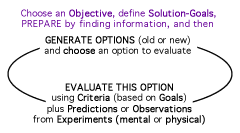 The thinking strategies are related, yet different, in two types of design: • during a typical design project (where the problem-solving objective is a better product, activity, strategy, or theory) a student's decisions about “what to do” will help them solve this problem and also improve their problem-solving skills in future projects; • with intentional learning, when a student's personal objective is better ideas-and-skills knowledge, their "strategic action-decisions about thinking-and-action" form a cognitive-and-metacognitive strategy that helps them improve their learning skills. These two types of design are related, as explained in my Overview of Design Process. The simplest verbal-and-visual representation of my model for Integrated Design Process is a two-step cycle, shown at the right.
On-and-Off Metacognition: In both types of design, often the best short-term strategy is to avoid “thinking about thinking” and just think, letting the process flow naturally with relaxed concentration. An extremely valuable metacognitive skill is knowing yourself well enough to know when you should focus your thinking on whatever you're doing now, and when to step back to think about strategies, planning, and thinking. Also essential is self-knowledge about how you can avoid “paralysis by analysis” and much weight you should give to rational analysis and to your instinctive feelings about a decision; either end of the spectrum, and the broad range in-between, can be informed by what we commonly call intuition.
Self-Regulated Learning — Applied Metacognition
This is a well-established area of study that is a cognitive/metacognitive approach to self-education, similar to what I'm describing above. It's just using a different term. Similar to other experts on metacognition, people in this area have developed a variety of high-quality programs — like those mentioned at the end of Livingston's page in "Metacognition and Cognitive Strategy Instruction" — for skills that are general and also specialized (for reading, writing, arithmetic,...) and for the whole range of ages. These programs are built on a strong foundation of knowledge about self-regulated learning; I think their work will be very useful for education, and soon this section will contain more information about self-regulated learning, or (more likely) their "applied metacognition" will be merged into the main section about "metacognition" above, since it already contains many applications.
Metacognition and Feedback that is based on Evaluations (formative & summative)
As a teacher, you can help students improve their learning strategies, both directly (by describing the strategies you enthusiastically recommend, and explaining why they work so well) and indirectly (by coaching students, to encourage and guide their own metacognitive discovery of personally customized learning strategies). During both of these, feedback that is based on evaluations can serve as useful guides for your coaching and your students' metacognition. When a student produces their own evaluative feedback by observing their own thinking/actions and the performance-results, this is metacognition. When teachers provide evaluative feedback about results and/or process, this “external metacognition” will serve a similar function when it facilitates and improves the metacognition of students.
Two Terms: Although I prefer to think & write about feedback, in the writing of others the word evaluation (or assessment) occurs more often. They are related, but in teaching they are different.
Stages of External Feedback: With external feedback, such as that provided by a teacher, there is a time delay between observation, interpretation, and communication. First, you (serving as a teacher) awarely observe to get information about the performance and learning of individual students, or groups. Second, you interpret your observations; you evaluate student performances and make inferences about the effectiveness of their learning processes, and decide if you want to recommend that they revise old strategies or apply new strategies. Third, you decide whether and why (and what, how, when) to communicate with your student(s). / With internal feedback your observations of your own performances-and-learning are “communicated” to yourself at the same instant, although there is a delay in your interpretations, and in your decisions about strategy revisions and applications. }
Educators distinguish between evaluations (and feedbacks) that are formative and summative, which differ in both purpose and timing:
Purpose — Throughout a course, the purpose of formative evaluations is to improve the quality of learning, with students and teacher using information about the ideas-and-skills being learned (or not learned) as a basis for asking “what changes in learning strategies or instruction might be educationally useful?” Later, summative evaluations (such as exams that try to measure what has been learned) are used for assigning grades. Or, using analogies, we can compare basketball practices (formative) and games (summative), or a chef tasting soup (formative) before customers taste the soup (summative).
Timings — A typical course is split into parts, and for each part formative evaluation precedes summative evaluation (it's formative then summative, formative then summative, formative...) so a summative evaluation for one part can be viewed as formative evaluation for the next part, by teachers and students. Teachers can adjust their instruction with improvised educational design in a process analogous to metacognition. Students who want to improve their learning strategies can ask themselves, for each exam question they miss, “Why did I miss it?” (did I study the wrong way? not study enough? not read the question carefully? omit a step in the process of thinking? think illogically? get too nervous to think clearly? run out of time?) and “How can I improve?” (so the next time I'll get it correct).
• Overview of Assessment by Marie Baehr & Steven Beyerlein, describes assessment as "a process used for improving quality [of a performance or an outcome]" that "is critical for growing lifelong learning skills and elevating performance in diverse contexts." They explain The Nature of Assessment, 10 Principles of Quality Assessment, and Issues that Affect Assessment Quality, and provide examples of assessment.
• Distinctions Between Assessment and Evaluation also by Marie Baehr, says "[formative] Assessment provides feedback on knowledge, skills, attitudes, and work products for the purpose of elevating future performances and learning outcomes. [summative] Evaluation determines the level of quality of a performance or outcome and enables decision-making based on the level of quality demonstrated. These two processes are complementary and necessary in education." Her paper logically explains, in a brief 4-page summary, many educationally useful ideas.
editorial comments about terminology: I think these papers by Marie Baehr (Overview... and Distinctions...) are excellent, but her unconventional terminology is not useful. I hope educators will continue using adjectives (formative and summative) combined with a noun (assessment or evaluation), instead of eliminating the adjectives and using only the nouns (assessment and evaluation) — which most people, including me, treat as synonyms — for labeling important distinctions. The two-word labels, using adjective and noun, clearly identify the differences (formative versus summative) and similarities (both are evaluations of quality), but the one-word labels don't. { And there is a more important reason to avoid one-word labels. }
• My Evaluation Philosophy by Julian Hermida, explains why he uses a wider variety of formative and summative evaluations, but "ephasizes formative feedback... throughout the course" because "my ultimate goal is to help my students develop strong metacognition skills."
• Formative and Summative Assessments in the Classroom by Catherine Garrison & Michael Ehringhaus, explains what formative assessment is, and emphasizes the importance of "what teachers do with the information they collect. ... research shows descriptive feedback to be the most significant instructional strategy to move students forward in their learning. Descriptive feedback provides students with an understanding of what they are doing well, links to classroom learning, and gives specific input on how to reach the next step in the learning progression."
Optimal Performance — Motivation & Anxiety
This section is closely related to Learning from Experience — which explains how objectives can be short-term (wanting optimal performance in the present) and/or long-term (wanting optimal learning for the future) — and later these two subsections may be combined.
I.O.U. — This sub section is underdeveloped now, but I wanted to begin developing it, mainly because it's important, but also to support my pages about Problem Solving & Metacognition in Education — Using Design Process, such as in these sections --
We can think about optimal performance for a wide variety of situations, but below I'll focus on four areas where we use cognitive skills and/or motor skills -- in the contexts of exams, speaking, music, sports:
• general - My brief section about Optimal Performance & Metacognition looks at principles for "avoiding, using, and regulating metacognition ... [to] help you regulate metacognition by turning it on and off, to maximize its actual positive effects (in helping you improve your thinking, learning, and performance) and minimize its potential negative effects (in being a distracting INTERFERENCE that will reduce performance) in an effort to achieve optimal benefits. In situations where metacognition is unproductive — if there is too much introspection of the wrong kind with the wrong timing — the difficulty is not metacognition, it's unskillful metacognition, due to a deficiency in skillfully using metacognition. [You should] develop the valuable metacognitive skill of knowing yourself (and your situations) well enough to know when to use metacognition, and how to use it, so it will be optimally beneficial."
sometimes turning metacognition "off" is a way to avoid a paralysis-by-analysis (or any decrease of cognitive efficiency, which is less serious than paralysis but is not optimally efficient) that could be the result of too much introspection of the wrong kind with the wrong timing
Here is an extremely rough-draft collection of "candidate pages" that I'll go through soon (probably in late-April 2012) to check them for quality and decide whether to retain or replace them, especially to add more in the categories for exams & speaking:
• speaking -
• music -- http://www.davidleisner.com/guitarcomposer/noname.html
• music -- http://www.uwec.edu/counsel/pubs/musicanxiety.htm
• music -- http://eeshop.unl.edu/anxiety.html
• stage -- http://www.psychologytoday.com/blog/finding-your-voice/201011/performance-anxiety
• sports - http://www.sportpsychologytoday.com/tag/performance-anxiety/
• sports -- http://sportsmedicine.about.com/cs/sport_psych/a/aa010603a.htm
• sports -- http://socialanxietydisorder.about.com/od/copingwithsad/a/sportsbasics.htm
• sports - http://www.brianmac.co.uk/psych.htm and http://www.brianmac.co.uk/companx.htm
• stage fright - http://www.webmd.com/anxiety-panic/guide/stage-fright-performance-anxiety?
• youth sports - http://www.momsteam.com/team-of-experts/keith-wilson-msw-d-div/performance-anxiety-in-youth-sports-parents-can-help-their-ch
1C. Constructivism as a Theory of Active Learning
Learning and Teaching: Although this section is 1C, which is still in Part 1 so it should be focused on learning, you'll notice that much of it is about teaching. And, as you'll see throughout this page, educators have differing ideas about the applications of constructivism for teaching.
The sections below examine various aspects of cognitive constructivism — meaningful reception learning, discovery learning, conceptual change — and social constructivism.
Meaningful Reception Learning — David Ausubel
You can see the constructivist foundation of David Ausubel's theories in his statement that "the most important single factor influencing learning is what the learner already knows." His views about meaningful reception learning, and how it can be promoted by skillfully organized explanation-based instruction, are summarized by Mimi Recker and Joyce Alexander. (also, Greg Kearsley) (and see "Moving Beyond the Pioneers" below) Discovery Learning — Jerome Bruner
Constructivist learning theory was also the foundation for the theories of Jerome Bruner, but he reached different conclusions about the best ways to teach. He advocated discovery-based instruction in which teachers provide situations that let students discover ideas for themselves, as explained by Learning-Theories and Greg Kearsley and Life Circles.
Moving Beyond the Pioneers: I'm describing the views of Ausubel and Bruner (*) because they were prominent early advocates for meaningful reception learning and discovery learning, respectively. But since their time our collective knowledge about learning-and-teaching has greatly expanded, due to educational research, critical analysis, and creative insights. Therefore, we should use the best current scholarship (which includes the ideas of Ausubel & Bruner, and more) when we are thinking about how people learn (by reception & discovery, and in other ways) and the implications for how we should teach. * But my brief sketches in this page, supplemented by the summaries I've linked to, cover only a small fraction of their thinking, theories, and suggestions for education.
I.O.U. on August 8, 2011 (and again in March 2012) — For more than two months I've been focusing on developing my ideas about Design Process and writing these ideas into web-pages to share with other educators. Eventually I'll return to a major revising of the writing-and-links below. In the rest of this page, many parts are fairly complete-and-coherent, and (I think) are worth reading. But for awhile, some parts of it will remain incomplete, and cluttered with loose ends that will be in green font (and often a smaller font) so you can ignore everything in green font of any size, as in what you see below.
Misconceptions and Conceptual Change
IOU - I'll find pages that skillfully summarize the basics — a misconception occurs when students construct knowledge for themselves, outside the classroom (or even in the classroom), because they sometimes get it wrong and construct misconceptions that don't match those of modern science — plus conceptual ecology, teaching for conceptual change (teachers should look at lists/descriptions of common misconceptions)
Social Constructivism — Bandura & Vygotsky
jigjiog -- the MANY types of constructivism (quote ERIC) including social (vygotsky & bandau) that are OK, and radical (von Glasersfeld) that can get weird, plus basic social interactions and their benefits (independent from the more extreme views, so philosophy-and-instruction is not a package deal) -- acknowledging that my "constructivism" in this page is not the same as "constructivism" you'll find elsewhere, mine is a subset of the whole, and my instructional implications are different but (I think) are logical
• http://www.learning-theories.com/social-learning-theory-bandura.html
• http://www.learning-theories.com/vygotskys-social-learning-theory.html
• http://www.lifecircles-inc.com/Learningtheories/social/bandura.html - solid short
• http://www.lifecircles-inc.com/Learningtheories/social/Vygotsky.html
• http://itls.usu.edu/~mimi/courses/6260/Theorists/Bandura/bandsc.html - detailed
• http://itls.usu.edu/~mimi/courses/6260/Theorists/Vygotsky/vygosc.html
• http://qcpages.qc.cuny.edu/~bmurfin/classes/fall2009/seys362/learn.html#lev
• http://tip.psychology.org/bandura.html - solid short w links to lave
• http://tip.psychology.org/vygotsky.html
Radical Constructivism — Postmodern Philosophy
A
summary-overview of Constructivist
Views of
Learning in Science & Math (from ERIC Digests) says, "Using the term ‘constructivism’ can be ambiguous because there are several forms of constructivism described in the professional literature. Good, Wandersee, and St. Julien (1993) offer 15 different adjectives to place in front of constructivism to clarify its meaning: contextual, dialectical, empirical, humanistic, information-processing, methodological, moderate, Piagetian, post-epistemological, pragmatic, radical, rational, realist, social, and socio-historical. ... All forms of constructivism incorporate the notion of individually constructed knowledge." --> taking one aspect of constructivism and extending it (sometimes very far) in that direction
2. Learning
Theories & Teaching Strategies — Designing Effective Instruction
Based on what we know about learning, how can we design instruction that will help students learn more effectively and enjoyably? We'll explore this question in three sections — 2A) basic principles of educational design, 2B) three types of teaching strategies, 2C) designing eclectic instruction to improve education — and here are some of the main ideas: [ I.O.U. — Soon, maybe before June, I'll write a relatively brief executive summary here, to explain the main ideas in Part 2, in 2A-2B-2C. ]2A. Basic Principles of Educational Design
Goal-Directed Designing of Education,
using Activities for Thinking/Learning:
During instruction, any experience that stimulates thinking and leads to learning is a thinking/learning activity.
For a goal-directed design of education, we can: • define goals for the desired results of education, for the ideas-and-skills we want students to learn, and • design instruction with thinking/learning activities that will provide opportunities for experience with these ideas-and-skills, and help students learn more from their experiences.
| What is design? An Introduction to Design by Craig Rusbult (editor of this page) explains how we use the creative-and-critical process of design for almost everything we do in life — whenever we solve a problem (this is "any situation where you have an opportunity to make things better") by improving a product, activity, strategy, or theory — which includes educational strategies (activities & methods) and the learning strategy of metacognitive reflection. My model of Integrative Design Process describes the integrated functional relationships between 9 modes of thinking-and-action used in a process of design, when we define an objective (for an improved product, activity, strategy, or theory) and try to achieve this objective by creatively generating options and critically evaluating options. We evaluate options by comparing our goals (the desired characteristics we want) with the observed characteristics for an option, or with its predicted characteristics, and we continue this process of generation-and-evaluation until we find a satisfactory option or abandon the search. This design process is a general framework that, for each design project, is supplemented with important details. Here are some examples of creative-and-critical thinking about how we can design improved education: |
 |
 |
• Methodology for Course Design - by Pacific Crest - outlines a 21-step process (analysis*, design*, development) plus implementation, assessment & evaluation*. (* links take you to 3 other slide shows) Their Overview of Instructional Design (Program Design for a Quality Enhancement Plan) is similar, but Slide 7 (.../7.htm) has extra information about Accreditation.
• I.O.U. — I'll look for web-resources, and more will be here later, maybe by mid-April 2012.
Goals for Education — Improved Ideas-and-Skills
We can define many educational goals for students in terms of ideas (what they know) and skills (what they can do); ideas are often called conceptual knowledge (or declarative knowledge), and skills are procedural knowledge, so a person's ideas-and-skills are the concepts-and-procedures they know and can use.
• With more precision and detail, Ton de Jong & Monica Ferguson-Hessler (in Types and Qualities of Knowledge) adopt a knowledge-in-use perspective to make a classification system with 4 types of knowledge (situational, conceptual, procedural, strategic) and 5 qualities of knowledge (level, structure, automation, modality, generality). They combine these to types & qualities to form 20 characteristics of knowledge, and explain how their system can help us design instruction to more effectively teach knowledges, and assessments to more accurately measure knowledges. {more about knowledges}
• Another valuable perspective, which includes the above knowledges plus others, is the Multiple Intelligences (linguistic, logical-mathematical, musical, spatial, bodily kinesthetic, intrapersonal, interpersonal) proposed and described by Howard Gardner.
• In addition to cognitive ideas-and-skills, we should also consider the affective aspects of instruction which include its influence on attitudes (about self, others, education) and motivations.
• A Model of Problem Solving — with Content Understanding, Problem-Solving Strategies (domain-dependent & domain-independent), Metacognition, and Motivation — is part of a larger Model of Learning — with Content Understanding, Collaboration, Communication, Problem Solving, and Metacognition — have been developed by CRESST (National Center for Research on Evaluation, Standards, and Student Testing). These models are described in reports about Problem Solving (by Harold O'Neil, John Schacter) and Learning (by Davina Klein, Harold O'Neilm, Eva Baker).
• Pacific Crest -- (IOU - this will link to 2 or 3 of their pages describing ideas-and-skills that contribute to successful performances in school and life)
Despite this complexity — with many types & qualities of knowledge, multiple intelligences, and affective factors, used in many ways in a variety of contexts — for simplicity I'll use ideas-and-skills (hyphenated to acknowledge the intimate interactions between ideas and skills and more) to represent “all of the above” with whatever blend of emphases you want to choose when defining your goals for education. The complexity of our educational goals (which typically involve multiple ideas-and-skills across a wide range) is a key factor in the following argument.
Logical Reasons to Use Eclectic Instruction
Later, I will explain why we should expect an eclectic blending of instructional approaches (including all three in Section 2B) to be most educationally effective. Here is a chain of logic that leads to this conclusion:
1a) we want students to learn a wide variety of cognitive & affective ideas-and-skills, and
1b) different approaches are useful for teaching various aspects of these ideas-and-skills;
1c) the learning preferences of students differ, and we want to match the preference(s) of more students with at least one of our teaching styles;
1d) as described in an 80-20 principle, usually there are diminishing returns for each type of instructional approach.
All of these factors contribute to a logical conclusion that
2) therefore instead of thinking that, for a particular teaching approach, “if some is good, more would be better, and all would be best,” we should try to design eclectic instruction, combining the best of each approach in a blend that produces an optimal overall result — a “greatest good for the greatest number” — in helping students achieve worthy educational goals.
whenever experiences stimulate mental activities that lead to meaningful learning, this is active learning. Mentally active learning of ideas-and-skills can occur in a wide variety of thought-stimulating activities, ranging from direct learning... to learning by discovery... or in design projects and other kinds of problem solving where the learning cannot be defined as either direct or discovery. All of these thought-stimulating activities can produce active learning, because educationally productive mental activity can occur, with or without physical activity in which you “do” something, during a wide variety of mentally-active experiences.The argument continues with the chain of logic above (in which 1a-1d leads to a conclusion of #2) and onward through Section 2B into 2C.
2B. Three Types of Instructional Activities
Constructivism — Learning and Teaching
This page begins by emphasizing that active learning occurs "whenever experiences stimulate mental activities that lead to meaningful learning," and this cognitive activity does not require physical activity.
Section 2B assumes a cognitive constructivist view of learning-and-teaching: "People learn by using what they know to construct new understandings" so a teacher should try to understand what students know, and build on this foundation.
What are the educational implications of constructivist learning theories? What kinds of teaching strategies-and-activities are consistent with constructivism? Here are simple responses, by Richard Mayer, for two key questions:
What is constructivist learning? "A basic premise in constructivism is that meaningful learning occurs when the learner strives to make sense of the presented material by selecting relevant incoming information, organizing it into a coherent structure, and integrating it with [the learner's own] organized knowledge." And...
What is constructivist teaching? Logically, when constructivist learning occurs during any instruction that "promotes appropriate cognitive processing," this is constructivist teaching.
Below, you'll see three general types of thinking/learning activities that can promote constructivist processing-and-learning — learning from others (yes, this is included because "Constructivist Learning is more than just Discovery Learning") and learning by discovery and learning by doing — to help students learn valuable ideas-and-skills.
A. Learning from Others — in Explanation-Based Instruction
Most of what I know (in ideas about math, science, history, philosophy, education,...) has been learned from others, from hearing or seeing their explanations of ideas. And even though most of my skills (in athletics, social situations, labs, at work,...) have been “discovered” from personal action-experience, often my discoveries have been enhanced by coaching, when other people have given me useful explanations for how to improve my learning and performing of skills. Does this match your own experiences, for the ways you have learned most of your ideas and skills?
The main motivation for direct explanatory teaching is the realization that by learning from others, we can "stand on the shoulders of giants" instead of constantly trying to “re-invent the wheel,” and learning from others is an efficient way to learn.
A common claim about constructivist teaching is that (according to theories of constructivist learning) people construct their own knowledge, so teachers should let students construct their own knowledge by discovering it for themselves, without any explanation from a teacher or textbook. But discovery learning is only one type of constructivist learning. We actively construct our own knowledge in a wide variety of situations, including meaningful reception learning which also is constructivist learning. How People Learn (page 11) agrees:
A common misconception regarding “constructivist” theories of knowing (that existing knowledge is used to build new knowledge) is that teachers should never tell students anything directly but, instead, should always allow them to construct knowledge for themselves. This perspective confuses a theory of pedagogy (teaching) with a theory of knowing. Constructivists assume that all knowledge is constructed from previous knowledge, irrespective of how one is taught (e.g., Cobb, 1994) — even listening to a lecture involves active attempts to construct new knowledge.For example, think about your own recent experiences in learning. Have you learned anything from reading this page, or the pages it links to? How? Even though the authors (myself and others) have tried to explain ideas clearly, any learning that occurs depends on you, when you invest time and effort in reading and thinking. You have been mentally active, by trying to understand and organize the ideas you've read, along with your own ideas that were stimulated by your use of critical thinking while you've been reading, and during all of this you combine your new knowledge with your previous knowledge. Your process of learning is an example of cognitively active reception learning (aka direct learning) that can be meaningful and effective, enjoyable and time-efficient.
Unfortunately, however, reception learning often is not effective. Why? The effectiveness of reception learning is decreased when the potential learners are not cognitively active, and when the explanatory teaching is not well designed. Let's look at some strategies for reducing the negative effects of passive students and unskilled teachers.
Passive Students? — Metacognition and Meaningful Reception Learning
When students are not cognitively active during explanations, their learning is diminished in both quantity and quality.
To help students cope with this problem so they can learn more from direct explanations, we can encourage them to use metacognition and provide useful advice for how they can do this. For example, here are some ideas (excerpted from the appendix) that could be useful in persuading students that metacognitive strategies will help them learn more effectively:
Learning from others is an easy way to learn a lot in a little time. ... Learning is an active process that requires thinking. When you learn by reading, for example, your thinking converts symbols on the page into ideas in your mind. Every time you learn a new idea, you are actively constructing your own mental representations of the idea in a personally meaningful form. And your new idea interacts with your old ideas, as you try to combine the new and old into a coherent system of ideas. The process of active reading is the theme when Virginia Voeks... explains how to learn more and enjoy more while reading: "Start with an intent to make the very most you can from whatever you read. ..." When you're an active reader, eagerly searching for new ideas, you will find them, and reading becomes a stimulating adventure. You can read passively or you can make it an active adventure. ... You control the quality of your learning.Of course, this motivational encouragement should be combined with practical advice for how to improve attitudes toward learning and quality of concentration.
Unskilled Teachers? — Principles for Designing Effective Direct Instruction
The basic goal of explanation-based instruction — to clearly explain an idea so it can be learned more easily — is straightforward. But when aiming for clarity it's important to think about what students know and how they think because, for explanatory communication, clarity is in the mind of the beholder.
David Ausubel wanted to promote learning that is meaningful (not rote) by reception (not discovery), so he described principles for increasing the quality of meaningful reception learning. How? By using advance organizers (to activate "what the learner already knows" or increase it, as a preparation for learning new ideas), moving from generalities to details, integrating new ideas with old ideas by making comparisons (of both similarities & differences) and showing their relationships in the context of a big picture; Recker's page summarizes "four processes by which meaningful learning can occur" (derivative subsumption, correlative subsumption, superordinate learning, combinatorial learning) plus the teaching tools of advanced organizers, comparative organizers, and progressive differentiation. All of these teaching strategies and others (because to Move Beyond the Pioneers "we should use the best current scholarship") can be used to improve the clarity of explanations.
To improve the effectiveness of explanations (in helping students understand, retain, and transfer) the context of explanation is important, and careful design is necessary.
• One principle of explanatory teaching is to lead a learner gracefully from what they are now thinking to what you want them to learn. During my writing and speaking, I (the editor, Craig Rusbult) try to do this in a way that is analogous to leading in ballroom dancing: "Let your partner know what you want to happen next, soon enough that she can do it — i.e., soon enough that she is not already physically committed (due to her momentum and direction-of-stepping) to doing what she would need to do if there was a continuation of the previous pattern." (from "details" of Ballroom Dancing) As a teacher, when you're explaining new ideas you should "let your partner [in learning] know what you want to happen next" so they can understand the new ideas (in terms of what they already know) and learn the new ideas more effectively.
• One popular way to provide a context for explanation is a model of instruction developed by Madeline Hunter, who proposed a set of lesson elements — anticipatory set (to activate prior knowledge and motivate interest) and explaining the objective, providing input (explanations, videos, modeling,...), checking for understanding (and providing feedback), guided practice & (often outside class) independent practice, and closure — that teachers can consider (and decide whether to use) when designing a lesson. The elements are described in brief outlines (A - B) and, with some differences in the terms and their order, in a little more detail and in another outline and an outline with guiding-questions and with additional helpful details (by Beth Lewis), plus What the "7-Step Lesson Plan" Isn't (by Patricia Wolfe).
• Design Theory for Direct Instruction by William Huitt, David Monetti, and John Hummel, is a modern (2009) in-depth analysis of direct instruction, in the context of recent research & current assessment standards, and "people [in a family, community, school] and institutions whose actions contribute to school learning." Their model, which is transactional because it "emphasizes teacher/student interactions at each point in the lesson," has three phases — presentation (with 5 elements), practice (guided & unguided, distributed), evaluation (summative & formative) — with monitoring and corrective feedback "throughout the lesson on an ‘as needed’ basis." They also describe scripted lessons that are useful for helping all students (with an authentic “no child left behind” attitude) build a strong foundation for continued learning; although a scripted-lesson approach is sometimes labeled “Direct Instruction” it is only one type of direct instruction; this section ends with 5 paragraphs about "deciding when to use a scripted-lesson approach."
Notice that these models for instruction, from Hunter and Huitt et al, are more than just “50 minutes of non-stop talking” as in the negative stereotype of a traditional lecture. Instead, their models-for-instruction combine explanations with activities. Another example of supplemented explanation is an overview, case study approach that combines explanations (of both ideas and skills) with activities for exploration-and-application. In their design of instruction, teachers have flexibility and options; explanation-based instruction can be designed with or without supplementary activities, because its essential feature is a confidence that explanations can be educationally useful, and should be used during instruction.
• The Importance of Organization: How People Learn states, as one of its three Key Findings, that "To develop competence in an area of inquiry, students must: (a) have a deep foundation of factual knowledge, (b) understand facts and ideas in the context of a conceptual framework, and (c) organize knowledge in ways that facilitate retrieval and application." A logical organization of knowledge will improve thinking and transfer: "The ability to plan a task, to notice patterns, to generate reasonable arguments and explanations, and to draw analogies to other problems are all more closely intertwined with factual knowledge than was once believed. ... A key finding in the learning and transfer literature is that organizing information into a conceptual framework allows for greater “transfer”; that is, it allows the student to apply what was learned in new situations and to learn related information more quickly." The last sentence in this section explains how we can help students develop a deep foundation of organized knowledge, which lets them "develop competence in an area of inquiry."
• My tips for Using Memory as a Problem-Solving Tool explain why "it's easy to find page 86 of a book, the
word ‘grace’ in a dictionary, or a book in a library, due to organization" and why Quiz #1 (remember 22 letters: t s e
k h a u o e n d y g c a l h t e y n m) is much more difficult than Quiz 2 (remember 6 letter-groups: sneaky the lunch dog my ate), especially when the words are organized into a meaningful story. In the classroom, a comparison of these two quizzes and asking “why?” is useful for persuading students that they should try to organize their ideas in ways that are logically and personally meaningful.
• Some of the most important influences on my thinking have been teachers who summarized knowledge and logically organized it, which inspired me to also do this in whatever I'm teaching, as described in the beginning ("influences" through "verbal-and-visual representations") of my web portfolio.
How to Teach Organized Knowledge: In my opinion, the best way to help students develop a deep-and-organized understanding of a large amount of conceptual knowledge, as recommended by How People Learn, is with skillful Explanation-Based Teaching supplemented by Activities for Application & Extension. { But inquiry activities are an excellent way to help students learn general and domain-specific procedural knowledge, as explained below. }
B. Learning by Discovery — in Guided Inquiry Instruction
Instruction for Discovery — A Process of Guided Inquiry (with appropriate difficulty)
A Broad Definition of Inquiry: What is inquiry? In a narrow definition, inquiry activities are associated with discovery learning in which students “discover” ideas instead of learning ideas from the explanations of a teacher or textbook. But I think we should define inquiry more generally, as any activity in which students explore situations and try to solve problems.
Overlaps of Instructional Approaches: With this broad definition, inquiry is just a problem-solving activity in which (as in the third instructional approach) students Learn by Doing in Activities for Application & Extension. And the following paragraph explains another overlap, between the first and second approaches, with teaching that emphasizes explanation or discovery.
Learning from Inquiry, by Discovery and/or Explanation: Opportunities for inquiry occur whenever a gap in knowledge — in conceptual knowledge (so students don't understand) or procedural knowledge (so they don't know what to do) — produces a situation where students must think on their own, and are allowed to think. A process of inquiry can lead to a result of discovery learning, or a result of explanation-based learning when the inquiry “prepares” students so they can more easily understand an explanation. The balance between discovery and explanation is adjusted when teachers aim for a level of "...Appropriate Difficulty" by "Guiding Inquiry...", as explained below.
A Contrast: In skillful explanatory-instruction the goal is to explain ideas with maximum clarity, thus making it easier for students to learn. But in skillful discovery-instruction a teacher doesn't explain, and tries to make learning a moderately difficult challenge. Why? Because the goal is to let students discover knowledge by constructing it for themselves. Eventually, clear explanations (by students and teacher) will be useful, but initially the goal is discoveries (by students). / Also, a teacher can decide to explain some concepts but let students discover others, in an eclectic mixing of explanation-based and discovery-based instruction.
The Importance of Appropriate Difficulty: For optimal educational benefits, both cognitive and affective (to promote learning and motivation), inquiry instruction must be well designed, which includes producing an appropriate level of difficulty. Well-designed inquiry instruction, like a well-written mystery story, aims for a level of
challenge that is “just right” so students will not become bored
if it's too easy, or frustrated if it's too difficult. Ideally, students
will struggle temporarily but eventually (in a reasonable amount of time) they will succeed, and in doing so they will feel genuine emotional-and-intellectual
satisfaction; they will place a high personal value on their success, improving their self-image and confidence, because they were able to overcome challenging obstacles
during the process of inquiry.
Guiding Inquiry to Adjust the Difficulty: During a process of guided inquiry leading to discovery, the level of difficulty — when we ask “how easily can students form a bridge from not-knowing to knowing?” — depends on the intrinsic difficulty of understanding a particular set of concepts (so each topic for inquiry should be chosen carefully) plus the guidance that increases students' ability to cope with an inquiry-challenge by helping them prepare before it, and coaching them during it. In coaching, a teacher (*) observes students while they work, and then does all (or none) of these — ask questions, answer questions, give clues, direct attention to useful information from past experiences or the current situation — to provide
guidance that will help students think productively and continue making progress toward solving the inquiry-mystery. Teachers can also coach afterward, by encouraging students to reflect on their experiences.
* Or coaching can be done by students. A common way to adjust difficulty (and stimulate educationally useful interactions) is by asking students to work in groups, where they naturally tend to coach each other, especially if this is encouraged by the teacher who explains how they can coach in productive ways.
An Example of Computer-Adjusted Guiding: A computer program can be designed to adjust a problem's level of difficulty based on the quality of student responses. If a student’s answers for one problem are correct, the next problem is adjusted to a higher level of difficulty. If the answers now become less correct, the program provides guidance (in questions, comments, clues) to help the student cope with the challenge. This program is simulating a teacher, trying to imitate the guidance adjustments that would be made by a skillful teacher.
An Example of Student-Adjusted Guiding: Or a program can let each student decide how much guiding they want, and when. For example, a problem might have 3 levels of clues — labeled in a count-down (3, 2, 1) to the answer being revealed at “0” — with the clues at Levels 3, 2, and 1 offering increasing amounts of guidance, making it easier to construct a solution. A student works for awhile and then (if it's necessary, if they cannot solve the problem and don’t think they are making satisfactory progress) they can ask for the clue at Level 3, and then (if necessary) at Level 2, and then (if necessary) at Level 1. The program provides a clearly explained Answer (at “Level 0”) whenever a student solves the problem, or gives up after receiving all 3 clues. If a submitted solution is incorrect, the program can just say “this is wrong” or it could say “that was a nice try, but...” and provide an explanation for why it was wrong, and (perhaps) guidance about what to do next. / This process can be repeated for a second problem with a level of difficulty that is adjusted depending on success (did they solve the problem?) and guiding (did they request 0, 1, 2, or 3 clues?). If a student solved Problem #1 with no clues, #2 will be more difficult. But #2 will be easier if they failed to solve #1 even after using all 3 clues. Or the program could let each student choose the level of difficulty for Problem #2. / The process can be repeated for Problem #3, and #4,... until a student decides to stop working the problems.
Questions about Guidance, Motivation, and Metacognition
The computer programs described above raise questions about the process of teaching. With the Student-Adjusted Guiding, do you think it's better if students can solve problems by themselves, without using clues? Most teachers (perhaps all) will say “yes”, but there will be disagreements about timing. Is it best if students refuse to accept any clues, even when they don't seem to be making progress? Or is it better if initially (in Problem #1, #2,...) they learn from the explanations in clues and answers, then in later problems they begin to solve problems independently? / To what extent will their struggles without clues — shall we call this “clueless struggling?” :<) — help them improve their skills in “learning how to learn” and their long-term abilities for self-education? But if there is too much struggling and not enough solving, will this cause some students to become discouraged? These questions — about "an appropriate level of difficulty" and the value of struggle that leads to discovery — are important, and there are no simple answers that don't oversimplify in an unsatisfactory way.
Or, approaching these questions from another perspective, if the computer problems are graded would you give more points to students who solve problems without receiving clues, by subtracting points for every clue that is requested? If yes, would you begin this grading policy with Problem 1? or later?
A student's decision to request a clue now, or to wait and continue thinking without it for awhile, is a metacognitive strategy decision. How would you motivate students to be more patient, to work longer with minimal guidance before they request the next clue? Would you tell them that their patience will be rewarded with greater satisfaction? {This is usually true, and I think students know this intuitively.} By explaining the research-evidence showing that their learning will have higher quality if it's the result of their own discovery? {But I don't think this evidence exists in equal-time comparisons, as discussed later in controversies about constructivism.} Or in other ways?
Procedural Knowledge and Conceptual Knowledge
In my opinion, inquiry activities are an excellent way to help students develop procedural knowledge (both general and domain-specific) and they should be part of every student's experience, but "the best way to help students develop a deep-and-organized understanding of a large amount of conceptual knowledge" is with a creative blending of skillful Explanation-Based Teaching supplemented by Activities for Application & Extension. Valuable discovery learning does occur frequently and naturally during problem-solving activities for application-and-extension, and occasionally a discovery approach can be a refreshing change of pace when teaching some carefully selected concepts. But I think Discovery Teaching cannot be a major part of the foundation for instruction in an effective curriculum.
Pure Discovery versus Guided Discovery
Very few educators propose that teachers should frequently use pure discovery, in which "the student receives representative problems to solve with minimal teacher guidance. (Mayer, 2003)" Here are the main difficulties with pure discovery: for all students, pure discovery learning takes longer than with guidance; if discovery is to occur, the problems must be relatively easy; in a typical classroom, if a discovery is reasonably challenging for some students, other students will never discover a solution (or concept) without guidance.
For a variety of pedagogical reasons, almost all proponents of discovery learning propose guided discovery in which the teacher provides problems along with "hints and directions about how to solve the problem, to keep the student on track (Mayer, 2003)." For example,
• Scaffolding and Achievement in Problem-Based and Inquiry Learning by Cindy Hmelo-Silver, Ravit Golan Duncan, and Clark Chinn. This pro-inquiry response in a controversy about pure-discovery learning examines the evidence, and explains why we should distinguish between various types of instruction (discovery, experiential, problem-based, inquiry) inspired by constructivism, because "problem-based learning and inquiry learning are not minimally guided instructional approaches but rather provide extensive scaffolding and guidance to facilitate student learning." They describe the types of scaffolding that are used, and suggest asking, "under what circumstances do these guided inquiry approaches work, what are the kinds of outcomes for which they are effective, what kinds of valued practices do they promote, and what kinds of support and scaffolding are needed for different populations and learning goals?"
• Scaffolded Inquiry by Karen Ostlund, with scaffolding gradually removed for the purpose of guiding students along a Continuum of Inquiry (from Directed Inquiry to Guided Inquiry to Full Inquiry) with descriptions of each stage, and tables to show differences in the types and amounts of scaffolding guidance by a teacher.
A Continuous Spectrum from Clear Explanation to Pure Discovery
Instruction spans a wide spectrum, ranging from clear explanation through moderate ambiguity (due to unclear explanation or intentional guided discovery) to pure discovery.
Even when totally clear explanation is the goal, this will not be achieved because “clarity is in the mind of the beholder” and ---
But even in the pure discovery described above, students have guidance by getting "representative problems" and having the level of difficulty chosen by the teacher; in a sequence of problems with gradually increasing difficulty, there will be even more guidance.
And the location of instruction can vary from one student to another -- another range, varies for students because "clarity... beholder".
middle range from both ends, due to unskillful explanation (so a student must work harder to learn, or
Reception-and-Discovery: The process of learning new knowledge, when it's required by an activity, can occur by any combination of mentally meaningful reception and/or discovery, using information or explanation from a teacher, another student, personal research, or the activity itself, as in a computer program.
You can find activities throughout this spectrum when you analyze the demands-for-discovery by asking “would an ideal student (who understands everything taught in previous instruction, and remembers it) have the ideas-and-skills needed to successfully complete the activity, or would they have to discover some new ideas-and-skills?”
• I.O.U. — There will be a couple of links here, about discovery-based instruction, before the POGIL-subsection below. Here are some of the many candidates:
• Educational Leadership, in
November 1999, looked at The
Constructivist Classroom and
you can read a foreword about The
C Word and 15
abstracts (from "The
Many
Faces
of
Constructivism" to "...a
Partial
Solution") and two articles: The
Courage to be Constructivist and Caution:
Constructivism
Ahead. [but CONSTRUCTIVISM does not necessarily mean DISCOVERY]
• a range of proposals for "constructivist education" and
the practical
difficulties of radical constructivism that concludes with "Constructivism
and... a New Look at Ausubel"; by ignoring the distinction
between "what we can know" and "what actually exists," super-radical
constructivism (which is proposed by some constructivist educators but not
by most) can get carried away into the silliness of extreme
postmodern relativism that ignores the important differences between humanly-constructed reality and human-independent reality, and between truth and truth-claims.
• chapter summary with an overview of models (cognitive, conceptual,
social contextual) for meaningful
learning in education by Mark & Cindy Grabe, plus informal
thoughts about constructivism by
Mark Grabe;
• Guided Inquiry: Learning in the 21st Century by Kuhlthau, Maniotes, & Caspari
• Process-Oriented Guided Inquiry Learning ( P O G I L ) - Introduction to POGIL by David Hanson & Richard Moog
• Inquiry Instruction by Vital Venture
• Using Inquiry in Science Instruction and Integrating the Inquiry Approach in Science from Glencoe Biology
• Inquiry-Based Approaches to Science Education: Theory and Practice by Wilfred Franklin
The BSCS 5E Instructional Model (http://science.education.nih.gov/houseofreps.nsf/b82d55fa138783c2852572c9004f5566/$FILE/Appendix%20D.pdf Engagement, Exploration, Explanation, Elaboration, Evaluation -- BSCS (= Biological Sciences Curriculum Study) by Rodger Bybee, et al -- executive summary is http://www.bscs.org/pdf/bscs5eexecsummary.pdf
comment: [ A transition/introduction will explain that this section is the response of educators, before and after 2004 when Mayer wrote about "The challenge of teaching by guided discovery is to know how much and what kind of guidance to provide and to know how to specify the desired outcome of learning." ]

I.O.U. — Eventually this major section, focusing on POGIL, will be preceded by other approaches to Guided Inquiry, to put it into an overall context.
• A prominent inquiry program is POGIL (Process-Oriented Guided Inquiry Learning) which has a website to explore, including About POGIL and Instructor's Guide and Designing Process-Oriented Guided-Inquiry Activities (HTML) and more.
• Introduction to POGIL by David Hanson & Richard Moog, explains the philosophy of POGIL and its foundation in cognitive science research (especially How People Learn), several ways to implement POGIL and a teacher's role as facilitator and the beneficial results for helping students learn ideas & skills, reducing student attrition and improving their attitudes toward other students, the course, instructor, and subject area. They describe three aspects of their instruction:
Cooperative Learning: POGIL emphasizes groupwork based on a premise that, compared with competitive or individualized environments, working in groups leads to improved learning and better attitudes. Differences (in knowledge, reasoning, opinions,...) lead to disagreements that, "when managed constructively using appropriate interpersonal, social, and collaborative skills, promote questioning, an active search for more information, and finally a restucturing of knowledge," with this increased use of higher-level reasoning leading to improved mastery & retention of ideas-and-skills. / editorial comment: All of these claims seem reasonable, but the benefits of cooperative learning can also be gained from instruction that is less discovery-oriented, as in design activities used for application & extension.
Metacognition: Along with most educators, they think metacognition "produces an environment for continual improvement" and "has been shown to be especially effective in improving problem-solving skills," as in their self-explanation self-regulation methodology with 5 steps — identify important concepts, identify connections between concepts, identify the steps needed to solve a problem, identify the reason for and meaning of each step, and relate concepts in the initial material to steps in the problem — that "helps students construct the large mental structures that are essential for success in problem solving: those linking conceptual and procedural knowledge." The valuable skill of metacognition is designed into their instruction: "POGIL requires students to use metacognition to help them realize that they are in charge of their own learning" so they need to monitor and self-manage their learning. There is frequent use of non-judgmental formative assessment (mainly by students to assess themselves or fellow students, and occasionally by a teacher) with the goal of improved learning for everyone.
Guided Inquiry: As a structure for instruction, POGIL uses a learning cycle of exploration, concept learning, and application. In exploration, students "respond to a series of questions that guide them through the process of exploring a model or executing a task." During their exploration, students can learn by concept invention or concept formation.* In application, students reinforce and extend their conceptual knowledge by doing simple exercises, complex problems, and their own research. / * "When the second phase involves concept invention, the exploration phase does not present the concept explicitly." Or, with concept formation "some representation of the concept is presented explicitly at the beginning... [and then] students work through questions which lead them to... develop an understanding of it." We'll return to this hybrid instruction, combining some aspects of ====
Hybrid Instruction — combining Discovery and Explanation: As described above, during POGIL exploration a student can learn concepts in two ways — by concept invention (constructing their own explanation) or by concept formation (understanding an explanation, then developing plus their own thinking) — or some combination of these two learning modes.
In either case, after exploration the instructor can explain some aspects of the concept, to clarify it and give it a name. Also, in most groups the student(s) who discover a concept first, or already know it, can explain it to the others. And if the inquiry is carefully designed so the mystery is not too difficult, there may be some “disguised explanation” in the guidance questions.
Students will learn from explanation
These two ways to learn are described in An Introduction to POGIL: Basically, this is the explanation-then-application method described later in ----. [but the main learning occurs by learner-construction, not teacher-explanation] [teacher + text]
Hanson in design-of-activities page — As a result of the exploration, concepts are invented, introduced, or formed. Rather than presenting information in texts or lectures, educators engage students in guided inquiry or discovery to develop their conceptual understanding. This process is structured by supplying questions that compel students to think critically and analytically as they engage in the exploration. These questions, which are called guided-inquiry, critical-thinking, or key questions, guide the learner in the exploration. They can [questions-for-guidance] help define the task, direct the learner to information, lead the learner to appropriate connections and conclusions, and help the lear er construct understanding of the concept being learned.
In the ---- BSCS, this step is called Explanation, which is carefully defined as "----" to accurately describe the possibilities without limiting learning to any single mechanism, locus of explanation
the discovery-oriented guided inquiry of
In a constructivist view, all meaningful learning is active learning (link to #active-learning) throughout the spectrum of external-to-internal explanation, independent of the locus of explanation. // guidance + other students during groupwork (difference? bandura/vygotsky social contructivists say yes, but... @ this is part of the controversy about constructivism // @ activities, computer activities with information & hints // research - journals, web-searching (more common now) alone or with help of others, including librarians
Case Studies -- from Buffalo & more
PBL -- http://www.learning-theories.com/problem-based-learning-pbl.html
C. Learning by Doing — in Activities for Application & Extension
Later in this section you'll see a wide variety of interesting activities for students. But first we'll look at relationships between application and exploration and possibilities for using activities in the context of instruction and asking Are activities educationally effective?
Is it application and/or extension ?
In a learning cycle of “exploration, knowledge learning, application” the difference between exploration and application is timing. If an activity requires only remembering old knowledge (already-learned ideas and/or skills), it's application. If some aspects of an activity can be done by applying old knowledge, but other aspects requires new knowledge, this is application-and-exploration, which in this context (where exploration involves extending old knowledge beyond simple application) is more logically called application-and-extension; some elements of a student's previous knowledge are becoming deeper and stronger due to application, while their overall knowledge is becoming wider due to the new ideas-and-skills they are learning from the exploratory extension.
A set of related activities will change from application-and-extension to only-application if the set begins by requiring that a student must learn new knowledge, but after this is learned the later activities become applications of what they have learned.
The mix of application and exploration-based extension will vary from one student to another, if their knowledge differs. An activity might be only-application for a student with strong knowledge (who understands and remembers all of the necessary ideas-and-skills) but mainly-extension (requiring exploration and learning new knowledge) for a student with much weaker knowledge, and some of each for other students. Or an especially difficult activity could be mainly-extension for all students, but this could be pedagogically useful if the activity is designed to include guidance (within the activity or supplied in some other way) to help all students cope with the challenge.
Contexts of Instruction — Using Student Activities with Explanation or Discovery
Activities are the foundation of discovery-based instruction in which students construct their own knowledge while doing activities — before, during, and/or after a lecture.
But what about explanation-based instruction? Although it can be done without activities (and its opponents seem to want it limited in this way), in almost all courses using explanatory instruction the students also do activities: before a lecture, students can do activities that help them prepare for learning-in-lecture by activating their existing knowledge (as recommended by Ausubel & others) or adding new knowledge, so they can learn more easily and effectively during the lecture; then after the lecture they can do activities in which their lecture-learning is strengthened (by reinforcement) and extended (by application in different contexts). Or they might do activities during a lecture, if the teacher chooses a go-and-stop style that alternates between explanations and activities.
With both styles of instruction, mixed in any combination, activities can be used to promote learning before, during, and after every lecture.
Are activities educationally effective?
Yes, when there is a skillful educational design of both the activities and their integration into the overall instruction.
No, activities will not automatically lead to --------
I.O.U. — As usual, everything in GREEN FONT needs to be developed-and-revised, which will happen... later.
• Interactive Engagement vs. Traditional Methods by Benjamin Yu, is a brief summary. But "traditional methods" should not mean "instruction with a strong explanatory component" because (as explained above) student activities can be used with instruction that is either explanation-based and/or discovery-based. // "A study... was conducted to compare the effectiveness of interactive engagement in the classroom as compared to traditional lecture style presentations."
• http://serc.carleton.edu/introgeo/models/IntEng.html Science Education Resource Center (SERC), an office of Carleton College, quotes Hake (2000) who defines a traditional courses as those that "make little or no use of IE methods, relying primarily on passive-student lectures, recipe labs, and algorithmic-problem exams
• Hake (2000) http://www.ecologyandsociety.org/vol5/iss2/art28/ -- Lessons from the Physics Education Reform Effort - especially (so link directly to) 14 lessons (6 on interactive engagement, 8 on implementation)
• for 2C - http://www.ecologyandsociety.org/vol5/iss2/art28/#EightLessonsOnImplementation
I.O.U. — The rest of this section will continue to develop in the future (maybe during April 2012?) as I continue writing it with more completeness & clarity, and (later in the IOU period) searching for activities.
Activities for thinking/learning can be done orally (as in a group discussion), on paper, or using a computer. Here are some examples:
Textbook Activities
These conventional favorites include inside-the-book problems and also computer-based resources developed by publishers, especially during the past decade.
• IOU - There will be pages describing these possibilities.
Computer Simulations
This is a huge area, with many fascinating options for activities.
• The coolest collection of activities I've found is the online set of simulations — for a variety of subject areas (physics, biology, chemistry, earth science, math) and grade levels — offered by PhET. {research about effectiveness}
• and from ACS meeting in 2011 -- C-Mellon/MIT & Arizona (I.O.U. - Later, I'll find these and will post links for them.)
Clicker Questions (during lectures)
A modern electronic response system (ERS), which let students respond to clicker questions, can be used effectively in either explanation-based or discovery-based instruction. If you've ever wondered “what are students thinking? do they understand? what should we do next? should we stay with this topic for awhile or move on?”, clickers can help you know and decide. They allow immediate feedback, providing information you can use in formative evaluations to make real-time improvised decisions about instruction.
• I.O.U. — In the future I'll look for other information-resources about this fascinating type of activity that has been very effective for helping students learn. Here are some useful pages I've found — overviews (A - B - C - D) & resource center (CWSEI) using colored cards or raising hands are options but may not work as well due to clickers' anonymity + accountability (1 - 2 - 3) & research (1 - 2) & how to use (questions with purposes & higher-order questions) & videos (WWU - UC - more) & conferences (A - B) & An Active Learning Approach — and I'm looking forward to exploring this very important approach to active learning.
Overview, Case Study
This instruction, which is a combination of explanations and activities, is described below.
Pen-and-Paper Activities (during lectures)
These are a low-tech possibility for student activities during lectures. ==
Collaborative Activities (working in groups)
Here are quotations from the report about "learning" of CRESST:
"learning how to cooperate with other members of a team... [to] enhance learning, task performance, work productivity, and product quality." taskwork skills and teamwork skills - adaptability, communication, coordination, decision making, interpersonal skills, leadership) / link to POGIL above
Communication Activities
"the ability to express oneself clearly and effectively, both orally and through writing, for various audiences and purposes" or (especially in collaborative situations) "the process by which information is clearly and accurately exchanged between people"
MISCELLANEOUS
• for a variety of subject areas, concept questions & challenge questions
• web-research by students
• textbook problems, web-pages (selected by teacher)
• textbook reading — old-style, requires motivation (how to use in context of overall instruction?)
• discovery activities (used in quided inquiry, plus case studies, problem-based learning,...)
Case Studies
"A good case study tells a story, is current and relevant, creates empathy, is short, requires solving a problem, and serves a pedagogical function." (Herreid, 1998, summarized by Taylor, 2011)
• Case Studies in Science Education from the University of Maine, is a good overview of principles and possibilities.
• National Center for Case Study Teaching in Science at the University at Buffalo, explains (in the link for ABOUT) what Case Studies are and why you should be interested, and you can explore their CASE COLLECTION by searching in 5 ways.
• What Makes a Good Case? by Clyde Herreid, explains how "Some Basic Rules of Good Storytelling Help Teachers Generate Student Excitement in the Classroom." This paper is the source of Herreid's ideas that (summarized by Ann Taylor in One Story, Different Classes) are quoted above: "A good case study tells a story,..."
IOU - There is LOTS to develop here, directly above and below, with case studies & problem-based learning, and this will happen later.
Problem-Based Learning
As with case studies (above) and Interactive Engagement (below), there are large communities devoted to investigating and developing this approach to teaching-and-learning. My attempt to do this (from more than 5 years ago, and very incomplete) is in the final section of a links-page about Problem Solving in Education.
Interactive Engagement
[as in physics education]
• New Models of Physics Instruction Based on Physics Education Research, by Edward Redish, begins Part 1 by describing the situation and difficulties, continues with cognitive principles (constructivist, context, change, variability) and their implications for teaching, and how we can use educational research for curriculum reform. Part 2 describes 4 types of research-based models of instruction (full studio, discovery labs, lecture-based, recitation-based) in 11 variations.
• IOU - This paper is from 1996, so I'll look for modern overviews of instruction.
Overview, Case Study
This instruction is a combination of explanations and activities.
In 1985, Arthur Farmer described how his direct-explanation overview of physics (first qualitative, then quantitative) was followed by problems that included challenging case studies combining ideas-and-skills from different areas of physics. After this AP-level class (one of three levels offered) his students have scored very high on the AAPT High School Physics Test.
Impressive results also have been reported with variations on this method used by other teachers, including Alan Van Heuvelen, as described in his paired 1991 papers ( 1 2 ) "Learning to think like a physicist: A review of research-based instructional strategies" and "Overview, Case Study Physics." In his college classes, each semester was split into blocks, and for each block here are the main components of instruction:
a qualitative overview to help students understand basic concepts, change misconceptions, and represent problem-situations with words, sketches, diagrams, and graphs;
a quantitative overview, covering the same concepts but now including math;
during both overviews, for a large number of problem-situations the students make multiple representations — verbal, pictorial, physical (with motion diagrams, force diagrams), mathematical — and translate these in both directions, usually moving from verbal to math (conventional) but sometimes from math to verbal so they can invent a problem that is consistent with the starting equation;
stop-and-go lectures with explicit explanations (of ideas-and-skills)* followed by activities (pencil-and-paper, using a set of Active Learning Problem Sheets he made) so students could apply what was explained; * students learn conceptual knowledge (concepts of physics), procedural knowledge (problem-solving strategies), and conditional knowledge (about when to use these strategies);
outside class the students also do activities (posing various types and levels of challenge) that include case studies in which they must combine ideas-and-skills from different parts of one block, or from different blocks;
throughout both semesters, the logical relationships between ideas are clarified and emphasized, to "help students integrate their knowledge into a comprehensive hierarchical structure built around the basic concepts of physics";
and overall the instruction moves in spirals of increasing sophistication, with students improving their understanding and retention by using their ideas-and-skills "over an extended time interval and in a variety of contexts."
welder story, principles + learning strategy (metacog? no?) -- principles plus practice (also how i didn't learn to ski, summary)
my "piecework incentive" description for 103/203, define amount of studying by what you learn (as investment to focus on learning) not by time invested
adopting a long-term perspective by helping students learn how to learn
discovery that doesn't require invention, if students find information that is explained by someone, but they must actively search for the source
Physics Education Research Group at U of Colorado & their tutorial (cited in #2 of clicker-cards "but...")
2C. Designing Eclectic Instruction for Effective Education
Questions — in a context of Controversies about Constructivism
In this section, eclectic instruction is a blending of conventional constructivist instruction (minds-on activities and guided inquiry) with explanatory instruction that some educators think is non-constructivist, so they label it “traditional” instruction and contrast it with “constructivist” instruction. But I think this is wrong in two ways:
First, when a teacher explains and a student learns, the learning is constructivist so the teaching is constructivist. This is emphasized in the first paragraph of the page ("whenever experiences stimulate mental activities that lead to meaningful learning, this is active learning [in which meaning is constructed" and this can occur in "a wide variety of thought-stimulating activities, ranging from direct learning... to learning by discovery") and in Section 1C (in David Ausubel's statement that "the most important single factor influencing learning is what the learner already knows") and the introduction for Section 2B ("Constructivism - Learning and Teaching" where any instruction that "promotes appropriate cognitive processing" is (according to Richard Mayer) constructivist teaching, so if "learning from others... can promote constructivist processing-and-learning," it is constructivist teaching.
Second, explanation-based instruction can be combined, in a synergistically productive cooperation, with discovery-based instruction and activities for interactive engagement. This is explained at the end of Section 2B-A ("these models for instruction, from Hunter and Huitt..., combine explanations with activities" and early in 2C ----------
ideological purity -- is explanation active learning? is it constructivist? -- cite earlier parts of page (first paragraph, first section of 2A,...) about these / POGIL implementation, they seem ok with partial adoption, but ... (quotes about what a teacher is not - do they mean only during discovery-phases, or always? is it just grudging toleration, or agreement?) / Our Way or No Way - Everything You're Doing is Wrong, some-more-all enthusiasm (+) but (-) competitive attitudes with ego, Ted Williams syndrome, fadism) //
use mayer statements [similar to my views], versus narrow definitions - Active Learning: Creating Excitement in the Classroom by Charles Bonwell and James Eison, "Surprisingly, educators' use of the term "active learning" has relied more on intuitive understanding than a common definition. Consequently, many faculty assert that all learning is inherently active and that students are therefore actively involved while listening to formal presentations in the classroom. ... it is proposed that strategies promoting active learning be defined as instructional activities involving students in doing things and thinking about what they are doing." ---- http://www.sedl.org/pubs/sedletter/v09n03/practice.html -- Constructivism's central idea is that human learning is constructed, that learners build new knowledge upon the foundation of previous learning. This view of learning sharply contrasts with one in which learning is the passive transmission of information from one individual to another, a view in which reception, not construction, is key. // The Practice Implications of Constructivism by Wesley Hoover // arguing from constructivism, as a package deal (if you think... then you should teach by...) -- use in eclectic 2c below
--> vigorous debates, as in 2007 (kirschner etc)
Here is an outline-summary from a powerpoint slide of Mimi Recker for a lecture on constructivism: "Cognitive Constructivism — Individual learners adapt and refine knowledge (Piaget; Brown et al) — Instructional Implications: be aware of prior knowledge; challenge and develop initial ideas; provide opportunities to discuss-debate-reflect on new ideas in a range of contexts; engage in complex, meaningful problem-based activities; multiple assessments, both process and products.
motivations -- who wants eclectic instruction? POGIL wants a change from traditional to inquiry (describe their section on implementation, with quotes) but would they prefer instruction to be all-inquiry? are they just being tolerant, rather than agreeing that a mix might be better? / one of my goals is to defend the pedagogical utility of clear explanations (in writing, lectures, and in other ways) for teaching
sage-on-the-stage versus guide-on-the-side, clever rhetoric by advocates of discovery, "sage" implies arrogance, goal is to force a choice, eliminate explntn
research about effectiveness of instruction: I.O.U. — This will be an important section, but I haven't begun serious writing about it yet, but... here are some preliminary comments: There is convincing evidence that ACTIVITIES (such as "active engagement" in physics) are educationally beneficial, but more research and analysis-plus-interpretation is required to apply this for questions about discovery-versus-explanations, because we must consider the timing of activities — are they exploration that precedes conceptual learning (by discovery and/or explanation) or are they applications that follow learning (by discovery and/or explanation) or application-and-extension in which additional learning occurs during the activity? — and the effects of designed-in guidance (which moves the instruction to different points along a spectrum from pure discovery to pure explanation). Also, discovery-oriented instruction takes much longer, so (to get equal time of study, which seems like a fair way to compare) explanation-based instruction should get equal time, and some of this time can be used in ACTIVITIES for application or application-and-extention, or exploration (but without demands for "discovery learning") to precede explanation, as in "A Time for Telling." / IOU - Later there will be more here.
like 2007 Kirschner's criticism about the ineffectiveness of pure discovery, with rebuttals not defending PURE discovery, but defending GUIDED inquiry and asking "what types/amounts of guidance are best?" and at end of the guidance-range is some input from instruction with strong explanatory component (from other students and/or teacher) / effects of dedicated teachers (caring, working, investing time and selves) on student achievements & attitudes, vs status quo of just getting by, punching a time clock approach) -- how to define instruction that is discovery (when typically it is guided) or reception (when it can be supplemented with activities), thus leading to ambiguity in exactly what kinds of instruction are being compared, and confusion about how the results should be interpreted. Also, what kind of assessment(s) should be used in defining the “results” that are outcomes of the instructions, because goals for education (i.e. outcomes for education) are so broad and widely defined. [fix this, especially at end] //
Hake-2000, make link here, or to elsewhere (re: reform)
reforms -- variety of reasons to advocate change away from explanation-based, or to resist this / but if we try to "idealize" by stripping these away, eclectic looks more appealing -- especially if there are easy ways to urge traditional-teaching teachers to use a little bit of activities/etc as a start (if this makes education better and makes them less resistant to further change) -- because lazy or stupid? versus time-wise and unpersuaded (complex analysis) / should also invest funding in efforts to improve explanatory instruction and find easy/comfy ways (for use-% increase) to combine it with IE methods
Logical Reasons for using Eclectic Instruction
Earlier, Section 2A — Basic Principles of Educational Design — concluded with an outline of this section, explaining why "we should expect an eclectic blending of instructional approaches to be most educationally effective" based on this chain of logic: IF our goals include a wide range of ideas-and-skills, and each instructional approach is useful for achieving some goals and helping students with different learning preferences, and has diminishing returns, THEN we should try to design eclectic instruction that combines the best of each approach.
Now we'll look more closely at each of these elements: diverse goals, benefits of instruction, learning preferences, diminishing returns, and the conclusion.
Goals for Education — A Wide Range of Ideas-and-Skills
I.O.U. — Later, when it's developed, this subsection will begin by briefly summarizing a few main ideas from Goals for Education plus a few extra comments, and it will include mini-subsections for
Conceptual Knowledge and
Procedural Knowledge -- For teaching general procedural knowledge, one of my favorite tools (well, I'm biased but I think it really is valuable) is my model of Design Process that can be used for promoting Problem Solving and Metacognition in Education.
Goal-Achieving Benefits (produced by each Instructional Approach)
jigjiog
Learning Preferences & Learning Styles (supported by each Instructional Approach)
in addition to intrinsic strengths of different methods (to teach students different knowledges), claims + criticisms (http://en.wikipedia.org/wiki/Learning_styles#Criticism), but certainly student preferences for different types of instruction, regarding what will motivate them to study more -- detective work in a fascinating mystery story in a case study vs reception in a lecture, for a student who really wants to learn vs one who doesn't for intrinsic learning but does enjoy a good story or a fun game / learning preferences (culture & personality) vs learning styles (neurophysiology) / frame discovery as mystery situations with students as detectives solving questions of science / frame reception learning as preparation for solving future mysteries, or as --- for practical job, and foundations for learning in their field, in school or on the job (the more you know, the easier/quicker it is to learn more, for both ideas and skills - but is this over-claiming about transfer? depends on overlaps) -- aim for greatest good for greatest number
Diminishing Returns (for each Instructional Approach)
jigjiog
A Logical Conclusion about Eclectic Instruction
jigjiog
Designing Eclectic Instruction to produce Effective Education
in 2A the basics, here we also consider a variety of important details
Improving the Effectiveness of Explanatory Instruction
[this will be one section, among several] -- using ideas from Ausubel & others, re: background, smooth flow (use "writing article" about connecting current with previous), keeping interest for focused attention and minds-on listening, ok pacing (not too fast) or go-and-stop with activities interspersed to allow processing and fixing of ideas/skills into long-term memory
Practical Reforms of Education
[ ideas from others, and from my 1992 paper for Kliebard - make reforms practical regarding ease of adoption (time required, skills of teachers) and confidence in quality (what are the goals, is delayed re-optimization required,...) ]
&&&&&&&&&&&&&&&&&&&&&&&&&&&&&&&&&&&&&&&&&&&&&&&&&&&&&&&&&&&&&&&&&&&&&&
Synonyms for inquiry: exploration, investigation, probing, research, study
This "aqua box" has miscellaneous ideas that probably will be included in the main body (above) or appendix (below) in revised form. Here are some editorial comments about eclectic instruction: Many generations of learners have shown that cognitively active reception learning (aka direct learning) can be meaningful and effective, enjoyable and efficient. In our efforts to develop instruction that can more effectively help students achieve worthy educational goals, I think it will be more productive if more efforts are invested in eclectic approaches, by trying to synergistically optimize the mutually supportive interactions that can occur between the mentally active learning in meaningful reception and in other types of activities. If we conclude that almost all educationally valuable learning is constructivist learning, we can simply ask “What kinds of instruction will be effective in helping students learn?” The introduction says, "this page... begins by examining learning theories before shifting its focus to teaching strategies and the design of effective instruction." But ---- quote part of intro-statement -- Active learning can occur in a schoolroom or outside, whenever there is mental activity that leads to learning. Since I'm ve borrowed these we analyze the timing of activities, it can be useful to consider the "think of the learning sequence used in POGILuseful to think n POGIL the process of guided inquiry follows a Learning Cycle of Exploration, Concept Learning, and Application. This cycle can be used whether the knowledge formation (conceptual formation) occurs by self-discovery or by understanding an explanation. @ ausubel quote voeks, encourage this approach to reading/listening/watching through metacognition and developing own strategies for effective learning Eclectic Approaches to Instruction •• Notice my combining of two terms (cognitively active, reception) that are sometimes implied to be logically contradictory and mutually exclusive. But this limiting perspective is wrong, Yes, cognitive activity and reception should be combined, and when this happens the reception learning can be time-efficient and effective; when this combination does not happen, this is a problem that should be addressed in our design of instruction. design projects involve both remembering and invention (@ steps 2a and 2b of idm, design.htm) -- is an excellent type of "we construct our own understanding of the world we live in. Each of us generates our own ‘rules’ and ‘mental models,’ which we use to make sense of our experiences. Learning, therefore, is simply the process of adjusting our mental models to accommodate new experiences. (from Funderstanding)" What you see below for awhile is in black font (not green) -- because I don't want to lose the "medium blue" that I use for quoting, so I haven't changed all of it to green -- but it should be considered "green"and thus to be ignored. The idea that constructivist learning requires active teaching methods is a recurring theme in the field of education. For example, in a textbook for teachers, Lefrancois (1997) summarized the field [of constructivist teaching] by noting that “the constructivist approach to teaching... is... based on the assumption that students should build (construct) knowledge for themselves. Hence, constructivist approaches are basically discovery oriented.” This statement — and similar prescriptions — may be interpreted to mean that a constructivist theory of learning in which the learner is cognitively active translates into a constructivist theory of teaching in which the learner is behaviorally active. I refer to this interpretation as the constructivist teaching fallacy because it equates active learning with active teaching. ..... Research... shows that the formula constructivism = hands-on activity is a formula for educational disaster. • These excerpts are from Richard Mayer (2004), Should There Be a Three-Strikes Rule Against Pure Discovery Learning? • Another critical analysis is Why
Minimal Guidance during Instruction Does Not Work by Paul Kirschner
(Netherlands), John Sweller (U.K.), Richard Clark (U.S.), in Educational Psychologist,
2006. They explain why "these approaches [with minimal guidance] ignore both
the structures that constitute human cognitive architecture and evidence from
empirical studies
over the past half century that consistently indicate that minimally-guided
instruction is less effective and less efficient than instructional approaches
that place a strong emphasis on guidance of the student learning process." These claims stimulated 3 responses and a counter-response: the most pressing concern facing educators and challenge to educational reformers is not in fact how to teach students but rather what to teach them. In other words, whether or not they have a correct answer, Kirschner et al. do not address the most pressing question. we "need to contemplate instructional methods within the broader context of instructional goals. ... The most defensible educational goals are those that pertain to mental self-management — taking charge of one’s own learning — and coming to value learning and knowing and one’s self as learner and knower. If one accepts these as worthy educational goals, the instructional methods for best achieving them must be debated in the context of and in relation to these goals." we should focus attention on what it is that students may be motivated to learn and why they wish to do so. What do they see as the value of this learning? Only then are we in a position to contemplate how best to help them achieve their goals. motivation theorists now focus directly on what the subject matter is that students may (or may not) have the motivation to learn and more specifically what the relation may be between a particular student’s dispositions and the particular subject matter we would like that student to master. In other words, motivation resides not within the individual but in the interaction between individual and subject matter. students need to learn what it is scientists do and why they bother to do it. Students can develop that understanding only by engaging, in however rudimentary a way, in the practice of science. Good instruction is never without structure. Indeed, designing the structure of problem-based instructional activities may require the most complex and demanding instructional design of all. There is a place for both direct instruction and student-directed inquiry. The challenge is to get the balance and sequence right. ..... • Problem-Based Learning is Compatible with Human Cognitive Architecture by Henk Schmidt, Sofie Loyens, Tamara van Gog, and Fred Paas; • A Reply to Commentaries by Sweller, Kirschner, & Clark http://blog.sciencegeekgirl.com/about-2/ • A Time for Telling by Daniel Schwartz & John Bransford
Constructivist Learning with Inquiry-Based Instruction using Guided Discovery2a. Instruction using Meaningful Reception Learning 2b. Instruction using Discovery-Based Learning 2c. Instruction using Interactive Engagement 2D. Instruction using Eclectic Approaches Interactive Engagement http://serc.carleton.edu/introgeo/models/IntEng.html Lessons from the Physics Education Reform Effort - http://www.ecologyandsociety.org/vol5/iss2/art28/ - by Richard Hake -- Using links in the Table of Contents, it's easy to find parts I found especially interesting: the Introduction, Popular interactive engagement methods, Can Educational Research Be Scientific Research?, Fourteen Lessons [6+8] from the Physics Education Reform Effort Guiding - condense my inq-cr for intro, plus: • ERIC Digests describe A
New Framework
(by David Merrill) for Teaching and Situated
Learning and Conceptual
Change in Science. ==== [cut from end of editorial - to use below?] By promoting awareness of “what can be learned” during educational experiences, teachers can make thinking activities more effective for... [continued in the appendix] Active Learning and Eclectic Instruction IOU - As with the parts above, soon this appendix will be radically revised, and most of what is below will be moved to another page. This appendix is Part 2 of an "editorial" by Craig Rusbult, elaborating on the basic ideas from two brief introductory overviews, #1 and #2. When you explore, you learn from your own experience. But you can also learn from the experience of others, by letting them help you learn. This happens when you read, listen, or watch what they have written, spoken, or filmed. Learning from others is an easy way to learn a lot in a little time. Learning is an Active Process |