New Physics and New Age? — Quantum Mysticism
What's all the fuss about? Since 1975, enthusiastic adcovates of non-scientific “mystical physics” have claimed that Quantum Physics lends scientific support to a pantheistic worldview of New Age beliefs about “creating your own reality.” But these claims are not scientifically justifiable. Instead the claims are based on nonscientific interpretations of scientific quantum physics, leading to implausible metaphysical speculations (caused by illogical uses of a word that has multiple meanings) that are rejected by almost all scientists.*
By contrast, the views in this page — which examines the scientific principles of quantum physics (aka quantum theory or quantum mechanics) in the context of a classic “thought experiment” about Schrodinger's Cat — are in the mainstream of conventional quantum physics, which is an excellent theory that I accept. I'm criticizing metaphysical mystical physics, not scientific conventional physics.
* mystical physics (aka quantum mysticism) is advocated in books like The Tao of Physics (Capra) and The Dancing Wu Li Masters (Zukav), plus Deepak Chopra on PBS & elsewhere; and many web-pages & videos; and an extremely silly pseudo-scientific film, What The Bleep Do We Know!? / Murray Gell-Mann (physicist who won a Nobel Prize) "coined the phrase 'quantum flapdoodle' to refer to the misuse and misapplication of quantum physics to other topics."
Two of my web-pages,
Basic Principles of Quantum Theory (in a non-mathematical overview)
and the page you're now reading,
Quantum Physics versus New Age Religion, re: Schrodinger's Cat
will help you be creative-and-logical by combining creativity with logical thinking. You need both, to understand quantum physics. You need to be creatively imaginative — this is necessary to understand the unfamiliar quantum reality (of small objects) that produces our familiar everyday reality (of large objects), as described in the unfamiliar ideas of quantum physics — and also be logical (instead of illogically unscientific) so you can realize that...
YES, things really are strange, but...
NO, things are not as strange as some people say they are. Why not? Four "why not" reasons will be carefully examined later in the page. But here the four reasons (••••) are briefly described:
• Authors of books (or articles, web-pages, videos) promoting mystical physics mix scientific physics and speculative metaphysics, without telling a reader where the science ends and their speculation begins. They explain the strange (but conventional) quantum physics of wave/particles that behave sort of like waves, and sort of like particles, but not totally like either. After correctly describing the strangeness of wave/particles in physics – yes, this behavior really is very strange, is an unsolved mystery – they try to pull the reader into their strange (and unconventional) metaphysics, by implying that the conventional physics leads to their unconventional metaphysics. This illogical leap, which is based on their speculative interpretations that extend far beyond the actual science, is accompanied by an implication that if you reject their metaphysics, you are also rejecting the physics, or you just don't understand the physics. Their implications (or even explicit assertions) that “quantum mysteries lead to quantum mysticism” will mislead a reader who is not scientifically confident, who thereforeis not likely to challenge the conclusions of an author that they perceive to be an expert. It's especially easy to fool readers who want to be fooled, because they want to have the personal power of “creating their own reality” so they're looking for a reason to believe they can do this.
• Much confusion occurs because “oops, they used a bad word” in the early history of quantum physics. How? The confusion is caused by common misunderstandings of what observation means in quantum physics. Let's look at what this word does and doesn't mean, in common language and in quantum physics. When we do an experiment – it's a situation that allows physical interactions that produce observations – the word observation can have four (or more) different meanings: human designing of the experiment; non-human physical interactions; human passive observation; human consciousness. According to the science of quantum physics, the first two meanings are important: the human experiment-designing leads to the context in which the physical interactions (that are the observations) occur; these physical interactions (observations) occur independent from humans, and human passive observation & consciousness do not play any role in observations so passively looking at the dial of a lab instrument (e.g. to see its measurement-result of “34”) is not an observation – as this term is defined in quantum physics – and neither is consciously knowing the result is “34”. / In everyday life and in quantum physics, observation has multiple meanings. This ambiguity can be used to mislead people, thus making it "a bad word" when it's used illogically. And this word is associated with quantum physics. This ambiguity-and-association lets authors mislead readers by using a scientifically-incorrect meaning of “observation” and by shifting from one meaning to another without warning a reader about the illogical shifting that seems to support (but doesn't actually support) the author's unscientific mystical speculations.
• An important large-scale evidence for the irrelevance of consciousness is the fact that almost all events in nature – throughout the whole universe, in its past and present – have occurred, and are occurring, without being observed by humans.* / This fact is one aspect of a pragmatic Here-and-Now Principle, stating that you make observations Here (where you are) and Now (when you are) in your particular location in Space-and-Time. { Two other aspects of here-and-now are that IF we live in a multiverse we would make the normal observations we do now plus anthropic principles logically concluding that the universe-type we observe must be consistent with the where-and-when of our here-and-now existence, which can be viewed as two selection effects, for observations and also for observers.} {* although "this fact" seems obvious, it's disputed when Arrogance conquers Humility.}
• quantum common sense is not everyday common sense, and we should avoid unwarranted extrapolations in both directions, either from everyday to quantum, or from quantum to everyday. There is a connection, described in scientific quantum physics, between the quantum level and everyday level, but the connection is not what is claimed by advocates of unscientific mystical physics. Strange quantum effects on a small scale (with individual small wave/particles) disappear on a large scale (in systems with a large number of wave/particles) due to the decoherence caused by numerous interactions between the numerous wave/particles in a large-scale system. In fact, the strange small-scale behavior PRODUCES the normal large-scale behavior that we experience in everyday life.
Mysteries that Remain
Although in quantum physics “NO, things are not as strange as some people say they are,” it's also true that “YES, things really are very strange” so there are many mysteries, in our unanswered questions about quantum-level Causation and quantum-level Behaviors.
What will you find in the rest of this page?
1 — Principles of Quantum Physics: Wave-Particle Duality, Uncertainty Principle, Two-Slit Experiment
2 — Schrodinger's Cat and Schrodinger's Non-Cat
3 — Why does the weirdness disappear? What does observation mean? Do we create reality? Is everything connected? Quantum Common Sense and Nonsense
4 — Are there any significant religious implications? (no)
Here is a summary of the main ideas in Sections 1A-1C of my longer page:
1. Basic Principles of Quantum Physics
1A. Wave-Particle Duality
The wave/particle dual nature of everything (photons, electrons, protons, neutrons,...) is unfamiliar and seems very strange, but all predictions of quantum physics — which is based on wave/particle duality and quantization — have been confirmed in a wide variety of situations.
To understand quantum physics, first you must recognize that “yes, quantum behaviors really are strange,” and then you must use critical thinking for proper balance, to recognize that “no, things are not as strange as some people claim.”
1B. The Uncertainty Principle
One result of wave-particle duality is a limit on the precision of measurements. For example, if we shine light-photons on a moving electron to determine the electron's location, physical interaction between the photon and electron changes the electron's momentum (which is mass x velocity). Due to this change, there is a natural limit on how precisely we can measure the combination of location-and-momentum for the electron; the more precisely we know its location, the less precisely we can know its momentum, and vice versa.
This limitation – which is caused by wave/particle duality, and described in the Uncertainty Principle – is due to physical interaction between the photon and electron, and it occurs whether or not the interaction is “observed” by a human and thus become a part of human knowledge. Because wave/particle duality is an essential characteristic of nature, it always occurs, even when we are “not looking.” For example, without its wavelike nature a negatively charged electron would cling tightly to a positively charged proton, forming a tiny negative/positive clump. If this happened, there would be no sunshine or biochemistry, and our universe would be boring and lifeless. But it doesn't happen because “clinging” would confine a motionless electron (with a precise momentum) to a small space (with a precise location) but this would violate the uncertainty relationship, so clinging doesn't occur. Instead, the electron gets “close to a proton, but not too close” in a simple hydrogen atom, and in other atoms (carbon, oxygen,...) inside your body. Yes, without the wave/particle duality that prevents “clumps of positive and negative charge (getting next to each other, as close as possible)” you would not be reading this web-page, because you would not be alive.
1C. An Example (two-slit experiments)
A series of experiments with two slits and a wall (see the diagram in Section 2A) show the fascinating wave/particle behavior of an electron, which can behave sort of like a wave (when it passes through both slits) or a particle (when it hits the wall) but not really like either. Amazingly, we see wave/particle duality even when only one electron is passing through the slits. Yes, one electron-wave can pass through two slits; an electron has self-interference (like a wave) but (like a particle) it does not have electrical self-repulsion. Wow.
This experiment, and many others (done with electrons and the other wave-particles form our bodies and our world) shows us that our ideas about waves and particles — ideas which are useful for describing familiar large-scale behaviors at our everyday level — are not sufficient for describing the unfamiliar small-scale behaviors of wave/particles at the quantum level.
Due to wave/particle duality, the math of quantum physics must be probabilistic, and even though we cannot use the equations of quantum physics to predict the location where an individual electron will hit the wall, we can predict the probability of this electron hitting at each location on the wall, thereby predicting the pattern (which shows wave-interference!) that forms when a large number of electrons have hit the wall.
2A. Schrodinger's Cat
The Experiment - Schrodinger's Cat: We can use a “two slits and a wall” setup, as described in 1C, to run a variation of the Schrodinger's Cat Experiment (a famous thought experiment proposed by Erwin Schrödinger in 1935) that produces the Schrodinger's Cat Paradox. Imagine that we put a cat in a box, and send one electron toward the slits and the wall. The experiment is set up so the wall detects the location where the electron interacts with the wall, and then sends a signal that executes the cat (by releasing a fast-acting poison gas) if the electron hits the bottom half of the wall, or protects the cat (by turning off the gas-releasing device) if the electron hits the top half.
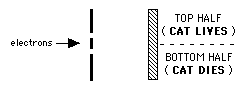
Our mathematical formulations of Quantum Physics let us calculate a probability for the electron hitting the top half or bottom half, but will not give a definite answer about where the electron will hit, and thus whether the cat will live or die. If the setup is symmetric, so the electron has an equal chance of hitting top or bottom, the probability of life or death is 50-50.
Another Experiment - Time-Delayed Schroedinger's Cat: In a time-delay version of the experiment, you provide the cat with plenty of food and water, then wait for two weeks. When you finally look in the box, you will observe either two weeks of eating or two weeks of rotting. {We'll assume that if the cat is not killed by the poison, it survives the full two weeks.}
A Cat Question
Everyone agrees that for two weeks we don't know if the cat is dead or alive.
Here is the controversial question: “During these two weeks, is the cat dead, or alive, or neither, or both?” The bizarre ending for this question ("...or neither, or both") is necessary because Mystical Physics challenges a claim that the cat IS either dead or alive. Basically, with this Cat Question we are asking “When is the cat's fate decided, and how?”
Here are two answers:
Quantum Nonsense in Mystical Physics — The cat's fate was delayed for two weeks because the quantum event – when electron hits wall – is not "completed" until the event-result is observed by the consciousness of a human. This proposal for consciousness-created reality differs from the...
Quantum Common Sense in Quantum Physics — Even though our state of knowledge is uncertain during the two weeks of waiting, the cat's fate was determined when the electron interacted with the wall because, based on the location of this interaction, at that time the detector-activated device either executed or protected the cat. What we know about the cat does not determine what the cat is, and the sequence of events that determines "what the cat is" (dead or alive) occurs quickly and irreversibly due to quantum decoherence.
Another Question — re: The Mystery of Quantum Causation
We can supplement this Cat Question with a Causation Question, by asking “what causes the electron to hit a specific location on the screen?” Or we can re-phrase this question to show its relationship to the Cat Question, by asking “what causes the electron to hit in the bottom half or top half?” to either kill the cat or protect it. / In a generalized form, using the language of cause-and-effect, we're asking “What causes the effect?”
What is the answer? According to conventional quantum physics, all we can say is that “we don't know” or, in a stronger claim, “we cannot know.” We cannot say what the cause is, and we cannot even say with certainty that either “there is a cause” or “there is no cause.”
Yes, this lack of knowledge about cause-and-effect relationships for quantum events, with "answers" that seem more like non-answers, can be frustrating for those who always want to know, and think we should know. But the science of quantum physics does place this humbling limitation on our knowledge about “why things happen.” (and, with its probabilistic predictions, about “what will happen”)
other mysteries: How should these causality-questions and quantum-answers influence our views of determinism (limited or total) and free will? If there is a God (or gods), "can God know?" and "can God cause?" and "does God cause?" {more about mysteries}
A Dice-and-Cat Experiment: My original full-length page describes another cat-experiment that uses dice (which are probabilistic but don't have significant quantum effects) instead of an electron (probabilistic with significant quantum effects). Then it “Compares the Cats” to show their major similarities (showing why “what we know about the cat” does not affect the cat) and minor unimportant differences. { I.O.U. - Later, this page will include a condensed description of the dice-and-cat thought experiment, to explain what we can learn by thinking about it, re: what does and doesn't matter in quantum physics. }
My Original Page: The page you're reading is a condensed-and-revised version of my original page that is similar, and actually is about the same size as this newer page. You may want to look at it (especially by using the link above for Dice-and-Cat plus Comparing the Cats) to see how it's a little different in its ideas and style. Also, it has a large appendix (about 3/5 the size of this page) with additional ideas (from me and others, with quotes) that you may find interesting.
2B. Schrodinger's Non-Cat
An Experiment with a Typewriter, without a Cat: To more clearly illustrate the foolishness of a "mystical physics" interpretation that proposes Consciousness-Created Reality, let's modify the experiment by replacing the cat with an electric typewriter that types either T or B when the electron hits the Top or Bottom half of the wall, and sends a signal that turns on a light bulb (outside the box) for 5 seconds. Then we unplug the typewriter, and nobody looks inside the box (to see whether the paper has T or B typed on it) for two weeks. To be analogous to the two weeks of eating or rotting for the cat, we can imagine using time-sensitive ink that will change color during the two weeks.
Or we can include Typewriter and Cat: with a top-half hit the detector+device protects the cat, types T, and turns the light on; but with a bottom-half hit it executes the cat, types B, and turns the light on; and we make a video/audio movie of the event and the following two weeks, showing the cat (eating or rotting) and paper (with a T or B that slowly changes color). We unplug the typewriter after hearing it type and seeing the light, but we don't observe the cat, paper, or movie until two weeks later. These three secondary result are correlated, so observing any of them tells us the result of the other two.
Think about three phases of this experiment:
1) while the electron is moving toward the wall, quantum physics just says “it might hit anywhere on the wall” so we cannot know where it will hit;
2) a primary event (the physical interaction of electron-hitting-wall, which causes the electron's many location-potentialities to become one location-actuality) leads almost immediately to secondary events involving the detector, typewriter-and-paper, light bulb, poison-releasing device and maybe a poisoned cat; at this time you hear the typewriter and see the light, so you know that the electron hit the wall and has been detected;
3) two weeks later, when you see either cat or paper or movie, you know the cat's fate, paper's result, movie's results, and electron-hitting location.
Everyone, whether they propose mystical physics or conventional physics, agrees that quantum physics will make only a probabilistic prediction (it only claims “the cat has a 50% chance of living”) and that until we observe the cat (or paper or movie) we won't know the cat's fate. So in what way do we disagree, and why?
EVERYDAY COMMON SENSE leads us to expect a delayed knowledge lasting two weeks. During this time period the primary event (electron hitting wall) and quickly-occurring secondary events (cat killed or protected, and T or B typed on paper) already have occurred, even though we don't know what the outcome is until someone observes the results.
QUANTUM COMMON SENSE – based on the scientific principles of quantum physics – leads to the same conclusion about delayed knowledge.
MYSTICAL NONSENSE (i.e. nonscientific Mystical Physics, Quantum Mysticism) disagrees by claiming that the primary event and secondary events don't really “happen” until a human observes the result. They claim that during the two weeks of delay, before a human knows the result, the cat is in a “half-dead and half-alive” limbo, because what the cat is really does depend on what a human knows about the cat. { The mystical argument, re: a “collapsing of the wave function” by human consciousness, will be debunked in Section 3A. }
Some intelligent people reject Quantum Common Sense, so they can believe the foolishness of Mystical Nonsense in Mystical Physics. But instead you should reject unscientific Mystical Physics, because you understand scientific Quantum Physics and you are willing to use logic. The scientific physics-and-logic is explained in Sections 3A-3E.
3A. Why does the weirdness disappear?
Topics in 3A: Two Levels - Rationally Justified Confidence - Quantum Decoherence .
Two Levels of Scale-and-Complexity: A typical quantum experiment is small-scale and simple; by contrast, everyday situations are large-scale and complex. The difference in scale-and-complexity is important, but it's usually ignored in mystical physics, and this ignoring is a major mistake.
Avoiding Two Mistakes of Scale-and-Complexity: As explained in Sections 1A-1C, we should not insist that concepts from our large-scale everyday experience are adequate for understanding the small-scale quantum realm. We also should avoid the reverse mistake, of simplistically extrapolating from small-scale to large-scale by assuming, as in mystical physics, that quantum descriptions of small-scale events (involving electrons,...) can be applied to large-scale events. You must avoid both mistakes, especially the second mistake — because what happens on a small-scale is not the same as what happens on a large-scale — if you want to understand why "things are strange, but not as strange as some people say they are."
The first prominent scholar to propose "mystical physics" was John von Neumann, a mathematician who in 1932 analyzed the process of quantum measurement by assuming that — since everything, including a small-scale wave/particle (electron, photon,...) and a large-scale observing device, is governed by quantum principles — the quantum effects do not disappear when moving from small-scale to large-scale levels. Because he could imagine constructing a continuous chain of interconnected mathematical wave-functions, from observed particle through actively-observing device to passively-observing human, he concluded that anything composed of quantum-matter cannot “collapse the wave-function” but human consciousness can do this. Basically his argument was that there is no obvious place to draw a line between small-scale and large-scale behavior, so he wouldn't draw a line, and he challenged others to “prove” where the line is. But for some strange reason, he considered quantum processes in the human brain to be in a different category (evidently not governed by the quantum principles of wave-particle duality?) so this is where he drew the line.
The physical process of decoherence is described by mathematical analysis — developed with more sophistication since the 1970s, after the era of von Neumann in the 1930s — to explain why “a line is drawn” by natural process within real physical systems, so “drawing the line” is not something humans need to do, or can do. But before we look at decoherence, let's take a few paragraphs to compare the expectations for proof and confidence in mathematics (the mental world of von Neumann and his mystical speculations) and in science (the physical world of quantum physics and systemic decoherence).
Rationally Justified Confidence (in Science) versus Technical Proof (in Math)
Part of the quantum debate is about the standards we should use for evaluation. In the scholarly world of theoretical mathematicians, proof is possible and is expected. But proof is impossible in science, so scientists are more practical; instead of demanding certainty, we aim for a rationally justified confidence in a “good way to bet.”
For example, the Second Law of Thermodynamics is based on probabilities, not certainty. If you place a drop of food color in a glass of water, the color will spread throughout the water. Can you be totally certain that this process will not reverse itself, with an un-spreading in which all of the color moves back into the drop? No, this reversed process is not impossible, it's just extremely improbable. The statistics of large numbers is the scientific basis for the Second Law, which claims that some types of events (such as an un-spreading of the color) will be extremely improbable, even though not impossible.
PROBABILITY is why large-scale events have thermodynamic irreversibility, and is the basis for the directionality of time that is accepted by scientists and nonscientists, with time running “forward” when events occur in ways that are more probable. If we made a molecular movie of the color-spreading process and ran it backward, every individual collision between molecules would obey the laws of physics, but the overall process would disobey the Second Law and it would appear to be running backward in time, in a strange un-natural way. Why? Most actual processes occur in the way we expect because a time-reversed process, violating the Second Law, would be extremely improbable so time-reversals do not occur naturally in large systems. The time-reversals that are practically possible (i.e are reasonably probable) on a small scale become practically impossible (i.e., super-extremely improbable) on a large scale. Scientists cannot prove that a reversal of color spreading is impossible, but they can show that betting against it is an extremely good way to bet, and you will (almost) always be correct.
Using similar principles of probability, scientists can show that unfamiliar small-scale behaviors (at the level of quantum wave/particles) produce familiar medium-scale behaviors (at the level of biochemistry) and familiar large-scale behaviors (at the level of everyday experience). Scientists cannot prove this, but we can show that – as with The Second Law of Thermodynamics – it's an extremely good way to bet. Why? The reason is...
Quantum DECOHERENCE
An excellent explanation of quantum mysteries — of why the weirdness “goes away” so small-scale quantum weirdness produces large-scale normal behavior — is in Where does the weirdness go? by David Lindley (1996), who explains the book's title: "If it's true that the weirdness of the quantum mechanical world seems to disappear when we look at ‘big’ objects, then where, precisely, does that weirdness go? ... Why should an assembly of a trillion weird little quantum objects behave any less mysteriously than its components?" To answer, Lindley describes the results and the reason:
Schrodinger's cat... therefore has some probability of being alive, some probability of being dead, and no probability at all of being both alive and dead at the same time. This vanishing of the probability for the superposed state [half-dead/half-alive] is known as "decoherence" .....
Decoherence inevitably happens in a large system built of quantum components: its individual quantum states rattle around at random, disposing of all the strange quantum superpositions that depend on almost impossibly precise coherence between all the constituent quantum states. ..... [decoherence] is a property of large systems in general, not of some specific "act of measurement" that has to be distinguished in some mysterious way from other straightforward physical processes. There's no need of human intervention, still less of human consciousness. .....
In quantum mechanics nature is, at the most fundamental level, genuinely unknowable, but despite that, the world at large, the world of which quantum mechanics is the foundation, can be known and understood.
Lindley explains why the weird quantum behaviors (of wave/particles) decohere and disappear, why in Schrodinger's Cat the strange small-scale behavior of a single electron becomes normal large-scale behavior when this electron, which is a single wave/particle, interacts with a large number of wave/particles in the wall-detector, and also in the wire carrying an electrical signal to a device that executes or protects the cat, in the spread of the poison gas (if it's released) and in the cat's body. All of this occurs before a human is involved in any way, before any of us passively observes the cat.
At each stage of a cat experiment, scientific analysis (using mathematical principles of statistical probabilities) shows what happens when interactions between wave/particles combine to produce irreversibility in the system (similar to irreversibility of The Second Law) due to a decoherence of the mathematical wave-functions that are calculated in quantum physics. If an advocate of mystical physics asks, “Can you prove it?”, the answer is “no, we can't prove it always will happen (and you can't disprove it) but we can show you why it's an extremely good way to bet!”
The reality of quantum decoherence (the fact that it does occur) also limits quantum effects in neurochemistry, at a medium-large level, and it forms the scientific foundation for logical critiques of Quantum Mind, as explained in a reality check by Victor Stenger, and in a book review (by Amanda Gefter for New Scientist) of Quantum Gods written by Stenger.
And there are many other scientific reasons for betting against mystical physics, as explained below in Sections 3B-3E.
3B. What does observation mean?
oops, they used a bad word: During the late-1920s, scientists made a bad decision when they were constructing the language of quantum physics. They used the word observation (which can imply a conscious human observer, and lead to unscientific speculation about the role of human consciousness) even though calling it interaction that could allow observation is a more accurate description of what is happening.* { When quantum-level interactions allow observation, the interaction usually occurs in a large-scale unconscious measuring device, to produce results that may or may not then be observed by a human. }
* I.O.U. - Here I might be over-limiting the scope of quantum interactions by not also including quantum events – such as transitions to and from excited states within an atom, or (as in the original Schrodinger's Cat Experiment, although the collapse-detection by a "counter" is what actually would kill the cat, not the decay itself; but the 50-50 probablity is based on the wave function for decay, it's assumed the "counting" is 100% sure) the radioactive decaying of an atom – that don't rely on "interaction" with another wave/particle. Maybe drawing a Venn Diagram showing relationships between interactions and observations would be useful? I will (iou) try to learn more about this, and get technical advice from quantum experts. But even now, I'm confident that although observation (with "collapse of a wave-function") might be defined more broadly than I have above, I don't think it should be defined less broadly, and certainly not in a way that requires an observer with human consciousness. / In early 2023 when I re-visited this page after many years of neglect, I again was bothered by this question. I forgot that I had written this iou-paragraph earlier, so while writing my intro-summary of observation (the "bad word") I wrote this to describe the difficulty: But I have a self-question about an event like radioactive decay (or an electron's transition to a lower energy level within an atom) where no "external interaction" is needed. In these cases, what "causes" the change? (of course "no cause" is an option, and that may be the answer} But for these cases, "consciousness" is not the answer, so in this way they're similar to "physical interaction" events.
visual observation is passive
Some people think that seeing involves emissions from the eye, but this is a false belief, a misconception. When you see, you do not “send something out” from your eyes. Instead, you see an object because light-photons move away from the object and into your eyes. Your mind is actively involved with processing and interpreting what you see, but the one-directional physical flow of matter/energy (and associated information) is from an external event into your eyes (and mind), so an event is not affected when you observe it by seeing it. (or hearing it) Here are three examples:
When you look at a tree, does your "act of observation" affect the tree? No. You see the tree because light-photons move from the tree to your eyes, but nothing moves from your eyes to the tree. Your passive observation is not the active interaction described in the uncertainty principle. If you shine a flashlight on the tree so you can see it more clearly, the light-photons will affect electrons in the tree's atoms, but nothing you have done as a person (except pressing the flashlight button, which could be done by a trained dog or mechanical robot) has affected the tree.
When you look at a cat, does your “act of observation” affect the cat? No. During a time-delayed Schrodinger's Cat experiment, the observation by a human is physically-passive, in contrast with the physically-active interaction that is important in quantum physics; we can see this in the Uncertainty Principle's description of how the thing-being-observed is affected by the physical interaction-during-observation. Advocates of mystical quantum nonsense must explain what happens when a human sees (or smells) the result two weeks later. Does something “go out” from the eyes (or nose or mind) of a human, time-travel back two weeks and cause the observed result? If so, how does this happen? what is the physical mechanism? Or, as in quantum common sense, did the physical wall-interaction affect the electron's probabilistic wave-function (which may exist only in our mathematics as a way to describe our knowledge), causing the wave-function to “collapse” at a specific location on the wall, thus triggering the detector+device and producing the cat's fate?
In a typical science experiment, including our cat experiment, a large-scale measuring device interacts with a wave/particle as part of the quantum event that is being observed, and this physical interaction produces the data (such as a meter reading or photograph) that we observe. During the event a human "observer" is not directly involved at the quantum level, and their passive observation (even if this occurs immediately instead of being delayed) does not affect what happens. Instead, usually an unconscious device "observes" the event, then a human passively receives information from the device in a one-way flow of information.
Loose language causes confusion. For this reason, confusion is common in quantum physics interpretations, because "observation" is a term overpopulated with meanings, since it can mean:
physical interaction (when wave/particles interact with each other);
human active intervention (by designing-and-doing an experiment);
human passive observation (to take information in through our senses);
human consciousness (to mentally process this incoming information).
All scientists agree (as explained below in Section 3C) that the first two meanings play an important role in quantum experiments, and (as explained above) that passive observation is irrelevant; almost all scientists think that human consciousness does not play any role in quantum phenomena and experiments.
Unfortunately, authors can confuse readers by their uses of observation, by using an incorrect meaning, or shifting from one meaning to another.
An author also can take advantage of the common misconception (which the author may also believe?) that the process of human vision produces an interaction with the object being observed. This mistaken belief in an extramission theory of vision is surprisingly common, and in recent studies "at least one-third of college students – and maybe more – wrongly believe that something such as rays or waves go out of the eyes during the act of seeing."
In a Time-Delayed Schrodinger's Cat Experiment this misconception about vision is raised to a much higher level of confused error, in a claim (made by Mystical Physics) that when rays "go out of the eyes" they can time-travel back two weeks. Wow.
3C. Do we create reality?
According to standard quantum physics (*), in a two-slit experiment we cannot know where a moving electron will hit the wall, and — more amazingly! — the electron does not even have a definite value for the attribute of “its future location” until an interaction (when electron hits wall) causes one outcome to manifest; before the wall-interaction this attribute has only potential probabilities-for-values, which can be calculated by quantum physics, instead of a definite value. {* Some scientists, but not most, propose hidden variables versions of quantum physics. They claim that some attributes (such as an electron's current location, momentum, future location, and spin) are specified by variables which aren't included in the standard versions of quantum physics advocated by most scientists. They claim that the wall-hitting location is determined before the electron hits the wall, even though we cannot know (before it is manifested) what this attribute is, if we use the standard formulations (without hidden variables) of quantum physics. }
But despite the claims of mystical physics, scientists do not “create the reality” of an electron during experiments. In quantum physics, a wave/particle has wave characteristics and particle characteristics, and an electron is equally “real” when it is traveling toward the wall (when in quantum theory its behavior is best represented as a wave) and when it hits the wall (when it's best represented as a particle or a collapsed-wave). Even if a moving electron does not have an attribute for “where it will hit the wall,” this moving electron is a real electron.
When this real electron hits the real wall, it attains a specific hitting-location because it interacts with wave/particles in the wall. This physical interaction, between electron and wall, occurs whether or not there is a one-way flow of information that occurs during passive observation by a human, so a human “act of observing” is irrelevant for the interaction.
Observation is also irrelevant for biochemical reactions, because the electrons inside your body always behave in a “real” way, even when they're not being observed. In a living cell, an electron is constantly interacting with other electrons inside an atom that is interacting with other atoms in a molecule that is interacting with other molecules, and so on. In this complex biochemical context (in a natural “wild state”) each electron has frequent interactions, similar to the ways that scientists can make an electron interact in a simplified experimental context. An absence of observation does not hinder the effective practical functioning of electrons during biochemical reactions.
And observation is irrelevant inside our sun (and in other stars in galaxies throughout the universe) where hydrogen atoms interact with each other to produce nuclear reactions and the life-allowing energy of sunshine, and (if a star becomes a supernova that forms heavier atoms and explodes them out into space where they eventually will combine with each other in planets and people) the atoms in our planet and inside our bodies.
And with or without human observation, hydrogen atoms form because wave/particle duality prevents "clumps of positive/negative charge," as explained in Section 1B.
In fact, almost all events in the history of nature (99.99999...%) have not been observed by humans, because we are limited by a Here-and-Now Principle. If nothing “really” happens until a human observes it, how did nature operate – with nuclear reactions in stars, biochemistry in organisms, and more – during the 14 billion years before we began making quantum observations? And even now, almost all quantum processes – occurring in distant galaxies, on earth, and in our own bodies – are unobserved. So does this persuade proponents of Mystical Physics? It should, but it doesn't when...
Arrogance conquers Humility (with the Participatory Anthropic Principle)
In the reality of quantum common sense, this fact — when we recognize what is obvious, the fact that almost all events, now and in the past, occur without being observed by humans — should be seen as evidence for the irrelevance of “consciousness” and as a logical reason to abandon claims that we play an important role in “creating reality.” It should be seen as a logical reason to be humble about the importance of humans, because the universe does not need us to “observe things and make them happen.” { Do scientists create reality? - silly postmodern claims! }
In the delusion of quantum mysticism, this obvious reason for humility is rejected. Instead, the evangelists of mystical physics arrogantly claim — in their Participatory Anthropic Principle — that the universe could not exist without us because "the eventual emergence of observers is necessary to bring our universe into existence." Wow. The claims for “humans creating reality” are similar in The Fate of Schrodinger's Cat and History of The Universe, but why mess around with a small Cat when you can imagine creating the big Universe?
Does quantum physics say “we are powerful” ?
No. In carefully controlled situations, scientists can make wave-particles (electrons,...) attain specific values for attributes (location, spin,...) that previously they didn't have. But here are some reasons to reject a claim that we are powerful:
The human action is limited to arranging a situation in which a physical interaction – not human consciousness – causes an observation, and the result is predicted (but only probabilistically, not with certainty) by the Schrodinger Wave Equation.
A scientist can make decisions when designing an experiment, about setting up the equipment, and then pushing a button to make it run. But these are ordinary human decisions (and many could be made by a trained dog or a random number generator) with an impact that is no greater than in other decisions: consider, for example, a physicist decides to design an experiment that will measure an electron's location instead of a photon's energy; or in a study of photosynthesis a biologist pushes a button that shines blue light on a plant, instead of green light; a chemist runs an experiment by mixing chemicals B and C instead of B and D; the physicist gets drunk at a party, decides to drive home instead of taking a taxi, and crashes headlong into another car; and so on. Is the human effect greater for the physicist's first decision, because it occurs at the level of individual wave/particles, than for his other “reality creating” decision?
In small-scale quantum experiments the effects are extremely small, and (as explained in Sections 3A and 3D) these effects are neutralized at higher levels, in medium-scale biochemistry or large-scale everyday events. But what about effects within your own body? Yes, there are “mind-body interactions” because your mind (your thoughts, emotions, attitudes, responses,...) can affect what happens inside your own body. But the level of action is medium-scale biochemistry and physiology (due to neurochemicals, hormones,...) rather than small-scale quantum physics, and quantum decoherence eliminates practical quantum effects at the medium-scale levels of neurochemistry and neurophysiology and whole-body physiology.
Many Worlds Interpretation
A speculative view of quantum physics is the Many Worlds Interpretation which claims that during every observation — i.e. during every interaction that collapses a quantum wave function, which happens zillions of times each second throughout the universe — the universe splits into ALL quantum possibilities, and every possibility actually occurs in a different physical universe.
The many worlds interpretation was introduced to avoid the “problem” of wave-function collapse, but why is this a problem? Let's look at physics and psychology:
Regarding physics, there is no problem because the process of decoherence explains why "things are not as strange as some people say they are" during the process of quantum interaction that usually is called "observation" even though, unfortunately, this term can lead people into confusion and error as in claims about "creating your own reality."
Regarding psychology, there should be no problem. Just because it's difficult for humans to understand a concept, or because we cannot calculate exact results and make precise non-probabilistic predictions using the mathematics of quantum physics, this is not a problem (except in our ego-driven lack of humility) that should be solved by extravagantly proposing, without any evidence, the physical existence of an unimaginably immense number of universes.
Although a many-worlds interpretation might be impossible to disprove, it seems excessive and imaginary, the stuff of science fiction rather than science.
3D. Is everything connected?
In quantum theory, the entire universe can be mathematically represented (in principle but not in practice) as a single interconnected quantum wave, spanning all space and time. Does this mathematical formalism mean that each part of the universe is physically connected with and affected by every other part? Probably. But...
The appropriate response is “so what?” because the effects are extremely small, and a quantum-connectedness wouldn't be significant. Think about this analogy: If a tiny grain of sand drops into the Pacific Ocean in California, in principle this will cause a change on the shores of Hawaii, but no practical effect is transmitted to Hawaii because the sand's tiny wave splash is quickly neutralized by random collisions with other water molecules. This also happens with analogous quantum effects, which were tiny (like the wave splash of the sand grain) even before the initially tiny quantum effects were further decreased by processes of decoherence.
Strange Quantum-Level Behaviors
In other web-pages (eventually links will be available here) you can learn about a variety of experiments and phenomena, regarding EPR & Bell & Aspect, complementarity & Afshar, Scully & delayed-choice quantum erasers, quantum entanglement, nonlocality, superluminal signaling or causation, no-communication theorem,... with interesting effects at the quantum level.
But what scientists have learned does not provide any evidence for “the power of human minds” because the quantum effects are extremely small and they occur with small numbers of wave-particles in unconscious experimental systems, and human consciousness does not seem to be involved in any of the interactions. { But even if human consciousness is not the powerful quantum-level causal force that is claimed by Quantum Mysticism, we still can ask “what is the nature of consciousness, and its cause(s)?” and we can wonder if our tentative answers are accurate-and-complete. }
3E. Quantum Common Sense (and Mystical Nonsense)
In an effort to minimize the misunderstandings that are encouraged by quantum nonsense, this brief review of Sections 3A-3D will summarize the scientific foundations for quantum common sense, and show how the basic principles of quantum physics can help us put human powers into proper perspective:
some behavior-effects in quantum experiments seem strange because they are unfamiliar, but these effects are extremely small; and due to decoherence [Section 3A] the effects disappear for large-scale systems, except for the fact that strange small-scale quantum behaviors produce normal medium-scale behaviors (as in biochemistry) and normal large-scale behaviors (in everyday experience);
quantum effects occur due to observation-allowing physical interaction [3B], not in “conscious observation” by a human because during this the passive one-way flow of energy & information is irrelevant for the quantum event;
when scientists “create reality” in small-scale quantum experiments [3C] their power is limited to constructing a situation in which wave/particles interact, and the resulting effects are extremely small;
almost everything in the history of nature has occurred, and is occurring, without human observation [3C] so humans are not necessary for the functioning of nature;
even if everything in the universe is interconnected at the quantum level, the appropriate response [3D] is "so what?" because the unfamiliar quantum-level effects are extremely small and do not involve human consciousness.
note to reader, about the mis-education used by quantum mystics: Eventually this section will continue the analysis begun in the introduction by looking at the surprisingly effective teaching methods used by advocates of quantum mysticism, to make their views seem scientific and logical for their readers (who typically are non-scientists) instead of pseudo-scientific and illogical (as they seem to me and most other scientists). {other starter-ideas & resources}
4. Are there any significant religious implications for Judeo-Christian Theism?
No. The science of quantum physics is not an actual problem for Judeo-Christian believers, and all of its scientific principles can be easily integrated into a Bible-based monotheistic worldview. But there can be apparent problems...
If scientific quantum physics is expanded, using metaphysical speculation, into nonscientific mystical physics and a pantheistic worldview claiming that “the quantum-connected whole universe is god” and a New Age belief that “each of us is part of the unified whole so each of us is god” and “we create our own reality.” This pantheistic new-age worldview is not compatible with a monotheistic worldview based on the Bible. { In pantheism, the universe creates god(s). In theism, God created the universe. }
If a Many Worlds Interpretation is used to claim that an "unimaginably immense" number of universes exist in an MWI-Multiverse, this would produce theological problems with human accountability and divine sovereignty. Therefore, an MWI-Multiverse would be incompatible with Judeo-Christian beliefs that are based on the Bible.
Unfortunately, some Christians have been persuaded by the claims of mystical physics. For example, Allen Emerson — in what I think is the worst article ever published by Christianity Today (February 1, 1985) — described "A Disorienting View of God's Creation." He began his 7-page paper by explaining how "a theologian remarked... that he considered quantum mechanics the greatest contemporary threat to Christianity. In fact, he said, if some of the results of this theory were really true, his own personal faith would be shattered." But careful thinking about scientific principles, as explained in this page, shows that there is no "threat" from the actual science, only from the misunderstandings of science that are encouraged by misleading authors who misinterpret the science to promote their pseudo-scientific mysticism.
Widespread Opposition to Quantum Mysticism
The people opposing quantum mysticism are not limited to those with a Judeo-Christian worldview. If you web-search for [quantum mysticism] or [quantum physics religion] or [quantum new age] or [quantum mysticism myth] or [quantum flapdoodle] or related variations/combinations of search-terms, in addition to pages by people who are promoting mystical physics you'll see scientific critiques from a wide range of worldview perspectives, including atheists (e.g. Victor Stenger) and agnostics, Jews and Christians.
One of our shared motivations is to improve the integrity of science education by decreasing the popularity and power of science mis-education. We share a common concern, because we are amazed that a surprising large number of seemingly intelligent people are believing the silly quantum flapdoodle being peddled by the evangelists of quantum mysticism. These popularizers of flapdoodle-psychobabble become rich and famous by misleading readers and listeners who are motivated to believe the alluring quantum-based claims about the personal power of "creating their own reality," who want to be persuaded that there are scientific reasons for believing mystical ideas that, for their own personal psychological reasons, they really do want to believe. {more}
Most scientists agree that wave/particle duality, which is the foundation of quantum physics, is one of the many properties of nature that seem necessary to allow intelligent life. Victor Guillemin explains: "It is quantization that accounts for the existence of stability and organization in the atomic substratum of the universe. ... Without quantization...there would be no well-defined organization of atoms into molecules or of molecules into large structures. The universe would be a formless and meaningless blob [as in the "clumps of positive/negative charge" I've described?] without history, plan or purpose." Maybe quantum strangeness, which produces everyday normality, is just a byproduct of a universe that has been designed so we can exist. But design cannot be proved or disproved, since we have THREE EXPLANATIONS for a Just-Right Universe and humility is logically appropriate, as explained in Anthropic Principle & Fine Tuning: Multiverse and/or Intelligent Design or the conclusion of my summary-overview.
The rest of this page examines – but does not answer – some questions (asked earlier) about quantum-level causation and the limits of our knowledge and our free will, and (in a theistic worldview) the knowledge & powers & actions of God, when we ask “can God know?” & “can God cause?” & “does God cause?”
Divine Knowledge of Natural Process: For humans, nature imposes limitations on observing (due to quantum uncertainties) and predicting (due to quantum uncertainties plus the amplification of small initial uncertainties to produce divergent histories that is described in chaos theory).* But an all-knowing God, whose observing and predicting are not constrained by these human limitations, could predict and therefore know what will occur. {* In classical physics most cause-effect relationships were clear, and many predictions were definite, but in quantum physics the causality is questionable and the predictions are probabilistic, although for large-scale events a probability can be so high that the prediction is very precise. I think these changes (to non-causality and probabilities) either aren't theologically significant, or they make our physics – and nature, if the physics is correct – more compatible with a theistic worldview. }
Divine Guidance of Natural Process: Or, instead of remaining a passive observer, as proposed in deism, God could influence natural process by converting one natural-appearing result (the one that would have occurred without any divine guidance) into another natural-appearing result (that actually occurs), as explained in Divine Guidance of Natural Process. One possible mechanism for natural-appearing guidance is for God to convert potentialities into actualities: from the multitude of quantum possibilities that might occur, God chooses to make one of these actually occur. In this way, and in other ways, God could influence (or determine) natural events by controlling some (or all) uncertainty at the quantum level, which could be done in a way that makes the guided events appear to be natural and statistically random.
Scientific Humility about Theological Questions
Because quantum interactions occur constantly, God could control everything that happens. God can control everything, but does God control everything? Throughout history, people have wondered about the frequency of divine guidance (does it happen always, usually, seldom, or never) and the degree of control (is it partial or total, for situations, thoughts, and/or actions). These questions, and many others, cannot be answered using quantum physics.