
Problem Solving
& Metacognition
in Education and Life
How can we use Design Process to help students improve their Problem-Solving Skills
(by more effectively combining creativity with critical thinking) in all areas of life, and
use Metacognitive Learning Strategies to improve their learning, thinking, and performance?

In early 2012, I began developing a new website with
many improvements (by revising, adding, cutting),
so I strongly recommend that you
read it instead of this page.
An Overview-Summary of the Page
This overview will give you a quick “executive summary” of the main ideas. If you want to study a topic more deeply, links will take you to places — inside this page or in other pages — where you can learn more.
Or if you want “less deeply but more quickly” you can read 3 shorter summaries. (145 words, 550 words, verbal-and-visual)
Who do I think "you" are? I'm writing this page for educators — teachers, curriculum developers, administrators, researchers, parents,... — so when I use undefined pronouns (you, your, we, our, us,...) usually I mean fellow educators. But all readers are welcome, especially students (in school) & lifelong learners (out of school), and I hope it will be a valuable educational resource for everyone.
Here is a Table of Contents for the Overview-Summary:
1 — Problem Solving, Metacognition, and Design Process
2 — Building Bridges from Life to Design to Science to Life
3 — A Wide Spiral Curriculum with Transfer of Learning
4 — Optimistic Humility and Adjustments of Instruction
5 — Using Design Process in a Problem-Solving Curriculum
6 — Using Design Process for Problem-Solving Instruction
7 — Using Cognition-and-Metacognition for
Learning & Teaching
1 — Problem Solving, Metacognition, and Design Process { full-length Section 1 }
Problem Solving: In design,
a problem is an opportunity to make things better; problem solving is converting an actual current situation into a more desirable future situation.
Metacognition: When you ask “how can I think and learn more effectively?” and you think about thinking, with the goal of improving the quality of your thinking-and-learning, this is metacognition. ( It's meta-cognition because it's your cognition about cognition. )
Design: In a wide range of fields, we solve problems by designing better products, activities, strategies, or theories, which includes almost everything we do in life.
Design Process: I have developed integrative models for Design Process and Science Process (which is usually called Scientific Method) with two goals:
• to improve our UNDERSTANDING by accurately describing the problem-solving process (i.e., the flexible goal-directed improvisational thinking-and-actions, and their functionally integrated relationships) that are used in design & science;
• to improve our TEACHING of the methods
used by designers & scientists who combine creative thinking (to generate ideas) and critical thinking (to evaluate ideas), with the goal of helping students
improve their own problem-solving skills.
My model of Integrative Design Process is briefly outlined in An Introduction to Design Process and is explored more deeply, by examining modes of thinking-and-action, in An Overview of Design Process. / note: In this page and other pages, when I simply say "Design Process" (or "Science Process" or "Scientific Method") I'm referring to my models (for Integrative Design Process,...) although other educators typically use these terms (Design Process,...) in other ways, for either a generalized design process or another model of design process.
Metacognition and Problem Solving in Education: Why should we should expect Design Process to be educationally valuable? Because it can be used to promote metacognition and teach problem-solving skills, and both of these functions have educational value.
Where can you learn more? The full-length version of this section ends by describing and linking to other pages where you can learn the principles of metacognition, and how an explicit teaching of Design Process can help students improve their cognitive & metacognitive skills.
2 — Building Bridges from Life to Design to Science to Life { full-length Section 2 }
Design in Life: Because design "includes almost everything we do in life,"* the everyday lives of students have been filled with design thinking, and this will continue into their future. Therefore, we can use design to make concrete connections with their past and their future:
Connecting the Past-and-Present, with a Bridge from Life to Design: A simple two-step model of design will let students recognize the design thinking they have been using in many everyday activities. This familiarity will make design seem less intimidating and, consistent with constructivist theories of learning, we can build on the foundation of what students already know. Then, through progressive explorations of Design Process in more depth, students will learn how to understand the coherent integration of creative-and-critical thinking skills to form a productive process of thinking. This understanding, along with opportunities to practice design thinking in new areas of application, will help students improve their thinking skills-and-methods.
Connecting the Present-and-Future, with a Bridge from Design to Life: Due to the wide scope of design, it can be used in practical ways that every student can imagine, in “real life” outside the classroom, with a transfer of learning (from design in the classroom to design in life) that will help them achieve their personal goals for life, so they will be more motivated to pursue self-education.
* This claim for "almost everything we do" seems justified because we use design when making our personal and professional decisions: when we make personal decisions, we are designing strategies for living, for achieving our goals in life; and business decisions are strategies for achieving business objectives, and so on. A useful activity for everyone, including students, is to think about the practical effects and wisdom of our decisions by asking, “Are my decisions helping me achieve my goals for life?”
We can move from experiences of everyday life to experiences of science in two stages.
An Educational Bridge from Life to Design: This is explained above.
An Educational Bridge from Design to Science: There are two reasons to teach design before science. First, design is more familiar for most students, in what they have experienced in the past, and can imagine for the future. Second, we can build strong bridges from design to science:
• Positive Experiences — If students have enjoyed design, and we explain why science is similar, they will look forward to science. { The Joy of Thinking in Design and Science }
• Science is Design — Science is similar because it's a special type of design in which the main objectives are to develop theories that are accurate and are useful for explaining, and experiments that are useful for providing information.
• Reality Checks — These are used in design, and are the logical foundation of science. During design activities, occasionally a teacher can ask a science question: when theory-based Predictions and reality-based Observations are compared, do they match?
• Design Process and Science Process (a.k.a. Scientific Method): Because science is design, a similar process of problem solving is used for design and science. This similarity is an educationally valuable bridge, because when students use Design Process they already are using all of the main components of Science Process, or (using its common name) Scientific Method: in addition to Making Predictions & Observations for use in Reality Checks to Evaluate Theories, designers and scientists both Generate Ideas for Theories & Experiments, Choose Objectives & Goals, Search for Relevant Information, and Make Action-Decisions. These overlaps in methods will help students transfer their ideas-and-skills knowledge of Design Process to Science Process.
Similarities and Differences: Students should understand the many similarities and also the differences between design and science. (and also between various types of design, and between types of science) The similarities are opportunities for transfer and the differences help us appreciate the unique characteristics of design & science and their interrelationships.
Engineering in Science Education: Engineering is the most well-known type of design, and I'm excited (along with engineering educators) to see that the new Framework for K-12 Science Education emphasizes the importance of Scientific and Engineering Practices by including this combination as one of the 3 "dimensions" outlined on page 4 of its Executive Summary. As explained above, using design-to-science bridges will be a useful way to help students learn the practices (the thinking-and-actions) used in engineering & science, in Engineering Design Process & Science Process. { Unfortunately, assessment is a practical problem because even if during instruction we place a high value on thinking skills, it's difficult and time-consuming to construct & grade exams that accurately measure
thinking skills. }
Design and Science in Education: Design Process and Science Process are educationally useful in similar ways, but in most of this page the focus is on design (and Design Process) because it's more general so it can be used in a wider range of areas, and because understanding design leads to understanding science.
Building Bridges from Science and Design to Life
Generalizing the Skills of Science: The logical methods of science span a wide range, because similar logic (to evaluate, infer, and persuade) is used in science, in most other fields, and in daily life, whenever we ask “what evidence-and-logic supports this claim?” and (quoting Bertrand Russell) is a claim believed "more or less strongly than is warranted"?
Generalizing the Skills of Design: The scope of design is even wider. We use design for strategies — for personal & professional decisions, plus a wide range of physical skills — so design includes almost everything we do in life. Because of this wide scope, Design Process can be part of the foundation for a wide spiral curriculum that builds bridges extending across many subject areas (engineering, architecture, mathematics, music, art, literature, education, philosophy, history, business, athletics, law, medicine, sciences,...) and into life outside school, as explained in the next section.
3 — A Wide Spiral Curriculum and Transfer of Learning { full-length Section 3 }
Levels of Coordination: Learning occurs in a short-term narrow spiral when related activities with mutually supportive educational functions are repeated and coordinated
(with respect to different types of experience, levels of sophistication, and
contexts) within one course. If the
learning experiences in this course are coordinated with experiences in other courses
for the same semester, by using Design Process (to show the generalizable skills of design) and in other ways, and if
this wide approach continues for a long time, the result will be a long-term
wide spiral. Well designed curriculum-and-instruction has a carefully planned
sequencing and coordinating of activities within each course and between
courses,
to make them mutually supportive in a synergistic system that is more effective in helping students learn the ideas-and-skills that are our educational goals.
Who and How? Every teacher can coordinate instruction-experiences in their own classes. In typical elementary grades (in early K-12) students have one teacher who can coordinate experiences across many subjects. In typical secondary grades (in later K-12) and college, subjects are taught by different teachers, so a coordinated wide spiral curriculum requires cooperation among teachers.
Coordination across Areas and Time: In a wide spiral curriculum that has wide scope (so related experiences are coordinated across different subject areas) and uses spiral repetitions (so related experiences are coordinated over time), an explicit teaching of Design Process can help students understand the coherent integration of thinking skills within each design experience and also the similarities between design experiences in different subject areas, with similar problem-solving strategies being used for design in each area. This understanding of similarities will help students transfer their thinking skills from one area to another, in sciences, engineering, humanities, and arts.
Transfer: To achieve an important objective — a transfer of ideas-and-skills between different subjects in school, and from school into everyday life — the research-based book How People Learn recommends that we:
A) teach knowledge in multiple contexts [as in a wide spiral curriculum],
B) teach knowledge in a form that can be easily generalized.
Design Process should be useful for doing both of these, because:
A) when we "teach knowledge in multiple contexts" we can show how different areas are related to Design Process (in their methods of problem solving) and thus are related to each other (similar to the "transitive" principle of math, where if A=C and B=C, then A=B), and
B) A verbal-and-visual outline of Design Process shows how we can describe problem-solving actions "in a form that can be easily generalized" by using generalized terms: define, generate, evaluate, and coordinate. These general terms can be used in all subject areas, because during design in all areas we Define (overall objectives and specific goal-criteria), Generate (by finding information, retroductively inventing ideas, making predictions & observations), Evaluate (by comparing goals with predictions or observations in Quality Checks, and comparing predictions with observations in Reality Checks), and Coordinate (by asking “what is the best use of my time right now?” and making action-decisions).
Other principles for improving transfer — by using metacognitive strategies to intentionally remember (from the past) and intentionally learn (for the future), and to develop conditional knowledge — are in Part 2.
The non-numbered section below is an interlude between Sections 3 and 4.
Educational Applications for Design Process
Two potential uses of Design Process are for Learning Strategies and Design Activities:
Learning Strategies that use Design Process are similar to conventional programs of Self-Regulated Learning that help students master principles for studying and learning. But when students use Learning Strategies that are design-based there will be increased transfer because design skills are used for "almost everything we do in life." (more about Learning Strategies) { note: The links for "more about " don't work because this section has been imported from the Overview-Summary where the links do work, taking you to another part of the page about Problem Solving & Metacognition - using Design Process in Education. }
Design Activities can be a valuable part of instruction in a wide range of possible areas (engineering, science, business, ...), and this should improve the transfer of thinking skills from one area to another. (more about Transfer)
The new K-12 Science Standards feature a combining of Scientific & Engineering Practices, and I'm beginning to write a page – Design Process & Science Standards – to show how design experiences can help students learn some of the ideas-and-skills defined in the new standards. (more about Science Standards)
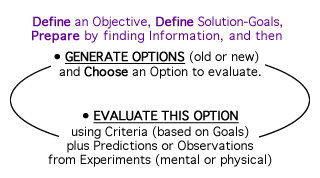
 Compared with other approaches to “thinking skills education” my model of Design Process is similar in many ways, which helps make it compatible with widely accepted approaches. But it's unique in some ways, offering special added value because it's more INTEGRATIVE (by showing the interactive functionally integrated relationships between different aspects of Design Process) in ways that include visually logical representations, as in this diagram that shows 3 types of comparisons used for Evaluation of Ideas by using Mental Quality Checks & Physical Quality Checks, plus the Reality Checks (Theory Checks) of science. Design Process also can be taught using a simple two-step cycle of creatively Generating Ideas and critically Evaluating Ideas, or at a deeper level by using 9 modes of thinking-and-action.
Questions:
When students learn how to use Design Process (and learn about it) this will help them learn more from their inquiry experiences. Well, that's my claim, and I answer a key question, "Should we teach Design Process?", by saying “yes” based on argument by analogy. But we need more information, from research, to answer this question with more confidence, and to explain “why”
(or “why not”) in a way that will be persuasive when educators make decisions about whether to teach Design Process.
How can we teach Design Process creatively in ways that won't be a distraction (so it won't interfere with the flow of design-thinking during a design activity) and so students won't think “this is boooorrring” compared with the design activity itself.
Especially at the college level, another tough question is whether Learning Strategies should be part of a separate “study skills” course offered for credit (but if it's optional it might be viewed as remediary, intended only for students with learning deficiencies, instead of being useful for all students)* or should be merged into existing courses (but this might be resisted by course instructors who want to focus on their own course content). / * Offering credit seems pragmatic because if learning about Learning Strategies is merely a suggestion, this probably won't work well because most students will rarely do optional non-credit activities. When we ask “should instruction for Learning Strategies be mandatory?” there are reasons to say both NO (because college students want freedom & independence to do things their own way) and YES (because most students won't sign up for this type of optional course even if they would benefit from it).
As one option for teaching, for students in K-12 and (especially) college, I want to develop a set of interactive Computer-Based Instruction Modules to help students learn Design Process & Science Process. (more about Instruction Modules)
4 — Optimistic Humility and Adjustments of Instruction { full-length Section 4 }
Optimistic Humility: I'm optimistic
about the educational value of Integrative Design Process, because there are logical reasons to expect that it can be used effectively in many ways, offering many benefits. So far, however, these applications and benefits are only potential, not actual, and my claims (for improved transfer,...) have not been tested. Therefore, this page should be viewed as an outline of potential applications
and benefits in the future, offered with confident optimism but appropriate humility.
Other Models: My optimism about Design Process is supported by a comparison with three other models for skills-and-methods of thinking; I conclude that "all four frameworks are mutually supportive, and these approaches (along with others) could be creatively blended to form an effective cooperative team... to improve education."
Contexts of Use: I think Design Process could be useful in special classes (or computer programs) for thinking skills or study skills, or for mainstream instruction in subject-area courses.
Three Practical Constraints when Making Adjustments of Instruction
First, instruction should be flexible so it can accommodate a wide range of learning styles and teaching styles. / a response: Design Process is compatible with a wide variety of teaching philosophies & student characteristics, in a wide range of subject areas.
Second, we should make it easy for teachers to teach well and to learn new teaching methods quickly with a minimum of extra preparation time. / The familiarity of design thinking will help teachers learn the basic ideas quickly. But some teachers don't use inquiry activities and most don't explicitly teach thinking skills-and-methods, so adjustments would be required, leading to concerns about the preparation time required to make these adjustments, and a possible decrease of teaching effectiveness.
Third, if teachers want to cover a large amount of subject-area content, they may not want to invest the classroom time required to teach thinking skills. / This important question is discussed in Ideas versus Skills which suggests "aiming for an optimal combination of ideas-and-skills."
Using Computer Programs to teach Design Process: We can design computer-based instruction modules to help students understand Design Process and use it more effectively. These modules would offer practical benefits for students, and for teachers regarding the three concerns above: a wider range of learning styles can be accommodated with a mixture of computerized experience and hands-on experience; if the concepts of Design Process are introduced using a computer, preparation time will decrease for teachers, and so will their concerns about a drop in teaching quality; using computerized design activities as homework will lessen the competition of ideas-versus-skills for use of limited time in the classroom. {more about Practical Constraints and Computer Programs}
An Idea Worth Exploring? Many educators have been (and will be) struggling with ways to achieve satisfactory solutions for these three challenges, and others. I don't claim to have any easy answers, but Design Process does show some promise for improving education, and I think this potential is worth exploring and developing. I would be happy to work with other educators in a process of cooperative development.
5 — Using Design Process in a Problem-Solving Curriculum { full-length Section 5 }
For a goal-directed designing of instruction, we can:
• define goals for the ideas and skills we want students to learn,
• design instruction with learning activities and teaching strategies that will provide opportunities for experience with these ideas & skills,
and help students learn more from their experiences.
In this section the focus is goals, and in Section 6 it's instruction.
The goals in a Model of Problem Solving (developed by educational researchers for CRESST) are Motivation, Metacognition, Conceptual Knowledge, and Procedural Knowledge (domain-specific skills & general ), plus (in their general Model of Learning) Collaboration and Communication. How can design activities and Design Process help students achieve these goals for attitudes, ideas, and skills?
Motivation: We use design for "almost everything in life," so design activities can help students see that what they are learning in school will be useful in their lives outside school, now and in the future. This forward-looking expectation can help students decide to "make things better" in their lives by investing extra mental effort in intentional learning, in a proactive problem-solving strategy for personal education with the goal of improving their own thinking and learning, by converting their actual current state (of knowledge) into a desired future state (of improved knowledge), with Metacognitive Self-Education. {more about motivation}
Metacognition: Design Process can help students improve their use of metacognition in both design activities and self-education. This is explained in other pages and continues in Using Cognition-and-Metacognition for Learning & Teaching.
Conceptual Knowledge: Design can support conceptual learning in four ways: 1) metacognitive skills & strategies (which are applications of design that can be improved with Design Process) can help students learn concepts more easily and effectively; 2) one mode in Design Process is a preparation in which we search for information (including concepts) so we can understand the current situation and our options for improving it, and when students want to solve a design problem this increases their motivation to search-and-understand; 3a) although I think (as explained in Design and Inquiry) that the best way to teach concepts is Explanation-Based Instruction plus Activities for Application & Extension, if Discovery Instruction is used or when situations in life offer opportunities for discovery, Design Process (and experience in design activities) can help students improve their creative-and-critical skill in using retroductive logic to select or invent theories that are useful for explaining, and for helping them understand; 3b) many students have scientific misconceptions, but Design Process shows how-and-why scientists use Reality Checks to evaluate theories, which helps students recognize why misconceptions are not correct explanations, motivating them to reject misconceptions and accept scientific conceptions that become a part of their everyday knowledge.
Procedural Knowledge (General & Domain-Specific): As with conceptual knowledge, metacognitive strategies (applications of design) can help students learn procedural knowledge, for both general skills & domain-specific skills. Design Process can be used to explicitly teach the general skills used in design, including their functional inter-relationships and a conditional knowledge of when and why to use each skill. One probable benefit of teaching general skills in a wide spiral curriculum is a transfer of skills between domain-areas. / What are the relationships between skills that are general & domain-specific? Typically there is some overlap between them (so a skill first developed for one area will also be useful in another area) and some transfer. When general & domain-specific skills are used together, there may be mutual support that makes the combination more effective. The general procedural skills used for design must be adapted for effective use in differing domain-contexts, and for differing objectives within each domain. Also, general design skills are often combined with domain-specific skills that vary from one domain to another. If teachers & students compare design thinking in different domains and for different objectives, to find similarities & differences, their analysis can help them develop a deeper understanding of procedural knowledge. For more about these relationships, see the full-length section.
Collaboration: Students often work together during design activities, giving them practice with the skills of cooperative collaboration. The principles of teamwork and coordination (for a teacher & students, coach & athletes, or supervisor & workers) are one part of Design Process.
Communication: Students in a group can practice communicating in ways that are appropriate, clear, and productive. More generally, any presentation — oral or written, short or long, formal or informal, for a design project (*) or in other contexts — is a design project in which the main goal is effective communication. * A design activity can include a presentation — describing what you did and found, what you concluded and why — by an individual or group.
Conceptual Knowledge versus Procedural Knowledge?
Yes, ideas and skills are related. But with limited teaching time
we cannot maximize a mastery of both ideas and skills, so
we
should aim for an optimal combination of ideas-and-skills. What is optimal? There is no consensus, but I think the balance should move toward more emphasis on thinking skills, including a use of design activities and Design Process. The goal would be an improvement in students' procedural knowledge that outweighs (in our value system) any decrease in conceptual knowledge; or maybe we can find a way to improve both.
For instructional design we can think about an 80-20 principle: in many situations, 80% of the total value comes from 20% of the whole. If there are diminishing returns when using each instructional approach, this logically supports the usefulness of an eclectic approach to instruction.
6 — Using Design Process for Problem-Solving Instruction { full-length Section 6 }
Inquiry and Design: In a broad definition, inquiry is any activity where students explore situations and try to solve problems. These two things happen in design, so all design activities are inquiry activities.
Three Types of Inquiry: in conventional Design-Inquiry the main objective is a better product, activity, or strategy; in Science-Inquiry the main objective can be an accurate theory, or a useful experiment; and in Personal Inquiry a student wants to improve their own thinking and learning.
Inquiry and Discovery: In a narrow definition, inquiry is Science-Inquiry with discovery-based learning in which students “discover” theories (i.e., concepts) instead of learning concepts with the help of clear explanations by a teacher or textbook (or web-page,...). I prefer my less restrictive definition because there should be no necessary connection between inquiry and discovery learning; but I want to avoid confusion so in most of the page, outside this subsection, I will refer to design activities rather than inquiry activities. {more about inquiry-and-discovery}
In early 2012, I began developing a new website with
many improvements (by revising, adding, cutting),
so I strongly recommend that you
read it instead of this page.
We can use inquiry activities to help students improve their procedural knowledge (skills) and conceptual knowledge (ideas):
Inquiry and Procedural Knowledge: Inquiry activities are an excellent way to help students improve their procedural knowledge (both general & domain-specific) and coordinate it with their conceptual knowledge to construct a functionally useful combination of skills-and-ideas.
Inquiry and Conceptual Knowledge: In my opinion, a combination of explanation-based instruction plus activities for application-and-extension is the most effective way to help students build a comprehensive foundation of conceptual knowledge, but this instruction should be supplemented by guided inquiry activities that occur either before explanations (when the inquiry will function as an exploration) or after explanations (so its function is application and maybe extension); or during inquiry, just-in-time learning occurs when students are motivated to search for explanations of ideas (or they self-discover ideas) that will help them solve the inquiry-problem(s). With all timings, activities for inquiry/design (especially when accompanied by an explicit teaching of Design Process) can help students develop skill with the creative-and-critical retroductive logic that will support their conceptual learning. And the logic of Design Process, which includes scientific Reality Checks, will help students understand why some explanations are better than others, and will motivate them to reject misconceptions.
Eclectic Instruction: Instead of thinking, for a particular teaching approach, that “if some is good, more would be better, and all would be best,” we should try to design eclectic instruction, combining the best of each approach in a blend that produces an optimal overall result — a “greatest good for the greatest number” — in helping students achieve worthy educational goals.
Section 5 began with an outline of goal-directed educational design — first we define Educational Goals for ideas-and-skills, and then we "design instruction with Learning Activities and Teaching Strategies that will provide opportunities for experience with these ideas-and-skills, and will help students learn more from their experiences." Now we'll look at Learning Activities and Teaching Strategies that can help students learn ideas-and-skills.
Design Activities are one type of Learning Activity. Because the objectives of design — to construct a better product, activity, strategy, or theory — can include almost everything in life, there is a wide variety of possibilities for design activities. {possibilities for Design Activities are explored much more thoroughly in this part of the full-length section}
Case Studies can be used in two ways, to promote first-hand experience (with students solving problems) or second-hand experience (with students examining the problem-solving adventures of other designers & scientists) in the context of an interesting story.
Deciding: A teacher can choose the topic for a design project, or provide guidance during a process in which students investigate options, make a list, discuss pros & cons, and decide what to do.
Searching: Many ways to use design activities for problem-based learning are outlined in the full-length subsection. You can develop your own ideas for activities and mini-activities (within major activities) or use ideas that you find by searching education journals or internet resources, and by asking fellow teachers in forums or in your school.
Reversible Inspirations: You can begin with goals (defined by yourself, or in external standards) and then search for activities to help students achieve these goals. Or you may see an activity that teaches an idea or skill, or an exam question that requires it, which inspires you to define this idea/skill as a goal, and then you look for other ways to teach it.
Inquiry and Discovery: I distinguish between inquiry (broadly defined so "all design activities are inquiry activities") and discovery (which occurs in a special type of design activity), as explained earlier.
Coordination of Activities: This is described in Section 3 for a short-term narrow spiral (within one course) and a longer-term wide spiral (across many courses). One technique for improving coordination is an Integrative Analysis of Instruction that helps you understand the structure of instruction more accurately and thoroughly, which "can help you coordinate – with respect to types of experience, levels of sophistication, and contexts – the activities that help students achieve goals for learning. The purpose of a carefully planned selection-and-sequencing of activities is to increase the mutually supportive synergism between activities [because "some activities will help students prepare for others, and the ideas-and-skills learned in early activities will be reinforced by later experiences"] to build a coherent system [that is]... a more effective environment for learning."
Teaching Strategies and Activities
During a learning activity, a teacher's interactions with students can produce mini-activities that are opportunities for learning. For example,...
Guiding-Activities: During any learning activity (lectures, design activities,...) a teacher aims for a level of challenge that is “just right” so students won't be bored if it's too easy, or overly frustrated if it's too difficult. The difficulty of a design activity can be adjusted before it begins (by defining what students will do) and during it (by guiding in which a teacher asks and answers questions, gives clues, models thinking skills, and directs attention with reflection requests). The goal of skillful guiding – by wisely choosing the types, amounts, and timings of guidance – is to help students think productively (so they can make progress toward solving a design problem) and learn effectively.
Reflection-Activities: In this type of guiding, a teacher encourages reflection (before, during, or after an activity) by directing attention to “what can be learned” from an experience, thus moving students from a minimally-aware mode (of just going through the motions) into a minds-on mode that is more effective for learning. The goal is to help students learn more from their experiences.
Should we teach Design Process? Yes, because research evidence shows that explicitly teaching domain-specific thinking strategies is effective, and there are logical reasons to predict that teaching general thinking strategies (which is the main educational function of Design Process) also will be effective.
How should we teach Design Process? Initially you can promote reflection on some principles of Design Process in the context of student experiences with design. Later you can invest some class time in explicitly teaching the skills-and-methods of design, in a progression that begins with the simplicity of a two-step cycle (generation & evaluation) and then explains how, during evaluation, designers compare 3 elements (predictions, observations, goals) in 3 ways, to do Quality Checks (the essence of design) and Reality Checks (the essence of science). Then you can decide how deeply to explore the process of design with the 9 modes of thinking-and-action used in design. During this progression you can use verbal-and-visual representations of Design Process on three levels: simple (2 steps), basic (3 comparisons), and detailed (9 modes). In separate questions, you'll decide what you want to teach about the combining of creativity with critical thinking, and cognition with metacognition. And another option — developing & using interactive computer programs to help students learn Design Process — would offer valuable benefits for students and teachers.
7 — Using Cognition-and-Metacognition for Learning & Teaching { full-length Section 7 }
When students and teachers are more effective in combining cognition with metacognition, they can improve their strategies for learning and teaching.
A General Strategy for Learning
Other pages summarize the basic principles of metacognition, explaining what it is and why it's useful. One valuable educational application is a Metacognitive Strategy for Learning that is an observing-and-improving process of design, using evaluative Quality Checks (for learning strategies) and Quality Controls (for applications of learning strategies) in a cognitive-and-metacognitive strategy to improve thinking and learning.
This application of Design Process uses a 3-Step Cycle of "Plan, Observe, Evaluate, Plan,..." that is similar to the learning cycles recommended by experts in Self-Regulated Learning. But using Design Process offers an additional benefit by promoting a transfer of thinking skills because the process of design-thinking that students use for their Learning Strategies also can be used in other areas, for almost everything they do in life.
Motivating students to invest time & intelligent effort in their Strategies for Learning should be an important part of an overall Strategy for Teaching, as explained below.
In a Learning Strategy based on Design Process, the "observing-and-improving process of design" uses a 3-Step Cycle that is similar to the learning cycles recommended by experts in Self-Regulated Learning. In 2011 after designing my 3-Step Cycle for a Learning Strategy, I was happy to discover that it was consistent with what Dale Schunk wrote in 1998: "Self-regulation theorists view learning as an open-ended process that requires cyclical activity on the part of the learner that occurs in three major phases." His three phases (forethought, performance, self-reflection) are functionally similar to mine (Plan, Observe, Evaluate) that are based on a process of design.
But using Design Process offers the additional benefit of promoting transfer because the skills that students use for their Learning Strategies can also be used for other aspects of school and life.
Motivations for Learning
For students, an effective strategy for improved self-education requires dedication and self-discipline, and thus motivation. We can improve student motivation with educational teamwork in two ways: by adjusting our goals to more closely match the way students are thinking (about what is fun now, or will be useful later) and by persuading students to adjust their thinking so our teaching-goals become their learning-goals, so they enthusiastically adopt our educational goals for them. When we try to persuade, we should consider all aspects of total motivation — intrinsic, personal, interpersonal, and extrinsic — which are all “internal” because all contribute to how a student thinks about what they want in life. With our words and actions, we can persuade students that we have good intentions (in trying to help them improve their lives) and we are competent (in defining goals, and helping them achieve these goals).
Self-Efficacy and Views about Personal Intelligence: An unfortunately common problem is when a student is motivated to learn, but does not feel confident that they have the abilities required for success. To avoid this frustration and the unproductive responses it can produce, students need accurate self-perception, but with optimism about their potential for growth & improvement. A realistic optimism is easier if students have an incremental view of intelligence (believing that their functional ideas-and-skills performances can be improved through their own efforts) instead of an entity view of intelligence (believing that intelligence is a fixed trait).
More — In the full subsection you can learn more about: the self-system including a “brain as muscle” analogy; two very different reasons for a student to say “why bother” instead of trying to develop better learning strategies; some possibilities for motivating students so they will want to more fully develop their potential for learning-and-thinking, with an example of “being the best you can be” for one type of student who says “why bother”; for the other type of “why bother” student, we can teach in ways that will help them achieve their full potential (yes, this is vague now, and I'll say more about it later).
This is an important topic, and to learn more about the self-system I recommend clicking this link for the full-length version.
Skills for Learning
In its full-length form, this subsection begins by briefly describing ways to improve general skills and domain-specific skills. It then continues with three stories — about a sneaky dog, how I didn't (and then did) learn to ski, and how to become an expert welder — illustrating four principles for learning skillfully:
• organize your knowledge in ways that are logical and personally meaningful by "learning how to understand-and-use the logically organized structures of knowledge provided by those who are more expert in this domain (teacher, textbook,...) and then working with the knowledge so you can internalize it";
• focus on high-quality practice (work smart, don't just work hard) after you have searched for insights about the meaning of "high quality" performance;
• make wise action-decisions by knowing yourself, and your problem situation, so you'll know whether you should tenaciously persevere or flexibly change your approach;
• learn from experience more effectively by using Quality Control with high standards — every time you do a job, try to do it better than the time before — by always concentrating on quality of thinking-and-action in the present, and sometimes trying to learn from the past or learn for the future.
In addition to these principles, you will find many more when you learn from the experiences of yourself and others.
Transfer of Learning — Part 2
Part 1 summarizes two general principles — transfer of learning increases when we teach knowledge in multiple contexts, in a form that can be easily generalized — indicating that using Design Process, which helps us teach generalized procedural knowledge in multiple contexts (as in a wide spiral curriculum), might increase the transfer of learning for this procedural knowledge.
Part 2 supplements these principles by looking at metacognitive strategies (intentionally remembering from the past, and intentionally learning for the future) that can increase the transfer of learning. And these metacognitive Learning Strategies are themselves one way to use "generalized procedural knowledge in multiple contexts" that (Part 1) can promote transfer because we use similar design thinking for learning strategies and for other design activities.
Teaching for Transfer and Learning for Transfer: If a strategy will help students learn more effectively, a teacher should motivate them to do it, and help them do it better. Effective strategies for increasing transfer should be taught by teachers and should be learned by students (for their own metacognitive self-education) so both perspectives, teaching and learning, are described in this section.
A Useful Theoretical Framework: Perkins & Salomon suggest that we analyze transfer along two dimensions,
• backward-reaching transfer (by using knowledge from the past) or forward-looking transfer (by learning for the future), and
• low-road transfer (when an idea or skill is practiced to a high level of automaticity) or high-road transfer (when we actively search for connections between previous learning and the current situation, using cognition and metacognition).
We should expect some high-road transfers, both backward-reaching and forward-looking, to be increased by using Design Process.
Intentionally Remembering to Produce Transfer (by using knowledge from the past)
Guiding and Self-Guiding: When a teacher guides a common purpose is to remind students of what they already know. / A student can do self-guiding with the metacognitive strategy of asking “what have I learned in the past that can help me now?”, trying to intentionally remember ideas or skills that have been useful in similar situations in the past.
Using Transfer for Teaching: Constructivist theories of learning propose that people build new knowledge on the foundation of existing knowledge, so all learning involves transfer. Therefore, when teaching any idea or skill a teacher should try to understand the prior knowledge of students, and build on this foundation. This principle is useful during the analysis-and-planning for a wide spiral curriculum.
The Timeline: In the past, our present was the future; and in the future, our present will be the past. It's important to “keep the timeline in mind” when we're thinking about learning from the past and for the future.
Intentionally Learning to Produce Transfer (by learning for the future)
Learning for the Future: Students can intentionally learn for transfer, by learning in ways that will make their knowledge (their ideas-and-skills) more easily available for personal use in the future, that will make their intentional remembering more effective. / And teachers can intentionally teach for transfer.
Here are some useful strategies for teaching (and learning) in ways that can increase transfers of knowledge:
Reflection and Self-Reflection: When a teacher guides by directing attention with a reflection activity one purpose is to promote awareness with intention to remember, which places knowledge into a student's memory so this knowledge will be available for applications in the future. / A student can promote their own self-reflection (and intentional learning) with the metacognitive strategy of asking “what can I learn now that will help me in the future?”
Conditional Knowledge: This valuable aspect of procedural knowledge is knowing the conditions-of-application in which a particular skill can be useful. Teachers should help students understand not just how to use each skill, but also when to use it, and why. Teachers can stimulate students to imagine if-then scenarios in the future — by thinking “if the situation is ___ , then I can use this skill” — and teach them the contextual clues for recognizing how they can match situations-and-skills by combining their knowledge of “what things need to be done” (for a problem-solving situation in the future) and “how things can get done” (by using various skills). When they find a match, there is a retention/transfer of skills. / Students who adopt a metacognitive strategy of self-education will assume responsibility for improving their own conditional knowledge.
Organized Procedural Knowledge: This is a reminder from Transfer - Part 1 about using Design Process to help students develop logically organized procedural knowledge (including conditional knowledge) for the process of design, by showing the functional capabilities of each thinking-and-action mode, and the interactions between modes, in an abstract form that can be easily generalized to promote transfer. When students understand the principles of design, this helps them improve their problem-solving performance and — especially when they practice using these principles in different subject areas — also improve their transfer of skills from one area to another. The transfer of skills from design to science can be especially strong.
Transfers from Life to Design to Science to Life: The main theme of Section 2 is transfer, when we build bridges from life to design (by connecting previous design-in-life experiences with design-in-school) and design to science (because "when students use Design Process they already are using the main components of Science Process") and then from science into life (in both science and everyday life, we should ask “what evidence-and-logic supports your claim?”) and design into life (because "the problem-solving skills of design can be used... in ‘real life’ outside the classroom").
Education to Prepare for Life: In a fast-changing modern world we cannot prepare students for every challenge they will face, but we can help them develop learning-and-thinking skills that will be useful for coping with a wide range of challenges.
Strategies for Teaching
Teaching-and-Learning: This subsection is short because teachers try to promote learning, so Teaching Strategies are also discussed earlier along with Learning Strategies.
Strategies for Teaching have two components: • teachers can motivate students to develop their own Learning Strategies, and help them do this better; • teachers can improve the quality of their own teaching with a Teaching Strategy in which they use "an observing-and-improving process of design" similar to the process for a Learning Strategy.
Improving the Quality of Guiding: When a teacher guides during a design activity — when they "ask and answer questions, give clues, model thinking skills, and direct attention with reflection requests" — they can use Quality Checks (for the effectiveness of their guiding strategies) and Quality Controls (for their performance in applying these strategies).
Teaching Design Process by using Reflection Activities: In this goal-oriented guiding, a teacher uses reflection activities to help students learn how to organize their procedural knowledge about problem solving with the logical framework of Design Process.
Two Educational Functions of Reflection Requests are "helping students think productively so they can make progress toward solving the design problem, and learn effectively." Usually these goals are mutually supportive. But there can be a tension between productive thinking and effective learning, in two ways:
As a teacher, usually you don't want reflection to slow down a process-of-design when a student's ideas are flowing smoothly. If you know your students well, you'll know when you should let them focus on whatever they're doing now, and when you can ask them to pause for reflection.
Another aspect of knowing your students is their attitudes about self-efficacy. Most students will feel intellectual & emotional satisfaction when they are challenged by a problem, but solve it eventually. To maximize their satisfaction, which can improve their attitude of self-efficacy, you can use guiding to adjust the level of difficulty so it's not too easy or too hard, so students will feel challenged but they will succeed.
Design Method (introduction)
Design Method (overview)
Using Design Method for
Education: Metacognition
and Problem Solving
Scientific Method (intro)
Scientific Method (overview)
Scientific Method (details)
Active-Learning Theories
and Teaching Strategies
Four Frameworks for
Thinking Skills Education
Aesop's Activities for
Goal-Directed Education
Productive Thinking:
Creative-and-Critical
Creative Thinking Skills
Critical Thinking Skills
Methods for Thinking

Table of Contents
Here are the parts of this page:
Overview-Summary (useful for a quick “big picture” view)
1 — Problem Solving, Metacognition, and Design Process
2 — Building Bridges from Life to Design to Science to Life
3 — A Wide Spiral Curriculum with Transfer of Learning
4 — Optimistic Humility and Adjustments of Instruction
5 — Using Design Process in a Problem-Solving Curriculum
6 — Using Design Process for Problem-Solving Instruction
7 — Using Cognition-and-Metacognition for Learning & Teaching
Appendix:
Conceptual Evaluation of Instruction (for predictions about education)
Coping with Complexity in Models of Design & Science (begin with simplicity)
and there will be a few more mini-sections in the appendix.
In early 2012, I began developing a new website with
many improvements (by revising, adding, cutting),
so I strongly recommend that you
read it instead of this page.
1 — Problem Solving, Metacognition, and Design Process { Condensed Section 1 }
Recognizing Opportunities and Solving Problems
What is a problem? In the context of design, a problem is any situation where you have an opportunity to make a difference, to make things better; and problem solving is converting an actual current situation (the NOW-state) into a desired future situation (your GOAL-state),

What is metacognition, and how is it useful?
When you personally use theories of learning — both general (developed by others) and personal (based on your self-knowledge) — to improve your own learning, when you ask “how can I learn more effectively?” and you think about thinking so you can improve the quality of your thinking & learning, this is metacognition.
Design and Design Process
What is design?
In every area of life, creativity and
critical thinking are essential. These mutually supportive skills are
intimately integrated in the problem-solving methods used in a wide range
of “design” fields — such as engineering, architecture, medicine,
mathematics, music, art, literature, education, philosophy, history, business, athletics,
law, and science — where the objective is to design
a product, activity, strategy, or theory. Broadly
defined, this includes almost everything in life.
note: The paragraphs above & below, about design & Design Process, are from Parts 1 and 4 of my 4-part Introduction to Design.
What is Design Process?
To improve our UNDERSTANDING and TEACHING of thinking
skills, I've developed two related models that are integrative (showing the integration between mutually supportive aspects of a process) for the methods of thinking-and-action used in design and
science to blend creative-and-critical thinking skills into an overall thinking process that is useful for solving problems. These frameworks for goal-directed improvisational thinking — Integrative
Design Process and Integrated
Scientific Method — were designed to achieve two main objectives: A) allow an accurate description of methods, of what designers (and scientists)
think-and-do when they are solving problems, thus improving our UNDERSTANDING; B) help students
increase the quality of their own thinking skills by helping them master the methods
of thinking used by designers and scientists, thus improving our TEACHING.
Let's look at the two objectives for Design Process:
A. Do problem-solving methods exist?
Yes. The first goal, accurate
description, is discussed in a page that asks "Is
there a method?" and explains that the methods used in design
(and science) are analogous to the flexible goal-directed structured improvisation of
a hockey skater, not the rigid choreography of a figure skater. It
concludes that "In science and design, there are
no universally used, rigidly predictable sequences. But there are
methods, based on logical principles. These methods can be summarized in models that help us understand
the goal-directed actions of improvising problem solvers."
B. Can these methods be taught?
Yes. The second goal is effective
education, and I'm confident that my models of Integrative
Design Process {and Integrated Scientific Method}
can help students improve the quality
of their own thinking by showing them how the mutually supportive skills
of creative thinking (to generate ideas) and critical
thinking (to evaluate ideas)
are integrated in the problem-solving methods used by designers {and scientists}, and helping students master the
methods of thinking used in design {and science}. This page explores productive ways to use
Design Process {and Scientific Method} in education for thinking skills, in classroom instruction and in an overall curriculum.
Using Design Process — Metacognition and Problem Solving in Education
Logically, we should expect Design Process to be educationally valuable because it can be used to promote metacognition and teach problem-solving skills, and both of these functions have educational value:
• Most educators who study metacognition have concluded that it can be very useful in education, and it should be more highly emphasized in education. For example, as one of its "three core learning principles" the highly respected book, How People Learn: Brain, Mind, Experience and School * (commissioned by the National Research Council of the U.S.) suggests that metacognition "should be consciously incorporated into curricula across disciplines and age levels... [because] integration of metacognitive instruction with discipline-based learning can enhance student achievement and develop in students the ability to learn independently. (page 21)" {* You can read it online and buy the book. }
• In a broad range of subjects (and especially in physics, where it has been studied most extensively), research has shown that an explicit teaching of domain-specific problem-solving strategies, combined with opportunities to practice these skills, can help students significantly improve their thinking skills within this domain. Therefore, we should ask...
an important question: Will an explicit teaching of general problem-solving strategies, such as those used in Design Process, help students improve their abilities in problem solving?
{ Why should we expect "yes" ? }
This page shows you a big-picture overview by combining new ideas with summaries of old ideas (already developed in other pages) plus external links to other pages. When you follow the links to these pages, here are some useful navigation tips:
These external links are all non-italicized and they open in this window (replacing this page), then when you're finished reading you can return to where you were by using your browser's BACK-button. But you can choose to make the new page open in its own new window (supplementing this page, which remains open in this window) by right-clicking on the link; or with a Mac you can option-click or do other actions.
All italicized links are internal links that keep you inside this page. / Here is a useful strategy that is based on the way web-browsers operate: In all of my own links to my pages (including this page) from other pages within this website, the URL ends with #i (or #somethingelse) because this prevents a page-reload when you click an internal link and then your back-button, and this absence-of-reloading lets you quickly move around inside the page. Of course, if any URL doesn't end in #something, you can add a suffix to prevent reloading when you use an inside-the-page link and then the back-button.
Learning More about Metacognition, Problem Solving, and Design Process
The following 3 pages contain sections that explain the principles of metacognition and how Design Process can help your students (and you) develop improved metacognitive skills and problem-solving skills.
A — Active-Learning Theories and Teaching Strategies is a links-page (*) with a major section — Metacognition: Using Personalized Theories for Learning — that has 3 subsections, What is metacognition, and how is it useful? & Metacognition as a Problem-Solving Approach to Personal Education & Metacognition and Formative Evaluation.
* A links-page includes summaries (written by me) of essential ideas, plus links to pages (by other authors) where you can explore these ideas in more depth.
B — An Introduction to Design explains why we design (to "make things better") and what we design (almost everything), describes the process of design, compares design with science, and outlines potential educational applications for design and Design Process. Its wide-view perspective begins with a 4-paragraph summary, and Paragraph #4 describes two ways that students can use metacognition: A) during any design project, students can evaluate the process of design and make action-decisions about what to do now, and later; B) during a special type of design project, in Metacognitive Self-Education students proactively try to improve their lives with goal-directed intentional learning in a problem-solving approach to personal education. Paragraph #4 ends with links to two other parts of the page: Five Types of Strategies, which include A & B above; and a brief overview of using metacognition in education. If you want to explicitly teach strategies for solving problems, "Five Types of Strategies" is preceded by an overview of the problem-solving process used for design, and is followed by a deeper exploration of the design process.
C — An Overview of Design Process concludes with an in-depth examination of using metacognition in design and for education. Within it the most important subsection is Learning Strategies which describes how to use Cognition-and-Metacognition for Quality Checks & Quality Control in Metacognitive Self-Education. / This page begins with an in-depth analysis of Design Process, by first explaining 9 modes of thinking-and-action and then examining their interactive relationships. These modes are useful — although not necessary, because Design Process can be taught with or without using mode labels — for an explicit teaching of problem-solving strategies.
Metacognition in Education is explored more deeply in Section 7.
2 — Building Bridges from Life to Design to Science to Life { Condensed Section 2 }
Design in Life
Because the everyday lives of students have been filled with design thinking, design makes a concrete connection with their past (so they can build on the foundation of what they already know) and with their future (so they will be motivated to learn skills that will help them achieve their own goals for life).
connecting the past and present, with a bridge from life to design:
Design is used for most activities in life, and the simplest representation of Integrated Design Process — with a two-step cycle of generating ideas and evaluating ideas — will help students recognize the design logic they use in everyday activities. This familiarity makes Design Process seem less intimidating, when students realize that they are working with methods of thinking they have been using in everyday life, instead of learning something new and strange. Familiarity will help to reduce feelings that “I can't do it,” thus reducing this emotional obstacle to learning that is a common cause (and effect) of low self-esteem in school. { Even though Design Process can be taught in a simple way, there are plenty of possibilities for exploring the functional relationships between different modes of thinking-and-action that we use when solving problems in design. These relationships convert isolated thinking skills into coherent thinking methods. }
Establishing connections with existing knowledge is pedagogically sound because, consistent with constructivist theories of learning, students can build on the foundation of what they already know. Design activities give students a chance to practice the thinking skills they already have, to improve these skills and use them in new areas, expanding their range of application.
connecting the present and future, with a bridge from design to life:
In design the goal can be an improved product, activity, strategy, or theory. Why do I claim that "this includes almost everything we do in life?" Because we use design for making our decisions in everyday life and professional life: "When you
make personal decisions, you are designing strategies for living, for the
actions that will help you achieve your goals in life.* Similarly, educational
decisions are strategies designed to achieve educational objectives, and business
decisions are strategies for achieving business objectives, and so on." This quotation is from An Introduction to Design Process in a section that describes the wide variety of activities in life (not just in school) that involve a designing of products, activities, strategies, and theories, or combinations of these objectives.
Due to this wide scope, the problem-solving skills of design can be used in activities that every student can imagine, especially if their imaginations are stimulated by a teacher who helps them see that what they are learning in school is practical because it can be used in “real life” outside the classroom, both now and in their future, to help them achieve their personal goals for life. If students are convinced that thinking skills learned in school will “transfer into life” they will invest extra mental effort because they are motivated by a forward-looking expectation that what they are learning will be personally useful in their future, that it will improve their lives.
* Because personal decisions are "strategies for living, for... helping you achieve your goals in life," an activity that might be interesting (and potentially life-changing) is encouraging students to think about the practical effects of their decisions — they can do this by observing & predicting — and the wisdom of their decisions, by asking themselves “Are my decisions helping me achieve my goals for life?”
Building Educational Bridges from Life to Design to Science
We can move from the experiences of everyday life to the experiences in two stages.
A Bridge from Life to Design: As explained above, due to the wide scope of design it's easy to find design projects that are relevant for life, that are fun-and-useful for students, who are thus motivated to think and learn during their design activities in school.
A Bridge from Design to Science: Why should we teach design before science? As a concept, Scientific Method is more familiar than Design Process. But as an activity, design is more familiar for most students, in what they have experienced in the past and what they can imagine for the future. For this reason, and because of the “bridges” described below, we should let students do design before science, and we should teach Design Process before Scientific Method.
Bridges from Design to Science
• Positive Experiences: If students have enjoyed their experiences in design, and we explain why science is similar, they will look forward to experiences in science. { The Joy of Thinking in Design and Science }
• Reality Checks: These are used in design, and are the essence of science. During design activities, teachers can watch for appropriate times to ask a science question: When theory-based Predictions and reality-based Observations are compared, do they match? Because this question is a Reality Check (a Theory Check) that is the logical foundation of science, it provides an opportunity to explain the basic logic of science. Other method-connections can also be used to build more bridges between design and science:
• Transfer of Skills – from Design Process to Science Process: Similar problem-solving methods are used for design and science. A comparison of my models for Integrated Design Process and Integrated Scientific Method shows that (as explained in Science and Design) when students use Design Process they already are using all of the main components of Science Process, or Scientific Method: during the Process of Design they have been Choosing Objectives & Goals, Searching for Relevant Information, Predicting and Observing so they can use Reality Checks to Evaluate Theories, Creatively Generating Ideas for Theories & Experiments by using Retroductive Logic, and Making Action-Decisions. These overlaps will let them learn the Process of Science much more easily, in a transfer of ideas-and-skills from design to science.
• Science is Design: The main reason for overlaps in methods, which produces a transfer of skills, is that science is a special type of design in which the main objective is to develop improved theories that more accurately describe-and-explain what is happening in nature, and the main strategy is to evaluate theories by using Reality Checks. But scientists want theories that are not just accurate, but also will be fruitful in stimulating further scientific research; and in addition to empirical Reality Checks, scientists also use some non-empirical criteria to evaluate theories. And "another major activity for scientists is designing experiments, because observations are essential for Reality Checks; improving our knowledge about nature (with observations) is essential for improving our understanding of nature (in theories)."
Similarities and Differences: When students compare Design Process and Science Process, this will help them understand the many similarities and also the differences between design and science. (and also between various types of design, and between types of science) It is useful to understand both the similarities and differences between design and science, because their similarities call attention to opportunities for transfer and their differences help us appreciate the unique characteristics of each area. Relationships between design and science, including their similarities & differences, are examined in An Introduction to Design.
Design and Science in Education: Even though Design Process and Science Process are similar, and are educationally useful in similar ways, in most of this page the focus is on design (and Design Process) because it's more general so it can be used in a wider range of areas, and also for linguistic simplicity, so you won't have to read “design and/or science” over and over.
Building Bridges from Science & Design into Life
Generalizing the Skills of Science: The methods of science span a wide range, because the logic used in science is just a formalizing of the logic you use in daily life. Similar kinds of reasoning (to evaluate, infer, and persuade) are used in science and in most other fields, such as history, law, philosophy, literature, auto repair & racing, whenever someone makes a claim — regarding the causes of a historical event, guilt of a defendant, philosophical view of ethics, literary analysis, diagnosis for what is wrong with a car, or plans to make it go faster — and we ask “what is the evidence-and-logic supporting your claim?” / Science encourages a logically appropriate humility — with a confidence that is not too little, not too much — that is described in a perceptive statement by Bertrand Russell: "Error is not only the absolute error of believing what is false, but also the quantitative error of believing more or less strongly than is warranted by the degree of credibility properly attaching to the proposition believed, in relation to the believer’s knowledge." { note: This principle applies to every claim & theory, whether or not it's intended to be probabilistic. }
Generalizing the Skills of Design: People try to "make things better" by solving problems in a wide range of design fields and in everyday life, where the objectives (to design a better product, activity, strategy, or theory) include almost everything in life. Because design extends across a wide range of subject areas and into life, it can be used in the wide spiral curriculum described below.
3 — A Wide Spiral Curriculum with Transfer of Learning { Condensed Section 3 }
What is a Wide Spiral Curriculum?
My models of Integrative Design Process and Integrated Scientific Method are descriptive and educational. These coherently organized models describe what designers and scientists do, but their main
function is to teach the methods of thinking used for design and science. These methods of thinking can be generalized so they extend across many subject areas and into life, thus making Design Process (and Science Process) useful in
a wide
spiral curriculum
designed to teach thinking skills-and-methods. This approach to education has
a wide scope due to a coordination of related learning experiences over a wide range of subject
areas. And it uses spiral repetitions, with a distribution of related learning experiences over time.
Levels of Coordination: Learning occurs in a short-term narrow spiral when related activities that have mutually supportive educational functions are repeated and coordinated
(with respect to different types of experience, levels of sophistication, and
contexts) within one course. If, by using Design Process or in other ways, there is a coordination of
learning experiences in this course with related experiences in other courses
a student is currently taking,
and if
this wide approach continues for a long time, the result will be a long-term
wide spiral. A well designed program of curriculum-and-instruction has a carefully planned
sequencing and coordinating of activities within each course and between
courses,
to form a synergistic system (with mutual support
between different aspects of instruction) for helping students learn higher-level
thinking skills.
Who? Every teacher can coordinate activities within each of their own classes. In typical elementary grades (in early K-12 where students have one teacher for many subjects) one teacher can self-coordinate experiences across the entire range of subjects being taught. In typical secondary grades (in later K-12, where students have a different teacher for every subject) and in college, coordination across subjects requires cooperation among teachers.
How? Some ideas for coordinating experiences are in Section 6, Using Integrative Analysis to Coordinate Goal-Directed Instruction.
Transfer of Learning — Part 1
My model of Integrated Design Process (abbreviated to IDP or Design Process) can help teachers and students recognize the similar skills used in a wide range of subject areas. For logical reasons that are analogous to the transitive relationship in math (if A = C and B = C, then A = B) we can see that similar skills-and-methods are used in design thinking (as described in IDP) for science, engineering, humanities, and arts; these areas are related to IDP (because they all use the methods of design) and thus are related to each other. This transitive characteristic of IDP — which can be used in many areas of life, thus connecting these areas with each other — provides a common context for instruction in different areas, making it easier to develop a goal-directed strategy for a coordinated teaching of thinking skills across the curriculum. And we should expect a transfer of some thinking skills from one area to another.
In its chapter on Learning and Transfer, How People Learn defines an important objective (transfer of ideas-and-skills from school to everyday life) and recommends research-based principles (teaching knowledge in multiple contexts, in a form that can be abstracted and thus generalized) for achieving this objective:
This chapter began by stressing that the ultimate goal of learning is to have access to information for a wide set of purposes... [which occurs if students can] transfer what they have learned in school to everyday settings of home, community, and workplace. ... Transfer across contexts is especially difficult when a subject is taught only in a single context. ... When a subject is taught in multiple contexts, however, and includes examples [as in a wide spiral curriculum] that demonstrate wide application of what is being taught, people are more likely to abstract the relevant features of concepts and to develop a flexible representation of knowledge [so it can be generalized into diverse areas]. ... Transfer is enhanced by instruction that helps students represent problems at higher levels of abstraction. / pages 73 & 62-63, with bold-emphasis and [transitions/comments] added by me
Students can more easily promote transfer by "representing problems at higher levels of abstraction" when they understand a model of Integrated Design Process that describes thinking-and-actions using the general terms you see in the left-side diagram below: choose a problem-solving Objective (for a better product, activity, strategy, or theory), define Goals (for the desired properties of an ideal problem-solution), find information (about the problem situation and potential solutions), creatively generate Options (for a satisfactory solution) and critically evaluate an Option by comparing your Goals (the criteria for desired properties) with Predictions or Observations (about actual properties for this Option); these two comparisons are, as shown in the right-side diagram, a Mental Quality Check and Physical Quality Check for this option, with quality defined by your goals; or you can compare Predictions with Observations in a Reality Check to test your Theories about “the way things are in the world.”
 |
 |
|
Later you'll find suggestions for teaching this model of Design Process in the context of hands-on/minds-on student experiences with design activities — because "the most effective transfer may come from a balance of specific examples [in activities] and general principles [in Design Process], not from either one alone" (How People Learn, page 77) — by using a progression from simplicity (as in the two-step cycle on the left side) to increased complexity (on the right side, and in modes of thinking-and-action).
Other principles for improving transfer — by using metacognition so you can intentionally learn in ways that will increase retention and transfer, and using Design Process to help students understand the logically organized structure of procedural knowledge — are in Transfer of Learning - Part 2.
4 — Optimistic Humility and Adjustments of Instruction { Condensed Section 4 }
Optimistic Humility
The
ideas in this page are shared with optimistic humility. I'm optimistic
because there are reasons to expect that Design Process will help students improve
their skills in creative/critical thinking and solving problems, thereby producing life-long practical benefits. For example, I've claimed that using Design Process will increase the transfer of thinking skills between subjects and into life.
So far, however, the potential applications (using Design Process for curriculum & instruction) have not been developed, and the many potential benefits (including improved transfer) have not been tested. But there are logical reasons — based on psychological principles for how people learn, when these principles are used in a Conceptual Evaluation of Instruction — for predicting that instructional applications using Design Process will be educationally useful, and the benefits will be achieved.
Therefore, this page should be viewed as an outline of potential applications
and benefits in the future, offered with confident optimism but appropriate humility.
There is a close connection between the thinking skills and methods in Design Process and in Dimensions of Thinking: A Framework for Curriculum and Instruction. Thus, it seems likely that Design Process could be smoothly integrated with the type of “education for thinking” recommended by the authors of Dimensions and by other educators. .....
These three frameworks [Dimensions and two others] are compatible with Design Process (and Scientific Method) and with each other. All four frameworks are mutually supportive, and these approaches (along with others) could be creatively blended to form an effective cooperative team, operating synergistically to improve education by curriculum development and in the classroom.
Contexts of Use: I think Design Process could be useful in special classes (or computer programs) with the objective of helping students improve their “thinking skills” or “study skills”, or for classroom instruction in subject-area courses. { I.O.U. — There will be more about this later, probably in late 2011. }
Three Concerns when Making Adjustments of Instruction
For any adjustments of instruction, challenges are posed by three practical concerns:
First, a curriculum and its associated instruction should be flexible so it can accommodate a wide range of learning styles and teaching styles. / a response: Design Process is a flexible framework that can be used in many ways, so it's compatible with a wide variety of teaching philosophies in a wide range of subject areas. In the culturally diverse, decentralized system of American education where most decisions are made locally, the wide scope of design should help it connect with the experience of students & teachers from a wide range of sociocultural backgrounds.
Second, we should make it easy for teachers to teach well and to learn new methods quickly with a minimum of extra preparation time. / Due to the familiarity of design thinking, teachers can quickly feel comfortable with Design Process. Even though it's new, it won't feel strange. It is simple and intuitive, yet offers plenty of room for intellectual growth, so it should be appealing for teachers. And it provides a bridge to scientific methods, making them seem more familiar and intuitive. But... Design Process is different in two ways: in its use of inquiry activities (these will be familiar and comfortable for some teachers but not others); and its explicit teaching of skills-and-methods for thinking, which are rarely taught, even by teachers who use inquiry activities. Teachers may hesitate if they think an adjustment of teaching methods will cause a decrease in their teaching effectiveness (even if this is only temporary *) or if the adjustments will require more personal preparation time than they are willing to invest. {* as in the delayed re-optimization of my backhand }
Third, if teachers want to cover a large amount of subject-area content, they may not want to invest the classroom time required to teach thinking skills. / As a teacher, you want to help your students improve their thinking skills. But you know that ideas are also important, and you may have a responsibility to help students prepare for standards-based exams, as in the U.S. program of No Child Left Behind. The question of Ideas versus Skills is important, because "with limited time available, we cannot maximize a mastery of ideas and also a mastery of skills, so we should aim for an optimal combination of ideas-and-skills."
Using Computer Programs to teach Design Process: We can design computer programs to let students gain experience in design (both first-hand and second-hand), to help them understand Design Process and use it more effectively.* These interactive programs would offer many practical benefits for students, and for teachers (in K-12 and college) regarding the three concerns above:
Some students like to learn by using computer programs, some prefer hands-on experience, and many enjoy both. Using a mixture of design activities (some on the computer, and some not) would accommodate a wider range of learning styles.
If teachers can use a program to introduce and develop the concepts of Design Process, this will decrease their preparation time, and (compared with a situation where they are totally responsible for teaching Design Process) it will decrease their concerns about personal quality of teaching.
If students do computerized design activities as homework, this will lessen the ideas-versus-skills competition for use of limited instruction time in the classroom.
* Currently no programs are available, but some possibilities are described in Using Interactive Computer Programs for Instruction.
An Idea Worth Exploring and Developing: Many educators have been (and will be) struggling with ways to achieve satisfactory solutions for these three challenges, and others. I don't claim to have any easy answers, but Design Process does show some promise for improving education, and I think this potential is worth exploring and developing.
Educational Collaborations: Any large-scale development of Design Process for use in education (as in the wide spiral curricula of Section 3) would be much more effective if it's done in a cooperative effort with other educators, especially those who, compared with myself, have more experience and expertise with the principles, details, and practicalities of curriculum development. I hope this will occur, and I would welcome the opportunity to work as part of a collaborative development team.
5 — Using Design Process in a Problem-Solving Curriculum { Condensed Section 5 }
What is a problem-solving curriculum?
A problem is "an opportunity to make things better," and problem solving is "converting an actual current situation into a desired future situation," as explained in the first section.
A problem-solving curriculum should include the two types of problem solving, Design Projects and Metacognitive Self-Education, described in An Introduction to Design.
The Process of Educational Design
For a goal-directed designing of instruction, we can:
• define goals for the desired results of education, for the ideas and skills we want students to learn,
• design instruction with learning activities and teaching strategies that will provide opportunities for experience with these ideas & skills,
and help students learn more from their experiences.
The focus of this section is goals, and in Section 6 it's instruction.
Goals for EducationSome worthy goals are described in my links-page for Learning Theories and Teaching Strategies:
We can define many educational goals for students in terms of ideas (what they know) and skills (what they can do); ideas are often called conceptual knowledge, and skills are procedural knowledge, so a person's ideas-and-skills are the concepts-and-procedures they know and can use. ... [then I describe and link to pages, including one from CRESST*, that explore goals in more depth, and the section ends with a summary] ... Despite this complexity — with many types & qualities of knowledge, multiple intelligences, and affective factors — for simplicity I'll use ideas-and-skills (hyphenated to acknowledge the intimate interactions between ideas and skills and more) to represent “all of the above” with whatever blend of emphases you want to choose when defining your goals for education.* CRESST (the National Center for Research on Evaluation, Standards, and Student Testing) developed a Model of Problem Solving with these educational goals: Motivation, Metacognition, Conceptual Knowledge, and Procedural Knowledge (domain-specific & general). Here are some ways that each of these might be affected by the use of Design Process during instruction:
• Motivation
Two types of problem solving (in Design Projects & Metacognitive Self-Education) can be mutually supportive, to improve the motivation of students. How? People use design in a wide variety of ways, to develop better products, activities, strategies, and theories. This includes "almost everything in life" so using Design Projects in school can help students see that what they are learning in school can be used outside school, leading to a forward-looking expectation that what they are learning will be personally useful in their future, that it will improve their lives. Design Projects can be one part of an overall plan for increasing students' motivation to learn in school, so they will decide to "make things better" in their lives with a proactive problem-solving strategy for improving the quality of their own thinking and learning, for converting their actual current state (of knowledge) into a desired future state (of improved knowledge), with Metacognitive Self-Education. {more about motivation}
• Metacognition
An examination of metacognition — what it is, how Design Process can help students improve it, and how students can increase their quality of thinking-and-learning by using it, in combined with cognition, during Design Projects and Self-Education — begins in other pages and continues in Section 7, Using Cognition-and-Metacognition for Learning & Teaching.
• Conceptual Knowledge
First, here is my conclusion: Although design activities & Design Process can be educationally useful in many ways, especially for teaching general procedural knowledge, I think the best way to teach conceptual knowledge is with skillful Explanation-Based Instruction (not Discovery Instruction) supplemented by Activities for Application and Extension, as explained in Design and Inquiry.
But... design can indirectly support the learning of conceptual instruction, in three ways:
An Overview of Design Process emphasizes the importance, during a Design Project, of PREPARATION — by finding background information (about potential problem-solutions and relevant theories) — "in an effort to understand the current situation more accurately and thoroughly." This preparation is an active search for relevant conceptual knowledge that can be used in the problem-solving process of design.
During design a student (or scientist) can evaluate a theory by comparing predictions and observations in evidence-based Reality Checks. When it seems useful they can use retroductive logic to select or invent a theory, or to understand an explanation of a theory, thus increasing their conceptual knowledge.
A major problem in science education is the misconceptions that many students bring into the classroom, based on their previous experiences. Design Process can serve a useful function during instruction by showing how scientists use Reality Checks to evaluate theories, to decide whether they should reject or accept a theory. When they understand the logical Process of Science, students can more easily recognize why their misconceptions are not correct explanations, and why scientists accept other concepts. This logical foundation will help students want to reject misconceptions and accept scientific concepts, not just on exams, but as part of the knowledge they use in everyday life.
And in many instructional contexts, metacognition (which can be improved using Design Process) will help students learn concepts more easily and effectively, for improved Self-Education.
• Procedural Knowledge — General and Domain-Specific
As with conceptual knowledge, using self-education metacognitive strategies (which are applications of design with an objective of improved learning & thinking) can help students learn procedural knowledge, both general and domain-specific.
Design Process can help students understand the logical organization of procedural knowledge (including conditional knowledge) in a process of design, which will help them use their procedural skills more effectively, and retain-and-transfer their skills, as explained in Transfer - Part 2.
Here are some relationships between procedural knowledge that is general and domain-specific:
We should be humble when categorizing skills as general or domain-specific, because although a skill might be used first in one domain, it may also be useful in other domains, as-is or adapted. When similar skills are used in different domains, maybe they should be considered minor variations of a general skill, and knowing one will make it easier to learn the other in a transfer of learning.
There can be useful synergistic interactions between general and domain-specific skills, with each supporting the other to make their combination more effective for solving problems.
The procedural knowledge in Design Process is general so it can be used in a wide spiral curriculum spanning a wide range of subject domains, to help students improve their problem-solving skills in each domain and promote a transfer of skills between domains.
But general design-skills must be adapted for effective use in differing domain-contexts, and for differing objectives within each domain. The general skills of design — choosing an objective, defining goal-criteria, learning relevant conceptual knowledge, generating solution-options and evaluating them, ... — will not be identical in all situations. Also, general design skills are often combined with domain-specific skills, which vary from one domain to another. / When teachers & students compare design thinking in different domains and for different objectives, to find similarities (these make the skills general) and adaptive differences, their analysis can help them develop a deeper understanding of procedural knowledge, including conditional knowledge. Thinking about all of this can produce a deeper understanding of relationships (and overlaps) between general procedural knowledge and domain-specific procedural knowledge, and also conceptual knowledge.
• Collaboration and Communication
This Model of Problem Solving (developed by CRESST) is part of their Model of Learning which includes two other skills, Collaboration and Communication, that also are useful for a problem-solving curriculum.
Collaboration: During design activities, students often work together, which gives them practice with the skills of working cooperatively with others. This aspect of a design project is discussed at the end of An Overview of Design Process and for Cooperative Learning during Guided Inquiry.
Communication: During a design project, students working in a group can practice communicating with each other in ways that are appropriate, clear, and productive. And when a student describes the project (what they did, what they found, and what they concluded) orally or in writing, their presentation is a design project with an objective of effective communication orally (in a product that is dynamic, with or without interactive Q-and-A) or a paper (a product that typically is static) or other forms (poster session, science project, web-page, blog,...) that communicate effectively.
Effective communication is often an essential part of a real-life design project, as described (for science projects) in a 4Ps Model of Problem Solving that includes Preparing (reading,...), Posing (formulating a problem), Probing (with thinking-and-actions to probe the problem and pursue a solution), and Persuading (with persuasive arguments that are effectively communicated).
During analysis of instruction we can consider the inter-relationships of goal components, with each influencing the other, with Mutual Interactions between Goal-Components.
Conceptual Knowledge versus Procedural Knowledge?
Yes, ideas and skills are related, as in the skill of retroductive logic (it's procedural knowledge) that we use to select-or-invent theories (conceptual knowledge), or in “application thinking”
that requires an understanding of concepts. Or in the claim of POGIL (Process-Oriented Guided Inquiry Learning) that their 5-step metacognitive strategy for self-regulation "helps students construct the large mental structures [those linking conceptual and procedural knowledge] that are essential for success in problem solving."
But with limited time available
we cannot maximize a mastery of ideas and also a mastery of skills, so
we
should aim for an optimal combination of ideas-and-skills. What is this combination and how can we
achieve it? For this important question there is no consensus. Even though I place a high value on ideas (and so do current U.S. policies)* I think the balance should be shifted in the direction of more emphasis on thinking skills; we should recognize the importance of high-quality thinking, and decide that this is worth an increased investment of time in school. The goal would be an improvement in students' procedural knowledge that outweighs (in our value system) any decrease in conceptual knowledge; or maybe we can find a way to improve both, as with metacognitive self-education that can help students improve both ideas and skills.
In pursuing this goal of an optimal combination, a valuable part of instruction could be design experiences in which students learn about Design Process and become skilled in using it.
For instructional design we can use an 80-20 principle — stating that in many situations, covering a wide range, 80% of the total value comes from 20% of the whole — in thinking about the diminishing returns for each instructional approach. This principle is useful for countering the enthusiasm of fanatics who see that “some is good” so they claim that “more would be better, and all would be best.” By contrast, I favor an eclectic approach to instruction.
Many educators, including me, place a high value on thinking skills. But this noble ideal is rarely converted into significant action, with curriculum & instruction that is widely adopted, because there is a major practical problem: It is extremely difficult to develop assessments of higher-level thinking skills that measure knowledge accurately (with a strong correlation between a student's exam score and their level of thinking skills), measure appropriate knowledge (by testing ideas-and-skills that are the educational goals), and differentiate between levels of knowledge (by including tasks that vary in difficulty, with some that most students can do, some only a few can do, and some in between). Unfortunately,
It's easy to construct (and grade) an exam that tests lower-level knowledge, such as a student's ability to recall facts or solve familiar problems by applying a known method. It's much more difficult to construct and grade exams (*) that accurately measure higher-level thinking skills by observing how well a student responds to challenges like a novel problem requiring creative improvisation, or testing the quality of their thinking in a complex situation that measures their ability to make evaluations based on multiple goal-criteria that cannot all be maximized so trade-offs (with a weighing of relative advantages) are necessary, or where students analyze a situation in which conflicting causal factors are operating. But if one of our goals is to help students learn higher-level thinking skills, then making exams that test these skills can be a worthwhile investment of time and effort that will be rewarded with improved education. / * It's difficult on a small scale for one semester in one class. And the time-and-effort multiplies when multiple exams are necessary. This occurs when a class will be repeated and a new exam must be constructed every semester (so a "novel problem" won't become a familiar problem), or for a sequence of classes taught by different teachers, [as in a wide spiral curriculum to teach thinking skills]. (quoted from Evaluation Activities: Why, What, and How?)
In the next section we'll look at ways to use design activities and Design Process during instruction.
6 — Using Design Process for Problem-Solving Instruction { Condensed Section 6 }
Design and Inquiry
The purpose of this initial subsection is to clarify what is and is not being recommended in the next subsection, Using Design Activities for Instruction.
All Design is Inquiry: I define inquiry as any activity in which students explore situations and try to solve problems. These two things happen in design, so all design activities are inquiry activities.
Science-Inquiry and Design-Inquiry: The scope of inquiry is wider than the scope of conventional design, because some inquiry is not conventional design. My Introduction to Design "distinguishes between two types of objectives, the designing of products or activities or strategies (in conventional design) and the designing of theories (in science)." During design, theories are often used, and are sometimes invented (usually by revision of existing theories) because this "helps designers improve the accuracy of their predictions, and thus the utility of their Quality Checks that compare predictions with goals." But a designing of theories is not the main objective in a conventional Design Project. By contrast, in research science a designing of theories is often the main objective, along with the common co-objective of designing useful experiments. And what about inquiry? In the most common type of inquiry instruction, the objective is to learn a theory; this type of inquiry is Science, but in other types of inquiry the objective is a product, activity, or strategy, and this inquiry is Conventional Design. Therefore, it's useful to think about science-inquiry and design-inquiry. In addition, we can think about the personal inquiry of Metacognitive Self-Education.
Inquiry and Discovery: During inquiry, gaps in a student's conceptual knowledge (so they don't understand) or procedural knowledge (so they don't know what to do) can stimulate them to think and learn. Because of this, and the accidents of historical contingency, and the term guided inquiry (*), and implications of educators who want to restrict our use of this term to the instruction they prefer, inquiry is often associated with Science-Inquiry and discovery-based learning in which students “discover” theories (i.e., concepts) instead of learning concepts with the help of clear explanations by a teacher or a textbook (or web-page, research paper,...). Although I don't like this narrow view of inquiry, and prefer my broader definition (because there should be no necessary connection between inquiry and pure discovery), I want to avoid confusion so in most of the page outside this subsection, I will refer to design activities rather than inquiry activities. / * The common term "guided inquiry" implies that without guiding the inquiry would be pure discovery: discovery = totally-unguided inquiry =
Inquiry is not Pure Discovery Learning: During science-inquiry when the objective is to learn a theory, a student can learn a theory by discovering it (on their own) or understanding an explanation of it (by the teacher or another student, or from a written source) or some combination of these thinking processes. If a teacher enforces pure discovery learning — by refusing to explain concepts or even give hints (by restricting guidance to the process of thinking, not the conceptual results), and not letting students work in groups where the student(s) who discovers a concept first (or already knows it) can explain it to the others — then most concept learning will occur by discovery, or it just won't occur. But in typical science-inquiry, most students learn from both discovery and explanation. In fact, with guided discovery this combination is the goal.
Inquiry Experiences: Opportunities for inquiry occur whenever a gap in knowledge — in conceptual knowledge (so students don't understand) or procedural knowledge (so they don't know what to do) — produces a situation where students must think on their own, and are allowed to think. In my opinion, every student should have many opportunities for small-scale science-inquiry, and at least one intensive longer-term experience, plus many experiences with design-inquiry. But I don't think it will be beneficial if inquiry activities, especially those that rely on discovery learning, are emphasized too heavily for instruction or in a curriculum.
Eclectic Instruction: My page about Active Learning Theories and Teaching Strategies begins with a reminder that explanation-based learning can be active learning because “whenever experiences stimulate mental activities that lead to meaningful learning, this is active learning.” Later, I describe a chain-of-logic leading to a conclusion: “Instead of thinking that, for a particular teaching approach [such as discovery-emphasizing inquiry], ‘if some is good, more would be better, and all would be best,’ we should try to design eclectic instruction, combining the best of each approach in a blend that produces an optimal overall result — a ‘greatest good for the greatest number’ — in helping students achieve worthy educational goals.”
Effective Instruction for Procedural Knowledge & Conceptual Knowledge: The link above takes you to a part of the "Active Learning..." page (at the end of Section 2A, and continuing through 2B & 2C) where I explain the benefits of eclectic instruction, and why I think that
inquiry activities are an excellent way to help students develop procedural knowledge — especially for general skills, but (if the inquiry is designed to do this) also domain-specific skills — and inquiry should be part of every student's experience. But the best way to help students develop a deep-and-organized understanding of a large amount of conceptual knowledge is with a creative blending of skillful Explanation-Based Teaching supplemented by Activities for Application & Extension. Valuable discovery learning does occur frequently and naturally during problem-solving activities for application-and-extension, and occasionally a discovery approach can be a refreshing change of pace when teaching some carefully selected concepts. But I think Discovery Teaching cannot be a major part of the foundation for instruction in an effective curriculum.But if Discovery Instruction is used, and when situations in life offer opportunities for discovery learning, an effective strategy for discovery is...
Using Retroductive Logic for Discovery Learning: When students invent a theory to explain observations, they are using creative-and-critical retroductive logic in which, guided by critical evaluations, they creatively generate solution-options (by selecting an old option or inventing a new option) for a theory (or in design-inquiry, for a product, activity, or strategy) or for experimental systems that let them produce useful predictions (in mental experiments) or observations (in physical experiments). If students practice-and-improve their retroductive logic during design experiences, so they can use this creative logic more skillfully, it can help them understand explanations of concepts, or discover concepts; and they can more easily recognize their misconceptions and convert these into observation-based scientific conceptions. The skill of retroduction — which combines diligence (to find existing theories) or creativity (to invent new theories) with critical thinking (to evaluate theories) — is described in a major section about Combining Creativity and Critical Thinking.
This is only one of the many ways that using Design Process (which in this case is being used for a Process of Science, for a generation-and-evaluation of theories) can help students learn ideas-and-skills, in various combinations. I agree with Dany Adams when she says that explicitly teaching the logic of Scientific Method "works better than hoping students will ‘get it’ if they" just have enough experiences.
Using Design Activities for Instruction
In the eclectic instruction recommended above, design-based activities can be a useful supplement that will help students apply-and-extend their knowledge. I'm not suggesting that design activities should be the main method for instruction. Just a supplement.
What kinds of design activities are possible? In their efforts to make things better, people solve problems in a wide range of design fields where the objectives (to design a product, activity, strategy, or theory) include almost everything in life. An Introduction to Design looks at the many possibilities for design projects where the objective is:
• a product (an object, repaired object, work of art, essay, e-mail or text message, tweet, inspirational talk, educational game, website, apple pie,...) or
• an activity (a party, entertainment event, office meeting, double date, bike ride or museum visit with a group, instructional activity,...),
• a strategy (for a situation that is social, romantic, athletic, political, military, legal, financial, entrepreneurial, agricultural, ecological, or educational*, involving competition and/or cooperation) that requires decisions (personal, educational, business,...) or making policies (for a family, community group, government, business, nonprofit organization,...); in all decisions (about personal strategies for living, or achieving business objectives,...) we use design thinking, and this is why I claim that we use design for "almost everything in life." / * educational strategies include learning strategies (for cognitive-and-metacognitive personal education) and closely related teaching strategies
• a theory (or system of theories) that is accurate, so you can learn what to do when your expectations (based on your theories about “how things work in the world”) don't match reality (defined by what actually happens), to help you achieve your objective of "building a solid foundation of knowledge (with a wide range of useful-and-accurate theories, plus the ability to use your theories skillfully) so you can make accurate predictions that, along with your good values, will help you make wise decisions,"
• or combinations where the objective is mixed (combining some aspects of a product, activity, strategy, and/or theory) or you must do sub-projects (in which you design a product,...) within an overall project. For example, "usually the design of a new product is accompanied by strategies," or you might want to design a combination (of products, activities, and strategies) that will help your new restaurant survive and thrive.
• An especially interesting type of design activity is encouraging students to think about the wisdom of their decisions by asking themselves, “Are my decisions helping me achieve my goals for life?”
Any of these objectives, and many more, could be the basis for an educational activity, for design-inquiry (where the main objective is a product, activity, or strategy) or science-inquiry (where the main objective is a theory and/or experiment) to provide design experiences or science experiences. In this section we'll look mainly at design-inquiry, in conventional design projects using Design Process. But there are overlaps (because designers use science, and scientists use design), and most principles of teaching apply to either design-inquiry or science-inquiry.
Case Studies: Another possibility — which provides a variety of opportunities to extend the range of student experiences in an interesting, time-efficient way — is case studies that are designed to teach useful principles about the process of problem solving in design. A case study can be used to frame the situation in which students are designers, so they're getting first-hand experience in design. Or the designing can be done by others, in a case study that just describes their thinking-and-actions, which are actively examined by students; this can be a time-efficient way to learn useful lessons, through students' second-hand experience with the design-adventures of other people. A case study can be based on actual history (ranging from the distant past to current events) or it can be a fictional invention, or anything in-between.
Case Studies - Stories - Design Projects - Aesop's Activities: "A good case study tells a story, is current and relevant, creates empathy, is short, requires solving a problem, and serves a pedagogical function. {principles from Clyde Herreid, summarized by Ann Taylor}" A good story also has these characteristics, but without a requirement for problem solving. A design project requires problem solving, and it could be a case study if it's set in the context of a story. If a case study, story, or design project is goal-directed so its pedagogical function is to help students learn specific ideas-and-skills, it's an Aesop's Activity.
Communities of enthusiastic, talented educators are exploring possibilities for using Case Studies (and Problem-Based Learning & Guided Inquiry & other types of Process Education) to make instruction interesting and effective. Here is one possibility, among many.
Energy-Based Case Studies in a Wide Spiral Curriculum: We can promote problem-based learning with case studies that let students examine various aspects of energy. Because energy is so important in such a wide range of subject areas — in natural sciences (physics, chemistry, biology) applied to space & earth (in astronomy and cosmology, geology and oceanography, plus environmental, weather, and climate studies) and in social sciences (economics, politics,...), history, and applications for engineering and business — energy can be a unifying concept for a wide spiral curriculum. Or case studies can be used in a single class, independent of what other classes are doing.
For example, students can think about the many factors involved when in the summer we cool a building by using air circulation to supplement (or replace) air conditioning. During this design project, students can learn (and learn how to use) a variety of energy-related concepts, including energy transfer (as heat or by convection, radiation,...), insulation, and heat capacities (of building materials, air, water,...), plus air circulation, weather (temperature differences between day and night), and the economics of energy in relative costs (of money & energy) for air circulation and air conditioning, the many benefits of energy conservation, weighing short-term and long-term factors (of one-time investments, maintenance costs, cumulative yearly energy savings, resale value, externalities), and the practical & economic differences in designing a new building, retrofitting an old building, or using resources already in an old building. They can study Cool Biz in Japan for the influences of culture, clothing, and the effects of air flow (cool breeze in summer, cold draft in winter) on evaporative cooling and convective energy transfer, and physiological effects (plus psychological placebo effects) on the physical & mental efficiency of humans. And what about analogous strategies for staying warm in winter?
Science, Technology, and Society: Comparisons of Design Process & Science Process can be useful for a study of relationships between science (a type of design) and technology (some results of design) to stimulate and structure our thinking about their relationships with design and thus with each other. And people in society use design for most of what we do.
Choices by Teachers & Students: If you're a teacher of any subject for students of any age, you can investigate the wide range of options and choose the topic for each design project. Or, especially after students have some experience with design, you can give students more “ownership” of their design activities by asking them what they want to do. While they are thinking about this — maybe starting as a homework assignment? — and are making a list, you can provide guidance by stimulating their ideas (with principles, examples, and suggestions, initially and later) and by eliminating or modifying any projects that would be impractical for your classroom due to limitations of time, knowledge, or other resources. Then all of you can discuss the pros & cons of potential projects on the list, and vote for one or more projects.
Learning Activities and Teaching Strategies
Section 5 began with a Process of Educational Design in which you define goals for ideas & skills, and then "design instruction with learning activities and teaching strategies that will provide opportunities for experience with these ideas & skills, and help students learn more from their experiences." Section 5 was about goals, and Section 6 is about "learning activities and teaching strategies" that can be used for instruction.
Learning Activities
In the previous subsection you'll find many ways to many ways to use design activities for instruction.
Of course, learning activities extend far beyond design activities, to include the many other activities that will help students learn. Here are some useful ideas, summarized (with some quoting) from three sections of Teaching Scientific Methods in Science Labs:
Learning Activities: This section begins with a statement — "any experience that stimulates thinking is a thinking activity, and is also a learning activity" — that is obvious yet important. It continues by describing the wide range of goal-directed activities that — by analogy with Aesop's Fables, which are designed to teach specific lessons about life — are Aesop's Activities, designed to teach specific ideas-and-skills for life: "During a thinking-and-learning activity, students can think and do, listen and talk, read and write." Notice that I include listening and reading as activities, because the goal is mental activity, which does not require physical activity. Possibilities for activities, or mini-activities within activities, include those you're already using, or that you invent. Of course, you can also borrow from others — check education journals & internet resources, ask fellow teachers in forums and in your school,... — which is useful because "it will be more time-efficient to learn from others."
Reversible Inspirations: You can first define goals and then find goal-teaching activities. But the sequence is reversed when you see an activity that teaches an idea or skill, which inspires you to define this as a goal, and then you look for other ways to teach it. Or you may see an exam problem (in a journal, forum, or test bank) and decide that the ideas-and-skills needed to solve this problem would be worthy goals to teach.
The section ends by describing many "Contexts for Learning" and concluding that "for an imaginative teacher who is creative in planning activities, the possibilities are numerous, spanning a wide variety of contexts."
Teaching Strategies: Due to overlaps between Teaching Strategies and Learning Activities, a teacher's interactions with students while guiding (as described in "Teaching Strategies" below) will produce mini-activities that are opportunities for learning.
Integrative Analysis of Instruction and Goal-Directed Coordination of Activities
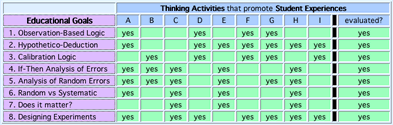 What is the purpose of integrative analysis? "Well-designed instructional activities promote educationally useful experiences that help students learn the ideas-and-skills that are our educational goals. A skillful coordination of activities will... improve their overall effectiveness. Some activities will help students prepare for others, and the ideas-and-skills learned in early activities will be reinforced by later experiences, and so on. Because a coordinating of activities will be more effective if the structure of instruction is understood more accurately and thoroughly, one useful tool is Integrative Analysis of Instruction."
This quotation is from a section about goal-directed designing of instruction — illustrated by a table [shown above] filled with goals & activities for a set of chemistry labs — that concludes with a summary of benefits: "In a table the visual organization of information [when you study the entries in rows, or columns, or cells] can improve our understanding of the functional relationships between activities, between
goals, and between activities and goals. This knowledge
about the structure of instruction can help us coordinate — with respect to types of experience, levels of sophistication, and contexts — the activities that help students achieve goals for learning. The purpose of a carefully planned selection-and-sequencing of activities is to increase the mutually supportive synergism between activities, to build a coherent system for teaching all of the goals, to produce a more effective environment for learning."
I developed the method of integrative analysis (well, I independently re-discovered it, since the basic idea certainly isn't new) in the second part of my Ph.D. dissertation where I used it for the conceptual evaluation of an inquiry-based course in genetics. This analytical approach can be useful in a wide variety of situations, ranging from coordinating short-term narrow spiral instruction (within one course) to a long-term wide spiral curriculum (across many courses). And we can also consider the mutual interactions between goals.
Teaching Strategies
All of the ideas below are part of the ideas-and-skills already used by most teachers. I'm just describing ways to adapt them for teaching design and Design Process.
Guiding: Well-designed instruction of all types (in lectures, discussions, labs, design,...) aims for a level of challenge that is “just right” so students will not be bored if it's too easy, or overly frustrated if it's too difficult. In some ways this is analogous to writing a good mystery story. For a design activity the level of difficulty can be adjusted in the choice of a project and the demands placed on students, and by guiding in which a teacher asks and answers questions, gives clues, models thinking skills, and directs attention with reflection requests. The goals of skillful guiding — achieved by wisely choosing the types, amounts, and timings of guidance — are to help students think productively so they can continue making progress toward solving the design problem, and learn effectively.
Reflection Requests: In one type of guiding, a teacher encourages reflection by directing attention to “what can be learned” from an experience, to shift students from a minimally-aware mode (of just going through the motions) into a minds-on mode that is more aware (of what they are doing and what they can learn) and is more effective for learning, for converting potential opportunities for learning into actual experiences of learning. A teacher can encourage reflection before, during, or after an activity. A reflection request — by asking a question, making a comment, or in other ways — can be pre-planned, or improvised during an activity. During a design project, reflections are usually brief so students can focus on designing.
Reflection Discussions: After work on a design project is finished, or during an interlude, a teacher can help students think about what they have been doing, how well this has worked and why, and how they can improve in the future. These discussions can include principles of Design Process if students already know it. And if not, principles of design can be recognized (in student experiences) and developed. At some point, decided by the teacher, these ideas can be organized into a more coherent understanding by using the logical framework of Design Process.
More — Section 7 looks at cognitive-and-metacognitive strategies you can use to improve Teaching Strategies.
Should we teach Design Process? Section 1 asks an important question: "Will an explicit teaching of general problem-solving strategies, such as those used in Design Process, help students improve their abilities in problem solving?" Research evidence indicates the effectiveness of teaching domain-specific strategies. But will teaching general strategies also be effective? I think the answer is “yes”, for logical reasons that are explained in Conceptual Evaluation of Instruction.
Dany Adams agrees, based on her own experiences with using Critical Thinking and The Scientific Method in a course she teaches: "Because the scientific method is a formalization of critical thinking, it
can be used as a simple model that... puts critical thinking at the
center of a straightforward, easily implemented, teaching strategy.
... Explicitly discussing the logic and the thought processes
that inform experimental methods works better than hoping students
will ‘get it’ if they hear enough experiments described."
How should we teach Design Process? Section 4 begins with a description of my optimistic humility. Although I'm confident that the ideas in this page, including the suggestions below, will be useful, I'm humble about my claims because they haven't yet been adequately tested in the classroom. Here are some possibilities:
Reflection: The purpose of Reflection Requests and Reflection Discussions, as outlined above, is to help students be more aware of what they are doing and what they can
learn, so they can learn more from their experiences. Teachers can use Design Process to help students take advantage of opportunities for learning that exist but often are missed.
Experience: Design Process should be taught in the context of student experience, especially first-hand (by doing design) but also second-hand (by examining design-thinking in case studies). Even though students already have lots of design experience in their everyday lives, and will have more in their future, they also should have design experiences in school.
Progression: The principle of progression, of moving from simplicity to complexity in easy-to-master steps, is used in all teaching. An Introduction to Design says, "begin with simplicity and gradually increase the detail... [and] decide how deeply to explore the process of design" so you can build on the foundation of what students know while gradually improving their foundation so it continually becomes wider and stronger. An Overview of Design Process — which carefully examines the entire range of a progression from simple through basic to detailed in-depth explorations — suggests first teaching a simple Two-Step Cycle (of creatively generating ideas & critically evaluating ideas) and then showing how, during evaluative thinking, we compare 3 elements (predictions, observations, goals) in Quality Checks (the essence of design) and Reality Checks (the essence of science). After this progression from “no method” to a simple cycle (shown below in the Simple Diagram, and described earlier) to comparative evaluations (in the Basic Diagram), a teacher has...
Options and Choices: Teachers who want to explore design more deeply can study the 9 modes of thinking-and-action used in design, and their functionally integrated relationships (as in the Detailed Diagram) and then decide how much to share with students. In a separate question, the Overview of Design Process describes (in its third main part) principles for improving quality of thinking by Combining Creativity & Critical Thinking, and by Combining Cognition & Metacognition. I strongly recommend a learning and teaching of these principles, but teachers can decide how deeply to explore for their own learning, and for teaching their students.
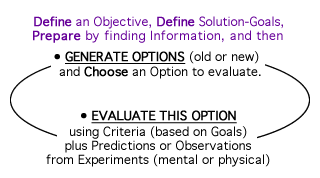 |
 |
 |
|
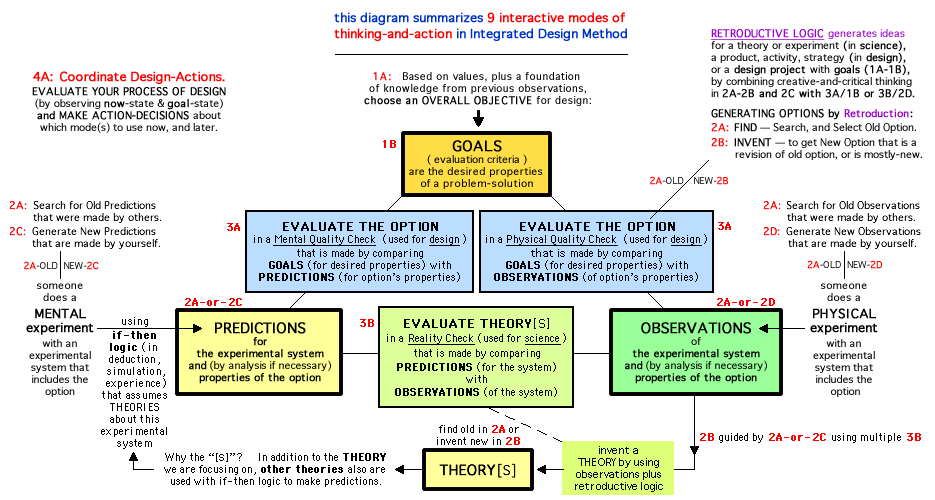 |
Simple Diagram |
Basic Diagram |
Detailed Diagram |
7 — Using Cognition-and-Metacognition for Learning & Teaching { Condensed Section 7 }
Learning & Teaching: This section, which is a summary-and-extension of ideas earlier in this page and in other pages, describes ways to combine cognition with metacognition, and use this blend to improve Learning Strategies and Teaching Strategies. First we'll focus on strategies for learning, but while doing this we'll also think about strategies for teaching because if students can learn more effectively by using a particular strategy, a teacher should develop strategies that will motivate them to use it, and help them use it better.
Learning Strategies (using Cognition-and-Metacognition)
Learning Strategy — A Process of Design (to Observe-and-Improve)
You can learn the basic principles of metacognition (asking “What is it, and why is it useful?”) in parts of other pages, which are outlined and linked-to at the end of Section 1. One valuable educational application is the Cognitive-and-Metacognitive Strategies for Learning that use an observing-and-improving process of design, with evaluative Quality Checks (for learning strategies) and Quality Controls (for applications of learning strategies) that help you improve the quality of your learning, thinking, and performance. Learning Strategies are a major part of an overall Strategy for Self-Education. To supplement this foundation, additional principles for high-quality learning (and for teaching learners) are described throughout this section.
In a Learning Strategy based on Design Process, the "observing-and-improving process of design" uses a 3-Step Cycle that is similar to the learning cycles recommended by experts in Self-Regulated Learning. In 2011 after designing my 3-Step Cycle for a Learning Strategy, I was happy to discover that it was consistent with what Dale Schunk wrote in 1998: "Self-regulation theorists view learning as an open-ended process that requires cyclical activity on the part of the learner that occurs in three major phases."* His three phases (forethought, performance, self-reflection) are functionally similar to mine (Plan, Observe, Evaluate) that are based on a process of design. / * quoted from page 2 of Self Regulated Learning: From Teaching to Self-Reflective Practice, which was the third volume of a series (1989, 1994, 1998) edited by Schunk & Zimmerman.
But using Design Process offers the additional benefit of promoting transfer because the skills that students use for their Learning Strategies also can be used in other areas to improve their learning, thinking, and performance.
Motivations for Learning
Why should a student want to develop and use learning strategies? Motivation is essential because it provides the driving force for a student's long-term commitment to self-education, which requires dedication and self-discipline. Motivation is a key component of problem solving in Section 5, which summarizes essential principles of motivation including a claim that "Design Projects can be one part of an overall plan for increasing students' motivation to learn in school" if we build a bridge from design to life so "students are convinced that thinking skills learned in school [during design] will transfer into life... [so these skills] can be used in ‘real life’ outside the classroom, both now and in their future, to help them achieve their personal goals for life" and they will be motivated to pursue a proactive strategy of Metacognitive Self-Education. In an ideal school situation there is...
Educational Teamwork: We should aim for a feeling of “us” with a combining of goal-directed teaching (by teachers) and goal-directed learning (by students), with our goals matching their goals. We can achieve a closer matching of teacher-goals and student-goals in two ways: by adjusting our goals to more closely match the way students are thinking (about what is fun now, or will be useful later) and by persuading students to adjust their thinking so our teaching-goals become their learning-goals, so they embrace our educational goals for them. When we try to persuade, we should consider all aspects of total motivation — intrinsic (enjoying an activity), personal (learning ideas-and-skills to improve their quality of life, now or later), interpersonal (impressing others), and extrinsic (performing for grades) — which are all “internal” because all contribute to how a student thinks about what they want in their whole life as a whole person. With our words (what we say in “pep talks”) and actions (what we do), we can try to persuade students that we have good intentions (we care for them, are “on their side” and are trying to define educational goals that will improve their lives) and we are competent (in defining goals, and helping students achieve these goals). {more about educational motivations}
Self-Efficacy and Self-Views: What if students are highly motivated to learn, but they don't feel confident about their abilities to succeed? This is an unfortunately common problem, especially for at-risk students. To avoid frustration and unproductive responses, students need accurate self-perception, but with optimism about their potential for growth & improvement,* and a healthy attitude of self-efficacy that is a belief in their ability to succeed in a particular situation. { A person's self-efficacy attitude depends on the type of situation and its details, so self-efficacy varies from one situation to another. } More broadly, "the self-system — which includes constructs such as self-efficacy, self-esteem, locus of control, motivation, and attributional beliefs — is a complex, interdependent system that supports both metacognitive functions and academic performance." (quoted from a page that is linked-to in my subsection about self-efficacy where you can learn more about these important ideas)
Views of Intelligence: * An optimism about potential improvement is easier if students have an incremental theory of intelligence (believing that their intelligence, and their intellectual performance, can be developed through their efforts) because this view fosters a confidence that their efforts to self-improve will be rewarded. By contrast, an entity theory of intelligence (believing that their intelligence is fixed) tends to promote an unproductive attitude, because “if I can't change my intelligence, why should I bother trying?” A brain-as-muscle analogy — explaining how our brains, like our muscles, will improve in response to well designed programs of exercise — can be useful for encouraging students to adopt an incremental view, and try to improve.
A Variety of Student Attitudes & Responses: The self-views of students, about "self-efficacy, self-esteem, locus of control, motivation, attributional beliefs, [views of intelligence,...]", span a wide multi-dimensional range. Different combinations of views can lead to similar unproductive responses for different reasons. For example, a student who is not doing well may think “why bother? it won't help me.” And a student who is doing well may think “why bother? I'm doing fine so I don't need it.” The first student may run into trouble, academically and in other ways. And even if the second student continues "doing fine" they will not fully develop their potential.
Effective Motivational Persuasion: In both of these cases, and many others, students don't "fully develop their potential." For them our education is not fully effective, because the main goal of education is to help students develop their full potential, so we are not helping them enough. Although saying “they don't want to be helped” is partially true, this is not the whole story, and metacognitive approaches — based on better understanding the motivational psychology of self-views and other relevant factors — might be more effective in designing education that promotes a greater good for a greater number of students. Because students have a wide range of abilities (of various types) and attitudes (of various types), based on inherited tendencies and influenced by experiences inside & outside school, there is no “formula for effective motivation” that will work for all students. But dedicated teachers and counselors can try to help more students decide to invest more of the intelligent effort (by working smart and working hard) that will help them improve their learning, thinking, and performing.
Let's look at the two types of students described above, who say "why bother?" for different reasons.
• Persuasion to Set Higher Self-Goals: Here is an approach that might help the second student — who seems to be satisfied with just "doing fine" — set higher personal goals. While writing this, I'm imagining that this student is an incoming freshman at UW-Madison, and here is one possible approach:
Why does Emily try to develop her basketball skills by working hard and working smart? In addition to playing in competitive basketball games, she practices all aspects of her game (dribbling, shooting, passing, guarding,...) on her own, follows the advice of her coach, attends summer camps for basketball, reads books & watches film & talks with other players, eats nutritious foods in physiologically useful amounts (not too much, not too little), works out to improve her strength & flexibility, speed & quickness, and does much more. Why? She invests her time and effort because she has some basketball ability, and wants to be the best she can be, to fully develop her potential.Following this two-part story, we would explain the benefits of using cognitive-and-metacognitive learning strategies as an essential part of a problem-solving approach to personal education.
What about you? You've been admitted to UW, so you obviously have some intellectual ability, and you probably will earn a living in a career with a heavy emphasis on thinking. Do you want to be the best you can be? Maybe with a reasonable amount of effort, studying the way you did in high school, you can “get by” with satisfactory performance. But if you want to set your goals higher than this — if you want to fully develop your potential for learning, thinking, and performance — you'll want to invest more time and effort, more intelligently. Of course, there are practical limits on the amount of time you can invest, because you want a balanced life that requires investing time in other ways, in sleeping and eating, relaxing and socializing, and maybe you also have a job or other duties. Therefore we want to help you improve the “working smart” part of a plan for “working hard and working smart,” by showing you ways to use your studying time so you can learn more efficiently and more effectively.
This motivational story is offered with appropriate humility, in hopes that others (both students & teachers) will read it and will offer suggestions for ways to make it better.
For example, the story above begins with a sports analogy, which will appeal to some students but not others. This is a problem because we want to motivate all students, but problem-solutions do exist because the basic approach — trying to let students see that they really do want to improve their learning skills — is flexible. We can reach a wider range of students by writing other kinds of stories, about students (or professionals) who invest intelligent effort to develop their abilities in other areas of life. (and in other sports)
Also, the story itself can be improved, in the introduction about Emily, and the analogous appeal to a student as the "you" who is reading the story.
Or maybe a different approach should be used, to supplement this approach, or maybe even replace it.
• Trying but not Succeeding: What can we do to help the first student, who "is not doing well" and is responding with a "why bother" attitude? This situation is more complex, and instead of making suggestions I'll simply defer to those who have more expertise and more experience with helping students in these situations, until I can learn more from them.
Appropriate Humility: In fact, I'm justifiably humble in this whole area (not just for the student who is "not doing well") due to my recognition that there is a lot I need to learn. And I recognize that — as with strategies for teaching — many of the ideas in this page "are part of the ideas-and-skills already used by most teachers; I'm just describing ways to adapt them for teaching design & Design Process" and developing educational strategies for learners and teachers. Many of the ideas in Section 7 are already principles in the field of self-regulated learning, which (according to Wikipedia) is "learning that is guided by metacognition (thinking about one's thinking), strategic action (planning, monitoring, and evaluating personal progress against a standard), and motivation to learn." Because I'm convinced that self-regulated learning is important, I am highly motivated to learn more about it. But I'm also confident. For reasons explained throughout this page, I have confidence that Design Process offers new benefits that will enrich the field of self-regulated learning, so I will be a learner and also a contributor.
Skills for Learning
How can students improve their Learning Skills so they can learn more efficiently and effectively?
General Skills: An example is learning from lectures, which is useful in many situations. This general skill is featured as the learning objective in my Analysis of a Learning Strategy. When a student wants to improve several general skills in several subject areas — in a “wide spiral” approach for using different skills in different contexts — a valuable tool for coordinating their efforts is a skills-and-subjects table that promotes two useful ways of thinking.
Domain-Specific Skills: In each subject domain, a student should ask “What domain-specific skills (and ideas) will improve my learning & thinking in this domain?” Although the student may find a way to generalize some skills and increase the transfer of skills to other domains, when asking this question the main short-term goal is to improve their performance in this subject area.
Most schools offer information about useful skills, plus wise advice from experts who want to help students, and classes or workshops. You can find some online resources in a links-page for Learning Skills.
Here are some useful principles for learning:
• Why is Quiz 1 (remember these 22 letters: t s e k h a u o e n d y g c a l h t e y n m) more difficult than Quiz 2 (remember the same letters in 6 letter-groups: sneaky the lunch dog my ate) or a story you can tell by rearranging the words? Most students don't sufficiently appreciate (and therefore don't efficiently use) the powerful benefits of organizing knowledge in a way that is logical and personally meaningful. Organizing your knowledge makes it easier to use effectively, and to remember (in similar situations) and transfer (to semi-similar situations): "learning with understanding is more likely to promote transfer than simply memorizing information. (How People Learn, p 236)" How can you organize your conceptual knowledge? (or your procedural knowledge?) Usually the most effective strategy is learning how to understand-and-use the logically organized structures of knowledge provided by those (teacher, textbook author,...) who are more expert in this domain, and then working with the knowledge in cognitively-active ways (by thinking about it, making personally customized summary notes, and using it in activities for application & extension) so you can mentally internalize the logically organized structures.
• How should you fill the blank for the incomplete word in “practice makes per ”? The best choice for a word reminds me of how I didn't learn to ski and how eventually, because I refused to give up despite early embarrassing failures, I did learn to ski by doing it correctly (using insights that allowed high-quality practice), not by making mistakes. My learning was consistent with what we should expect, because “practice makes permanent”, not perfect. / Here is another principle: When I was trying to ski, "perseverance led to opportunities for additional experience, but flexibility allowed the new experience that produced insight and then improvement," which illustrates how "perseverance and flexibility are contrasting virtues, a complementary pair whose optimal balancing depends on aware understanding (of yourself and your situation) so you can make wise decisions... [because] sometimes tenacious hard work is needed... or it may be wise to be flexible."
• One of the most powerful master skills is knowing how to learn from experience. A friend became an expert welder by following the wise advice of his teacher, “Every time you do a job, do it better than the time before.” In this strategy for continual self-improvement, he was using the Quality Control described in my Analysis of Learning Strategies for this strategy: always concentrate on quality of thinking-and-action in the present, and sometimes ask “what have I learned in the past that will help me now” and “what can I learn now that will help me in the future?”(*) Decisions about "always" and "sometime" will depend on the main objective – is it Performance or Learning? {more about Learning from Experience} * These questions, about the past and future, will be useful in the next section, when we look at ways to increase Transfer of Learning.
In addition to these principles — Organizing Knowledge, Practicing Productively, Perseverance versus Flexibility, Learning from Experience — you will find many more when you learn from the experiences of yourself and others.
Transfer of Learning — Part 2
Of course, Part 2 builds on the foundation of Part 1, which describes two principles for improving a transfer of learning — teach knowledge in multiple contexts, in a form that can be easily generalized — and explains why using Design Process should improve transfer because it helps students learn generalized procedural knowledge in multiple contexts.
Here is a summary of the context for Part 1: In a design-based wide spiral curriculum that has wide scope (to allow a coordination of related experiences across different subject areas) and uses spiral repetitions (to allow a coordination of related experiences over time), an explicit teaching of Integrated Design Process will help students understand the coherent integration of thinking skills within each design experience, and also the similarities between thinking skills in different subject areas, with similar problem-solving strategies being used in each area. This understanding of similarities will help students transfer their general thinking skills from one area to another.
In Part 2, we'll look at metacognitive strategies (for intentionally remembering from the past, and intentionally learning for the future) that can increase the transfer of learning. And these metacognitive Learning Strategies are one way to use "generalized procedural knowledge in multiple contexts" that, as explained in Part 1, is a valuable way to promote transfer because we can use similar methods of design thinking for learning strategies and for other types of design projects.
Learning from the Past — Intentionally Recalling for Transfer
Like the expert welder, we should ask “what have I learned in the past that will help me now?”
Guiding and Self-Guiding: When a teacher guides (by asking questions, providing hints, directing attention) a common purpose is to remind students of what they already know from their past experiences. A student can “guide themselves” with their own asking, providing, and directing, in an effort to remember ideas or skills that have been useful in similar situations in the past. With this self-prompting, a student is using a proactive metacognitive strategy instead of depending on external guidance. How People Learn describes the effects of guiding and metacognition: "With prompting, transfer can improve quite dramatically. ... Metacognitive approaches to instruction have been shown to increase the degree to which students will transfer to new situations without the need for explicit prompting." (pages 66, 67)
Constructivism and Transfer: How People Learn (pages 68, 236) explains that because "people learn by using what they know to construct new understandings,... all learning involves transfer that is based on previous experiences and prior knowledge... [so] effective teachers attempt to support positive transfer by actively identifying the strengths that students bring to a learning situation and building on them, thereby building bridges between students’ knowledge and the learning objectives set out by the teacher" and adopts a broad view of transfer, suggesting that we "consider how learning affects subsequent learning, such as increased speed [and quantity & quality] of learning in a new domain." When teaching any idea or skill a teacher should try to understand the prior knowledge of students, and build on this foundation, consistent with constructivist theories of learning & teaching. This approach is especially valuable in teaching that intentionally uses spiral repetitions, as in a wide spiral curriculum with careful analysis-and-planning to achieve a Goal-Directed Coordinating of Activities.
A Theoretical Framework for Analyzing Transfer
Two Dimensions of Transfer: Perkins & Salomon (1987-1989) suggest that the transfer of knowledge can be analyzed along two dimensions: backward-reaching or forward-looking, and high road or low road.
Backward-Reaching Transfer is learning from the past, as described above.
Forward-Looking Transfer is learning for the future, as described below.
Low-Road Transfer occurs when an idea or skill is practiced to a high level of automaticity; typically a response is triggered by familiar conditions, similar to those during practice, for a near transfer.
High-Road Transfer occurs due to thinking, by actively searching for connections (*) between previous learning (mentally represented in abstract form) and the current situation; it can promote far transfer to less-similar contexts.
* In a "searching for connections," conditional knowledge is very useful.
Because high-road transfer requires cognitive and metacognitive effort, it's the main type of transfer that can be improved by using Design Process, although design activities might stimulate motivation that leads to practice and low-road transfer.
An excellent overview of Learning Transfer — covering definitions, prospects, specialization, conditions, mechanisms, and teaching — is an encyclopedia article, by Perkins & Salomon, that I have summarized briefly (by omitting many important ideas!) along with selected quotations, in a section about Transfer of Learning.
Remembering and Transfering are closely related, differing mainly in the degree of similarity(s) between a previous context and the current context, which can range from very similar for near transfer (that is mainly remembering) to much less similar in far transfer. Therefore, learning and teaching in ways that improve a remembering of knowledge (by storing, retaining, and recalling it) will also improve a transfer of knowledge.
Time-Perspectives on Past, Present, and Future: Obviously, these terms are relative. In the past, our present was the future. In the future, our present will be the past. These reminders may seem trivial, but it's important to keep the timeline in mind when we're thinking about ways to more effectively learn from the past, and for the future.
Learning for the Future — Intentionally Learning for Memory & Transfer
Like the self-aware welder, we should ask “what can I learn now that will help me in the future?” Everyone who wants to learn (students, teachers, and others) can intentionally learn for memory-and-transfer, by learning in a way that will make ideas-and-skills knowledge more easily available for personal use in the future. / And teachers can use a strategy of intentionally teaching for transfer.
Here are some useful strategies for teaching (and learning) in ways that can increase transfers of knowledge:
Performance and Learning: Here are some useful principles about priorities, related to my friend's strategy for learning how to weld: • when you're doing an important job, so you're on-task with a performance objective, always concentrate on quality of thinking-and-action in the present, which sometimes involves metacognitively asking “how can I do it better” and “what have I learned in the past that will help me now?”, and occasionally you'll ask “what can I learn now that will help me in the future?”; • but at other times in life you'll be on-task with a personal education objective, when asking “what can I learn now?” is the top priority.
Reflection and Self-Reflection: Teachers can use reflection activities to help students learn more from their experiences. One aspect of this learning is improved memory that can promote transfer, because reflection promotes two powerful memory-improving actions by stimulating original awareness with intention to remember (if a student is motivated to do intentional learning) and it's also a review when it reminds us of previous learning, as in a spiral repetition. Here is a timeline for memory: in the present we learn with an intention to store-and-retain in memory, so in the future we can intentionally remember. / A student can promote their own self-reflection — producing an intention to learn now, with storage-and-retention in memory, so they can recall-and-use in the future — by choosing to adopt a metacognitive strategy of intentional learning, by frequently asking “what should I learn now?”
Conditional Knowledge: This valuable aspect of procedural knowledge is knowing the conditions when a particular skill (including a use of conceptual knowledge) can be useful. During a process of design, wise decisions about actions depend on conditional knowledge: you must know WHAT things need to be done (by being aware of the now-state and goal-state) and HOW things can get done (by understanding the functional capabilities and conditions of application for each procedural skill) so you can find a match between the situation-need and a skill-capability, as explained in Evaluating-and-Coordinating the Process of Design. / As with all other aspects of ideas-and-skills knowledge, students should take responsibility for developing their own conditional knowledge — including preparation with intentional learning for the future, and application by intentionally remembering from the past — and teachers should help them do this.
Organized Procedural Knowledge: Usually "organized knowledge" refers to organized conceptual knowledge which offers many benefits, including a more effective use of knowledge, plus improved memory-and-transfer. But procedural knowledge also can be organized, with similar benefits. During an improvised process of design, different problem-solving actions are functionally related in ways that are flexible yet logical. We can help students construct a deeper understanding of this organized procedural knowledge (including conditional knowledge) when we use a model of Integrated Design Process to show the integrated relationships between modes of thinking-and-action and how these interactive modes can be effectively
coordinated within a process of design. When students understand the principles of design, and practice using these principles for design in different subject areas, their problem-solving skills in each area will improve, and so will their transfer of skills from one area to another, as in a wide spiral curriculum or in the special case of building bridges from design to science.
Transfers from Life to Design to Science to Life: The main theme of Section 2 is transfer, by building bridges from life to design to science to life: • There is transfer from life into design because in design activities, "students are working with methods of thinking they have been using in everyday life... so they can build on the foundation of what they already know." • There is a strong transfer from design into science because "when students use Design Process they already are using all of the main components of Science Process." • A transfer from science into life occurs "because the logic used in science is just a formalizing of the logic you use in daily life. Similar kinds of reasoning (to evaluate, infer, and persuade) are used in science and in most other fields... whenever someone makes a claim... and we ask ‘what evidence-and-logic supports your claim?’ " • And "the problem-solving skills of design can be used in activities that every student can imagine... in ‘real life’ outside the classroom, both now and in their future," so there is a transfer from design into life.
Transfer as Preparation for Life: In the "Conclusions" chapter of How People Learn, the section on Learning for Transfer (page 235) begins by stating that "a major goal of schooling is to prepare students for flexible adaptation to new problems and settings." This preparation is a transfer of school knowledge into life, and it's especially useful in a rapidly changing modern world: As explained by CRESST, "schools cannot possibly teach students everything they will need to know for the future; problem-solving skills fill the gap by allowing students to use what they have learned to successfully solve new problems or learn new skills." Or, in wisdom from ancient China, “Give a man a fish and you feed him for a day. Teach him how to fish and you feed him for a lifetime."
Teaching Strategies (using Cognition-and-Metacognition)
Teaching and Learning: The final section in An Overview of Design Process explains how...The two educational strategies (viewed from the perspectives of a Learner and Teacher, so they're a Learning Strategy and Teaching Strategy, eL and eT) are closely related in two ways:Here is a closer look at two of the Teaching Strategies described in Section 6:
First, what Learners do in eL for themselves, Teachers do in eT for others. When you’re thinking as a teacher, you look at everything that occurs in a Cognitive-and-Metacognitive Learning Strategy (when a learner uses Quality Checks for strategies, plus Quality Controls for strategy-applications) and you ask “how can I motivate my students so they will want to do this, and how can I help them do it more effectively?”
Second, teachers can try to improve the quality of their own teaching in a variety of ways — including the support for eL described above — by developing Strategies for Teaching that are analogous to Strategies for Learning. Both educational strategies, eT and eL, use a similar process of design.
A Teaching Strategy for Improving the Quality of Guiding
Let's look at the guidance during a design activity when a teacher "asks and answers questions, gives clues, models thinking skills, and directs attention with reflection requests... [in] skillful guiding achieved by wisely choosing the types, amounts, and timings of guidance." The process of guiding is complex and challenging, as you can see in a description of how to guide inquiry (which is similar to a guiding of design) from An Introduction to POGIL (Process-Oriented Guided Inquiry Learning); after you click the link, search for "expert", then read about the teacher as a "facilitator who guides students in the process of learning. ... In this context, the instructor has four roles to play: leader, monitor/assessor, facilitator, and evaluator" and you'll see what is required, for each of the many student groups, in these 4 roles. Wow, all of this will keep a teacher busy!
How can a teacher determine if their guidance has been skillful and wise? With the same design process as in a Learning Strategy: they use a Quality Check to evaluate the effectiveness of their facilitation strategy (planned before the class) in achieving the desired result (of helping students understand concepts and use problem-solving skills); in another Quality Check they evaluate how closely their application of the strategy (during the class, in their actions as facilitators of learning in each of the four roles) matched their goal-expectations for how they wanted to facilitate, and this check (for the quality of their strategy-application) is called a Quality Control.
Teaching Design Process by using Reflection Activities: In one type of guiding, a teacher helps students learn more from a design experience by using reflection activities that direct their attention to “what can be learned,” with the goal of eventually helping them organize their knowledge about problem solving "into a more coherent understanding by using the logical framework of Design Process."
Designing Explanations and Designing Reflections: A teacher's explanations of Design Process should be skillfully designed with a logical step-by-step progression, building on the foundation of what students already know, in the context of student experiences (by doing design and discussing design), with appropriate pacing and timings, as outlined in progression and choices. Teachers should also skillfully design reflection activities, so a reflection request won't be a distraction that interferes with the flow of design-thinking by students, and so they don't respond to a reflection discussion by complaining that “this is boooorrring.”
Two Educational Functions of Reflection Requests
The two main goals of skillful guiding are "helping students think productively so they can continue making progress toward solving the design problem, and learn effectively." Usually these goals operate cooperatively, with mutual support. But there can be a tension between productive thinking and effective learning, in two ways:
My main section about metacognition begins with Allowing & Stimulating Productive Creative-and-Critical Thinking. In this title a key word is "Allowing" because "a useful strategy is to just ‘let it happen’ when it's going well and ideas are flowing smoothly... in ways that are intuitive and automatic. A valuable metacognitive skill is knowing yourself well enough to know..." and here I'll modify this principle so it's appropriate for a teacher: “A valuable teaching skill is knowing your students well enough to know when you should let them focus on whatever they're doing now, and when you can ask them to pause for reflection.”
Another factor to consider in "knowing your students well" is their attitudes about self-efficacy. For most students the process of being challenged by a problem, but eventually succeeding, will produce a feeling of genuine emotional-and-intellectual satisfaction. They will place a high personal value on their own success because they were able to overcome challenging obstacles during the process of problem solving, which will improve their confident feelings of self-efficacy. But this feeling can be lessened in two ways, either if they cannot solve the problem, or if solving it was too easy. For this reason, a teacher tries to aim for a level of challenge that is “just right” so students can solve a problem, but with minimal guidance, so the problem is maximally challenging and they will experience genuine satisfaction.
Learning-and-Teaching: This subsection on Teaching Strategies is relatively short, compared with Learning Strategies. Why? This is mainly because, as explained earlier, "first [in Section 7] we'll focus on strategies for learning, but while doing this we'll also think about strategies for teaching." Much of Learning Strategies is a mixture of Learning-and-Teaching, especially in the parts about Motivation & Transfer which describe strategies that teachers can use to improve motivation & transfer for their students.
I.O.U. — Soon, but not until November or later, this section will end without an IOU. (there is a little more to add, but not much) One idea that shows great promise is developing interactive computer programs to "help students understand Design Process and use it more effectively" because these programs "would offer many practical benefits for students, and for teachers in K-12 and college," so I'm writing a page about using computer programs for instruction. / And the main body of the page, before the appendix, will end with some kind of conclusion.


APPENDIX
I.O.U. — More than half of this appendix is still in rough form, and eventually (probably in late 2011) these will be developed & revised, and this IOU will be removed.
Executive Summary — A Definition
"An executive summary is an overview. The purpose of an executive summary is to summarize the key points of a document for its readers, saving them time and preparing them for the upcoming content. Think of the executive summary as an advance organizer for the reader. ....." {written by Susan Ward for About.Com}
Conceptual
Evaluation of Instruction
The purpose
of instructional evaluation is to estimate the extent to which
a particular program of instruction achieves an educational objective,
such as helping students improve their thinking skills. Evaluation
provides essential input for developing new approaches to instruction,
and for making policy decisions about instruction.
Of course, instructional development
and policy decisions should be based on reliable knowledge, including
data about instructional activities (what
students are asked to do), student actions (what
students actually do), and learning outcomes (what
students learn). Based on this data, an evaluation of instructional
effectiveness can be mainly empirical or conceptual.
An empirical
evaluation occurs by gathering and interpreting outcome-data in
an effort to determine the effectiveness of a program. Empirical
evaluation can be very useful, but doing it well is usually difficult
and time consuming.
A conceptual
evaluation is based on data about either activities or activities-and-actions,
about what students do during instruction. By knowing what students
do, we can predict what they are likely to learn.
Basically, described in terms
of IDP-ISM, these are two types of quality-checks: empirical evaluation
uses physical experiments that produce observations, while conceptual
evaluation uses mental experiments that produce theory-based predictions. And
both can be used during curriculum design, to achieve goals of effective
education.
As an example of conceptual
evaluation, consider an extreme case where the dual objectives of instruction
are to help students learn about the nature of science and improve
their thinking skills, yet the activities-data shows that there is
no discussion of either science or thinking, and students have no opportunities
to solve problems. Even with no outcome-data it is easy to predict
that this program, due to the mismatch between objectives and activities,
will not achieve its objectives.
But real-life situations
are more complex, so a conceptual evaluation is more difficult, its
meaning is open to a wider range of interpretations, and its conclusions
are justifiably viewed with caution. And a conclusion may be
indefinite. For example, a conclusion of "beneficial but
not sufficient" occurs when we claim to know that a particular
condition will help achieve a better match between objectives and
activities, so it will probably help contribute to success, but we
also think it is not sufficient because even if this condition is
present there is no guarantee of success because other conditions
that also influence the outcome are needed for effective instruction.
During educational design, conceptual evaluation should be based on a deep, accurate understanding of instruction, and this essential knowledge base can be improved by using a coherent analytical framework, such as an activity-and-experience table (explained below) that includes IDP and/or ISM. If IDP is useful for describing the integrated structure of design process, it should also be useful for describing the integrated structure of "thinking skills" instruction in which students learn and use the process of design. Similarly, ISM can be useful for understanding the structure of instruction about scientific thinking. In fact, in the second half of my PhD dissertation I used ISM as the analytical framework for studying the structure of instruction in a creative science classroom. { The first half of it was developing and describing ISM. }
Mutual Interactions between Goal-Components
While thinking about design of instruction it's useful to consider mutual interactions between goal-components. Below, influences exerted by Motivation (on Metacognition, Conceptual Knowledge,...) are in the first yellow column, and influences on Motivation (by Metacognition,...) are in the first row. In each gray cell you can describe the ways you plan to use this component for instruction or in a curriculum, and in its column (where it's an influencer) you can predict the effects that this type of use might produce on other components, or you can observe the effects. And maybe you'll want to revise your use of this component when you think about its effects, or (looking across a row) how it's affected by other components. / also: Why do you think I've made two components a different color? In what ways do you think this distinction is valid or useful, or is not?
influencer influencee |
Motivation |
Metacognition |
Conceptual Knowledge |
Procedural Knowledge (domain) |
Procedural Knowledge (general) |
Collaboration |
Communication |
| Motivation | |||||||
| Metacognition | |||||||
| Conceptual Knowledge | |||||||
| Procedural K (domain) | |||||||
| Procedural K (general) | |||||||
| Collaboration | |||||||
| Communication |
I.O.U. — This subsection — about Skills-and-Subjects Tables — probably will have content in late 2011.
I.O.U. — The ideas in this section need to be revised.
Here [in a leftover-cut from the 2003 version] is a brief history of ISM and IDP:
The process of development
was very different for the two models. I constructed ISM first, by
synthesizing lots of ideas — mainly from scientists and philosophers,
but also from historians,
sociologists, psychologists, and myself — into a coherent system for
use in education. By contrast, for IDP (which was developed later) there
has been very little use of external sources. Mainly I've just thought
about the process of design, in isolation from what others have done.
Recently, however, I've been looking at
the work of others in design education, and IDP seems to be consistent with
their ideas. One of my goals for the future is to learn more about what
other educators are
doing
in developing
models for design and using these models in
education.
I'm beginning to look into the work of others, in engineering education and
also in papers and books for general education, including Design as a Catalyst
for Thinking.
But even though it was independently
developed, IDP seems to be compatible with the work of other educators.
Eclectic Diversity, Central Location,
and Stimulating Discussion [in appendix? for better ending to main]
The eclectic nature of ISM and IDP-ISM
could help these models play a useful role in a collaborative effort among scholars.
Because ISM is a synthesis of ideas from many fields, it is centrally located
at the intersection of many disciplines and the diverse perspectives they encompass.
When IDP is included, the diversity is even greater. The centrality of
ISM (and IDP-ISM) could facilitate a cooperative sharing of ideas among scholars
involved in science, the study of science, and science education. ISM
can easily connect with the large amount of thinking that has been done about
the methods of science and their application to education. The widespread
familiarity of "scientific method" as a concept (and of design activity
as an experience) will make it easier to use ISM (and IDP) for communicating
ideas. Of course, familiarity can also lead to disagreements about foundational
assumptions (and subsequent conclusions), but once these are in plain view they
can become the focus for stimulating discussions among scholars and for exciting
activities in a classroom.
The Delayed Re-Optimization of My Backhand: I.O.U. — This story, about reasons to change and not change, will be here later, probably in late 2011.
The Joy of Thinking in Design and Science
It's exciting to use our minds skillfully. Thinking is a grand adventure, in design and in science.
Design is used in many areas of life, so you can find many ways to enjoy the excitement of design thinking, to experience the satisfaction of solving a problem and achieving a practical goal. Since the beginning of human history, people have been designing strategies for better living, and designing products to carry out these strategies more effectively. For example, strategies for getting food (by hunting and farming) were more effective when using products (spears and plows). Design continues to be useful in the modern world.
Science is also useful and fulfilling, in two ways:
First, the understanding gained by science is often used by designers. The technological results of “applied science” are familiar, especially for new products.
Second, science can help us fulfill a deep human need, because it is a useful way to search for answers when, inspired by our curiosity, we ask questions about what, how, and why, about the operation of causes-and-effects in nature. Most of us want to know the truth, so an intrinsically appealing goal is the design of scientific theories that are true, that correctly describe what is happening now and has happened in the past. In our search for truth in nature, we are motivated by curiosity about how things work, a desire to solve mysteries.
For example, The Joy of Science tells a fascinating mystery story; when scientist-detectives discover a simple answer, one says "I am reading your paper in the way a curious child eagerly listens to the solution of a riddle with which he has struggled for a long time, and I rejoice over the beauties that my eye discovers," and the paper's writer responds by agreeing that "everything resolves itself with unbelievable simplicity and unbelievable beauty, everything turns out exactly as one would wish.” They struggled with a problem, solved it, and were thrilled. Yes, it's fun to think and learn!
I.O.U. — Later I'll decide whether to use this idea, to develop it or cut it: By helping teachers develop a more coherent understanding of design and science, the integrated structure of IDP-ISM could serve a valuable function, consistent with proposals (e.g., Matthews, 1994) that teacher education would be improved by a more effective use of insights from the history and philosophy of science.
Coping with Complexity in Models of Design & Science
When a complex process (like
design or science) is described in a model (like IDP or ISM) there is a tension
between the conflicting criteria of simplicity and completeness. When
a model is more complete it allows a more accurate description, but the resulting
complexity can make the model less useful for education if students feel overwhelmed
and confused because too many concepts are presented too quickly.
But this potential difficulty can
be minimized — thus allowing a model to be used for teaching students
of different ages and experience, abilities and interest — if the information
content of the model is adjusted by simplification and enrichment.
This idea, about strategies for effective teaching, is examined in detail in a page about Coping with Complexity that ends with some thoughts about Essential Tension in Models,
When we try to represent a complex process with a simple
model, tensions are unavoidable.
In the early days of developing
ISM, when I showed people the ISM-diagram a
common criticism was that "It's too complicated, and students will feel
overwhelmed." My response to this valid concern, which has influenced
the subsequent development of ISM and then IDP, is based on three principles:
First, the process of science is complex, so an accurate
model of science must be complex.
Second, a model is a simplified representation of reality,
and each model contains many factors that can be adjusted in an attempt to achieve
various goals, as explained in Describing
Science using a Flexible Framework.
Third, in order to achieve
common educational goals we need effective teaching strategies for coping
with complexity, as discussed above. ... { Below, Section 2 also
contains excerpts from "Coping with Complexity." }