Date: Thu May 22 2008 - 15:05:44 EDT
I heard one YEC answer a couple of weeks ago when I learned there was a Creation Seminar at a local church and I decided to invest a couple of hours to listen. This speaker said the following: time = distance/ speed. First we considered the distance measurement to be wrong but now we know that objects really are that far away. Then it was considered that the speed of light used to be much faster, thus accounting for the discrepancy, but now we know that c has remained constant. So we must consider time and this is where Einstein's general theory of relativity saves the day. Time slows down in a gravitation field, says he. Put this together with Humphreys' white hole cosmology and the idea that we have a geocentric universe where the highest gravitational field is at the center of the earth, then we can see that time is much slower on earth than it is in the stellar regions. Hence, all is consistent. It only took 6,000 years for light to travel 13 billion light-years because time speeds up out there where the gravitational field is so weak. And he pointed out a new book by John Hartnett published in 2007 that resolved any remaining concerns with white hole cosmology. Here's the blurb:
Randy
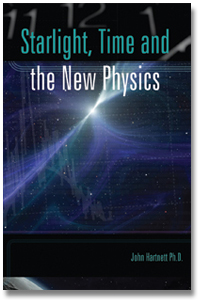
NEW: Starlight, Time and the New Physics: Starlight Traveltime-Solved!
by John Hartnett, Ph.D.
Many still doubt the Bible's clear timescale because, they think, it is impossible for light to have reached Earth in only a few thousand years from stars that are millions of light-years away. This is often the ultimate stumbling block to belief in the Bible and its salvation message.
In this exciting new book, physics professor John Hartnett, inspired by the pioneering work of creationist Russell Humphreys, and building on the work of secular cosmologist Moshe Carmeli, shows how the answer to the 'starlight travel-time problem' falls out of the same equations that undermine many of the props for big bang thinking.
The main text is easily digestible for the intelligent layperson, with a supporting series of technical appendices for the specialist.
Paperback, 150 pages
----- Original Message -----
From: Dehler, Bernie
To: asa
Sent: Thursday, May 22, 2008 1:28 PM
Subject: [asa] YEC cosmology question: astro shows
Yahoo news yesterday reported that astronomers have observed a star explosion (super nova):
http://news.yahoo.com/s/nm/20080521/sc_nm/supernova_dc_1
Excerpt:
Soderberg's team looked across space and time to witness the death throes of supernova 2008D, found in one arm of the galaxy NGC 2770, 88 million light-years from Earth.
How do YEC's deal with that statement that it is 88 million light years from earth? I know they think time and light can be warped, or light doesn't behave in the past as it does now, but a difference of 88 million compared to 6,000 (their age for the universe)??? Do they simply avoid the issue? So modern science thinks this actual explosion happened around 88 million years ago. when do YEC's think it happened?
.Bernie
To unsubscribe, send a message to majordomo@calvin.edu with
"unsubscribe asa" (no quotes) as the body of the message.