Date: Mon Dec 17 2007 - 13:39:50 EST
This is a very interesting article on the front page of CNN today.
John
What Your Brain Looks Like on Faith
Friday, Dec. 14, 2007 By <javascript:void(0)> DAVID VAN BIEMA
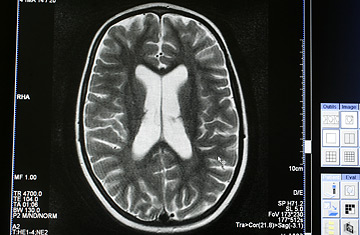
Brain scan
A scan of a brain.
Owen Franken / Corbis
Sam Harris is best known for his barn-burning 2004 attack on religion, The
End of Faith, which spent 33 weeks on the New York Times best-seller List.
The book's sequel, Letter to a Christian Nation also came out in editions
totalling hundreds of thousands. Last Monday, however, the combative
Californian produced a shorter (seven pages) and seemingly calmer
publication that will be a hit if it reaches 10,000 readers: "Functional
Neuroimaging of Belief, Disbelief and Uncertainty." It appears in the
respected journal Annals of Neurology. And Harris, 40, claims it has little
if any connection to his popular two books. Believers, however, may draw
their own conclusions - and may want to read his subsequent neurological
studies even more carefully.
The current paper recovers Harris's identity as a doctoral candidate in
neurology at UCLA, his occupation before he commenced what he calls his
"extramural affair jumping into trenches in the culture wars." It is an
addition to the growing field of brain scan trials, and Harris thinks it may
be the first to detail how the brain processes belief. At first read, it
seems less dangerous to Christianity than to another cherished pillar of
Western thought - that "objective" beliefs like "2 + 2 = 4" and "subjective"
beliefs like "torture is bad" belong to entirely separate categories of
thought.
Harris and two co-authors ran 360 statements by 14 adult subject whose brain
activities were then scanned by functional magnetic resonance imaging (fMRI)
devices. It suggests that within the brain pan, at least, the distinction
between objective and subjective is not so clear-cut. Although more complex
assertions may get analyzed in so-called "higher" areas of the brain, all
seem to get their final stamp of "belief" or disbelief in "primitive"
locales traditionally associated with emotions or taste and odor. Even "2 +
2 = 4," on some level, is a question of taste. Thus, the statement "that
just doesn't smell right to me" may be more literal than we thought.
Harris tested how the brain responded to assertions in seven categories:
mathematical, geographic, semantic, factual, autobiographical, ethical and
religious. All seven provided some useful data, but only the ones relating
to math and ethics produced results clear enough to give a vivid picture of
the way the simple and the complex, the subjective and the objective
intertwine. Regardless of their content, statements that the subjects
believed lit up the ventral medial prefrontal cortex (VMPC), a location in
the brain best known for processing reward, emotion and taste. Equally
"primitive" areas associated with taste, pain perception and disgust
determined disbelief. "False propositions may actually disgust us," Harris
writes.
Is there a practical application here? He speculates that if belief brain
scanning were sufficiently refined it could act as an accurate lie detector
and help control for the placebo effect in drug design.
Harris says there is no critique of faith hidden somewhere in his brief
paper. But his next neurological enterprise may be another matter. He is
planning an fMRI run that will concentrate specifically on religious faith,
which Harris thinks he now knows how to plumb more deeply. He also plans to
set up two different subject groups - the faithful and non-believers. "That
way," among other things, he says, "you can ask, 'Do believers believe that
Jesus was born of a virgin the same way that nonbelievers believe that
Chevrolet makes cars and trucks?'" It may turn out that the brain treats
religious faith as its own special category of belief unlike ethics and
math.
But that is not what Harris expects to find. He suspects the machines will
show that "belief is belief is belief." And that conclusion, he admits, may
put him at loggerheads with familiar foes. No one, he says, could accuse him
or anyone else of trying to disprove God's existence on the basis of an
fMRI. But faith is more vulnerable. "People who feel that religious faith is
a singular operation of the brain - if they admit that it's an operation of
the brain at all - would object to what I'm doing, since it may show that
faith is essentially the same as other kinds of knowing or thinking. The
whole thing will seem fishy to anyone who thinks we have immaterial souls
running around in our bodies."
Which, of course, a lot of people do. And despite the fact that, as Harris
puts it, his current literary mode "is not beach reading," they may find
that they are keeping up with his academic writings more avidly - and
nervously - than they do his bestsellers.
To unsubscribe, send a message to majordomo@calvin.edu with
"unsubscribe asa" (no quotes) as the body of the message.