- Previous message: Howard J. Van Till: "Re: Evagelical ID"
- Maybe in reply to: Keith B Miller: "Johnson and "Icons""
- Next in thread: Keith B Miller: "Re: Johnson and "Icons""
- Messages sorted by: [ date ] [ thread ] [ subject ] [ author ]
Robert Dehaan wrote:
"Blaine,
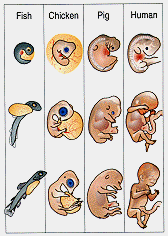
The issue is not whether the use of drawings, per se, or the simplification
of them is legitimate. The issue is whether they are accurate. Wells shows
by use of simplified drawings that Haeckel's simplified drawings are
inaccurate, and that the biological community has known this for a long time
and done nothing in concert to correct the situation. Wells goes further
and
claims that not only are the drawings inaccurate, but that they are
deliberate misrepresentations of the facts. "
It is simply not correct that "the biological community has known this for a
long time
and done nothing in concert to correct the situation". The following is from
Kenneth Miller's website linked to his textbook:
As you read this, you may wonder why evolution should be limited to changes
tacked on at the end of the process of development. So did evolutionary
biologists, and Haeckel's idea was quickly discarded. In fact, evolution can
affect all phases of development, removing developmental steps as well as
adding them, and therefore embryology is not a strict replay of ancestry.
Nonetheless, many of the stages that embryos pass through can indeed be
understood as remnants of their evolutionary past. One example is the fact
that the embryos of all placental mammals (including humans) form a yolk sac
during their development. Why is this important? Because the eggs of these
organisms do not have large amounts of stored yolk, and therefore their yolk
sacs are empty! Nonetheless, the persistence of a yolk sac stage makes
perfect sense when one considers that these animals are descended from
egg-laying reptiles in which the sac encloses a massive amount of yolk to
support embryonic development.
This idea has been pushed back into the news recently by the
news that Haeckel's drawings of
embryonic similarities were not correct. British embryologist
Michael Richardson and his colleages
published an important paper in the August 1997 issue of Anatomy
& Embryology showing that
Haeckel had fudged his drawings to make the early stages of
embryos appear more alike than they
actually are! As it turns out, Haeckel's contemporaries had
spotted the fraud during his lifetime, and got
him to admit it. However, his drawings nonetheless became the
source material for diagrams of
comparative embryology in nearly every biology textbook,
including ours!
So, what have we done? Well, we fixed it. Joe Levine and I have now revised
the drawings that appear on these pages of our textbooks, and the 5th
Edition of the Elephant book has been published with an accurate drawing of
the embryos made from detailed photomicrographs. We have also rewritten page
283 of the 5th edition to better reflect the scientific evidence regarding
the similarities of early development:
<<New-embryo-figure.gif>>
The revised Figure 13-16, showing accurate representations of vertebrate
embryos, Page 283 During certain embryological stages, vastly
different organisms show similarities. During later stages of development,
however, profound changes occur. Thus the adults bear little
resemblance to one another.
You can find Miller's comments at:
http://BioCrs.biomed.brown.edu/Elephant%20stuff/Chapters/Ch%2013/Haeckel/Hae
ckel.htm
Jim Hofmann
Philosophy Department and Liberal Studies Program
California State University Fullerton
http://nsmserver2.fullerton.edu/departments/chemistry/evolution_creation/web
- Next message: Moorad Alexanian: "Science and Creationism website:"
- Previous message: Howard J. Van Till: "Re: Evagelical ID"
- Maybe in reply to: Keith B Miller: "Johnson and "Icons""
- Next in thread: Keith B Miller: "Re: Johnson and "Icons""
- Messages sorted by: [ date ] [ thread ] [ subject ] [ author ]
This archive was generated by hypermail 2b29 : Tue May 15 2001 - 12:26:13 EDT